


Posted on May 23 2026
How Much Can Indians Save Working in Canada? Salary vs Cost of Living Breakdown

By , Editor & Director
Updated June 02 2026
Professionals moving from India to Canada can save around $1,500 to $3,000 CAD (approx. ₹90,000 to ₹1.8 Lakh) per month, provided their average salary is approximately $75,000 to $90,000 CAD. Every Indian professional asks this before applying for Canada PR: “Will I actually save more money there?” While Canadian salaries are 5–6x higher in INR terms, the cost of living is also substantial. Not only do you need to calculate gross salary, but you also need to calculate net savings after tax deduction and lifestyle expenses.
*Want to apply for a Canada work visa? Let Y-Axis assist you with the process.
India vs Canada Salary Snapshot
Some of the highest-paying job roles in Canada include IT, Healthcare, and Engineering. The table below highlights the comparison between the average salary of professionals in Canada and India:
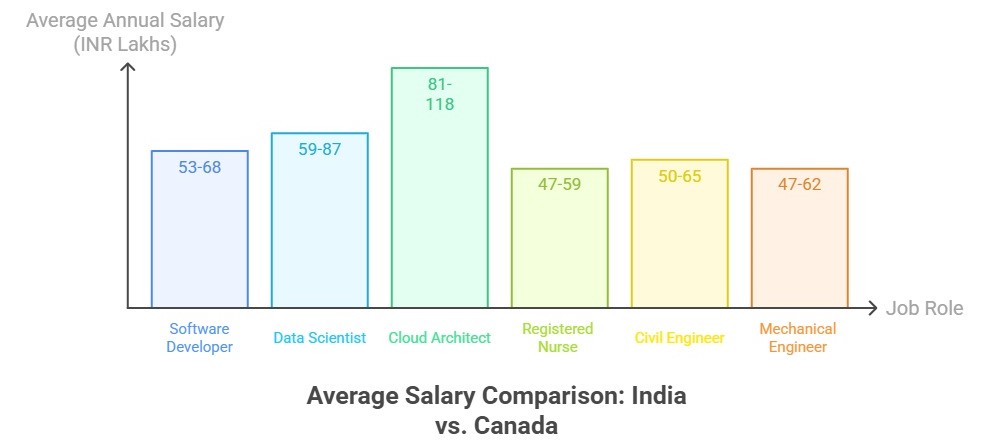
| Job Role | India (INR/year) | Canada (CAD/year) | INR Equivalent (approx.) |
|---|---|---|---|
| Software Developer | ₹12–22 LPA | CAD 85,000–110,000 | ₹53L–68L |
| Data Scientist | ₹15–30 LPA | CAD 95,000–140,000 | ₹59L–87L |
| Cloud Architect | ₹25–50 LPA | CAD 130,000–190,000 | ₹81L–118L |
| Registered Nurse | ₹3–6 LPA | CAD 75,000–95,000 | ₹47L–59L |
| Civil Engineer | ₹6–14 LPA | CAD 80,000–105,000 | ₹50L–65L |
| Mechanical Engineer | ₹5–12 LPA | CAD 75,000–100,000 | ₹47L–62L |
Also, read...
What is the Real Cost of Living in Canada vs India?
The real cost of living in Canada is significantly higher than in India, especially for rent, groceries, transport, and utilities; however, higher average salaries, better infrastructure, and public healthcare are attracting foreign professionals to settle in Canada.
The country continues to attract a higher immigrant population due to its high quality of life, career opportunities, and long-term settlement options.
| Expense | Major Indian City (Monthly) | Major Canadian City (Monthly) |
|---|---|---|
| Rent (1 BHK / Studio) | ₹20,000–45,000 | CAD 1,800–2,500 (₹1.1L–1.55L) |
| Groceries | ₹10,000–15,000 | CAD 400–550 (₹25K–34K) |
| Utilities & Internet | ₹4,000–7,000 | CAD 200–380 (₹12K–24K) |
| Public Transport / Fuel | ₹3,000–6,000 | CAD 120–180 (₹7.5K–11K) |
| Total Monthly Outflow | ₹37,000–73,000 | CAD 2,520–3,610 (₹1.56L–2.24L) |
Also, read...
How can I migrate to Canada as a Civil Engineer?
How Much Can You Save in Canada?
The table below shares a realistic view of the average income, expenses and practical saving opportunities to Indians wanting to migrate to Canada.
| Metric | India (Mid-Level Developer) | Canada (Mid-Level Developer) |
|---|---|---|
| Annual Gross Salary | ₹20 LPA | CAD 100,000 |
| Monthly Take-Home (after tax) | ~₹1,40,000 | ~CAD 6,500 (~₹4.03L) |
| Monthly Expenses | ~₹55,000 | ~CAD 3,200 (~₹1.98L) |
| Monthly Savings | ~₹85,000 | ~CAD 3,300 (~₹2.05L) |
| Annual Savings | ~₹10.2 Lakhs | ~CAD 39,600 (~₹24.6L) ★ |
Note: Canada wins by 2.4x on absolute annual savings for a mid-level Software Developer. The gap widens further for Healthcare and Engineering roles.
Also, read...
Which countries will make me a Millionaire Faster?
Province-by-Province Savings Guide
Choosing the right province is also vital for saving funds in Canada. Alberta and Saskatchewan consistently outperform Ontario and British Columbia in net savings, due to several factors, such as lower cost of living and affordable public health care. The table below compares different Canadian provinces and territories in terms of deductions and cost of living.
| Province / City | Avg. Provincial Tax | Avg. 1BHK Rent (CAD/mo) | Savings Rating |
|---|---|---|---|
| Alberta (Calgary/Edmonton) | ~8% (No PST) | CAD 1,600–1,850 | ★★★★★ Best |
| Saskatchewan (Saskatoon) | ~9% | CAD 1,100–1,350 | ★★★★★ Best |
| Manitoba (Winnipeg) | ~10.8% | CAD 1,200–1,450 | ★★★★ |
| Nova Scotia (Halifax) | ~10% | CAD 1,400–1,700 | ★★★★ |
| Ontario (Toronto) | ~11.5% | CAD 2,200–2,600 | ★★★ |
| British Columbia (Vancouver) | ~10.5% | CAD 2,300–2,700 | ★★★ |
Also, read...
Canada Introduces New PNP Rule: Provinces Get Full Authority Over PR Selection. Apply Now!
Why Should You Work in Canada: The Hidden Benefits Worth ₹5–8 LPA
Professionals earning ₹20–30 LPA in India can expect 2–3x higher absolute annual savings in Canada. Migrating to Canada is not just a salary upgrade but also a lifestyle upgrade through better healthcare, social, and lifestyle facilities.
- Free public schooling for children allows savings up to ₹3–5 LPA vs private schools in India
- Universal healthcare with no hospital bills or private insurance premiums.
- Canada Child Benefit (CCB) of up to CAD 7,437/year per child under 6 (₹4.6L)
- RRSP + TFSA are tax-advantaged savings accounts that compound wealth significantly faster
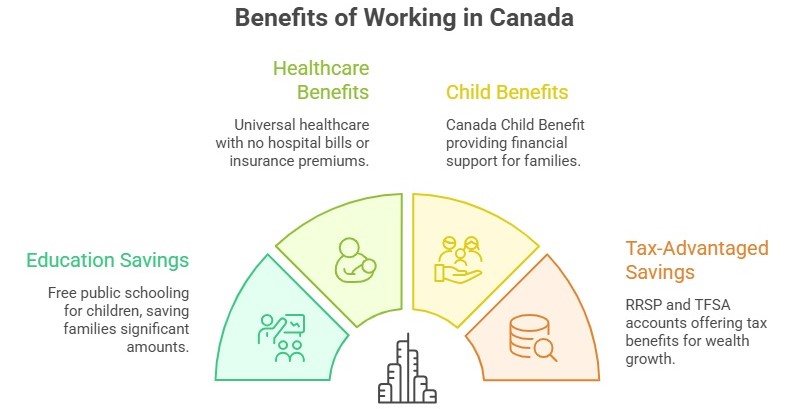
Note: These benefits add the equivalent of ₹5–8 LPA to your effective package. Most Indians don't factor this in when comparing salaries.
Watch: In-Demand UK Jobs & Salary Insights
Explore the most in-demand UK job roles, salary benchmarks, and visa eligibility for skilled professionals.
Also, read...
Canada Ranks Among the World’s Top 10 Most Powerful Passports for 2026
Tips to Save More While Working in Canada
Given below are the practical tips to save more while settling and working in Canada:
- Get certified in India first with courses like AWS, Azure, PMP, or CPA, which cost 50–70% less in India than in Canada.
- Land in Alberta or Saskatchewan first, which has lower taxes and rent, allowing you to save up toup to ₹4–6L more than in Toronto or Vancouver.
- Explore the job market in provinces like Alberta, which offer greater opportunities across IT, Healthcare, and Trades.
- Open your TFSA in Year 1, a tax-free savings account that allows you to invest up to CAD 7,000/year tax-free.
- Start early to avoid tax-free compound growth lost.
*Are you looking for step-by-step assistance with Canadian immigration? Contact Y-Axis, the world’s No. 1 overseas immigration consultancy, for end-to-end assistance!
FAQs
Is Canada still worth it financially for Indians?
Yes — for most Indians, Canada is absolutely worth it financially. A mid-level IT professional in Canada saves approximately CAD 39,600 per year (around ₹24.6 Lakhs) after tax and living expenses. The same professional in India typically saves ₹10–12 Lakhs annually. That is a 2–2.5x savings advantage in absolute terms. Add universal healthcare, free public schooling, child benefits, and a pathway to a powerful passport — and the financial case for Canada becomes even stronger. The key is choosing the right province and profession. Call Y-Axis at +91-7670800000 for your personalized Canada financial assessment.
How much tax will I pay on a CAD 80,000 salary in Canada?
On a CAD 80,000 annual salary in Canada, you can expect to pay roughly 20–24% in combined federal and provincial tax, depending on the province. In Ontario or BC, your effective tax rate is around 22–24%, leaving a monthly take-home of approximately CAD 5,200–5,400. In Alberta (which has no provincial sales tax), the effective rate drops to around 18–20%, leaving roughly CAD 5,500–5,600 per month. Tax-saving tools like RRSP contributions can reduce your taxable income significantly. Indian professionals should use both RRSP and TFSA from Year 1. Contact Y-Axis for a complete Canada financial planning guide: +91-7670800000.
Which Canadian province is best for Indians to save money?
Alberta and Saskatchewan offer the highest savings potential for Indian professionals. Alberta (Calgary and Edmonton) has no provincial sales tax (PST), lower income tax rates (~8%), and average rents of CAD 1,600–1,850 per month for a 1BHK. Saskatchewan (Saskatoon and Regina) has even lower rents — CAD 1,100–1,350 — and strong job demand in healthcare, IT, and agriculture. Both provinces have active Provincial Nominee Programs (PNP) for skilled workers, making PR more accessible. Ontario and BC have higher salaries but also much higher rents and taxes. For first-time movers, Alberta or Saskatchewan is the smart financial choice. Call Y-Axis: +91-7670800000.
Can I send money home to parents in India while working in Canada?
Yes, and many Indian professionals in Canada send remittances home regularly. With 1 CAD ≈ ₹62 (2026 average), even sending CAD 500 per month to India provides approximately ₹31,000 — a meaningful amount for most Indian families. On a CAD 100,000 salary with disciplined expenses, a professional can comfortably save CAD 3,000–3,500 per month and still send CAD 300–600 home. Platforms like Wise, Remitly, and Canadian bank wire transfers offer competitive exchange rates with low fees. Canada has no restrictions on foreign remittances for PR holders or citizens. Many Indian-origin families build combined wealth across both countries effectively.
How long does it take to become financially stable in Canada after moving from India?
Most Indian professionals reach financial stability in Canada within 6–18 months of arrival, depending on their field, province, and preparation level. Those who arrive with Canadian-equivalent certifications (AWS, Azure, PMP, CFA) and a pre-arranged job offer typically stabilize faster — within 3–6 months. Healthcare workers and engineers may need 6–12 months for provincial licensing. The first 3 months are the hardest — rent deposits, setup costs, and a new city all demand upfront spending. Choosing a more affordable province like Alberta or Saskatchewan shortens the stabilization window significantly. Y-Axis prepares clients with a pre-arrival financial checklist. Call +91-7670800000.
What is the minimum salary to live comfortably in Toronto?
To live comfortably as a single person in Toronto, you need a minimum annual salary of CAD 70,000–75,000. This allows for rent (approximately CAD 2,200–2,500 for a studio or shared 1BHK), groceries (CAD 400–550/month), utilities and internet (CAD 250–400), and transit (CAD 156/month Metropass). At this salary level, you can save CAD 1,000–1,500 per month — less than other Canadian cities. For a family of four in Toronto, a combined household income of CAD 130,000+ is recommended. If your offer salary is below CAD 70,000, we strongly recommend considering Calgary, Edmonton, or Saskatoon instead. Contact Y-Axis for province-specific salary guidance.
Do I need a Canadian degree or diploma to earn a good salary in Canada?
Not necessarily, but a Canadian credential or internationally recognized certification significantly increases your starting salary and employability. For IT roles — Software Developer, Data Scientist, Cloud Architect — Indian engineering degrees (B.Tech, B.E.) from accredited universities are widely accepted by Canadian employers. However, adding Canadian-relevant certifications (AWS Certified, Azure Administrator, Google Cloud Professional) before you arrive gives you a strong advantage. For regulated professions like Civil Engineering, Nursing, Teaching, or Medicine, provincial licensing is mandatory regardless of your Indian degree. Y-Axis guides clients through the Educational Credential Assessment (ECA) process, which formally recognizes Indian degrees for Express Entry. Call +91-7670800000.
How much can a Registered Nurse from India earn in Canada?
A Registered Nurse (RN) from India can earn CAD 75,000–95,000 per year in Canada, depending on the province and years of experience. In Ontario and BC, RN salaries can reach CAD 95,000–110,000 with overtime included. In Alberta and Saskatchewan, salaries are CAD 80,000–95,000 but with lower rents and taxes, resulting in higher net savings. This compares to just ₹3–6 Lakhs per year for a nurse in India's private hospital sector. Canada is facing a severe nursing shortage — the demand is high and PR pathways for nurses are among the fastest available. Y-Axis assists with NCLEX-RN preparation guidance and Canada nursing immigration. Call +91-7670800000.
What are RRSP and TFSA, and how do they help Indians save in Canada?
RRSP (Registered Retirement Savings Plan) and TFSA (Tax-Free Savings Account) are Canada's two most powerful savings tools for immigrants. RRSP lets you contribute pre-tax income — every ₹1 you contribute reduces your taxable income, giving you an immediate tax refund. Your money grows tax-free inside the RRSP and is only taxed when withdrawn at retirement (at a typically lower tax rate). TFSA lets you invest up to CAD 7,000 per year (2026 limit) and all growth — dividends, capital gains — is 100% tax-free forever. Together, RRSP and TFSA can save Indian professionals CAD 3,000–8,000 in taxes annually. Y-Axis partners include Canada-based financial advisors for NRI clients.
How can Y-Axis help me plan and execute my move to Canada?
Y-Axis is India's No. 1 immigration consultancy with 25+ years of experience and 10 lakh+ clients successfully placed in Canada, Australia, the UK, USA, and the UAE. For Canada specifically, Y-Axis offers: free eligibility assessment for Express Entry, PNP (Provincial Nominee Program), and Study Permit pathways; CRS score calculation and improvement strategies; ECA (Educational Credential Assessment) guidance; job search assistance with Canadian employers; document review and application filing; pre-departure and post-arrival settlement support; and connections to Canada-based financial advisors. We don't just process visas — we optimize your entire Canada journey for maximum financial outcome. Call +91-7670800000 or email info@y-axis.com.
📞 Call: +91-7670800000
📩 Email: info@y-axis.com
🌐 Visit: https://www.y-axis.com
Tags:
Canada work visa
work in Canada
migrate to Canada
Canada immigration
saving in Canada
Indian professionals in Canada
Canada PR
jobs in Canada
high-paying jobs in Canada
Canada permanent residence
Share
Options for you by Y-Axis

Get it on your mobile

Get News alerts

Contact Y-Axis
Latest Article
Popular Post
Trending Article

Posted On October 08 2026
The Things Indians Abroad Export That Never Appear on a Customs Form