

Posted on January 23 2026
How can I migrate to Saudi Arabia as a Pilot?

By , Editor
Updated January 27 2026
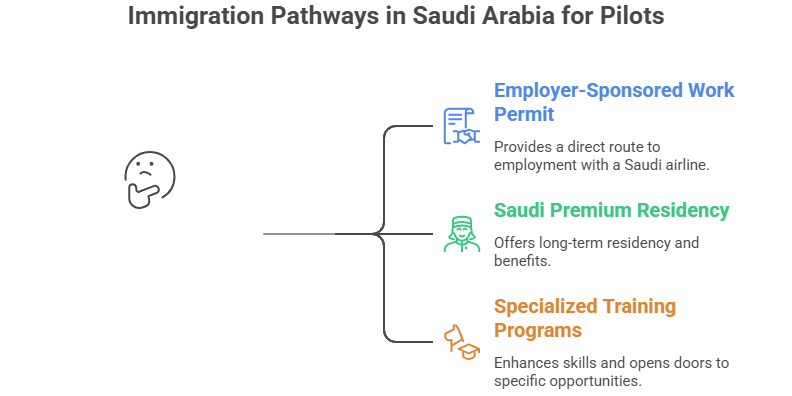
You can migrate to Saudi Arabia as a pilot through immigration pathways such as an employer-sponsored work permit (Iqama), Saudi Premium Residency (Green Card), and Specialised Training Programs. Pilots need to secure a job offer with a Saudi Arabian aviation or airline company and a legal work contract. The employer sponsors the work permit and visa for pilots after you validate your existing foreign pilot license with the Saudi Arabian General Authority of Civil Aviation (GACA). Specialised training programs like the Riyadh Air Aviation Training Scholarship Program and the AeroGuardArabia℠ Program offer a direct pathway to training and cadet roles in Saudi Arabia's aviation hubs.
*Want to work in Saudi Arabia? Let Y-Axis guide you with the steps.
Immigration Pathways in Saudi Arabia for Pilots
Immigration pathways in Saudi Arabia for pilots include employer-sponsored work permits, also known as Iqamas, with long-term residency options under Vision 2030. The Saudi Premium Residency (Green Card) is offered to highly qualified senior pilots, allowing them to work and live in Saudi Arabia for a significant period without local employer sponsorship. Pilots can also migrate to Saudi Arabia through specialised training programs (Riyadh Air Aviation Training Scholarship Program and AeroGuardArabia℠ Program), which are national initiatives to train pilots to meet Saudi Arabian aviation standards. The following are the immigration pathways for pilots to Saudi Arabia:
Employer-Sponsored Work Permit (Iqama)
The Employer-Sponsored Work Permit (Iqama) is a direct immigration pathway for pilots to migrate to Saudi Arabia. Foreign pilots hired by Saudi Arabian aviation centres can apply for the work permit (Iqama), which is a part of the Vision 2030 initiative. This is an employer-mediated, structured pathway in which the employer acts as a sponsor, initiating most of the visa application process for you. An Iqama is valid for up to 2 years and can be renewed upon contract extension.
How it works: After job confirmation, the employer initiates visa issuance, handling the necessary licensing and Iqama processing steps.
Benefits: An employer-sponsored work permit grants the legal right to live and work in Saudi Arabia, with a tax-free salary, a high compensation package, healthcare benefits, a housing allowance, and family sponsorship.
Pathway to PR: Upon long-term employment in Saudi Arabia, the standard work permit can be converted to a Saudi premium residency based on educational qualifications and experience.
Also read..
High-paying job opportunities in Saudi Arabia
Saudi Premium Residency (Green Card)
The Saudi Premium Residency (Green Card) is an immigration pathway for pilots offering a long-term residency option. Highly skilled seniors and specialised pilots can qualify for a Green Card in Saudi Arabia without relying on local employer sponsorship. This makes Saudi Premium Residency a suitable immigration pathway for pilots with high educational qualifications, advanced training, and prior work experience.
How it works: Pilots can apply independently for a Saudi Premium Residency-based experience, education, and minimum income criteria. Residency through a Green Card is granted as a renewable long-term permit or as a Saudi Arabia PR.
Benefits: Pilots with a Saudi Premium Residency have the privilege to switch job roles within the country’s aviation unit and seek permanent residency status. A Green card for pilots also includes benefits such as family sponsorship, property ownership, and investment rights.
Pathway to PR: A Saudi Premium Residency (Green Card) provides access to an expedited permanent residency pathway.
Also read...
Saudi Arabia’s Green Card to attract skilled professionals. Are you eligible?
Specialized Training Programs
Saudi Arabia has Specialized Training programs for pilots to build a strong international and domestic aviation workforce. Foreign pilots can migrate to Saudi Arabia to train under the specific aviation programs with employment opportunities after course completion.
Riyadh Air Aviation Training Scholarship Program
The Riyadh Air Aviation Training Scholarship Program is initiated by the premier airline Riyadh Air in Saudi Arabia to train cadet pilots to meet the requirements of the Saudi General Authority of Civil Aviation (GACA). The training program for pilots includes structured flight training, simulator sessions, and airline-specific preparation to prepare foreign pilots in accordance with Saudi Arabia’s aviation standards.
AeroGuardArabia℠ Program
The AeroGuardArabia℠ Program is also a specialised pilot training initiative in Saudi Arabia to train pilots for Saudi carriers. The program combines Saudi aviation regulations with international flight policies to provide comprehensive training for foreign pilots. Upon completion of the AeroGuardArabia℠ Program, pilots can expect employment in Saudi airlines, leading to employer-sponsored visas and long-term residency in Saudi Arabia.
*Want to migrate to Saudi Arabia as a pilot? Sign-up with Y-Axis for step-by-step assistance.
Eligibility Criteria for Pilots to Migrate to Saudi Arabia
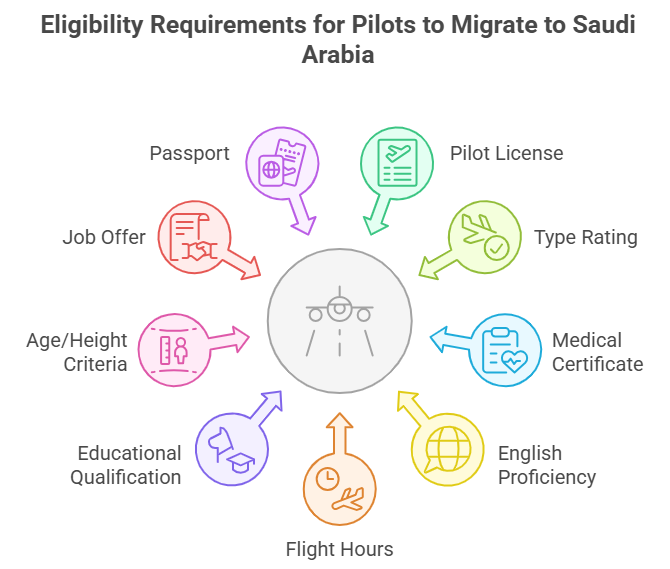
To migrate to Saudi Arabia as a pilot, you need to secure a valid ICAO/GACA Commercial Pilot License (CPL/IR), a Class 1 Medical, and proven English proficiency (ICAO Level 4+). Additionally, pilots need to have significant flight hours (250+ hours), specific type ratings, and meet age/height/and qualification (education/experience) requirements. To apply for a standard Saudi work permit (Iqama), pilots must secure a job offer with a Saudi aviation centre willing to conduct the visa application process on their behalf. The following are the eligibility requirements for pilots to migrate to Saudi Arabia:
- Multi-Engine CPL/IR, recognized by GACA (General Authority of Civil Aviation) or ICAO.
- Type Rating for specific airline roles.
- Valid GACA Class 1 Medical Certificate.
- English proficiency of at least ICAO Level 4 or higher.
- Minimum flight hours (240-250 hours).
- Pilot-specific educational qualification.
- Minimum age/height criteria.
- Valid job offer with employer sponsorship.
- Valid passport.
*Looking for pilot jobs abroad? Consult Y-Axis to help you find the right one.
How to Apply for Arabia Immigration as a Pilot?
Pilots can migrate to Saudi Arabia through a standard work permit (Iqama), the Saudi Premium Residence (Green Card), or specialised pilot training programs. After job confirmation, the employer conducts the majority of the visa/permit application steps based on your educational qualification, experience, and medical reports. The steps to apply for Saudi Arabia immigration as a pilot are as follows:
Step 1: Check eligibility for different Saudi Arabia immigration pathways for pilots.
Step 2: Select a suitable immigration pathway to migrate as a pilot to Saudi Arabia based on qualification, minimum income, work experience, etc.
Step 3: Secure a job offer with employer sponsorship (for a standard work permit; not needed for Saudi Premium residency).
Step 4: The employer applies for the work visa/permit (Iqama) with the necessary documents on your behalf.
Step 5: Upon visa approval, fly to Saudi Arabia.
Step 6: Clear the GACA Medical Examination to obtain a current Class 1 Medical Certificate from a GACA-approved medical examiner (AME) for valid licensing.
Step 7: Convert Your Foreign License to a GACA License through the GACA online portal or an approved training organization (ATO).
Step 8: Pass the medical examination set for pilots in Saudi Arabia.
Step 9: Upon successful licensing, live and work in Saudi Arabia as a licensed pilot.
*Are you looking for step-by-step assistance with overseas immigration? Contact Y-Axis, the world’s No. 1 overseas immigration consultancy, for end-to-end assistance!
FAQs
How to migrate to Saudi Arabia as a pilot?
To migrate to Saudi Arabia as a pilot, you need to first secure a job role in Saudi Arabia's aviation facilities with valid employer sponsorship for the work visa/permit. Saudi Arabia immigration pathways for pilots include an employer-sponsored work permit (Iqama), Saudi Premium Residency (Green Card), and Specialised Training Programs. After obtaining a work visa/permit, upon entry into Saudi Arabia, pilots need to convert their foreign pilot license to a General Authority of Civil Aviation (GACA) license.
What are the visa requirements to migrate to Saudi Arabia as a pilot?
Pilots migrating to Saudi Arabia on a standard work visa/permit (Iqama) must first secure a job offer with employer sponsorship, as this is an employer-mediated pathway. Upon job confirmation, the employer applies for the work visa/permit (Iqama) with the necessary documents, including attested educational/pilot certificates (GACA-approved), a valid GACA medical certificate, a passport, and a police clearance record. In addition to the Ministry of Foreign Affairs (MOFA) sponsor referral from your employer, you also need to meet specific GACA (General Authority of Civil Aviation) standards and English language proficiency at Level 4+.
How to validate Indian pilot licenses for flying in Saudi Arabia?
Indian pilot can validate their license (DGCA) before flying to Saudi Arabia by applying for a GACA license (General Authority of Civil Aviation) in Saudi Arabia. At the GACA, Indian pilots can prove the validity of their license in India by clearing local medicals, theoretical, and practical exams. Pilots also have to meet specific flight-hour requirements set by ICAO.
What is the average salary for pilots working in Saudi Arabian airlines?
The average salary for pilots working in Saudi Arabian airlines varies based on official ranking and experience, and is around SAR 29,000/year for First Officers. Captained and highly trained pilots earn approximately SAR 314,000 annually, along with additional bonuses. Certain airlines offer even higher packages, inclusive of housing costs and other benefits, bringing the annual compensation to around SAR 200k-370k+ for senior pilots.
How to apply for a work permit in Saudi Arabia as a pilot?
To apply for a work permit (Iqama) in Saudi Arabia as a pilot, you need to secure a job offer with a Saudi Arabian aviation centre or company that is willing to sponsor your work visa application via the MHRSD and your work permit. The work permit approval (Qiwa), followed by visa authorization at MOFA, is an employer-initiated pathway in Saudi Arabia for pilots. Upon arrival in Saudi Arabia on a work visa, you will receive your Iqama ( residence permit) after clearing the medical/background check.
What documents do pilots need to migrate and work in Saudi Arabia?
Pilots migrating to work in Saudi Arabia need to convert their Indian flying license to a GACA (General Authority of Civil Aviation) license. The migration process for pilots involves documentation for both general immigration requirements and aviation-specific criteria approved by the General Authority of Civil Aviation (GACA).
The documents needed by pilots to migrate and work in Saudi Arabia are as follows:
- Valid ICAO Pilot License/Certificates
- GACA Medical Certificate.
- Proof of Level 4+ English language proficiency.
- Type Rating Certificate.
- Employment Contract.
- Attested educational certificates/diploma.
- Work experience letter.
- Police Clearance Certificate (PCC)
- Valid passport.
How to convert an Indian commercial pilot license to meet Saudi regulations?
Pilots can convert their Indian commercial pilot license (CPL) to comply with Saudi Arabian regulations by applying to the General Authority of Civil Aviation (GACA) for a foreign license conversion. To convert the CPL to a Saudi Arabia-approved flying license, pilots need to submit their Indian CPL documents, medical certificates, logbooks, and pass specific GACA exams and skill tests.
What are the medical and fitness requirements for pilots migrating to Saudi Arabia?
Foreign pilots migrating to Saudi Arabia need a GACA Class 1 Medical Certificate as proof of complete physical and mental fitness. GACA conducts comprehensive physical and mental health checks, vision/hearing tests, ECG, and blood work (HIV, Hepatitis B/C), along with standard Saudi work visa medicals, such as blood/urine tests and chest X-rays, to examine a foreign pilot's complete health status before license approval.
How to register with Saudi aviation authorities as a foreign pilot?
You can register as a foreign pilot with GACA, the Saudi aviation authorities, by applying for a Temporary Flight Authorization (TFA) or license conversion via GACA's e-services online portal. Pilots need to submit documents such as a foreign license, logbook, valid passport, English proficiency certificate, and medical test reports after completing GACA-approved operator indoctrination. Additionally, foreign pilots need to clear the KSA AIP knowledge tests and security checks to successfully register with the Saudi aviation authorities.
Can I apply for permanent residence as a pilot in Saudi Arabia?
Yes, it is possible to apply for permanent residence in Saudi Arabia as a pilot through the Vision 2030 initiative. Pilots can secure Saudi Arabia PR for long-term work and residence through the Premium Residency Program (Green Card). To secure a Green Card, pilots must pay a one-time fee of SAR 800,000, granting them the freedom to live and work in Saudi Arabia and own property legally.
Tags:
Migrate to Saudi Arabia
work in Saudi Arabia
jobs for pilot in Saudi Arabia
pilot jobs in Saudi Arabia
General Authority of Civil Aviation
Saudi Arabia PR
permanent residence in Saudi Arabia
Employer-Sponsored Work Permit
Ministry of Labor
Share
Options for you by Y-Axis

Get it on your mobile

Get News alerts

Contact Y-Axis
Latest Article
Popular Post
Trending Article

Posted On April 01 2026
Study vs Work Abroad – Which is Better for Indians in 2026?