

Posted on October 07 2026
Germany Opportunity Card for Indians: 5 Checks Before You Apply

By , Editor & Director
Updated October 07 2026
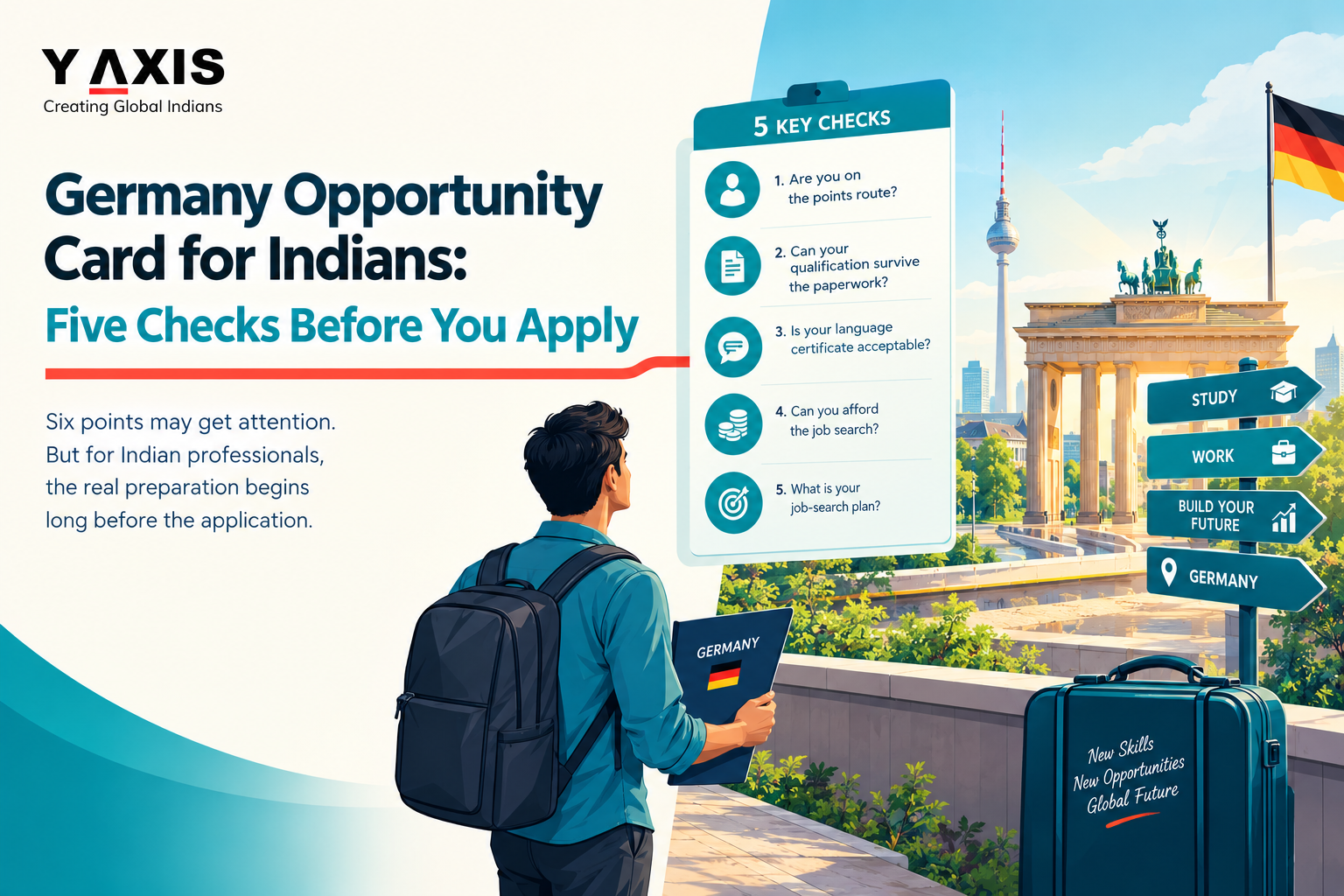
Six points may get your attention. But for Indian professionals, the real preparation begins long before the application.
For an Indian professional looking at Germany, the first question is often simple:
“Can I score six points?”
It is an important question, but it is not the first thing every applicant needs to ask. Germany’s Opportunity Card allows eligible people from outside the EU, EEA and Switzerland to enter Germany to look for suitable employment. Depending on their circumstances, applicants can qualify either through a recognised-qualification route or through a points-based route.
That changes the question from:
“Can I get six points?”
to something more useful:
“Which route applies to me - and can I prove that I qualify?”
What is the Germany Opportunity Card?
The Opportunity Card, or Chancenkarte, is a residence route designed for eligible international jobseekers who want to look for suitable employment in Germany. It is not the only way to look for a job in Germany. If you already have a qualifying job offer, another employment-related residence route may be more appropriate. The Opportunity Card is primarily relevant when a person wants to come to Germany to search for employment or pursue certain qualification-related measures.
There are two ways to qualify:
- Through a qualification recognised in Germany, without using the points system.
- Through the points system, by meeting the qualification and language requirements and scoring at least six points.
For Indian applicants, understanding which route applies can be more important than simply calculating points.
1. First check: Are you actually on the points route?
The Opportunity Card is not simply a six-point immigration calculator.
Route 1: Your qualification is recognised in Germany
Applicants who have a foreign academic or vocational qualification that is fully recognised in Germany can qualify for the Opportunity Card through the skilled-worker route without having to collect six points. People who have completed an academic degree or non-academic vocational qualification in Germany can also qualify under the relevant framework. For this route, proof of language skills is not specifically required for the Opportunity Card. However, the German government recommends German-language knowledge because it can improve the chances of finding employment.
Route 2: You qualify through the points system
If you do not have a German qualification or a qualification fully recognised in Germany, you may qualify through the points route.
This route requires:
- a qualifying foreign academic or vocational qualification;
- the qualification to meet the applicable recognition requirements in the country where it was obtained;
- at least German A1 or English B2; and
- at least six points under the Opportunity Card points system.
So, before calculating your score, establish whether you are even required to use the points system.
How are the six points calculated?
|
Criterion |
Points |
|
Partial recognition of a foreign qualification |
4 |
|
German language skills |
1–3 |
|
Relevant professional experience |
2–3 |
|
Qualification in a shortage occupation |
1 |
|
English at C1 or above / applicable native-speaker criterion |
1 |
|
Age no older than 35 |
2 |
|
Age 35–40 |
1 |
|
Previous qualifying legal residence in Germany |
1 |
|
Spouse or life partner who also meets the Opportunity Card requirements |
1 |
The points are subject to specific definitions and must be supported by appropriate evidence. Professional experience, for example, is not simply a matter of counting years worked. Two points are available for at least two years of relevant professional experience within the previous five years, while three points are available for at least five years within the previous seven years. The experience must relate to the formal qualification being relied upon. Language points also have specific thresholds:
- German A2: 1 point
- German B1: 2 points
- German B2 or above: 3 points
- English C1 or above, or applicable native-speaker status: 1 additional point
The practical lesson is simple:
A point on a spreadsheet is useful only if you can substantiate the reason for receiving it.
2. Second check: Can your qualification survive the paperwork?
For Indian applicants, qualification documentation can become one of the most important parts of the process. For the points route, the qualification itself has to meet the applicable requirements. A foreign academic degree may need to be established through the Anabin database or, where appropriate, a Statement of Comparability from the Central Office for Foreign Education (ZAB). For vocational qualifications, different evidence and recognition requirements can apply. This is where applicants should avoid leaving recognition questions until the final stage.
For example, an Indian university degree may require supporting academic documentation. Depending on the qualification and the application, applicants may need to provide degree certificates, academic records and other evidence. Distance-learning qualifications can also require closer attention to the relevant recognition and documentation requirements.
The key question is:
“Is my qualification recognised or otherwise acceptable for the route I am using?”
That should be answered before the job search becomes urgent. For regulated professions, there may also be separate professional-recognition or licensing requirements before the person can actually practise the profession in Germany.
3. Third check: Is your language certificate actually acceptable?
There are two different questions here:
Do I meet the immigration requirement?
and
Will my language ability help me find the job I want?
They are not necessarily the same. For the points route, applicants need at least German A1 or English B2. Higher German-language ability can contribute additional points. But language can matter well beyond the points calculation. German official guidance recommends German because it can improve an applicant's chances of finding employment in Germany.
What about English tests for Indian applicants?
This is an important detail.
The German Missions in India states that proof of English must meet the applicable requirements and specifically notes that PTE, Duolingo and TOEFL Online results are not accepted as proof of English for Opportunity Card applications in India. So applicants should check the current certificate requirements before paying for a language test. A certificate that is valid for another purpose is not automatically acceptable for a German visa application.
The broader lesson is simple:
Meeting the minimum language requirement and being ready for the German workplace are two different stages of preparation.
4. Fourth check: Can you afford the job search - not just the flight?
The Opportunity Card provides a route to search for employment in Germany. It does not provide an income. Applicants therefore need to demonstrate that they can support themselves during their stay. For 2026, the financial benchmark is €1,091 net per month. A full 12 months at that amount comes to €13,092. Applicants can demonstrate sufficient funds through an accepted blocked bank account or a declaration of commitment.
A qualifying part-time employment contract can also contribute to the financial assessment. If the net income is below €1,091 per month, the difference can be supplemented through a blocked account. The Opportunity Card also requires appropriate health insurance coverage.
That means the financial question should not simply be:
“Can I show the required amount?”
A better question is:
“Have I planned how I will financially sustain the entire job-search period?”
That is a very different calculation.
5. Fifth check: What will you actually do after you land?
This may be the most overlooked part of the Opportunity Card. The card allows eligible holders to look for suitable employment in Germany. While searching, holders can undertake secondary employment for a total of up to 20 hours per week. They can also undertake job trials for up to two weeks per employer, subject to the applicable conditions. That can change the distance between an international applicant and a German employer. Instead of applying entirely from India, an eligible jobseeker can be physically present in Germany while searching, networking and pursuing permitted employment opportunities. But being in Germany does not automatically produce a job. The German Missions in India specifically advises applicants to research employment opportunities and potential employers before travelling, noting that jobseekers who arrive without doing this research have often struggled to find employment.
What should you prepare before travelling?
Your preparation can include:
- identifying relevant employers and current vacancies;
- checking whether your occupation has recognition or licensing requirements;
- understanding language expectations in your target sector;
- preparing a German-market-ready CV and application documents;
- organising evidence of your qualifications and professional experience;
- identifying cities or regions where relevant employers are concentrated;
- planning accommodation, insurance and living expenses; and
- understanding which residence route could follow after securing employment.
The Opportunity Card can move the job search from outside Germany to inside Germany.
It cannot move the responsibility for preparing for that job search.
What if you already have a job offer in Germany?
This distinction matters. The Opportunity Card is fundamentally a job-search route. If you already have a qualifying job offer or employment contract, another employment residence route may be more appropriate depending on the circumstances. The German government's guidance specifically distinguishes the Opportunity Card from routes for people who already have an offer of qualified employment.
However, having a part-time offer of up to 20 hours per week does not automatically prevent someone from using the Opportunity Card. Such employment can, under the applicable rules, contribute to the financial requirement. The important distinction is therefore not simply “Do I have a job offer?”
It is:
“What type of employment do I have, and which residence route is designed for my situation?”\
What happens after you find a job in Germany?
Finding a job is not the same as automatically receiving permanent residence. Once an Opportunity Card holder finds suitable employment, they can apply to the competent foreigner’s authority for an appropriate residence permit. Depending on the circumstances, this could be a residence route for:
- qualified employment;
- vocational training;
- recognition of qualifications; or
- self-employment.
If the job meets the requirements for qualified employment but the applicant does not yet qualify for another residence title, the Opportunity Card can, under the applicable conditions, be extended for up to two additional years. The initial Opportunity Card is generally issued for a maximum of one year. Think of it as a bridge into the German labour market, rather than an automatic ticket to permanent residence.
Germany Opportunity Card: 5 questions to ask before you apply
Before submitting an application, an Indian professional can use this simple test.
1. Which route am I using?
Is my qualification fully recognised in Germany, or am I relying on the points system?
2. Can I prove my qualification?
Have I checked the relevant recognition requirements and determined whether I need Anabin, ZAB documentation or other evidence?
3. Is my language evidence acceptable?
Do I meet the required language level, and is my particular certificate accepted for an application from India?
4. Can I finance the job search?
Can I demonstrate the 2026 requirement of €1,091 net per month through an accepted form of financial proof?
5. What is my actual job-search plan?
Can I name the employers, roles, locations and application strategy I intend to pursue?
If the fifth answer is simply “I will start looking after I arrive,” the application may be only half-prepared.
FAQs
Do I need six points to get the Germany Opportunity Card?
Not necessarily.
Applicants with a foreign academic or vocational qualification that is fully recognised in Germany can qualify through the skilled-worker route without using the points system. Applicants using the points route must score at least six points and meet the other applicable requirements.
What if I have exactly six points?
Six points meet the minimum threshold for the points route, provided you also meet the applicable qualification, language, financial and other requirements.
How many points do I get for being 35?
Applicants who are no older than 35 at the time of the visa application receive two points. Applicants aged 35 to 40 receive one point.
Can my work experience give me points?
Yes, if it meets the applicable definition of relevant professional experience.
You can receive two points for at least two years of relevant professional experience within the previous five years, or three points for at least five years within the previous seven years. The experience must be related to the formal qualification being relied upon.
Can I work in Germany on the Opportunity Card?
Yes. While searching for employment, Opportunity Card holders can undertake secondary employment totalling up to 20 hours per week. Job trials of up to two weeks per employer are also permitted under the applicable conditions.
If I have a 20-hour job, do I still need to prove financial resources?
Financial requirements do not simply disappear.
A qualifying part-time employment contract can contribute to the financial assessment. If the net income is below the required €1,091 per month in 2026, the shortfall can be supplemented through a blocked account.
Can I use a PTE or Duolingo English certificate for an Opportunity Card application from India?
The German Missions in India states that PTE, Duolingo and TOEFL Online results are not accepted as proof of English for the Opportunity Card application in India. Applicants should check the latest accepted evidence before taking a test.
Does the Opportunity Card guarantee a German job?
No.
The Opportunity Card provides an eligible person with a route to search for employment in Germany. It does not guarantee employment. The German government recommends preparing for the job search before travelling.
Can I apply for the Opportunity Card if I already have a job offer?
It can depend on the nature of the offer and your circumstances. A part-time job of up to 20 hours per week can, for example, contribute to the financial requirement for an Opportunity Card.
However, if you already have a qualifying offer for substantial employment, another employment residence route may be more appropriate.
What happens when I find a suitable job?
You generally move to the appropriate residence route for the next stage rather than remaining on the Opportunity Card indefinitely. The correct residence permit depends on the employment, qualification and individual circumstances.
The six points are only the threshold
The Germany Opportunity Card can look deceptively simple from a distance:
Six points. Germany. Find a job.
The actual process is more nuanced.
For one applicant, the decisive issue may be whether a foreign qualification is recognised. For another, it may be the evidence behind professional experience. For someone else, the problem may not be points at all, but whether the qualification documents, language certificate or financial proof meet the requirements.
And once the applicant reaches Germany, another question begins:
What happens next?
That is why the Opportunity Card is better understood not as a points calculator, but as a job-search framework.
The strongest preparation happens before the flight:
Understand the route. Verify the qualification. Check the language evidence. Plan the finances. Research the employers.
Because the real advantage is not simply being allowed to look for a job in Germany.
It is being prepared enough to know what you are looking for when you get there.
Tags:
Germany Opportunity Card
Germany Opportunity Card for Indians
Chancenkarte
Germany job seeker visa
Germany visa for Indians
Germany skilled immigration
Germany jobs for Indians
Germany points system
Germany work visa
German immigration 2026
Share
Options for you by Y-Axis

Get it on your mobile

Get News alerts

Contact Y-Axis
Latest Article
Popular Post
Trending Article

Posted On October 08 2026
The Things Indians Abroad Export That Never Appear on a Customs Form