

Posted on November 24 2026
EU pushes AI skills across universities as digital skills gap widens: What Indian students must know

By , Editor & Director
Updated November 24 2026
~ Dr. Serah Vinodini Vilvaraj
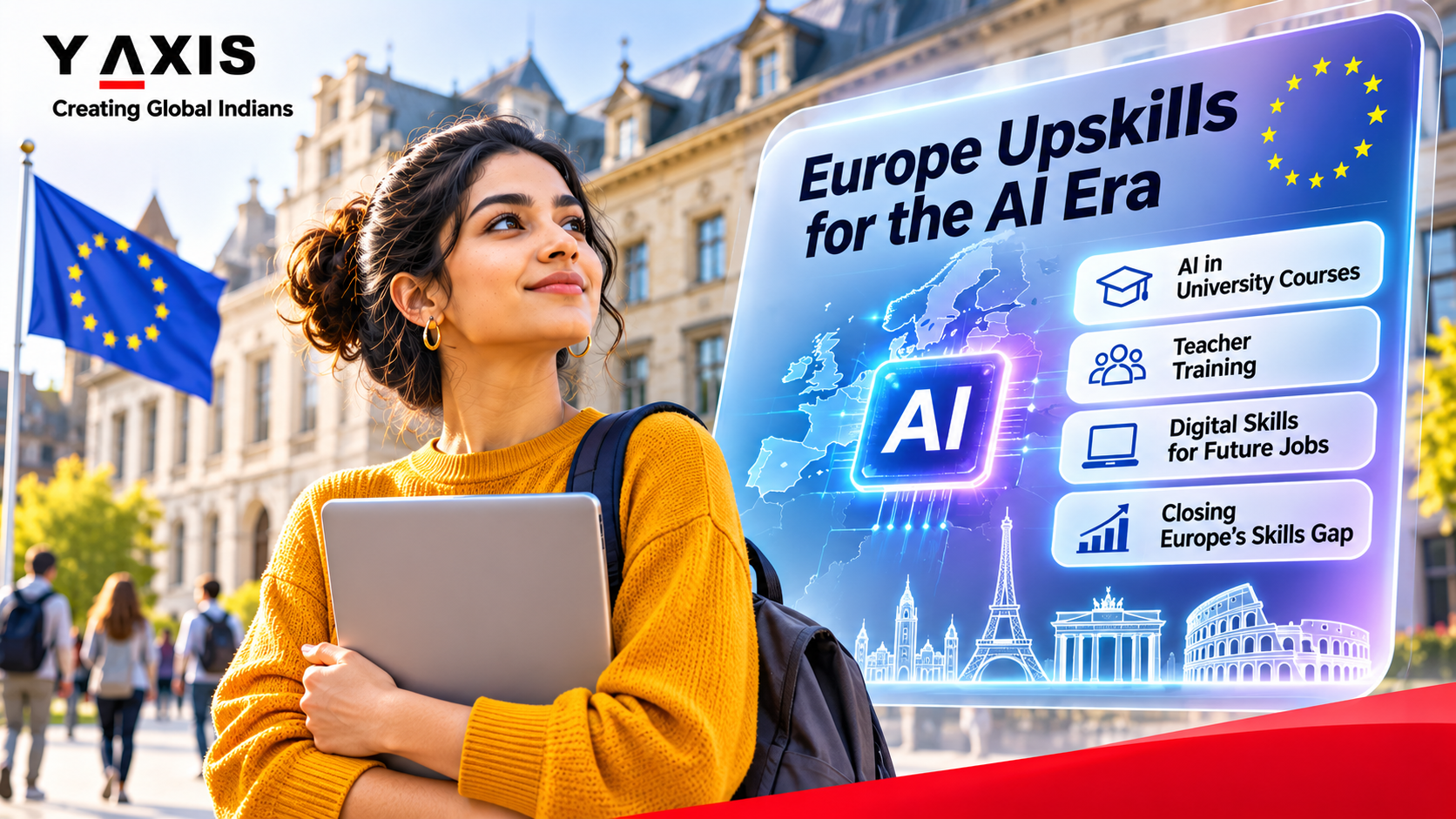
Europe is preparing its education systems for an AI-driven future. On November 19, 2026, the Council of the European Union approved new conclusions encouraging universities and training institutions to strengthen artificial intelligence education. With only 60.4% of EU residents possessing basic digital skills, the development raises an important question for Indian students: could AI-ready qualifications become increasingly valuable when choosing where and what to study abroad?
Why Is Europe Making AI Skills an Education Priority?
Europe's education system is facing a significant technological challenge: artificial intelligence is changing workplace expectations faster than many traditional learning programmes can adapt. On November 19, the Council of the European Union approved conclusions calling for stronger AI literacy, advanced digital training and lifelong learning across member states.
The recommendations encourage universities and vocational education and training providers to modernise existing programmes and develop new courses reflecting changing occupational requirements. The Council also emphasised responsible AI use, teacher training and the importance of ensuring that technological advances do not widen educational inequalities. The development comes immediately before the European Education and Skills Summit on November 20, which focuses on preparing schools for the AI era.
How Large Is Europe's Digital Skills Gap?
Recent Eurostat figures illustrate why European policymakers are prioritising digital education.
|
Digital skills indicator |
Latest verified figure |
|
EU residents aged 16–74 with basic digital skills, 2025 |
60.4% |
|
EU target for basic digital skills by 2030 |
80% |
|
Young Europeans aged 16–24 with basic digital skills, 2025 |
74.6% |
|
ICT specialists employed in the EU, 2025 |
10.4 million |
The figures reveal that Europe remains approximately 19.6 percentage points below its 2030 basic digital skills target. Among young people, Denmark recorded 92.1% with basic digital skills, followed by Czechia at 91.7% and Malta at 91.5%. Bulgaria and Romania recorded 52.8% and 53.3%, respectively. These statistics measure digital competence, not AI expertise specifically. Nevertheless, they demonstrate the broader skills challenge facing European education and employment systems.
What Changes Could European Universities Introduce?
The Council's recommendations encourage education providers to reconsider how students develop technical and transferable skills. Universities may increasingly explore AI-related learning within programmes beyond computer science, including engineering, business, healthcare and other disciplines.
Potential areas of curriculum development include:
- AI literacy: Understanding how artificial intelligence works, including its capabilities and limitations.
- Data analysis: Developing skills to interpret information and use digital tools effectively.
- Responsible AI: Recognising ethical concerns, privacy risks and potential algorithmic bias.
- Workplace applications: Applying AI tools to practical problems within different industries.
- Critical thinking: Evaluating AI-generated information rather than accepting outputs without verification.
However, the Council's conclusions are not legally binding. Individual universities and national education authorities will determine whether, when and how programmes change.
Why Should Indian Students Planning to Study in Europe Pay Attention?
For Indian students considering European universities, the announcement provides an additional factor to consider when selecting courses. Traditionally, international applicants compare tuition fees, university rankings, scholarships, language requirements and post-study employment options. The growing emphasis on AI suggests that curriculum relevance and opportunities to develop practical digital skills may deserve greater attention.
For example, students considering engineering, finance or healthcare-related qualifications can examine whether programmes include relevant technology modules, industry projects or opportunities to develop digital competencies. Importantly, AI skills do not automatically make graduates eligible for employment. Hiring decisions continue to depend on qualifications, experience, employer requirements and applicable immigration rules. Students should also avoid assuming that every European university will immediately introduce new AI modules following the Council announcement.
Is Europe Introducing New AI Courses or Scholarships?
The November 19 conclusions do not announce a single EU-wide AI degree, scholarship scheme or international student admission programme. They establish a policy direction encouraging member states and education providers to strengthen relevant skills. Separately, the European Commission's Education and Skills Package, announced on November 5, includes plans to pilot an AI Literacy Certificate from the 2027–28 school year. That proposed pilot is aimed at learners within the broader education system. It should not be interpreted as a new qualification required for international university admission. Students seeking AI-related courses or funding should verify individual university offerings and official scholarship eligibility criteria.
Could AI Skills Improve Employment Prospects in Europe?
Europe's digital economy is expanding, creating demand for people capable of working with emerging technologies.
The European Commission's 2026 Digital Decade reporting indicates that nearly 20% of EU enterprises use artificial intelligence, highlighting the growing relevance of AI in business operations. Eurostat also reports that 10.4 million people worked in ICT specialist occupations in 2025. However, these figures do not mean that all employers are recruiting international graduates or that AI training guarantees a job. For Indian students, the practical opportunity lies in choosing recognised qualifications that combine subject knowledge with relevant digital competencies. Employment and post-study residence options must be assessed separately under the immigration rules of the destination country.
What Should Students Check Before Choosing a European University?
Students interested in future-focused programmes should investigate several questions before applying.
Does the course teach practical digital skills? Review the official syllabus and assessment methods.
Are industry projects or internships available? Check whether the university offers relevant practical learning opportunities.
Is the qualification recognised? Verify the institution's accreditation and the programme's academic standing.
What are the post-study work rules? Review the destination country's current immigration requirements rather than assuming that EU education recommendations create new work rights.
Will the course remain relevant to career goals? Consider how technology skills complement the student's chosen profession.
Official Sources
- Council of the European Union — Equipping Europeans for the Age of AI, November 19, 2026
- European Commission — European Education and Skills Summit, November 20, 2026
- Eurostat — Towards Digital Decade Targets for Europe, 2026
- Eurostat — 75% of Young Europeans Have at Least Basic Digital Skills, July 15, 2026
- European Commission — 2026 State of the Digital Decade
Frequently Asked Questions
1. Has the EU made AI education compulsory for international students?
No. The Council approved non-binding conclusions encouraging stronger AI education. It has not introduced compulsory AI coursework for all international students.
2. Will Indian students receive new EU scholarships under this announcement?
No new international student scholarship scheme was announced in the November 19 conclusions.
3. Are European universities required to introduce AI courses immediately?
No. Universities and national authorities retain responsibility for implementing educational changes.
4. Does studying AI guarantee a European work visa?
No. Work visa eligibility depends on the immigration requirements of the relevant country and the applicant's circumstances.
What Does This Mean for the Future of Studying in Europe?
Europe's latest AI education initiative signals a growing emphasis on qualifications that combine academic knowledge, digital competence and adaptability. For Indian students, the message is practical: when choosing a European university, evaluate not only the degree but also the skills it will help you develop. The November 19 announcement does not change visa eligibility. It does, however, provide a useful indication of the competencies European policymakers want education systems to strengthen in the years ahead.
Tags:
EU AI education policy 2026
EU AI Education
Study in Europe
Indian Students
European Universities
AI Skills
Digital Skills Gap
European Commission
AI Courses
International Education
Europe Education News.
Share
Options for you by Y-Axis

Get it on your mobile

Get News alerts

Contact Y-Axis
Latest Article
Popular Post
Trending Article

Posted On November 26 2026
Australia visa services to go offline November 27–28: Applicants warned to act before shutdown