

Posted on July 07 2026
Estonia Visa Sponsorship Jobs: In-Demand Roles, Top Employers & Work Permits

By , Editor & Director
Updated July 12 2026
Estonia is one of Europe's most digitally advanced nations and a growing destination for skilled foreign professionals. Known as the "Silicon Valley of Europe,".Estonia has built a strong technology ecosystem that has produced global companies such as Skype, Bolt, and Wise. Although the country has a population of only about 1.4 million, it faces labour shortages in key sectors, including IT, healthcare, engineering, manufacturing, and education.
To fill these workforce gaps, Estonian employers actively recruit skilled professionals from outside the EU and EEA and sponsor work visas for eligible candidates. The Estonian government has also simplified its immigration process, making it easier for employers to hire international talent. For Indian professionals, Estonia offers competitive salaries, a high quality of life, a transparent immigration system, and a clear pathway to long-term residence and permanent residency. Recent labour market projections indicate that more than 100,000 job openings are expected between 2026 and 2030. Skilled workers in technology, engineering, healthcare, management, and other high-demand occupations are expected to have strong employment opportunities.
Why Apply for Jobs in Estonia with Visa Sponsorship?
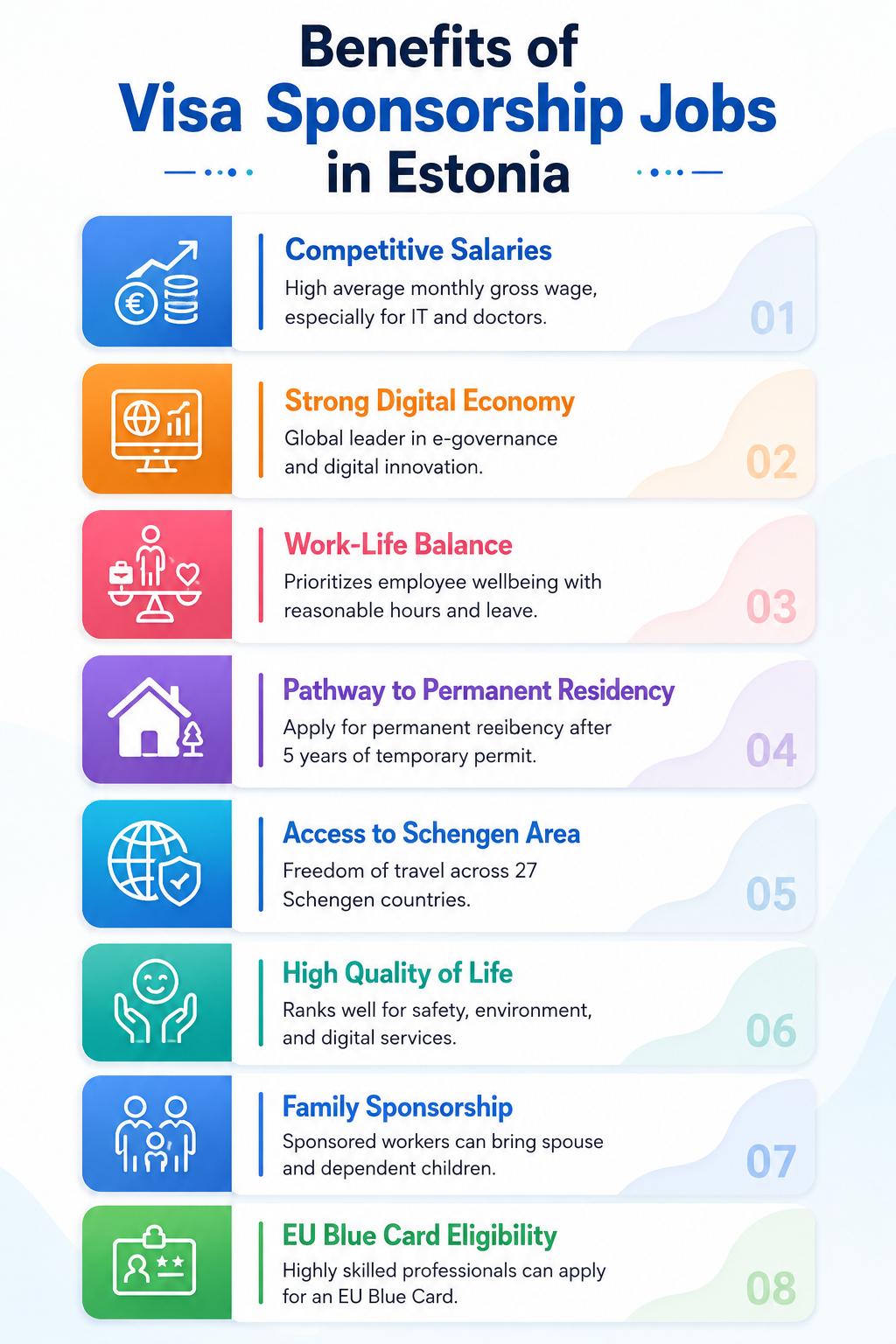
- Competitive salaries: The average monthly gross wage in Estonia reached €2,135 in Q1 2026, with IT professionals and doctors earning significantly more.
- Strong digital economy: Estonia is a global leader in e-governance and digital innovation, offering excellent career opportunities for IT and tech professionals.
- Work-life balance: Estonian work culture prioritises employee wellbeing, with reasonable working hours and generous annual leave entitlements.
- Pathway to permanent residency: After holding a temporary residence permit for 5 years, foreign nationals can apply for permanent residency in Estonia.
- Access to the Schengen Area: Living in Estonia gives you freedom of travel across 27 Schengen countries.
- High quality of life: Estonia consistently ranks well for safety, clean environment, low corruption, and digital services.
- Family sponsorship: Sponsored workers can bring their spouse and dependent children to Estonia under family reunification provisions.
- EU Blue Card eligibility: Highly skilled professionals can apply for an EU Blue Card in Estonia, which also provides rights across EU member states.
What are Visa Sponsorship Jobs in Estonia?
Visa sponsorship jobs in Estonia are positions where an Estonian employer agrees to support a foreign worker's application for a work permit or residence permit. Because non-EU/EEA nationals cannot simply move to Estonia and start working, they need a legal basis typically a job offer from a registered Estonian company willing to sponsor their visa.
When an employer sponsors you, they formally support your work permit application with the Police and Border Guard Board (PPA) of Estonia. This means the employer takes responsibility for your legal employment status during your stay. Anyone with the right qualifications, relevant work experience, and a valid job offer from an Estonian employer can apply. This includes skilled workers, IT professionals, healthcare staff, engineers, teachers, and semi-skilled workers in sectors facing labour shortages.
*Read about...
In-Demand Visa Sponsorship Jobs in Estonia
Estonia has a growing demand for skilled professionals across several industries. Employers in information technology, healthcare, engineering, manufacturing, finance, education, construction, and logistics actively recruit qualified international workers and may offer visa sponsorship for eligible candidates. The table below lists the major sectors, some of the most in-demand job roles, and their average annual salaries.
| Sector | In-Demand Job Roles | Average Annual Salary (EUR) |
|---|---|---|
| Information Technology | Software Developer, IT Project Manager, Cybersecurity Specialist, Data Analyst | €36,000–€48,000 |
| Healthcare | Physician/Doctor, Registered Nurse, Caregiver/Social Worker | €19,200–€61,380 |
| Engineering & Construction | Civil/Structural Engineer, Construction Worker | €21,600–€36,000 |
| Manufacturing | Welder/Metal Worker, Manufacturing/Production Operator | €21,600–€24,000 |
| Finance | Financial Analyst, Accountant | €28,800–€37,968 |
| Education | Secondary School Teacher | €23,640 |
| Transport & Logistics | Logistics Coordinator | €24,000 |
Highest Paying Jobs in Estonia
Estonia offers good salaries for skilled professionals, especially in technology, healthcare, engineering, and finance. Jobs that require specialised skills and experience usually pay the highest salaries. The table below shows some of the highest-paying jobs in Estonia, along with their average annual salaries.
| Job Title | Average Annual Salary (EUR) | Average Annual Salary (INR) |
|---|---|---|
| Physician / Doctor | €61,380 | ₹66,29,040 |
| Software Developer | €48,000 | ₹51,84,000 |
| IT Project Manager | €48,000 | ₹51,84,000 |
| Cybersecurity Specialist | €45,600 | ₹49,24,800 |
| Financial Analyst | €37,968 | ₹41,00,544 |
| Data Analyst | €36,000 | ₹38,88,000 |
| Civil / Structural Engineer | €36,000 | ₹38,88,000 |
| Registered Nurse | €32,256 | ₹34,83,648 |
| Accountant | €28,800 | ₹31,10,400 |
| Welder / Metal Worker | €24,000 | ₹25,92,000 |
| Logistics Coordinator | €24,000 | ₹25,92,000 |
| Secondary School Teacher | €23,640 | ₹25,53,120 |
| Construction Worker | €21,600 | ₹23,32,800 |
| Manufacturing / Production Operator | €21,600 | ₹23,32,800 |
| Caregiver / Social Worker | €19,200 | ₹20,73,600 |
Read about - What are the most in-demand jobs in Estonia for the next 10 years?
Top Companies Offering Visa Sponsorship Jobs in Estonia
Many leading companies in Estonia hire skilled international professionals and may offer visa sponsorship for eligible candidates. These companies operate in sectors such as technology, finance, telecommunications, healthcare, energy, logistics, and consulting. The table below lists some of the top employers, their industry, and the common job roles they recruit for.
| Company Name | Industry | Common Job Roles |
|---|---|---|
| Bolt | Technology / Ride-Hailing | Software Engineers, Data Analysts, Operations Managers |
| Pipedrive | Customer Relationship Management (CRM) Software | Software Developers, Product Managers, Customer Success Managers |
| Wise | Financial Technology (FinTech) | Software Engineers, Financial Analysts, Compliance Officers |
| Nortal | IT Services & Digital Transformation | IT Consultants, Software Developers, Project Managers |
| Playtech Estonia | Gaming Technology | Software Developers, QA Engineers, Data Scientists |
| CGI Estonia | IT Services | Systems Analysts, IT Consultants, Java Developers |
| Ericsson Estonia | Telecommunications | Network Engineers, Software Developers, Technical Specialists |
| Telia Estonia | Telecommunications | Network Engineers, Customer Support Specialists, IT Specialists |
| Eesti Energia (Enefit) | Energy | Engineers, Project Managers, Environmental Specialists |
| Tallink Grupp | Transport & Hospitality | Hospitality Staff, Engineers, Logistics Coordinators |
| LHV Bank | Banking & Finance | Financial Analysts, Software Developers, Risk Managers |
| Omniva | Postal Services & Logistics | Logistics Coordinators, IT Specialists, Warehouse Managers |
| East Tallinn Central Hospital | Healthcare | Doctors, Nurses, Medical Technicians |
| KPMG Estonia | Audit & Consulting | Auditors, Financial Consultants, Tax Advisors |
| Microsoft Estonia | Technology | Software Engineers, Cloud Architects, IT Specialists |
*Want to apply for jobs abroad? Try Y-Axis Resume Marketing services to find the right one.
Eligibility Requirements for Visa Sponsorship Jobs in Estonia
To qualify for a visa sponsorship job in Estonia, you must meet the following requirements:
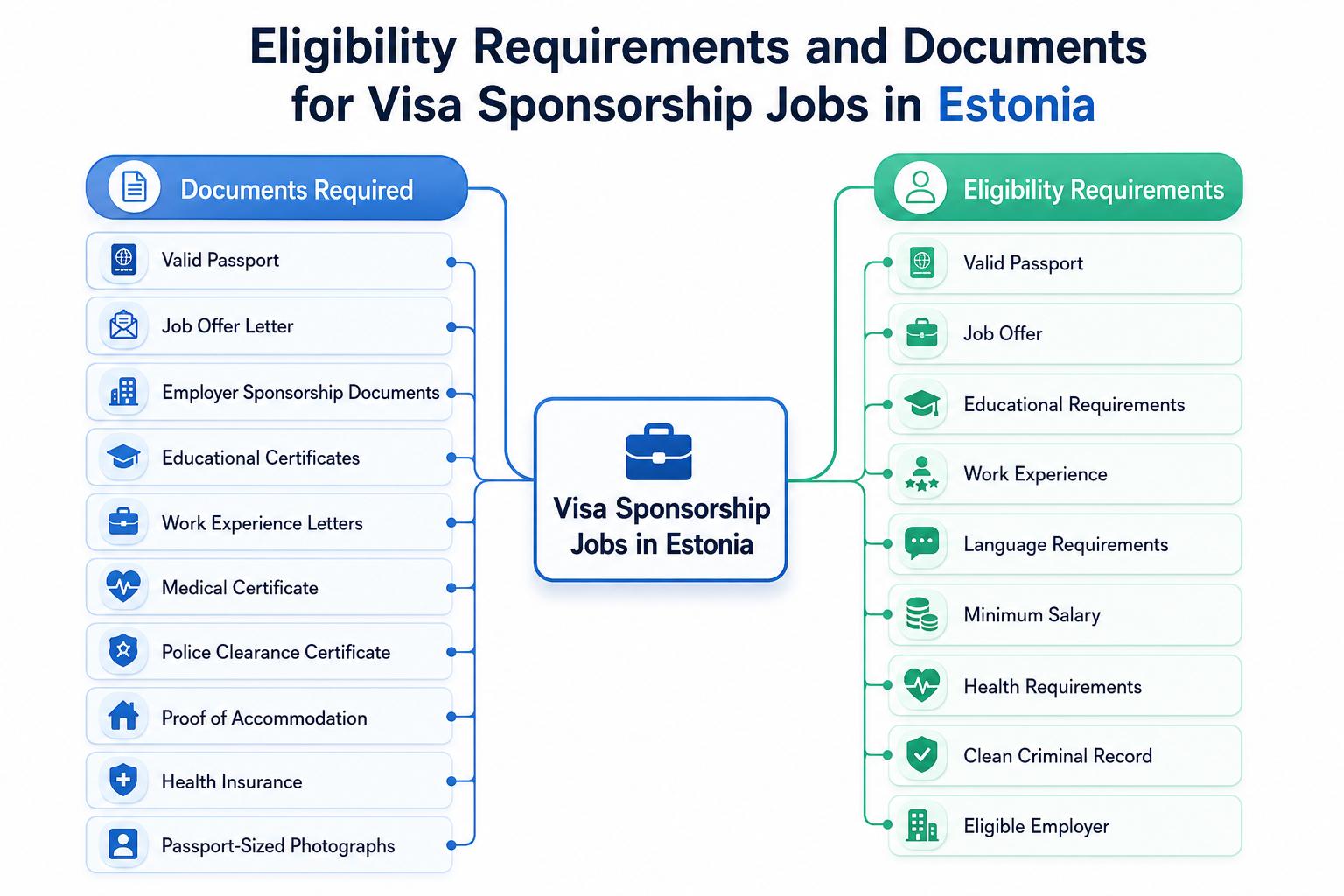
- Hold a valid passport: Your passport must be valid for the entire period of your stay in Estonia.
- Have a job offer: You must receive a formal job offer from a registered Estonian employer that has been operating for at least six months.
- Meet the educational requirements: You should have the degree, diploma, or vocational qualification required for the job. Some foreign qualifications may need recognition through ENIC/NARIC Estonia.
- Have relevant work experience: Most jobs require 1 to 5 years of relevant work experience, although some entry-level and trade jobs may accept candidates with little or no experience.
- Meet the language requirements: English is commonly accepted for IT and multinational companies. Estonian language skills may be required for healthcare, education, and public sector jobs.
- Meet the minimum salary requirement: Your salary must meet the minimum salary threshold set by the Estonian government. As of Q1 2026, this is around €2,135 per month, while the EU Blue Card requires around €2,601 per month.
- Meet health requirements: A medical certificate may be required for certain occupations, especially in healthcare and food-related jobs.
- Have a clean criminal record: You must provide a police clearance certificate showing that you have no serious criminal record.
- Work for an eligible employer: Your sponsoring employer must be registered in the Estonian Business Registry and comply with Estonian labour laws.
Documents Required for a Sponsored Work Visa in Estonia
When applying for a sponsored work visa or residence permit in Estonia, you will generally need the following documents:
- Valid passport: A passport valid for your intended stay in Estonia.
- Job offer letter: An employment offer showing your job title, salary, and contract details.
- Employer sponsorship documents: Documents confirming that your employer is sponsoring your employment and is registered in the Estonian Business Registry.
- Educational certificates: Degree certificates, diplomas, and academic transcripts. Some documents may need to be notarised or apostilled.
- Work experience letters: Reference letters or employment certificates from previous employers.
- Medical certificate: Required for certain occupations such as healthcare, childcare, and food services.
- Police clearance certificate: Proof of a clean criminal record from your home country and any country where you have lived for more than one year.
- Proof of accommodation: A rental agreement or accommodation confirmation for your stay in Estonia.
- Health insurance: Valid health insurance covering your stay. Some visa types, such as the Digital Nomad Visa, require a minimum coverage of €30,000.
- Passport-sized photographs: Recent photographs that meet the requirements of the Estonian Police and Border Guard Board (PPA).
- Completed application form: A completed and signed residence permit or Type D visa application form submitted to the Estonian Police and Border Guard Board (PPA) or an Estonian embassy.
How to Get a Visa Sponsorship Job in Estonia?
Step 1: Check if Your Job Is in Demand
Find out if your occupation is in demand in Estonia. Check whether you are eligible for a standard work permit, an EU Blue Card, or another work visa.
Step 2: Prepare Your Resume
Create a professional resume that follows European standards. Keep it short, highlight your skills and work experience, and update your LinkedIn profile with the same information.
Step 3: Search for Visa Sponsorship Jobs
Look for jobs on trusted websites such as CV.ee, Work in Estonia, LinkedIn, Indeed Estonia, and Relocate.me. Search for jobs that accept applications from non-EU citizens.
Step 4: Apply for Jobs
Send your resume and a well-written cover letter to employers. Focus on companies that sponsor work visas, especially in IT, healthcare, engineering, manufacturing, and logistics. Clearly mention that you need visa sponsorship.
Step 5: Attend Job Interviews
If you are shortlisted, attend the interview online. Be ready to talk about your skills, work experience, and why you want to work in Estonia. Learn about the company before the interview.
Step 6: Get a Job Offer
If you are selected, your employer will send you a job offer. The offer will include your job title, salary, and employment contract. Read all the details before accepting it.
Step 7: Employer Starts the Sponsorship Process
After you accept the job offer, your employer will begin the visa sponsorship process. They will apply to the Estonian Police and Border Guard Board (PPA) or register your employment. If you qualify, they may also apply for an EU Blue Card.
Step 8: Apply for Your Work Visa or Residence Permit
Submit your work visa or residence permit application at the nearest Estonian Embassy or Consulate. You will need to provide all the required documents. Processing usually takes 2 to 8 weeks, depending on the type of permit.
Step 9: Travel to Estonia and Start Working
Once your visa or residence permit is approved, travel to Estonia. Register your address with the local authorities and complete your employer's joining process before starting your new job.
*Want to apply for an Estonia work visa? Sign up with Y-Axis to help you with the process.
Work Visa Options for Foreign Workers in Estonia
Estonia offers different types of work visas and residence permits based on the type of job, the length of employment, and the applicant's qualifications. The table below explains the main work visa options available for foreign workers.
| Work Visa / Permit | Who Can Apply? | Validity |
|---|---|---|
| Short-Term Employment Registration | Foreign nationals who want to work in Estonia for a short period without applying for a residence permit. | Up to 12 months within a 455-day period |
| Temporary Residence Permit for Employment | Foreign workers with a long-term job offer from an Estonian employer. This is the most common work permit for sponsored employees. | Up to 5 years, renewable |
| EU Blue Card | Highly skilled non-EU professionals with a recognised degree and a qualifying salary. | 1 to 5 years, renewable |
| Digital Nomad Visa (Type D) | Remote workers and freelancers employed by companies outside Estonia who meet the minimum income requirement. | Up to 12 months |
| Intra-Company Transfer (ICT) Permit | Employees transferred from an overseas office to an Estonian branch of the same company. | Up to 3 years for managers and specialists, 1 year for trainees |
| Startup Visa | Entrepreneurs whose startup has been approved by the Estonian Startup Committee. | Up to 18 months |
*Are you looking for step-by-step assistance for overseas immigration? Contact Y-Axis, the leading visa and immigration consultancy in India!
FAQs
What are visa sponsorship jobs in Estonia?
Visa sponsorship jobs in Estonia are positions where an Estonian employer provides a formal job offer and supports the foreign worker's work permit or residence permit application. Since non-EU/EEA citizens cannot work in Estonia without legal authorisation, an employer who "sponsors" them takes responsibility for initiating and supporting the work permit process with the Police and Border Guard Board. These jobs are available across IT, healthcare, engineering, manufacturing, and other sectors.
Can Indians get visa sponsorship jobs in Estonia?
Yes, Indian nationals can obtain visa sponsorship jobs in Estonia. India is not an EU/EEA country, so Indians require a valid work permit or temporary residence permit sponsored by an Estonian employer. The process involves receiving a formal job offer, having the employer register the employment with authorities, and submitting a visa application at the Estonian Embassy in New Delhi. Indians working in IT, healthcare, engineering, and skilled trades are in particular demand.
Which companies sponsor foreign workers in Estonia?
Several well-known Estonian companies actively hire international talent, including Bolt, Pipedrive, Wise, Nortal, Playtech, CGI Estonia, Ericsson Estonia, and Telia Estonia. In healthcare, East Tallinn Central Hospital and various care home operators sponsor foreign professionals. Multinational companies operating in Estonia, such as Microsoft and KPMG, also sponsor skilled workers. Smaller Estonian tech startups are increasingly open to international hiring for specialised roles.
Which jobs are easiest to get with visa sponsorship in Estonia?
Manufacturing and production roles, welding, caregiving, construction work, and general logistics positions are among the most accessible for foreign workers due to severe labour shortages. In the skilled category, nursing, software development, and teaching are also relatively straightforward to enter with the right qualifications. Estonia's government publishes shortage occupation lists to guide applicants toward the most needed roles in the country.
What are the highest-paying visa sponsorship jobs in Estonia?
The highest-paying roles for sponsored foreign workers in Estonia include physicians and doctors (€61,380/year), software developers (€48,000+/year), IT project managers (€48,000/year), cybersecurity specialists (€45,600/year), and financial analysts (€37,968/year). The IT and healthcare sectors consistently offer the best salaries. Senior software engineers in Tallinn's startup ecosystem can earn well above €90,000 per year, making Estonia competitive with Western European tech hubs.
What qualifications are required for visa sponsorship jobs in Estonia?
Requirements vary by sector. For IT roles, a Bachelor's or Master's degree in Computer Science or a related field is typically expected. Healthcare professionals need recognised medical or nursing degrees plus registration with Estonian professional bodies. Engineers must hold relevant engineering degrees. Trade roles such as welding and construction may require vocational certificates. Regardless of profession, your qualifications may need to be recognised by the relevant Estonian authority before you can work in a regulated profession.
Do I need work experience to apply?
For most professional roles — including IT, healthcare, finance, and engineering — relevant work experience of at least 1 to 3 years is expected. Senior-level positions require 5 or more years of experience. However, for manufacturing, construction, and caregiving positions, entry-level candidates may be considered, especially if the employer provides on-the-job training. Some companies are open to fresh graduates for junior IT and data roles if academic credentials are strong.
Is IELTS or English proficiency required?
For most IT and corporate roles, demonstrating English proficiency through an interview is sufficient — a formal IELTS certificate is not always mandatory. However, for healthcare roles, teaching positions, and any job involving patient or client communication, an English or Estonian language test may be required. The EU Blue Card pathway does not have a language test requirement, though practical language ability is expected by most employers in professional settings.
How long does visa processing take in Estonia?
Processing times for Estonia work permits and visas vary by type. Short-term employment registration can be processed in 5–10 working days. The Temporary Residence Permit for Employment typically takes 2 to 8 weeks. The EU Blue Card has a similar timeline of 2 to 6 weeks. The Digital Nomad Visa is processed in 15 to 30 days on average but may take up to 60 days for complex applications. Applying during peak seasons may cause delays.
Can family members accompany me to Estonia?
Yes, once you have a valid Temporary Residence Permit for Employment or EU Blue Card in Estonia, your spouse and dependent children under 18 can apply for a family reunification visa. Family members receive a residence permit that allows them to live in Estonia, and spouses are generally permitted to work as well. You must demonstrate that you can financially support your family and provide suitable accommodation for all family members during the stay.
Can visa sponsorship lead to permanent residency in Estonia?
Yes, working in Estonia on a Temporary Residence Permit can lead to permanent residency. After residing legally in Estonia for 5 consecutive years, you may apply for a long-term residence permit. Further down the road, you can apply for Estonian citizenship after at least 8 years of legal residence, including a minimum of 5 years on a permanent residence permit. Knowledge of the Estonian language at B1 level is required for citizenship.
What industries hire the most foreign workers in Estonia?
The industries with the highest demand for foreign workers in Estonia include Information Technology, healthcare (doctors, nurses, caregivers), engineering, manufacturing and metal trades, construction, education, logistics and transport, and hospitality. IT is by far the largest employer of international talent, driven by Estonia's digital economy. Healthcare and manufacturing follow closely due to severe domestic workforce shortages. All these sectors actively offer employer-sponsored positions.
How can I find sponsored jobs in Estonia?
The best platforms to find sponsored jobs in Estonia include CV.ee (the main Estonian job board), LinkedIn, Work in Estonia (workinestonia.com), Indeed Estonia, Relocate.me, and Glassdoor. You can also reach out directly to Estonian tech companies, hospitals, and manufacturing firms. Y-Axis can assist you with active job searches and employer connections through our overseas career services, saving you time and improving your chances of securing a sponsored position.
Are healthcare jobs in demand in Estonia?
Yes, healthcare is one of Estonia's most critical shortage sectors. Doctors, nurses, midwives, physiotherapists, speech therapists, and caregivers are all in high demand. The government has significantly increased healthcare wages — the median monthly salary for nurses reached €2,688 and doctors earned over €5,000 per month as of 2025. Foreign healthcare professionals must have their qualifications recognised by the Health Board of Estonia and demonstrate adequate language proficiency.
Are IT jobs available in Estonia with visa sponsorship?
Absolutely. IT is Estonia's fastest-growing and most internationally open sector. The country is home to tech giants like Bolt, Wise, Pipedrive, and Skype, all of which hire international talent. Common sponsored IT roles include software developers, full-stack engineers, data scientists, cybersecurity specialists, cloud architects, and IT project managers. Estonia's startup ecosystem also creates strong demand for product managers and UX/UI designers. English is the primary working language in most tech companies.
Can fresh graduates apply for visa sponsorship jobs in Estonia?
Fresh graduates can apply for certain roles in Estonia, particularly in IT (junior developer, QA analyst, data analyst), manufacturing (production operators), caregiving, and logistics. Most professional roles in healthcare, engineering, and finance require prior work experience and professional registration. Fresh graduates with strong academic credentials in computer science, engineering, or data science have the best chances. Internship programmes and graduate schemes at Estonian tech companies also provide entry points for new talent.
What is the average salary for sponsored jobs in Estonia?
The average monthly gross wage in Estonia reached €2,135 in Q1 2026, which equates to approximately ₹2.31 Lakh per month (at 1 EUR ≈ ₹108). However, sponsored jobs often pay above average. IT professionals earn €3,300–€5,400/month, doctors earn over €5,000/month, and nurses earn around €2,688/month. Entry-level manufacturing and caregiving roles start at approximately €1,600/month. Salaries are subject to income tax and social contributions, though Estonia's tax system is relatively straightforward.
What documents are required for a work visa to Estonia?
The key documents required for an Estonia work visa or residence permit include: a valid passport, a formal job offer letter from an Estonian employer, employer sponsorship documents, educational certificates (apostilled), work experience letters, a police clearance certificate from India, a medical certificate (if applicable), proof of accommodation in Estonia, health insurance, recent passport-sized photographs, and a completed visa application form. Some regulated professions may require additional documents such as professional registration certificates.
Can I change employers after arriving in Estonia?
Yes, but there are specific rules. If you hold a Temporary Residence Permit for Employment, your permit is typically tied to a specific employer. Changing jobs may require you to notify the Police and Border Guard Board and potentially apply for a permit amendment or a new permit. EU Blue Card holders have more flexibility and can change employers after the first 2 years, with some restrictions in the first 2 years. It is advisable to consult an immigration expert before switching employers to ensure you remain compliant.
How can Y-Axis help me get a visa sponsorship job in Estonia?
Y-Axis offers end-to-end support for Indian professionals seeking visa sponsorship jobs in Estonia. Our services include professional resume writing tailored to the Estonian job market, active job search assistance, visa application guidance for the right permit type, documentation support including apostille and police clearance coordination, interview preparation coaching, and post-landing settlement guidance. With over 25 years of experience and offices across India, Y-Axis is your trusted partner for a successful overseas career in Estonia.
Tags:
Visa sponsorship jobs in Estonia 2026
Estonia work visa sponsorship for Indians
Estonia work permit jobs
In-demand jobs in Estonia with visa sponsorship
Estonia employer-sponsored jobs
Estonia jobs for foreign workers
Estonia work visa for skilled
Share
Options for you by Y-Axis

Get it on your mobile

Get News alerts

Contact Y-Axis
Latest Article
Popular Post
Trending Article
Posted On October 01 2026
The Borderless Indian