


Posted on July 06 2026
What are the Eligibility Requirements for an Oman Work Visa?

By , Editor & Director
Updated July 12 2026
To apply for an Oman work visa from India, you need a confirmed job offer from an Oman-registered employer and a labour clearance (work permit) issued by the Ministry of Labour. The process is fully employer-led with your Omani employer submitting the application to the Royal Oman Police Immigration Department and the Ministry of Labour on your behalf. After you arrive in Oman, your employer must register you with the Royal Oman Police Civil Status Department within 30 days to obtain your Oman Residence Card (Oman ID), which is your legal proof of residency and work authorisation.
*Interested to work in Oman? Let Y-Axis assist you with the process.
Eligibility Criteria to Apply for an Oman Work Visa from India
Applying for an Oman work visa from India requires employer sponsorship under Oman Labour Law (Royal Decree 35/2003 and its amendments). For non-government employers, a labour clearance from the Ministry of Labour is required before an employment visa can be issued. The employer applies for labour clearance and the work permit through a single-window online portal managed by the Royal Oman Police Immigration Department.
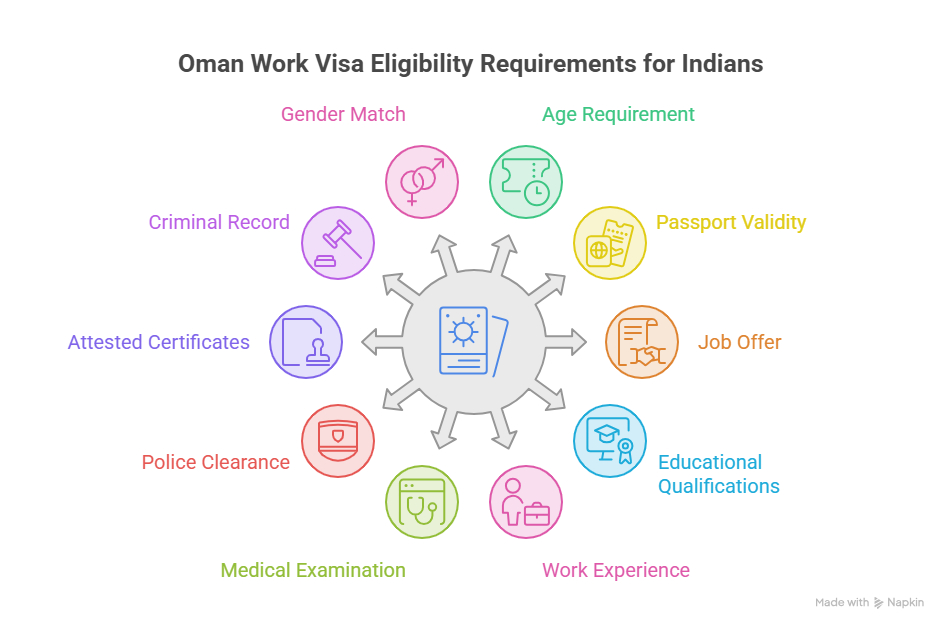
The general eligibility criteria for an Oman work visa are as follows:
- Aged between 21 and 60 years of age
- Valid Indian passport
- Confirmed job offer and signed employment contract from an Oman-registered employer
- Bachelor's degree, vocational diploma, or professional certification relevant to the applied role
- Proof of relevant work experience in the applied field
- A GAMCA-approved medical examination at an authorised centre in India before departure
- Police Clearance Certificate (PCC) from India
- Educational certificates attested by the HRD Ministry India
- Have no record of criminal activity
- The applicant's gender must match the gender stated in the Ministry of Labour
*Interested to apply for an Oman work visa? Sign up with Y-Axis for end-to-end assistance.
Eligibility Requirements by Visa and Permit Type
Oman's work authorisation system involves two stages: the employment visa issued before arrival and the Residence Card (Oman ID) registered after arrival.
The table below outlines the main visa and permit types available to Indian professionals.
| Visa / Permit Type | Who Can Apply | Fee / Validity | Validity | Key Benefit |
|---|---|---|---|---|
| Standard Employment Visa | Foreign nationals aged 21–60 with a confirmed job offer from an Oman-registered employer; labour clearance from Ministry of Labour required for non-government roles | OMR 20 government fee (approx. ₹4,300) — employer-paid; late renewal penalty OMR 50 per month | 2 years; renewable | Most common route; employer initiates and manages the full process |
| Temporary Work Visa | Foreign nationals coming to Oman for specific short-term or project-based work; employer-sponsored | OMR 20 government fee; additional charges may apply for project-based categories | Duration of project; extendable with employer sponsorship | Suitable for contract or fixed-term project professionals |
| GCC Resident Entry | Residents of GCC member states with valid residency and professional qualifications | Exempt from standard work permit fees under GCC bilateral agreements | Up to 1 month extendable | Simplified processing no standard sponsorship requirement |
| Residence Card (Oman ID) | All employment visa holders after arrival must register within 30 days of entry | Included in employer onboarding process employer registers with Royal Oman Police Civil Status Department | Tied to employment visa duration renewed by employer | Legal proof of residency required to open bank accounts, access services, and work legally in Oman |
Also, read...
Oman Job Market Trends and Opportunities
What are the Employer Requirements for Sponsoring Indian Professionals in Oman?
Oman employers sponsoring a work visa must hold a valid commercial registration, a valid membership card from the Oman Chamber of Commerce and Industry (OCCI), and a copy of the authorised signatories' specimen signature sheet issued by the Ministry of Commerce and Industry. Without these documents, the labour clearance application cannot be submitted.
Under Ministerial Decision 411/2025, all foreign-investor businesses in Oman must register at least one Omani national within one year of establishment. For non-government employers, a labour permit from the Ministry of Labour is required to hire foreign workers. The Omani employer needs to cover for all visa-related fees during the process.
Also, read...
Oman Opens Doors to More Indian Talent Under New Trade Agreement
Omanization Quota Compliance
Oman's Omanization policy requires private sector employers to maintain sector-specific minimum percentages of Omani nationals in their workforce. Non-compliance directly affects an employer's ability to obtain new or renewed expatriate work permits.
- Omanization targets vary by sector: banking and finance require a minimum of 60% Omani nationals; retail requires at least 20%
- Under Ministerial Decision 602/2025 (effective January 2026), employers are classified into Green, Yellow, or Red categories based on Omanization performance. Green-category employers (meeting or exceeding their quota) receive a 30% discount on work permit fees. Yellow and Red-category employers pay a 100% surcharge, doubling the standard permit fee on every expatriate hire
- Companies failing to meet Omanization targets face restrictions on government contracts, with a compliance deadline of May 31, 2026 for government contract eligibility
- Oman Vision 2040 targets 50%+ overall Omanization by 2030, with an annual target of approximately 60,000 new Omani private-sector jobs per year under the 11th Five-Year Development Plan 2026–2030
Also, read...
In-demand Job Opportunities in Oman
Wage Protection and Salary Standards
Oman operates a Wage Protection System (WPS) that mandates electronic wage payment via bank transfer for all employees. Employers who fail to pay salaries on time face fines and restrictions on future work permit applications.
- Minimum wage for Omani nationals: OMR 325 per month (OMR 225 basic + OMR 100 allowances), set by Royal Decree and effective since 2023 — from January 2026, a mandatory annual performance-based increment of 2%–5% applies for Omani employees
- There is no statutory minimum wage for expatriate workers in Oman as salaries are determined by employment contract, market standards, and mutual agreement
- Average salary benchmarks for expatriates: technical and skilled roles OMR 300–OMR 600/month; engineering, medical, and IT specialists OMR 800–OMR 2,500+ per month; average gross monthly salary across all sectors approximately OMR 850–OMR 900 (early 2026)
- Employers are legally required to provide basic health insurance for all employees
- Standard working hours: 45 hours per week (9 hours per day)
Job Mobility and the 30-Day Contract Registration Rule
Oman's labour law provides mechanisms for workers to transfer employers under specific conditions. Under 2026 regulations, if an employer fails to register a renewed employment contract within the Ministry of Labour's digital system within 30 days of work permit renewal, the employee has the legal right to transfer to a new employer without the current employer's consent.
- Standard job transfer: worker must serve notice period as per the employment contract and submit a transfer request through the Ministry of Labour
- 30-day contract registration rule (2026): employer non-compliance with contract registration within 30 days of permit renewal gives the employee a legal right to transfer without consent
- Late renewal penalty: OMR 50 per month for each month of delayed work permit renewal — paid by the employer
- Oman no longer operates the same complete NOC (No-Objection Certificate) restriction as pre-2020 Gulf labour systems; contract terms and the 30-day rule govern mobility
Watch To Know More: New Oman Cultural Visa Explained in 30 Seconds!
Get a quick overview of the new Oman Cultural Visa, including its purpose, eligibility, and key highlights—in just 30 seconds.
What Sector-Specific Requirements Apply for Oman Work Visas?
Certain professions in Oman require additional regulatory approvals before a work visa can be issued. Critically, as of January 2026, Oman has expanded its list of Omanization-restricted job categories, meaning new expatriate work permits for these roles may not be issued. The table below outlines sector-specific requirements for Indian professionals.
|
Sector |
Additional Requirements |
|
Healthcare and Medical |
Doctors, nurses, and allied health professionals must obtain a licence from Oman's Ministry of Health (MoH) and register with the Oman Medical Speciality Board (OMSB) or the relevant health authority before practising. Indian medical credentials require primary source verification through the Medical Council of India. Foreign-trained healthcare professionals must pass the Oman Prometric examination for licensing in most clinical roles. |
|
Engineering and Construction |
Engineers must register with the Engineering Council of the Oman Authority for Partnership for Development or the relevant engineering authority for regulated project roles. Civil, structural, and electrical engineers working on Oman government or infrastructure contracts require local professional accreditation. Note: As of January 2026, certain technical roles including systems analysts, computer engineers, and electronic engineers are on the Omanization restricted list and may not be available to new expatriate applicants. |
|
Education and Teaching |
Teachers in Oman's public schools must meet the qualification standards of the Ministry of Education. Degrees must be attested by the HRD Ministry India, MEA India, and the Omani Embassy in India. Private school and university teachers require accreditation from the relevant educational licensing authority. Arabic language proficiency may be required for certain teaching roles in public institutions. |
|
Finance and Accounting |
Finance and banking roles are subject to some of the highest Omanization sector quotas — a minimum of 60% Omani nationals is required in banking and finance companies. Expatriate accountants, auditors, and financial analysts working with licensed entities must comply with regulations set by the Capital Market Authority (CMA) and Central Bank of Oman (CBO). ACCA, CFA, and CA qualifications are recognised; public practice roles require local authority approval. |
|
Oil, Gas and Energy |
Oman's oil and gas sector, led by Petroleum Development Oman (PDO) and OQ (formerly Oman Oil Company), maintains modified hiring and permit requirements. Positions within PDO and OQ operations typically require pre-approval through the company's HR system before the Ministry of Labour labour clearance is issued. Sector Omanization targets apply; expatriate engineers and technicians should verify current job-category restrictions before applying. |
|
Information Technology |
As of January 1, 2026, Oman placed Computer Programmers, Computer Engineers, Systems Analysts, and related roles on the Omanization restricted list. New work permits for these job titles may be declined or face additional scrutiny. Indian IT professionals should confirm with prospective Omani employers whether their specific job code is currently open to expatriate applications before proceeding with the visa process. |
Also, read...
What Are the Most In-Demand Jobs in Oman for the Next 10 Years?
How to Apply for an Oman Work Visa from India?
The Oman work visa process is fully employer-led. The employer secures the labour clearance and employment visa before the employee arrives, then completes the Residence Card registration post-arrival through the Royal Oman Police Civil Status Department.
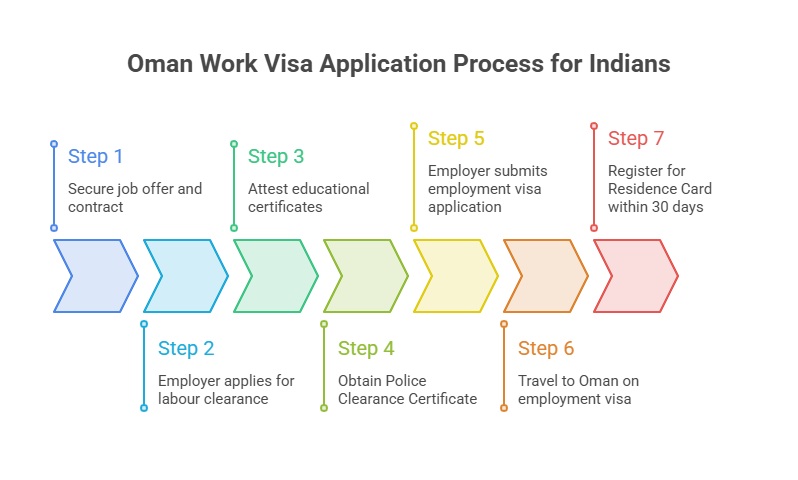
The steps to apply for an Oman work visa for Indians are as follows:
Step 1: Secure a confirmed job offer and signed employment contract from an Oman-registered employer.
Step 2: Your employer applies for labour clearance (work permit) from the Ministry of Labour through the online portal, submitting the commercial registration, OCCI membership card, and authorised signatory documents.
Step 3: Attest your educational certificates by the HRD Ministry India.
Step 4: Obtain your Police Clearance Certificate (PCC) from India.
Step 5: Your employer submits the employment visa application to the Royal Oman Police Immigration Department via the single-window online portal, including the labour clearance approval and all required documents.
Step 6: Travel to Oman on the employment visa upon approval.
Step 7: Within 30 days of arrival in Oman, your employer registers you with the Civil Status Department of the Royal Oman Police to obtain your Residence Card (Oman ID).
Are you looking for step-by-step assistance with overseas immigration? Contact Y-Axis, the world's No. 1 overseas immigration consultancy!
FAQs
What is the Oman work visa for Indians?
The Oman work visa is an employer-sponsored employment visa that allows Indian nationals to live and work legally in Oman. The process is managed by the Ministry of Labour and the Royal Oman Police Immigration Department. Oman is home to over 700,000 Indian expatriates, making Indians the largest foreign community in the Sultanate. Strong bilateral ties between India and Oman make the document attestation and visa process relatively well-established for Indian applicants. Employers cover all government fees under Omani labour law.
Can Indian nationals apply for an Oman work visa?
Yes. Indian nationals are among the most welcome foreign workers in Oman, with over 700,000 Indians currently residing in the Sultanate. The process is employer-initiated — your Omani employer applies for the labour clearance and employment visa through the Ministry of Labour and Royal Oman Police portals. Educational certificates from India must be attested by the HRD Ministry, MEA India, and the Omani Embassy in New Delhi or Mumbai. Processing typically takes 15–25 working days from document submission.
What are the age requirements for an Oman work visa?
The standard age requirement for an Oman work visa is between 21 and 60 years. This applies to most private-sector employment categories under Omani Labour Law.
- Applicants above 60 years require special dispensation from the Ministry of Labour.
- Applicants below 21 years cannot be sponsored for standard private-sector employment visas.
- The applicant's age must align with the employer's labour clearance and workforce planning documents.
- Y-Axis can verify your eligibility before you apply.
What documents are required for an Oman work visa from India?
Documents required for an Oman work visa include:
- A valid Indian passport with at least 6 months' remaining validity
- Signed and registered employment contract
- Educational certificates attested by the HRD Ministry India, MEA India, and the Omani Embassy
- Police Clearance Certificate attested by MEA India
- GAMCA medical fitness certificate from an approved Indian centre
- Recent passport-sized photographs
- Employer's commercial registration, OCCI membership card, and Ministry of Commerce authorised signatory documents
The job title in all documents must match the Ministry of Labour labour permit category exactly.
How long does the Oman work visa process take?
The Oman work visa process typically takes 3–6 weeks from the date of the confirmed job offer to visa stamping, depending on document completeness, the Ministry of Labour labour clearance timeline, and current processing volumes at the Royal Oman Police Immigration Department. Educational certificate attestation—which must go through the HRD Ministry India, MEA India, and the Omani Embassy—should be started at least 4–6 weeks in advance. After arrival in Oman, your employer must complete your Residence Card registration within 30 days.
What is the Oman work visa fee for Indian applicants?
The government fee for an Oman employment visa is OMR 20 (approximately ₹4,300 or USD 52) for a 2-year visa, applicable to all nationalities including Indians. Employers are legally required to pay this fee—any employment contract that passes this cost to the employee breaches Omani labour law.
- Government visa fee: OMR 20
- Late renewal penalty: OMR 50 per month
- Green Omanization employers receive a 30% fee discount
- Non-compliant employers pay a 100% surcharge
Can I change jobs on an Oman work visa?
Yes. Oman's labour law allows employees to transfer employers under specific conditions.
- If an employer fails to register a renewed employment contract within 30 days of work permit renewal, the employee may transfer without the employer's consent.
- Standard transfers require serving the contractual notice period.
- A transfer request must be submitted through the Ministry of Labour.
- A late renewal penalty of OMR 50 per month applies to the employer for delayed renewals.
- Y-Axis can advise on your specific transfer situation.
Which job categories are restricted for expatriates in Oman?
As of January 1, 2026, Oman expanded its Omanization-restricted job list under the Ministry of Labour's phased nationalization policy. Roles restricted for new expatriate work permits include:
- Computer Programmers and Computer Engineers
- Electronic Engineers and Systems Analysts
- Operations Analysts and Web Designers
- Hotel Reception Managers
- Travel Agents
- Marketing Specialists
- Quality Control Managers
- Quality Supervisors
Indian professionals in these fields should verify with their prospective Omani employer whether the specific job code is currently open to expatriate applications before initiating the visa process.
Can an Oman work visa lead to permanent residency?
Oman does not offer a conventional permanent residency pathway equivalent to an Indian PR or green card system. Long-term legal residence is maintained by consecutively renewing the employer-sponsored work visa and Residence Card. Oman has introduced a Long-Term Residency scheme for investors, retirees, and professionals under specific criteria, but this is not a standard pathway available to most Indian workers. Most Indian professionals maintain their residency through continuous employment and visa renewal. Y-Axis can provide current information on available long-term residency options.
How does Oman Vision 2040 create job opportunities for Indian professionals?
Oman Vision 2040 is the Sultanate's long-term economic diversification framework targeting growth in tourism, logistics, manufacturing, renewable energy, healthcare, and financial services. It drives sustained government investment in infrastructure, smart cities, and the Duqm and Sohar free zones, creating demand for skilled foreign professionals, including Indians.
Oman's 11th Five-Year Development Plan (2026–2030) targets approximately 60,000 new private-sector jobs annually, with 50,000 positions reserved for Omani nationals, creating parallel demand for skilled expatriates in specialised roles not covered by Omanization quotas.
Tags:
Work in Oman
Oman work visa
migrate to Oman
Oman immigration
eligibility requirements for Oman work visa
Oman work permit for Indians
Oman Residence Card
Oman work visa from India
Omanization
Oman Vision 2040
Share
Options for you by Y-Axis

Get it on your mobile

Get News alerts

Contact Y-Axis
Latest Article
Popular Post
Trending Article
Posted On October 01 2026
The Borderless Indian