


Don't know what to do ?
Get Free Counseling
Last Updated 09 September 2026
Oman Job Market: Trends and Opportunities
- Expatriate workers make up approximately 68% of Oman's overall employed labour force and 86% of private sector jobs, reflecting deep structural reliance on international talent, particularly in technical, construction, and services roles.
- The country has a stable economy supported by oil & gas, logistics, construction, mining, tourism, IT, and healthcare.
- As of early 2026, Oman's total workforce stands at approximately 2.69 million workers — around 893,000 Omani nationals and 1.79 million expatriates. The unemployment rate for skilled workers remains low, and Indians represent the second-largest expatriate group with over 512,000 professionals in the country.
- Thousands of work visas are issued every year for international professionals.
- The government is creating new jobs in IT, renewable energy, finance, education, healthcare, and engineering under Oman Vision 2040.
- Oman's new Labour Law (Royal Decree 53/2023), effective July 2023, introduced remote work arrangements, strengthened worker protections for expatriates, and from 2026 extends social insurance benefits including maternity, paternity, and employment injury cover to foreign workers — making Oman a more rights-protective destination for Indian professionals.
Want to work in Oman? Let Y-Axis guide you with the process.
Job Outlook in Oman
Oman's job market is steadily growing. The economy is projected to grow at 2.4–3.4% in 2025, accelerating to as high as 3.7% in 2026 as OPEC+ production caps ease and non-oil momentum builds. Non-oil GDP now accounts for over 76% of the economy, supported by digital transformation, new infrastructure, and active diversification away from oil. The country offers tax-free salaries, a high standard of living, safe cities, and strong employment benefits. With major investments in healthcare, technology, tourism, logistics, and manufacturing, Oman continues to attract skilled workers from India and other countries.
There is increasing job demand in IT, engineering, construction, healthcare, education, banking, hospitality, oil & gas, and logistics. Digital initiatives, port expansion, tourism growth, and large development projects are opening new career opportunities. Most jobs are concentrated in Muscat, Sohar, Duqm, and Salalah. Oman's Eleventh Five-Year Development Plan (2026–2030) targets 300,000 new jobs across public and private sectors, at a rate of 60,000 opportunities per year, backed by investments of OMR 15.6 billion.
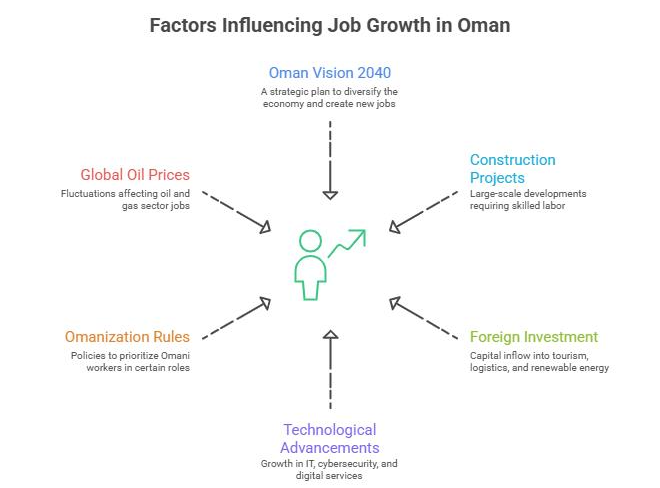
Factors Influencing Job Growth or Reduction in Oman
- Oman Vision 2040 is helping the country create new jobs in areas other than oil.
- Big construction and industrial projects are increasing the need for engineers, technicians, and skilled workers.
- Foreign companies investing in tourism, logistics, and renewable energy are creating more job opportunities.
- As Oman uses more technology, new jobs are opening in IT, cybersecurity, and digital services.
- Omanization rules may reduce some basic or office jobs for foreign workers.
- Highly skilled and technical professionals are still in strong demand.
- Changes in global oil prices can affect hiring in oil, gas, and energy jobs.
- Oman's Eleventh Five-Year Development Plan (2026–2030) targets 4% annual GDP growth and prioritises digital economy expansion (10.8% targeted growth), tourism (5.7%), and transport and logistics (7%) as the highest-growth employment sectors.
- New Labour Law reforms from 2026 extend social insurance and maternity/paternity benefits to expatriate workers, improving conditions and attracting more qualified international professionals.
Also, read..
In-demand Job Opportunities in Oman
Job Vacancy in Oman
Oman is seeing steady growth in job opportunities due to economic diversification and long-term development plans. Industries such as construction, oil and gas, healthcare, engineering, IT, logistics, education, and tourism continue to hire skilled professionals from both local and international markets. Under Oman Vision 2040, the government is investing heavily in major projects across sectors. MIGA of the World Bank Group has secured USD 1.2 billion in commercial financing for infrastructure works at the Duqm Special Economic Zone alone. Key projects include Duqm SEZ, Sohar Port expansion, Salalah Port upgrades, green hydrogen developments, renewable energy projects, and national tourism infrastructure — all generating sustained demand for skilled workers. Economic modelling for the 2026–2030 plan suggests around 700,000 total job opportunities could be created during this period. These initiatives are increasing demand for engineers, healthcare workers, IT professionals, and skilled workers across sectors.
The table below highlights high-demand sectors in Oman and verified growth targets under the Eleventh Five-Year Development Plan (2026–2030).
| Sector | Demand Level | Eleventh Plan Growth Target (2026–2030) |
|---|---|---|
| Digital Economy & IT | Very High | 10.8% targeted annual growth (highest among all sectors) |
| Transport & Logistics | Very High | 7.0% targeted annual growth |
| Tourism & Hospitality | High | 5.7% targeted annual growth |
| Manufacturing & Industry | High | 5.9% targeted annual growth |
| Healthcare | High | 3.5% targeted annual growth, supported by population-driven demand |
| Education | Moderate–High | 3.0% targeted annual growth |
| Agriculture & Fisheries | Moderate | 4.2% targeted annual growth |
| Engineering & Construction | High | Ongoing demand from Duqm, Sohar, Salalah, and infrastructure projects |
| Oil & Gas & Energy | High | Growth driven by exploration, refinery, and green hydrogen projects |
| Accounting & Finance | Moderate–High | Demand supported by private sector growth and banking expansion |
Planning to work abroad? Y-Axis will guide you step-by-step.
In-Demand Jobs in Oman
Below are some of the most in-demand occupations in Oman along with their average monthly salaries in Omani Rial (OMR).
| Occupation | Average Monthly Salary (OMR) | Notes |
|---|---|---|
| IT & Software | 1,000 – 1,800 | Network engineers and IT managers can earn OMR 2,500–4,000/month at senior levels. |
| Engineering | 1,200 – 2,200 | Senior oil & gas engineers can earn OMR 3,500–4,500+ per month. |
| Accounting & Finance | 900 – 1,600 | Financial analysts in the banking sector may earn OMR 1,500–3,000/month. |
| Healthcare (Doctors) | 1,500 – 3,500 | General practitioners earn around OMR 2,500/month, while specialists can earn up to OMR 5,000/month. |
| Human Resources | 900 – 1,400 | Salaries vary based on experience and industry. |
| Manufacturing & Industry | 700 – 1,200 | Demand supported by industrial and infrastructure growth. |
| Sales & Marketing | 900 – 1,600 | Commission structures are common, increasing total earnings potential. |
| Data Science / Analytics | 1,200 – 2,000 | AI, machine learning, and cloud computing skills can attract a 10–25% salary premium. |
| Teaching & Education | 700 – 1,100 | International school positions may include housing and additional benefits. |
Impact of Oman’s Oil & Gas Sector on Workforce Demand
Oman’s oil & gas industry plays a major role in employment generation. The country invests heavily in exploration, drilling, refining, petrochemical plants, and pipeline operations, creating continuous demand for skilled professionals. Engineers, technicians, safety officers, quality control staff, and project managers are always needed to support these activities.
The sector also creates thousands of indirect jobs. Companies in construction, logistics, IT support, finance, transportation, and equipment supply depend heavily on the oil industry. New refinery projects in Duqm, pipeline expansions, and renewable energy initiatives are opening more job opportunities.
Because oil remains Oman’s major revenue source, the energy sector is one of the most secure, stable, and high-paying fields, offering long-term career growth for expatriates.
Oman's Emerging Green Hydrogen Sector
Oman is actively developing green hydrogen as a strategic energy export. The country's green hydrogen project pipeline has grown to over USD 30 billion, with two new major deals signed in 2025. These projects are creating new demand for renewable energy engineers, electrochemical process engineers, project managers, and environmental and sustainability specialists — roles that sit alongside traditional oil and gas positions and represent the future growth direction of Oman's energy workforce.
Looking for jobs in Oman? Talk to Y-Axis for expert guidance.
Skills In-Demand in Oman
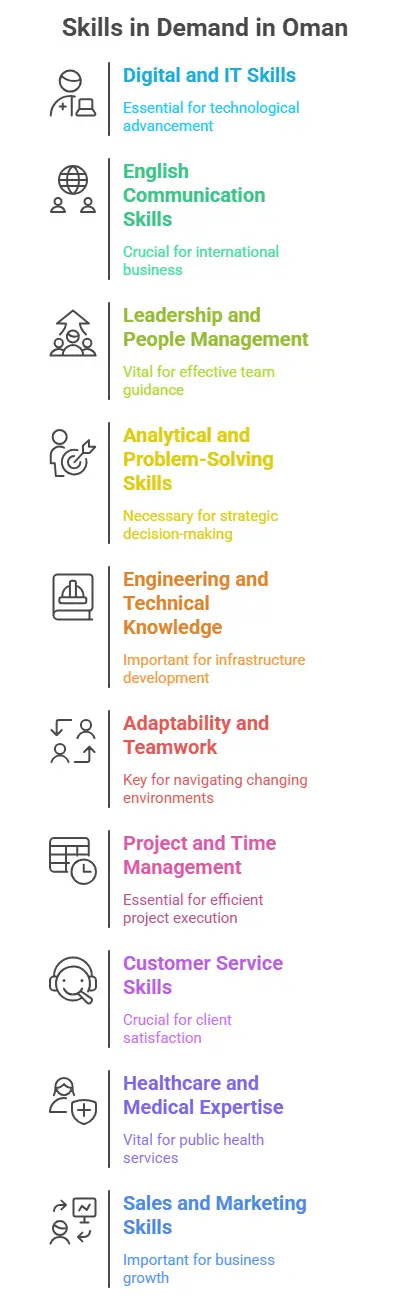
Oman’s modernization has increased the need for skilled workers who can support new technologies, high-quality services, and industrial development. Employers prefer professionals with strong technical and communication abilities.
Top in-demand skills include:
- Digital and IT skills
- English communication skills
- Leadership and people management
- Analytical and problem-solving skills
- Engineering and technical knowledge
- Adaptability and teamwork
- Project and time management
- Customer service skills
- Healthcare and medical expertise
- Sales and marketing skills
Workers with global certifications and relevant experience have better job opportunities.
Tips to Find the Right Job Opportunities in Oman
- Build a strong, professional Oman/Gulf-style resume
- Improve English fluency and basic Arabic communication
- Gain job-related certifications to stand out
- Research employers and industry requirements
- Network with professionals and recruiters on LinkedIn
- Keep an updated LinkedIn profile
- Apply early and prepare well for video interviews
Oman Work Visa for Indians
Indian professionals are the second-largest expatriate group in Oman, with over 512,000 Indians working across IT, healthcare, construction, engineering, oil and gas, education, and retail. Oman uses an employer-sponsored work visa (Iqama) system.
Key facts Indian applicants should know:
- The employer applies for the work visa on behalf of the candidate through the Ministry of Labour and the Royal Oman Police.
- Work visas are typically linked to specific employers — professionals cannot freely switch employers without completing formal procedures.
- Oman's new Labour Law (Royal Decree 53/2023) makes it easier to transfer employment, introduces anti-discrimination provisions, and recognises remote work arrangements.
- From 2026, social insurance benefits including employment injury cover, maternity leave, and paternity leave are being extended to expatriate workers under the new law.
- There is no personal income tax in Oman, so gross salary equals take-home pay.
- Dependent residency is available for spouses and children provided the primary applicant meets the income requirements.
- The minimum wage in Oman is OMR 325/month for Omani nationals. There is no statutory minimum wage for expatriates — salaries are market-determined by contract.
To apply for an Oman work visa, your employer submits the application to the Ministry of Labour and Royal Oman Police on your behalf. Once approved, you travel to Oman, complete a medical fitness test and biometric registration, and collect your Iqama (residence card) through your employer. For full documentation requirements and processing timelines, visit our Oman Work Visa or speak to a Y-Axis counselor directly.
Oman Residency Options for Professionals
Oman offers several residency options for expatriates who want to work and live in the country:
- Work Visa Residency (Iqama): The most common pathway where the employer sponsors the professional’s work permit, residency, and renewals.
- Dependent Residency: Skilled professionals who meet the income requirement can sponsor their spouse and children.
- Longer Validity Residency: Highly skilled professionals in IT, engineering, healthcare, and energy may receive residency with longer validity depending on employer needs.
- Project-Based Residency: Workers employed in government or private mega projects receive project-linked residency, which can later be extended or transferred. Residency in Oman is stable and allows professionals to build long-term careers.
- Long-Term Investor and Professional Residency: Oman has introduced longer-validity residence permits for investors and qualifying senior professionals under Vision 2040 reforms, with certain categories receiving multi-year residency options outside the standard employer-renewal cycle.
Summary of Oman Job Outlook
Oman provides excellent job opportunities across oil and gas, IT, engineering, healthcare, finance, education, construction, logistics, and tourism. With GDP growth projected at 3.7% in 2026 and non-oil GDP exceeding 76% of the economy, Oman's diversification is delivering real results. Tax-free salaries, safe living conditions, and high demand for skilled workers make Oman one of the most stable Gulf destinations for Indian professionals. The Eleventh Five-Year Plan (2026–2030) is expected to create 300,000 jobs, backed by OMR 15.6 billion in new investment, ensuring strong hiring momentum through the end of the decade.
Note: From January 2026, Oman's Ministerial Decision No. 317/2025 mandates annual performance-based salary increments of 2–5% for Omani nationals in the private sector. This applies to Omani employees only — expatriate workers including Indian professionals are not covered by this mandate, though individual employers may apply similar policies voluntarily.
Looking to work in Oman? Connect with Y-Axis, the world’s number one immigration consultancy, for expert guidance on job search, visas, and resume building.
Y-Axis snapshot
1M
Successful applicants
1500+
Experienced counselors
25Y+
Expertise
50+
Offices
Don't know what to do ?
Get Free Counseling
Looking for Inspiration
Explore what Global Indians have to say about Y-Axis in shaping their future