

Posted on July 23 2026
What are the eligibility requirements for a USA Work Visa?

By , Editor
Updated July 26 2026
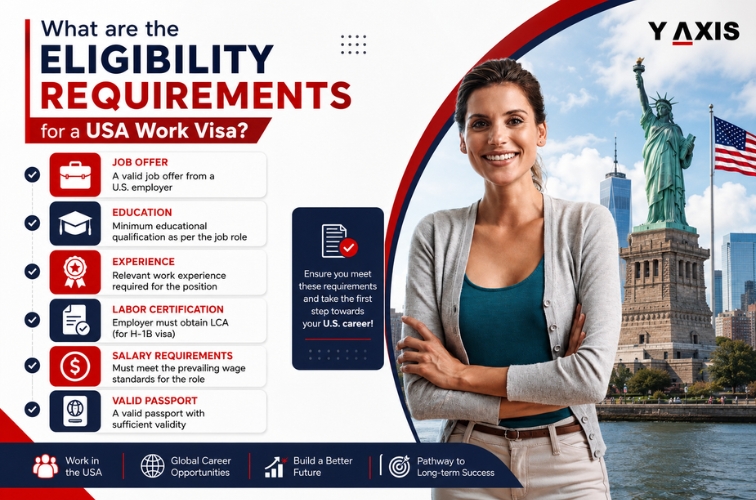
The eligibility requirements for a USA work visa depend on the visa category, but for the H-1B visa (the most common US work visa for skilled Indian professionals), you need a job offer from a US employer in a specialty occupation, a bachelor's degree or higher in a related field, and an approved Labor Condition Application (LCA) certifying fair wages. The employer must file a petition (Form I-129) with USCIS, and the visa is subject to an annual cap of 65,000, plus 20,000 for US master's degree holders.
*Want to apply for a USA work visa? Let Y-Axis guide you with the steps.
USA Work Visa Requirements
The United States does not have a single "work visa" — it offers 11 temporary worker visa categories under US law, based on the nature of the job and the applicant's qualifications. The H-1B (specialty occupation) is the most common route for Indian professionals in IT, engineering, finance, and similar fields. Other categories include the L-1 (intracompany transferee), O-1 (extraordinary ability), and H-2A/H-2B (temporary agricultural/non-agricultural work).
The complete list of H-1B work visa requirements is as follows:
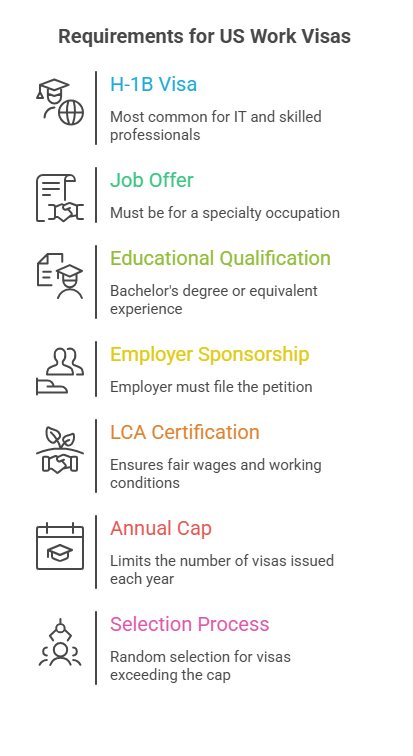
- Job offer: A valid job offer from a US employer for a role that qualifies as a "specialty occupation" requiring theoretical and practical application of specialized knowledge.
- Educational qualification: At least a US bachelor's degree or its foreign equivalent in a field directly related to the job. Relevant work experience can substitute for a degree, generally at three years of experience for each year of missing education.
- Employer sponsorship: The visa is employer-sponsored; you cannot self-petition. Your employer must file Form I-129 (Petition for a Nonimmigrant Worker) with USCIS.
- Labor Condition Application (LCA): The employer must first obtain a certified LCA from the US Department of Labor, confirming that you will be paid the higher of the actual wage paid to similar employees or the prevailing wage for the occupation in that geographic area.
- Annual cap: H-1B visas are capped at 65,000 per fiscal year, with an additional 20,000 reserved for applicants holding a master's degree or higher from a US institution.
- Selection process: Registrations exceeding the cap go through a USCIS selection process. A new weighted selection system (effective for the FY 2027 cap season, from 27 February 2026) gives higher-wage, higher-skilled beneficiaries a greater chance of selection.
Other common US work visa categories
|
Visa |
Who it's for |
Key requirement |
|
H-1B |
Specialty occupation professionals |
Bachelor's degree + job offer + LCA |
|
L-1 |
Intracompany transferees (managers, executives, specialized knowledge staff) |
1 year of employment abroad with the same employer group in the last 3 years |
|
O-1 |
Individuals with extraordinary ability in sciences, arts, education, business, or athletics |
Evidence of sustained national/international acclaim |
|
H-2A |
Temporary agricultural workers |
Citizens of designated countries; employer-sponsored |
|
H-2B |
Temporary non-agricultural workers |
Citizens of designated countries; employer-sponsored |
*Want to work in the USA? Sign up with Y-Axis to guide you with the process.
Documents required for a US work visa
The documents typically required for an H-1B visa interview are as follows:
- Passport valid for at least six months beyond your intended stay
- Nonimmigrant Visa Application confirmation page (Form DS-160)
- Visa application fee payment receipt
- Passport-style photograph (uploaded with DS-160)
- Petition Receipt Number from the approved Form I-129 or Notice of Action (Form I-797)
- Educational certificates and evidence of work experience related to the specialty occupation
US work visa validity and family
An H-1B visa is initially valid for up to three years and can be extended for a total of up to six years. Your spouse and unmarried children under 21 may apply for H-4 dependent status to accompany you; you must be able to show you can financially support them in the US.
*Are you looking for step-by-step assistance with overseas immigration? Contact Y-Axis, the world's No. 1 overseas immigration consultancy, for end-to-end assistance!
FAQs
What are the eligibility criteria for a USA work visa from India?
For the H-1B, the most common US work visa for Indian professionals, eligibility criteria include a job offer from a US employer in a specialty occupation, at least a bachelor's degree (or equivalent experience) in a related field, employer sponsorship through Form I-129, and a certified Labor Condition Application confirming fair wages.
Is there a minimum salary or bank balance requirement for a US work visa?
There is no minimum personal bank balance requirement for the H-1B visa. However, your employer must pay you at least the prevailing wage or the actual wage paid to similarly qualified employees in that role and location, whichever is higher, as certified in the Labor Condition Application.
What documents are required to apply for a USA work visa from India?
You typically need the following documents:
- Valid passport
- DS-160 confirmation page
- Visa fee payment receipt
- Recent passport-sized photograph
- Approved Form I-129/I-797 petition receipt number
- Educational certificates and transcripts
- Relevant work experience documents
What is the H-1B visa annual quota?
The H-1B has an annual cap of 65,000 new visas, plus an additional 20,000 visas for applicants with a master's degree or higher from a US institution. Certain employers, including universities and non-profit research organisations, are exempt from the cap.
How long is an H-1B visa valid?
An H-1B visa is initially granted for up to 3 years and can generally be extended for a maximum total stay of 6 years.
Can my family accompany me to the USA on a work visa?
Yes. Your spouse and unmarried children under the age of 21 can apply for H-4 dependent visas to accompany or join you in the United States. You must demonstrate that you have sufficient financial resources to support your dependents during your stay.
What is the USD 100,000 H-1B fee, and does it apply to everyone?
The fee applies to certain new H-1B petitions for beneficiaries who are outside the US and do not already hold a valid H-1B visa, for petitions filed on or after 21 September 2025. It does not apply to H-1B extensions, amendments, or change-of-status applications for individuals already in the US. As the fee is currently subject to ongoing litigation, applicants should verify the latest USCIS guidance before applying.
Can I apply for a US work visa without employer sponsorship?
Most US temporary work visa categories, including the H-1B, require employer sponsorship and do not allow self-petitioning. However, the O-1 visa (for individuals with extraordinary ability) and certain EB-1A and EB-2 National Interest Waiver (NIW) immigrant categories permit self-petitioning, subject to strict eligibility requirements.
What is the difference between an H-1B and an L-1 visa?
| H-1B Visa | L-1 Visa |
|---|---|
| For specialty occupation professionals. | For intra-company transferees. |
| Requires a qualifying degree and a US job offer. | Requires at least one year of employment with the overseas branch of the same employer within the previous three years. |
| Subject to the annual H-1B cap (unless exempt). | No annual visa cap. |
| Suitable for professionals in specialised fields. | Suitable for managers, executives, and employees with specialised knowledge. |
Do I need a labor certification for every US work visa category?
No. The H-1B requires a Labor Condition Application (LCA), not a full labor certification. Certain employment-based immigrant visa categories, such as some EB-2 and EB-3 classifications, require a full PERM labor certification from the US Department of Labor before the employer can file an immigrant petition.
Tags:
USA work visa
USA work visa eligibility
USA work visa requirements
USA work permit
US employment visa
H-1B visa
USA employer-sponsored visa
USA work visa for Indians
USA work visa documents
USA job offer visa
Share
Options for you by Y-Axis

Get it on your mobile

Get News alerts

Contact Y-Axis
Latest Article
Popular Post
Trending Article
Posted On September 28 2026
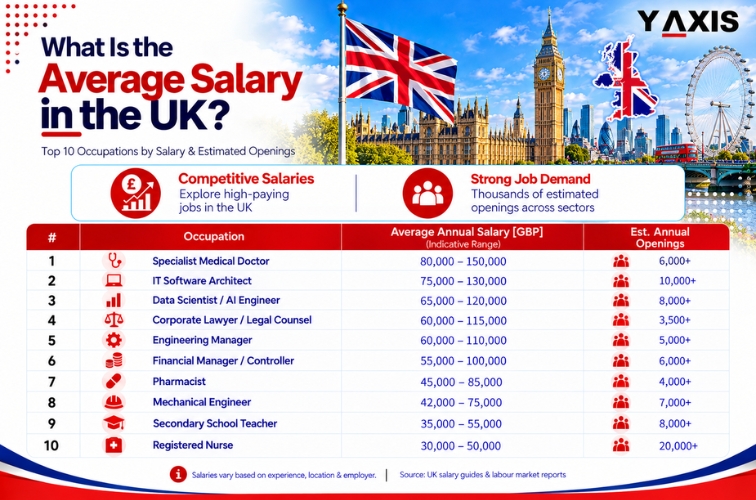
What Is the Average Salary in the UK?