

Posted on October 30 2026
Canada vs. UK for Healthcare Professionals: Which Country Should You Choose?

By , Editor & Director
Updated October 31 2026
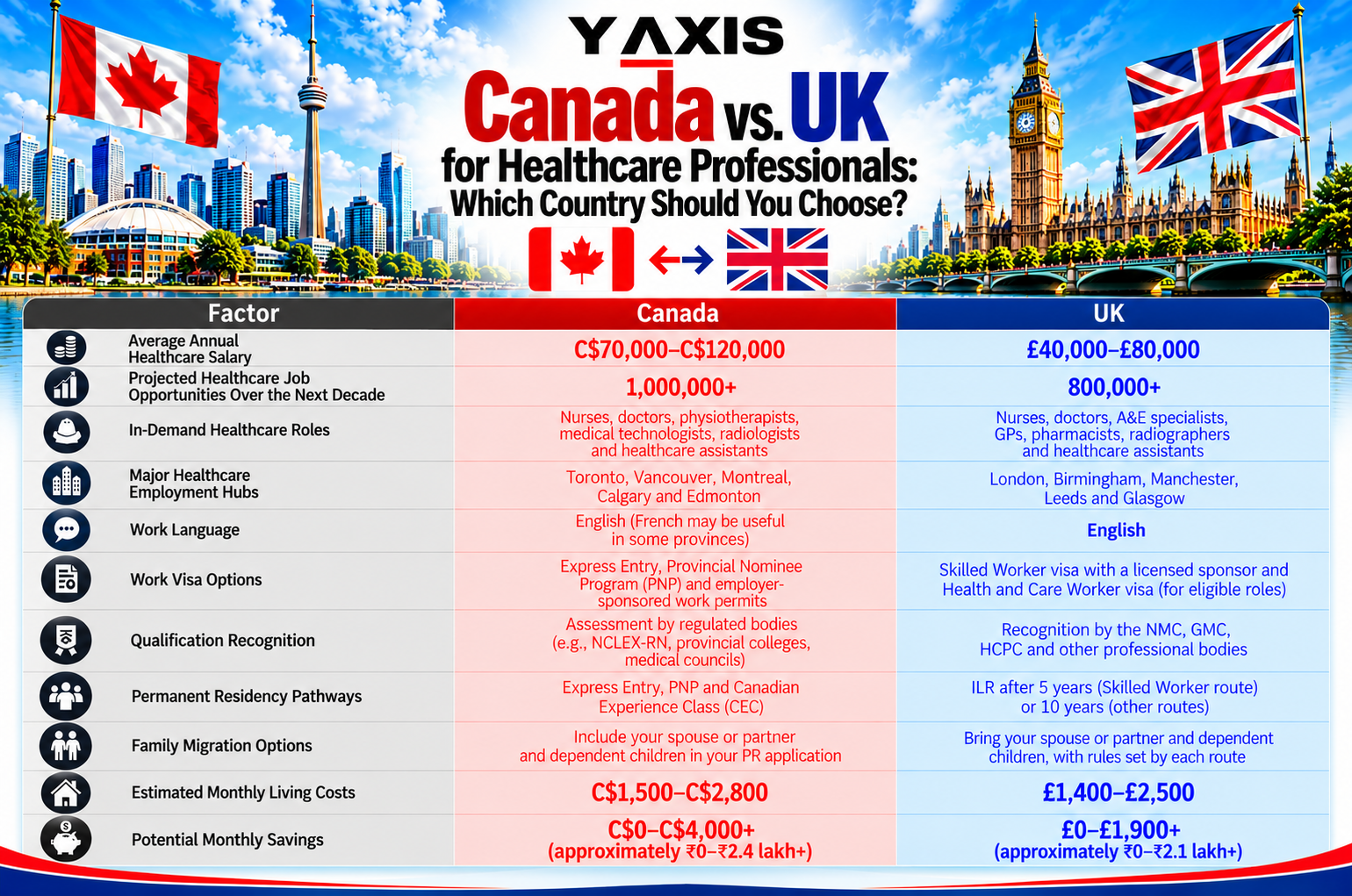
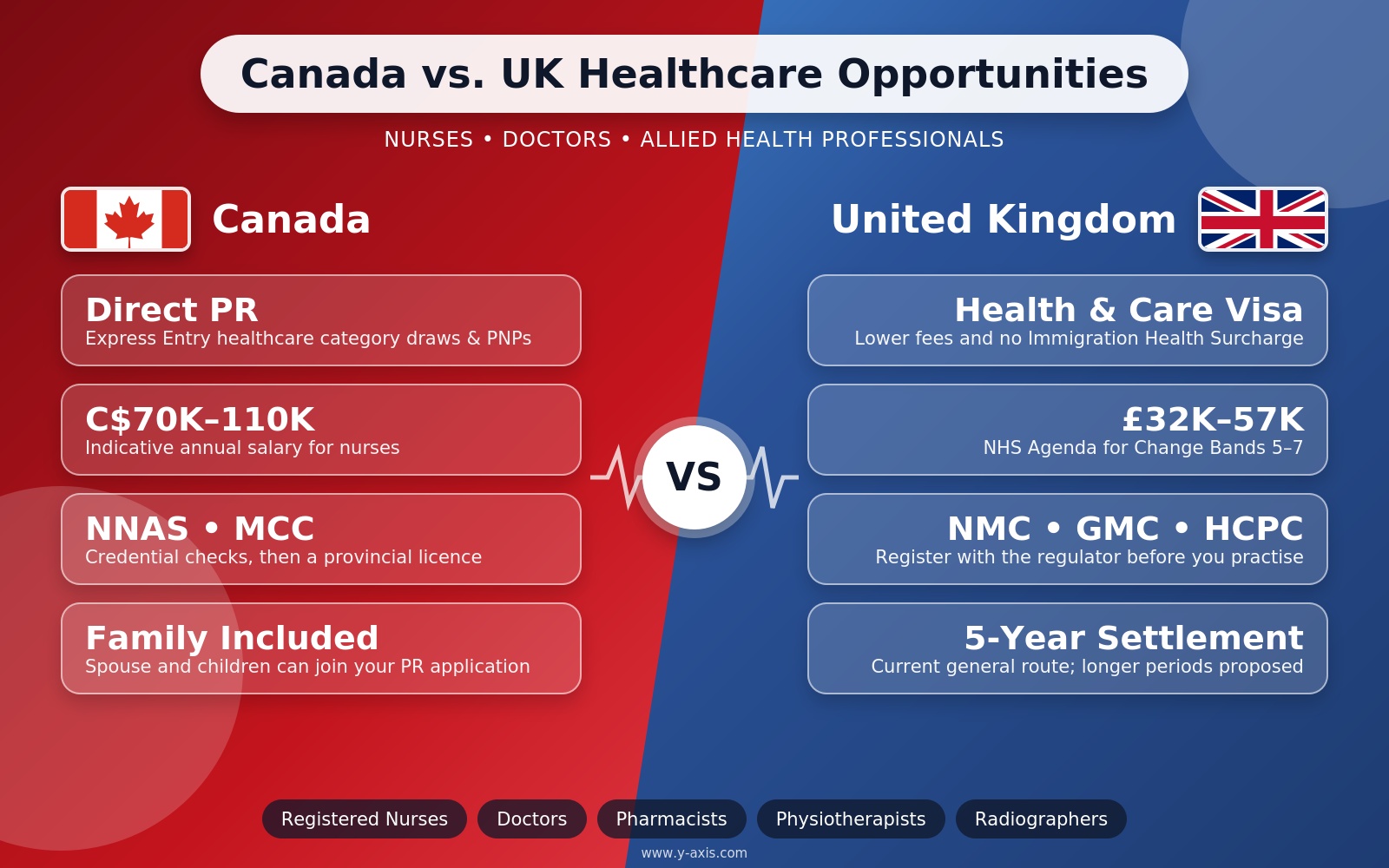
Canada and the United Kingdom both offer strong careers for qualified healthcare professionals. Canada is suitable for healthcare professionals if they want a direct route to permanent residence, as Express Entry runs dedicated draws for healthcare and social services occupations. The UK may suit you if you want faster entry with an employer, as the Health and Care Worker visa offers lower visa fees and no Immigration Health Surcharge. In both countries, you must register with the relevant professional regulator before you can practise as a healthacare personel.
The right destination depends on your profession, qualifications, licensing timeline, salary expectations and long-term plans. Both countries need nurses, doctors, pharmacists, physiotherapists and other allied health professionals in hospitals, clinics and community care. Before choosing a country, compare licensing requirements, visa eligibility, salaries, living costs and the route to permanent residence.
*Want to migrate abroad? Contact Y-Axis for guidance and assistance with your immigration plans.
Canada vs. UK for Healthcare Professionals: Quick Comparison
|
Factor |
Canada |
United Kingdom |
|
Healthcare job demand |
Steady demand for registered nurses, physicians, pharmacists, physiotherapists, medical laboratory technologists and other allied health professionals. |
Steady NHS and private-sector demand for nurses, doctors, midwives, pharmacists, radiographers and allied health professionals. |
|
Major healthcare hubs |
Toronto, Vancouver, Calgary, Edmonton, Ottawa, Montreal, Winnipeg and Halifax. |
London, Manchester, Birmingham, Leeds, Bristol, Glasgow, Edinburgh and Cardiff. |
|
Popular healthcare roles |
Registered Nurses, Nurse Practitioners, Family Physicians, Pharmacists, Physiotherapists and Medical Laboratory Technologists. |
Staff Nurses, Midwives, Resident Doctors, Pharmacists, Physiotherapists and Radiographers. |
|
Skilled migration |
Express Entry, including healthcare and social services category draws, Provincial Nominee Programs (PNPs) and other eligible programmes. |
Health and Care Worker visa, a type of Skilled Worker visa, and other eligible work routes. |
|
Qualification assessment |
Nurses usually start with the National Nursing Assessment Service (NNAS) or their provincial regulator. Doctors start with the Medical Council of Canada. |
Nurses register with the Nursing and Midwifery Council (NMC), doctors with the General Medical Council (GMC) and allied professionals with the HCPC. |
|
Professional licensing |
A licence from the provincial or territorial regulator is required to practise. Many nurses must pass the NCLEX-RN exam. |
Registration is required to practise. Nurses usually pass a computer-based test and an OSCE. Doctors usually pass PLAB 1 and PLAB 2. |
|
Educational requirements |
A recognised degree or diploma in your field is required. Some regulators may require bridging courses or extra training. |
A recognised qualification in your field is required. Regulators check whether it meets UK standards. |
|
English-language requirements |
English or French test results are required for immigration. Regulators set their own language requirements. |
Regulators set their own English test scores. B2-level English is required for new Skilled Worker visa applicants. |
|
Visa sponsorship |
A job offer is not required for Express Entry. Employers may support a work permit if the role and applicant meet the rules. |
A job offer from a licensed sponsor is required. Health and Care Worker visa holders pay lower fees and no Immigration Health Surcharge. |
|
Permanent residence potential |
Eligible applicants can apply for permanent residence directly through Express Entry, PNPs or other programmes. |
Settlement is generally possible after 5 years. The government has proposed longer settlement periods, so check the rules in force. |
|
Family migration |
Eligible family members can be included in a permanent residence application. Spouses of some workers may qualify for open work permits. |
Eligible family members of nurses, doctors and other qualifying professionals can join you as dependants. |
|
Best suited for |
Healthcare professionals seeking a direct path to permanent residence and opportunities across many provinces. |
Healthcare professionals seeking faster employer-led entry, NHS experience and structured career progression. |
*Check your eligibility for Canada through the Y-Axis Canada CRS Score Calculator.
Canada vs. UK: Which Country Offers Better Opportunities for Indian Healthcare Professionals?
Canada may be a suitable option if you:
- Have a recognised nursing, medical, pharmacy or allied health qualification and relevant work experience.
- Are prepared to complete NNAS, Medical Council of Canada or other credential assessments.
- Can meet the licensing requirements of a provincial or territorial regulator, including exams such as the NCLEX-RN where required.
- Have strong English or French language skills for immigration and professional licensing.
- Are eligible for Express Entry, a Provincial Nominee Program (PNP) or another suitable immigration route.
- Have work experience in an occupation covered by Express Entry healthcare category draws.
- Want to apply directly for permanent residence rather than start on a temporary work visa.
- Are open to working in smaller cities and regional communities as well as major urban hospitals.
*Want to migrate to Canada? Contact Y-Axis for guidance on your immigration options.
The UK may be a suitable option if you:
- Hold a recognised nursing, medical, pharmacy or allied health qualification and relevant work experience.
- Can register with the NMC, GMC, HCPC or another relevant UK regulator.
- Can meet the regulator's English requirements, such as IELTS or OET, and the visa's B2 English requirement.
- Have a job offer from an NHS trust or another employer with a sponsor licence.
- Want lower visa costs and an exemption from the Immigration Health Surcharge through the Health and Care Worker visa.
- Want structured career progression through NHS pay bands and training programmes.
- Are interested in working in London or other major UK cities.
- Understand that long-term settlement depends on your visa, qualifying residence and the rules in force when you apply.
*Want to migrate to the UK? Contact Y-Axis for guidance on available immigration pathways.
Canada vs. UK: Salary, Living Costs and Savings for Healthcare Professionals
The following table provides illustrative planning estimates for a registered nurse or allied health professional living alone in a major city.
|
Factor |
Canada |
United Kingdom |
|
Indicative annual gross salary |
C$70,000–C$110,000 (approximately ₹42–₹66 lakh) |
£32,000–£57,000 (approximately ₹35–₹63 lakh) |
|
Indicative monthly gross salary |
C$5,833–C$9,167 (approximately ₹3.5–₹5.5 lakh) |
£2,667–£4,750 (approximately ₹2.9–₹5.2 lakh) |
|
Estimated monthly take-home salary |
C$4,200–C$6,600 (approximately ₹2.5–₹4 lakh) |
£2,150–£3,500 (approximately ₹2.4–₹3.9 lakh) |
|
One-bedroom city-centre rent |
C$1,600–C$2,800/month (approximately ₹96,000–₹1.68 lakh) |
£1,000–£2,000/month (approximately ₹1.1–₹2.2 lakh) |
|
Monthly grocery expenses |
C$300–C$550 (approximately ₹18,000–₹33,000) |
£200–£350 (approximately ₹22,000–₹39,000) |
|
Public transport expenses |
C$100–C$180/month (approximately ₹6,000–₹11,000) |
£80–£200/month (approximately ₹9,000–₹22,000) |
|
Utilities, internet and mobile |
C$180–C$350/month (approximately ₹11,000–₹21,000) |
£150–£300/month (approximately ₹17,000–₹33,000) |
|
Estimated monthly living costs |
C$2,500–C$4,200 (approximately ₹1.5–₹2.5 lakh) |
£1,600–£3,000 (approximately ₹1.8–₹3.3 lakh) |
|
Potential monthly savings |
C$0–C$4,000+ (approximately ₹0–₹2.4 lakh+) |
£0–£1,900+ (approximately ₹0–₹2.1 lakh+) |
|
Potentially lower-cost cities |
Edmonton, Winnipeg, Halifax, Quebec City and some smaller regional centres |
Sheffield, Liverpool, Newcastle, Glasgow and some smaller regional centres |
|
Major expensive cities |
Toronto and Vancouver |
London and some high-cost areas in the South East |
Note: UK figures reflect NHS Agenda for Change Bands 5 to 7 in England. Doctors earn considerably more in both countries, depending on specialty, grade and province or NHS contract. Shift, weekend and overtime pay can raise earnings further.
*Looking for assistance with overseas immigration? Contact Y-Axis, the world's number one immigration consultancy, for guidance on immigration options and visa requirements.
FAQs
Is Canada or the UK better for healthcare professionals?
It depends on your goals. Canada suits professionals who want a direct route to permanent residence, as Express Entry holds dedicated healthcare category draws. The UK suits those who want faster employer-led entry through the Health and Care Worker visa. Both countries require you to register with a professional regulator before you can practise.
Do I need a job offer to move to Canada as a nurse?
No. You do not need a job offer to apply through Express Entry. However, a job offer can help, and some Provincial Nominee Programs prioritise healthcare workers with offers. You still need a licence from a provincial or territorial regulator before you can work as a nurse in Canada.
What is the UK Health and Care Worker visa?
The Health and Care Worker visa is a type of Skilled Worker visa for eligible doctors, nurses and other health professionals. It needs a job offer from a licensed sponsor. Holders pay lower visa fees than standard Skilled Worker applicants and are exempt from the Immigration Health Surcharge.
How do Indian nurses register to work in Canada?
Most internationally educated nurses start with the National Nursing Assessment Service (NNAS) or their provincial regulator. The regulator then reviews your education and experience. You may need to complete bridging courses and pass the NCLEX-RN exam. Requirements vary by province, so check your chosen regulator's process first.
How do Indian nurses register with the NMC in the UK?
You apply to the Nursing and Midwifery Council (NMC) and meet its English requirements, such as IELTS or OET. You then pass a computer-based test of theory and an OSCE practical exam. Most employers support candidates with the OSCE. Once registered, you can work as a nurse in the UK.
Can Indian doctors work in Canada and the UK?
Yes, but both countries require licensing. In Canada, doctors start with the Medical Council of Canada and then apply for a provincial licence. In the UK, doctors usually pass PLAB 1 and PLAB 2 before registering with the General Medical Council (GMC). Requirements differ by specialty and experience.
Which country pays healthcare professionals more?
Canada usually offers higher gross salaries for nurses, often between C$70,000 and C$110,000 a year. In the UK, NHS nurses typically earn £32,000 to £57,000 across Bands 5 to 7. Taxes, living costs and overtime affect what you save, so compare take-home pay rather than gross salary alone.
Which country offers a faster route to permanent residence?
Canada offers a more direct route, as eligible healthcare professionals can apply for permanent residence through Express Entry or PNPs. In the UK, you usually start on a work visa and can apply to settle after 5 years. The UK has proposed longer settlement periods, so check the rules in force.
Can I bring my family to Canada or the UK?
Yes, in most cases. In Canada, your spouse and dependent children can be included in your permanent residence application. In the UK, nurses, doctors and other qualifying professionals can bring eligible dependants on the Health and Care Worker visa. Care workers cannot bring dependants under current UK rules.
Which English test do I need for healthcare jobs in Canada and the UK?
For Canadian immigration, accepted tests include IELTS General Training, CELPIP and PTE Core, while regulators set their own requirements. In the UK, the NMC and GMC accept IELTS Academic or OET at set scores. UK work visa applicants must also show B2-level English.
Tags:
Canada vs UK for healthcare professionals
Canada vs UK for nurses
nursing jobs in Canada
NHS jobs for Indians
UK Health and Care Worker visa
Express Entry healthcare category
healthcare jobs abroad
migrate to Canada
migrate to UK
Share
Options for you by Y-Axis

Get it on your mobile

Get News alerts

Contact Y-Axis
Latest Article
Popular Post
Trending Article

Posted On October 30 2026
Canada Invests C$1.7 Billion and UK Expands Research Visas: Where Can International AI Researchers Find Opportunities?