

Posted on November 06 2026
Canada Reports 68% Drop in Asylum Claimants as New Immigration Rules Take Effect

By , Editor & Director
Updated November 06 2026
~ Dr. Serah Vinodini Vilvaraj
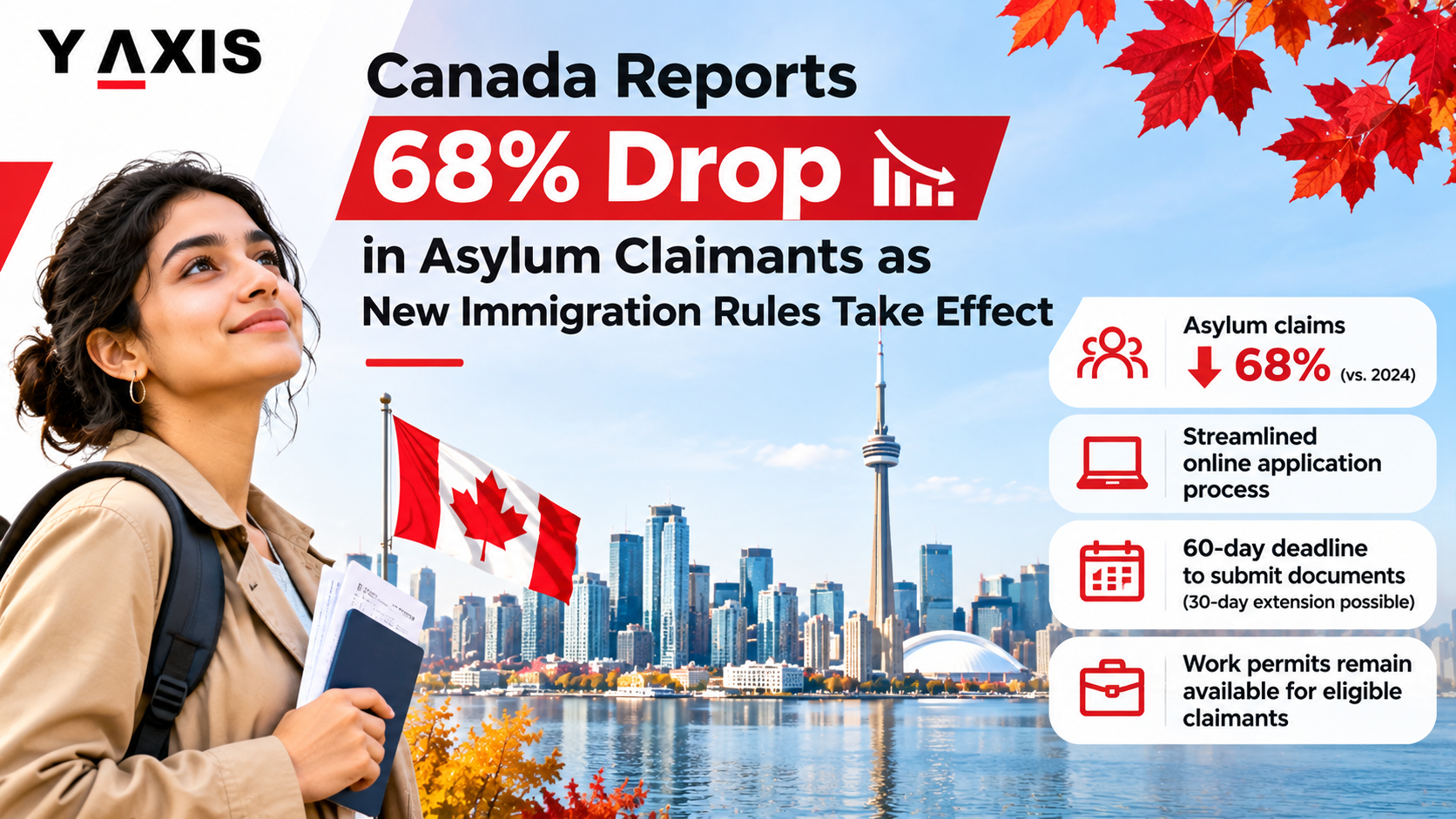
Canada has introduced major changes to its asylum system, effective November 3, 2026, as the government reports a 68% decline in asylum claimants compared with 2024. The reforms introduce a streamlined online process, stricter eligibility rules, clearer documentation deadlines and continued work-permit access for eligible refugee claimants.
Announced by Immigration, Refugees and Citizenship Canada (IRCC), the changes aim to reduce processing delays while maintaining protection for people fleeing persecution and serious threats to their safety. The latest figures also reveal a significant shift in Canada's immigration landscape, with asylum claimant numbers declining sharply over the past two years.
Canada Records 68% Decline in Asylum Claimants
According to IRCC's November 3 announcement, the number of people submitting asylum claims between January and August 2026 declined substantially compared with the same eight-month periods in previous years.
The government reported:
- 68% fewer asylum claimants compared with January–August 2024.
- 52% fewer asylum claimants compared with January–August 2025.
- A 73% decline in claims from temporary resident visa holders in August 2026 compared with August 2024.
IRCC's administrative data show that claims submitted at airports, land borders and marine entry points totalled 44,000 during January–August 2024, compared with 25,045 in 2025 and 9,640 in 2026. These port-of-entry figures represent a subset of asylum claimants and should not be confused with the government's nationwide 68% decline, which includes claims made inside Canada. The statistics highlight changing asylum patterns, although they do not establish that the new November regulations caused the earlier decline.
What Changed in Canada's Asylum Rules on November 3, 2026?
The government introduced updated regulations under the Strengthening Canada's Immigration System and Borders Act, also known as Bill C-12. The reforms focus on making asylum applications more consistent, reducing administrative duplication and improving the processing of eligible claims.
1. A Streamlined Online Application Process
Canada has introduced a unified online process for people seeking asylum, whether they initiate claims from inside the country or at a port of entry. Inland applicants begin by submitting information through the IRCC Portal and are subsequently invited to an in-person appointment with an immigration officer. The claim is formally made during that appointment. The new system reduces repeated questions and introduces clearer instructions for submitting documents.
2. New 60-Day Documentation Deadline
For eligible claims referred to the Immigration and Refugee Board of Canada (IRB), claimants have 60 days to submit their completed application and supporting documents. A one-time extension of 30 days may be requested. This requirement is intended to help decision-makers receive the information needed to assess claims without unnecessary delays. Applicants must follow the official instructions applicable to their circumstances.
3. Stronger Screening Before Refugee Hearings
The regulations establish clearer timelines for government reviews involving security, criminality, admissibility and programme integrity. Completing these checks earlier is intended to reduce hearing cancellations and prevent incomplete cases from progressing unnecessarily. The independent Immigration and Refugee Board remains responsible for determining whether eligible claimants qualify for refugee protection.
Who Could Become Ineligible to Claim Asylum?
Bill C-12 introduced additional eligibility restrictions that became law on March 26, 2026.
Under the new framework, certain claims may be ineligible if they are made:
- More than one year after the claimant's first entry into Canada, where that first entry occurred after June 24, 2020.
- More than 14 days after entering Canada between official ports of entry along the Canada–United States border.
These provisions have exceptions, including protections for unaccompanied minors and qualifying individuals who indicate their intention to claim asylum within the required period. The rules should not be interpreted as a blanket prohibition on asylum claims or as applying identically to every applicant.
Can Asylum Claimants Still Work in Canada?
Yes. Canada's updated regulations maintain access to work permits for eligible asylum claimants while their protection claims are being processed. IRCC has made permanent its existing approach to facilitating work-permit access for eligible claimants after they submit a complete claim.
Actual timelines depend on the claimant's circumstances and completion of the required procedures. This measure is intended to help eligible individuals support themselves while awaiting decisions. However, an asylum-related work permit is not equivalent to a regular skilled-worker immigration programme, nor does it automatically provide permanent residence.
What Happens to Applications Submitted Before November 3?
IRCC has clarified that people who submitted their asylum applications before the new process took effect will generally continue under the existing processing arrangements. Those who started but did not submit applications before the November 3 transition may need to answer additional questions and review previously entered information. Existing personal information is retained in the IRCC Portal. Applicants should check their accounts and follow instructions issued directly by IRCC or the Canada Border Services Agency.
What Do These Changes Mean for Indian Nationals?
Indian nationals who are already in Canada and genuinely require refugee protection may be affected by the revised application procedures and eligibility rules. However, asylum is intended for individuals who meet Canada's legal requirements for refugee protection. It is not an alternative route for people who simply wish to work, study or remain in Canada after their temporary status expires. Indian students, skilled professionals and prospective migrants should continue exploring appropriate immigration programmes based on their circumstances and eligibility.
Official sources:
- IRCC – Canada Modernizes the Asylum System, November 3, 2026
- IRCC – Backgrounder on the New Asylum Regulations
- IRCC – Changes to Canada's Asylum Process in 2026
- IRCC – Official Asylum Statistics
FAQs
When did Canada's new asylum rules take effect?
The updated asylum-processing regulations came into force on November 3, 2026. Additional eligibility restrictions were enacted earlier, on March 26, 2026.
Did Canadian asylum claims fall by 68%?
IRCC reported 68% fewer asylum claimants between January and August 2026 compared with the same period in 2024. The decline was 52% compared with 2025.
What is the new deadline for asylum documents?
Eligible claimants referred to the IRB generally have 60 days to provide completed applications and supporting documents, with a one-time 30-day extension available on request.
Can asylum claimants obtain Canadian work permits?
Eligible asylum claimants may access work permits under the applicable requirements. A work permit does not guarantee refugee protection or permanent residence.
Do these changes affect regular Canadian PR applicants?
The announcement primarily concerns Canada's asylum and refugee-protection system. It does not introduce a new Express Entry, Provincial Nominee Program or skilled-worker PR pathway.
Tags:
Canada Immigration
Canada Asylum Rules
IRCC
Canada Immigration News
Refugee Protection
Bill C-12
Asylum Claims
Canada Work Permits
Immigration Policy
Canada Visa Updates
Share
Options for you by Y-Axis

Get it on your mobile

Get News alerts

Contact Y-Axis
Latest Article
Popular Post
Trending Article
Posted On November 06 2026
Canada Reports 68% Drop in Asylum Claimants as New Immigration Rules Take Effect