


Posted on January 06 2026
Can I convert my China work visa to permanent residency?

By , Editor
Updated January 08 2026
Yes, you can convert a China work visa (Z-Visa/Work Residence Permit) into permanent residency (PR), but it is not automatic. You must apply for PR through a separate process. In most cases, you need to live and work in China for several years with a valid permit and have a stable income with tax records. People in senior or skilled jobs, those who make big investments, or those who make important contributions to China, may get PR faster. The rules can change by city (such as Beijing or Shanghai). Family ties, like marriage to a Chinese citizen, are also accepted in some cases.
Are you interested in applying for a Chinese work visa? Contact Y-Axis to guide you in every step!
Eligibility requirements to convert a China Work Visa into Permanent Residency (PR)
Chinese permanent residence (PR) is granted to foreigners who have a stable income, a clean criminal record, and strong qualifications. Professionals with high skills or special expertise often have a faster path to PR.
To move from a China work visa to permanent residency, you usually need to meet the following conditions:
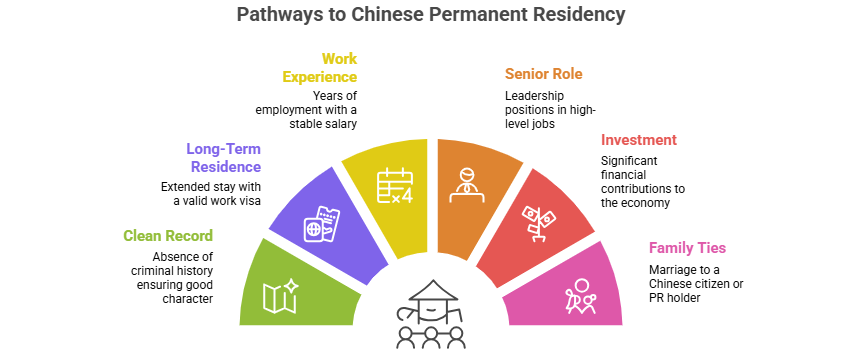
- Long-term residence permit: You must live and work in China on a Z work visa and hold a valid long-term residence permit for several years.
- Work experience: In most cases, you should have worked in China for at least 4 years, with a stable salary and a clean tax record.
- Senior job role: People working as managers or senior professionals in high-level positions have better chances of PR approval.
- Significant investment: Making a large or long-term investment in China, or contributing directly to the business or economy, can support your PR application.
- Family ties: Marriage to a Chinese citizen or to a foreigner who already holds a China PR can help speed up the PR process.
Are you planning to work in China? Sign up with Y-Axis to find assistance in migration and visa processing!
Steps to convert a China Work Visa to a China PR
The following are the steps to convert from a China Work Visa to a China PR:
Step 1: You must legally live and work in China on a Z work visa with a valid residence permit.
Step 2: In most cases, you need at least 4 years of continuous work and stay in China, along with a stable income and a clean tax record.
Step 3: You should meet one or more criteria, such as holding a senior or highly skilled job, making a significant investment, contributing to China’s economy, or having family ties in China.
Step 4: Collect documents like your passport, residence permit, work history, income and tax proof, police clearance, and health check report.
Step 5: Apply for permanent residency at the local Public Security Bureau (PSB) where you live in China.
Step 6: Attend verification or interview (if required).
Step 7: Once approved, you will receive the Foreigner’s Permanent Residence Card, which allows you to live and work in China without renewing your visa.
*Are you looking for step-by-step assistance with overseas immigration? Contact Y-Axis, the world's No. 1 overseas immigration consultancy, for end-to-end assistance!
FAQs-
Can I convert my China work visa to a PR
Can I convert my China work visa to permanent residency?
China does not offer a traditional permanent residency pathway similar to PR systems in Canada or Australia, but it provides a Foreign Permanent Resident ID Card, commonly called the Chinese Green Card. Converting a Chinese work visa directly into permanent residency is possible only for a limited category of foreign nationals. Eligibility depends on factors such as long-term employment, high-level professional skills, investment contribution, family ties to Chinese citizens, or outstanding achievements. Most applicants must first hold a valid work permit and residence permit for several consecutive years before qualifying. Approval rates remain low, and applications are reviewed by Chinese authorities.
How many years must I work in China before applying for permanent residency?
Foreign employees usually need to work in China continuously for at least four years before applying for permanent residency. During this period, applicants must live in China for no less than nine months each year and maintain stable employment with a legally registered Chinese employer. Consistent tax payments, social insurance contributions, and a clean legal record are essential. Authorities also evaluate job seniority, salary level compared to local averages, and the economic value the applicant brings. Merely holding a work visa does not guarantee eligibility, making long-term compliance and contribution extremely important. Early preparation improves approval chances significantly over time.
Does my job role affect my chances of getting China permanent residency?
China’s permanent residency eligibility favors highly skilled professionals, executives, and specialists in industries aligned with national priorities. Scientists, researchers, senior managers, and technical experts with internationally recognized qualifications have stronger chances. Applicants often need recommendation letters from employers and local government authorities. Higher education degrees, patents, published research, or leadership roles in multinational companies strengthen applications. Ordinary employees in junior or mid-level roles face significantly lower approval odds. Demonstrating irreplaceable expertise and long-term value to China’s economic or technological development is a critical success factor. Clear documentation and compliance with immigration regulations remain essential throughout the entire application process period.
Can investors convert a China work visa into permanent residency?
Investment-based permanent residency is possible for foreigners who make substantial and qualifying investments in China. Typically, this requires investing millions of RMB in encouraged sectors, regions, or government-approved projects and maintaining the investment for several years. Applicants must demonstrate lawful income sources, business credibility, and positive economic impact. Merely registering a small business or holding company shares is insufficient. Local government endorsement plays a major role in approvals. This pathway suits entrepreneurs, investors, and business owners with long-term commercial commitments in China. Professional legal advice improves compliance and reduces rejection risks during the application review stage and renewal assessments later.
Does marriage to a Chinese citizen help in getting permanent residency?
Foreigners married to Chinese citizens may apply for permanent residency after meeting specific residency and marriage duration requirements. Generally, applicants must be married for at least five years, live in China for nine months annually, and have a stable income and housing. Supporting documents include marriage certificates, household registration records, and police clearance certificates. Approval is discretionary and not automatic. Authorities carefully verify the authenticity of the marriage and long-term settlement intent. This pathway is commonly used but still subject to strict scrutiny and regional implementation differences. Applicants should prepare extensive proof of shared life including finances and residence history details.
Are there special routes for highly skilled or talented foreigners?
Outstanding foreign talents can qualify for Chinese permanent residency through special talent introduction programs. These applicants include award-winning scientists, top academics, innovative entrepreneurs, and experts urgently needed by China. Requirements vary by city and province but usually involve high salaries, recognized achievements, and official recommendations. Some regions offer accelerated processing for urgently needed professionals. This route bypasses long residency requirements in certain cases. However, documentation standards are high, and selection remains competitive due to limited annual approvals. Applicants must align expertise with national development strategies and demonstrate measurable contributions over recent years through verified projects, patents, or leadership roles internationally.
What is the application process for China's permanent residency?
Applying for permanent residency in China involves submitting documents through the local Exit and Entry Administration. Required paperwork typically includes passport copies, residence permits, employment contracts, tax payment certificates, health checks, and police clearance certificates. Applications are reviewed at municipal, provincial, and national levels, resulting in long processing timelines. Interviews or additional verification may be requested. Processing can take several months or longer, depending on the region and category. Careful preparation reduces delays, errors, and rejection risks significantly. Professional translation and notarization are mandatory for foreign documents, and inaccuracies often lead to immediate application refusal by reviewing officers at higher levels.
How difficult is it to get permanent residency in China?
There is no fixed quota publicly announced for Chinese permanent residency, but approvals are extremely limited each year. China maintains strict immigration controls, prioritizing national interest over population growth. As a result, rejection rates are high even for qualified applicants. Meeting eligibility criteria does not guarantee approval. Applications are assessed holistically, considering economic contribution, skills scarcity, compliance history, and regional demand. Understanding this reality helps applicants set realistic expectations and prepare strong, well-documented submissions. Legal guidance can improve clarity, but outcomes remain uncertain due to discretionary authority exercised by multiple government agencies throughout the multi-stage review process for foreign applicants.
What benefits do I get after receiving China permanent residency?
Holding a Chinese permanent residency card grants long-term residence without repeated visa renewals. Cardholders can work, invest, and live in China with fewer administrative restrictions. Benefits include simplified employment changes, easier property transactions, and access to certain social services. However, it does not grant Chinese citizenship, voting rights, or a Chinese passport. Card validity ranges from five to ten years and requires renewal. Despite benefits, compliance with Chinese laws and regulations remains mandatory at all times. Serious violations can lead to revocation of residency status including criminal offenses, tax evasion, or fraudulent applications discovered during audits or investigations by authorities.
What alternatives exist if I cannot convert my China work visa to permanent residency?
Foreign nationals unable to qualify for permanent residency should consider alternative long-term options. These include renewing work visas, upgrading to higher-level talent permits, or securing long-term residence permits through employment or family ties. Some cities offer extended residence permits for senior professionals without full permanent residency status. Strategic career planning, salary growth, and compliance improve future eligibility prospects. Consulting immigration professionals helps applicants choose realistic pathways while minimizing legal risks and maintaining uninterrupted lawful residence in China. Rules change periodically, so regular updates are strongly recommended from official immigration authorities and local government notices to avoid noncompliance and processing delays.
Tags:
China work visa from India
China work visa for Indian
China PR
China work visa invitation letter
China work visa requirements
China work visa types
Permanent residence in China
How to get permanent residency in China
Share
Options for you by Y-Axis

Get it on your mobile

Get News alerts

Contact Y-Axis
Latest Article
Popular Post
Trending Article

Posted On April 01 2026
Study vs Work Abroad – Which is Better for Indians in 2026?