

Posted on September 24 2026
What Is the Average Salary in Switzerland?

By , Editor & Director
Updated September 26 2026
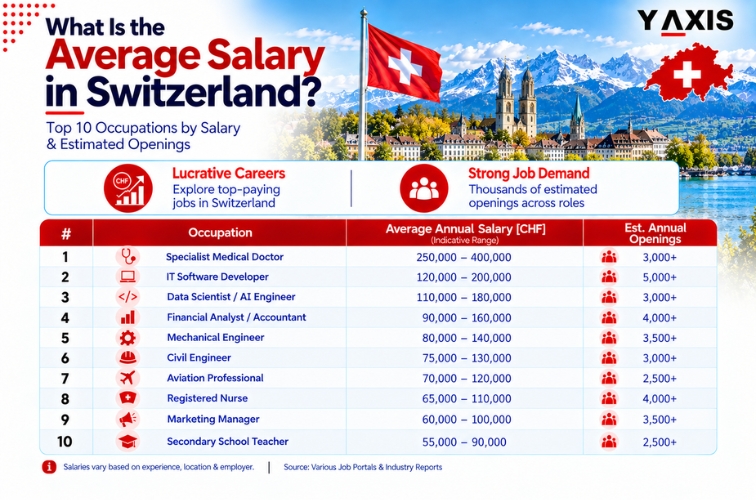
The average salary in Switzerland is approximately CHF 7,900 to CHF 8,300 (roughly ₹8.69–9.13 lakh) per month for full-time employees, or around CHF 95,000 to CHF 100,000 (₹1.05 crore approx.) per annum. Skilled professionals in finance, technology, and life sciences generally earn CHF 10,000 to CHF 15,000 per month. Your salary in Switzerland will vary widely based on canton and sector. Zurich, Zug, and Basel-City pay more than most other regions, and banking, pharmaceuticals, and information technology roles command the highest premiums nationwide.
*Want to work in Switzerland? Let Y-Axis guide you through the process.
Top 10 Highest-Paying Occupations in Switzerland
Switzerland's job market spans major sectors like banking and finance, pharmaceuticals, information technology, and engineering. Salaries of foreign professionals in Switzerland hence vary widely based on the sector. Certain high-demand roles create more job opportunities and greater compensation due to persistent skill shortages, especially in finance, life sciences, and IT.
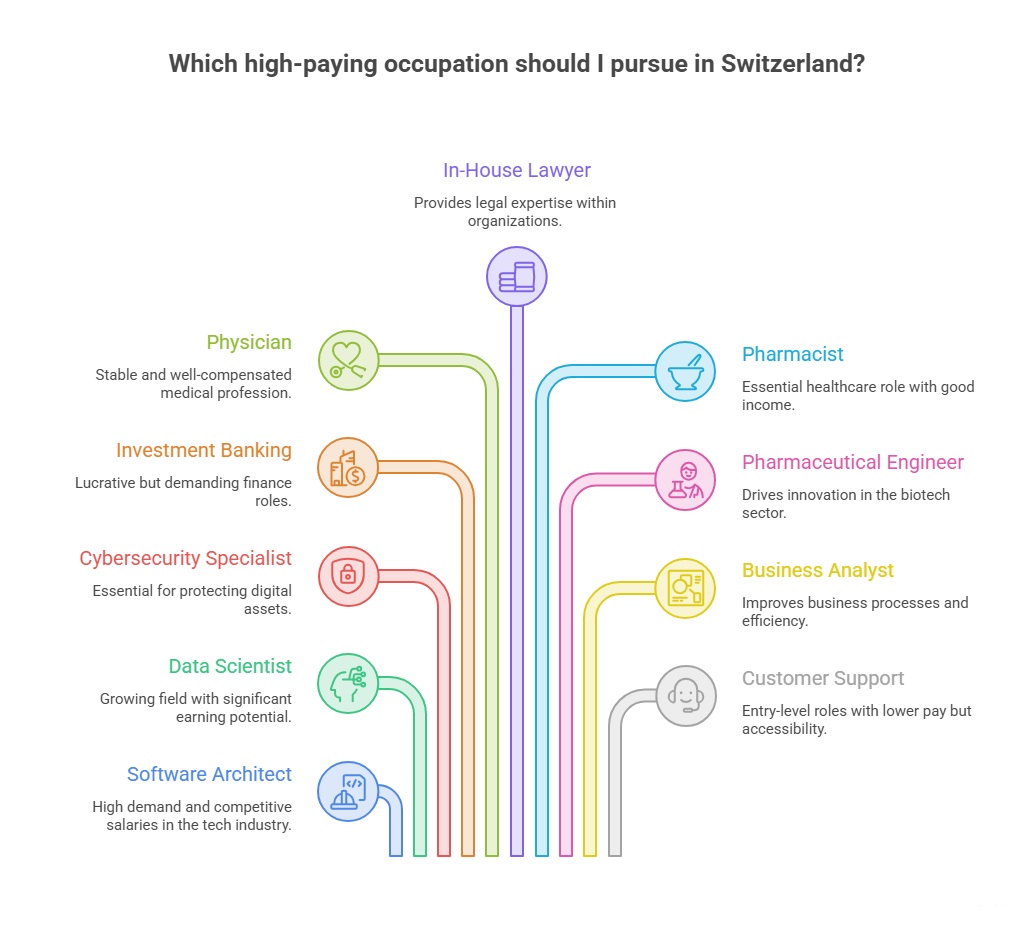
The table below shows ten occupations with strong salaries and steady hiring demand in Switzerland.
|
Occupation |
Average Annual Salary (CHF) |
Est. Annual Salary (INR) |
Demand Outlook |
|
Software Architect / Senior IT Specialist |
CHF 120,000–220,000 |
₹1.32–2.42 crore+ |
High demand in Zurich's banking and tech ecosystem; senior architects reach CHF 240,000 |
|
Data Scientist / AI Engineer |
CHF 110,000–180,000 |
₹1.21–1.98 crore+ |
Strong demand across finance, pharma and tech; AI/ML specialists command a premium |
|
Cybersecurity Specialist |
CHF 100,000–173,000 |
₹1.10–1.90 crore+ |
Rising demand as banking, healthcare and government digitise operations |
|
Investment Banking / Finance Manager |
CHF 120,000–200,000 |
₹1.32–2.20 crore+ |
Zurich and Geneva's private banking and asset management sectors drive senior pay |
|
Physician / Medical Doctor |
CHF 120,000–220,000 |
₹1.32–2.42 crore+ |
Persistent shortage of specialists and hospital doctors nationwide |
|
In-House Lawyer / Legal Counsel |
CHF 108,000–147,000 |
₹1.19–1.62 crore+ |
Chemical, pharmaceutical and financial services sectors pay above average |
|
Pharmacist |
CHF 90,000–120,000 |
₹99–132 lakh+ |
Steady demand across pharmacy chains, hospitals and pharma companies |
|
Pharmaceutical / Biotech Engineer |
CHF 85,000–130,000 |
₹93.5–143 lakh+ |
Basel's pharmaceutical hub (Roche, Novartis) sustains strong hiring |
|
Business Analyst / ERP Project Manager |
CHF 100,000–150,000 |
₹1.10–1.65 crore+ |
Digital transformation and SAP implementation projects driving demand |
|
Customer Support / Entry-Level Roles |
CHF 55,000–70,000 |
₹60.5–77 lakh+ |
Common entry point in retail, hospitality and shared-services roles |
Also, read...
Highest Paying Job Opportunities in Switzerland
Average Lifestyle Expenses in Switzerland
Switzerland offers strong salaries in Zurich and other major hubs, but the cost of living is among the highest in the world. Housing costs are followed by mandatory health insurance, groceries, and transport. Knowing these costs in advance helps you assess whether a salary offer in Switzerland is genuinely competitive.
- Rent (1-bed apartment, city centre, Zurich): CHF 2,000–3,500 per month
- Rent (1-bed apartment, outside city centre / other cities, e.g. Bern): CHF 1,500–2,200 per month
- Groceries (single person): CHF 500–700 per month
- Utilities (electricity, water, and heating, ~85 m² apartment): CHF 150–250 per month
- Public transport (monthly pass): CHF 80–90 per month
- Mobile and internet plan: CHF 90–120 per month combined
- Mandatory health insurance (per adult): CHF 350–500 per month, billed separately — not deducted from salary or covered by the employer
- Dining out (casual meal for two): CHF 60–90
- Overall monthly budget, single person, excluding rent: CHF 1,600–2,100
- Overall monthly budget, single person, including rent (comfortable baseline, Zurich): CHF 4,500–6,000
Note: Many professionals reduce costs by living in Winterthur or Baden, or by registering as a cross-border commuter (Grenzgänger) from France or Germany while still earning a Swiss salary. Choosing a lower-tax canton such as Zug or Schwyz can also meaningfully raise take-home pay.
Also, read...
What are the most in-demand jobs in Switzerland for the next 10 years?
Salary Structure and Take-Home Pay in Switzerland
Switzerland has no single national income tax rate. Instead, employees pay federal, cantonal, and communal (municipal) income tax together, and the combined effective rate varies significantly by canton. Zug and Schwyz apply some of the lowest rates nationwide, at roughly 15% to 25% for typical salaries, while Geneva, Vaud, and Basel-City apply some of the highest, often 30% to 38% at higher income levels. On top of income tax, employees contribute 5.3% of gross salary to AHV/IV/EO (state pension, disability, and income compensation) with no income ceiling, 1.1% to unemployment insurance (ALV) up to a set income ceiling, and 5% to 8% to the mandatory occupational pension (BVG), depending on age. Mandatory health insurance is billed separately and is not deducted from salary.
The table below highlights gross monthly salary and approximate take-home pay for an employee in the canton of Zurich. Figures are indicative only; actual take-home pay depends on canton, marital status, and children:
|
Gross Monthly Salary |
Mandatory Deductions (Tax + AHV/IV/EO + ALV + BVG) |
Approx. Take-Home Pay |
|
CHF 6,700 (~CHF 80,000/year) |
~CHF 1,500 (~22%) |
~CHF 5,200 (~78%) |
|
CHF 8,300 (~CHF 100,000/year) |
~CHF 2,150 (~26%) |
~CHF 6,150 (~74%) |
|
CHF 10,000 (~CHF 120,000/year) |
~CHF 2,650 (~27%) |
~CHF 7,350 (~73%) |
|
CHF 15,000 (~CHF 180,000/year) |
~CHF 4,650 (~31%) |
~CHF 10,350 (~69%) |
Also, read...
What are the eligibility requirements for a Switzerland work visa?
How Switzerland's Average Salary Compares to Other Countries
Switzerland pays the highest average salaries in Europe, well above neighbouring Germany, France, and Italy. When evaluating job opportunities in Switzerland compared with other countries, looking at net income after rent and mandatory health insurance provides a more realistic view of your potential financial benefit. This approach helps professionals better understand how far their income can go compared with opportunities in other parts of the world.
The country is particularly appealing for professionals in sectors such as banking, pharmaceuticals, technology, and engineering, where demand for skilled workers continues to create strong opportunities. Salaries can also vary significantly depending on canton, city, experience, qualifications, and industry.
*Are you looking for step-by-step assistance with overseas immigration? Contact Y-Axis, the world's No. 1 overseas immigration consultancy, for end-to-end assistance!
FAQs
What is the average salary in Switzerland?
The average (mean) gross salary in Switzerland is approximately CHF 7,900 to CHF 8,300 per month, or CHF 95,000 to CHF 100,000 per year, based on Federal Statistical Office wage data. This figure is pulled upward by high earners in banking, pharmaceuticals, and senior management. The median salary, a more typical measure, is CHF 7,024 per month, or CHF 84,288 per year. Skilled professionals in finance, technology, and life sciences often earn considerably more than both figures.
What is the difference between average and median salary in Switzerland?
The average (mean) salary adds up all earnings and divides by the number of workers, so a small number of very high earners in banking and pharma pull the figure upward. Switzerland's average is about CHF 7,900 to CHF 8,300 per month. The median is the middle value, meaning half of all workers earn more and half earn less. Switzerland's median is CHF 7,024 per month, making it a more realistic picture of typical pay nationwide.
Which jobs pay the highest salaries in Switzerland?
The highest-paying roles in Switzerland include software architects, AI and data engineers, investment banking managers, and senior physicians, often earning CHF 150,000 to CHF 250,000 per year or more. Cybersecurity specialists, in-house lawyers, and pharmaceutical engineers also earn well above the national average. These roles cluster around Zurich's banking and tech sector and Basel's pharmaceutical hub, where skilled professionals remain in short supply.
Is there a minimum wage in Switzerland?
Switzerland has no single national minimum wage. Instead, a handful of cantons set their own statutory minimum, including Geneva, Neuchâtel, Basel-City, Jura, and Ticino. Geneva's rate is the highest in the world, at approximately CHF 24.59 per hour, or roughly CHF 4,400 per month for full-time work. Most other sectors and cantons rely on collective bargaining agreements (GAV/CCT) that set sector-specific wage floors instead of a statutory minimum.
How much tax do I pay on my salary in Switzerland?
Switzerland levies income tax at three levels: federal, cantonal, and communal. The combined effective rate depends heavily on your canton, ranging from roughly 15% to 25% in low-tax cantons such as Zug and Schwyz, up to 30% to 38% in higher-tax cantons such as Geneva and Basel-City. On top of income tax, employees also contribute around 6.4% of gross salary toward AHV/IV/EO and unemployment insurance, plus a mandatory occupational pension contribution.
Is the average salary in Switzerland enough to live comfortably?
It depends on the canton and lifestyle. Outside major cities, CHF 5,000 to CHF 5,500 per month comfortably covers rent, mandatory health insurance, groceries, transport, and some savings for a single person. In Zurich or Geneva, CHF 6,000 or more is a more realistic baseline due to higher rent. Choosing a lower-cost neighbourhood, sharing accommodation, or living in a nearby town can help an average salary stretch considerably further.
Do foreign workers earn more than local workers in Switzerland?
Foreign professionals in Switzerland generally earn salaries comparable to Swiss nationals in similar roles, particularly in banking, technology, and pharmaceuticals, since Swiss law requires equal pay for equal work regardless of nationality. Employers must typically demonstrate that no suitable local or EU/EFTA candidate was available before hiring a non-EU national, and salaries must meet the customary local, regional, and professional wage for the canton and role.
What is a good salary in Switzerland for a single person?
A good salary for a single person in Zurich or Geneva is generally CHF 100,000 or more per year, comfortably covering rent, mandatory health insurance, groceries, transport, and savings. In smaller cities such as Bern, Lucerne, or Basel, CHF 80,000 or more is a realistic threshold, since rent and daily costs are considerably lower. Salaries above CHF 120,000 place you well above the national average in most sectors.
How does Switzerland's average salary compare to other countries?
Switzerland's average salary is the highest in Europe, well above neighbouring Germany, France, Italy, and Austria. Swiss professionals typically earn 30% to 50% more in gross terms than counterparts in these countries. However, Switzerland's high cost of living and mandatory private health insurance offset some of this advantage, so comparing net income after rent and insurance gives a more accurate picture of the real financial benefit.
What salary do I need to qualify for a work permit in Switzerland?
Switzerland does not publish a single fixed salary threshold for a work permit. For non-EU/EFTA nationals, the employer must show the offered salary matches the customary local, regional, and professional wage for the role and canton, and that no suitable Swiss or EU/EFTA candidate was available. EU/EFTA citizens benefit from freedom of movement and face fewer restrictions, though the same wage rules generally apply.
What is the standard working week in Switzerland?
The standard contractual working week in Switzerland is typically 40 to 42 hours, depending on the sector and employer, with a legal maximum of 45 hours for industrial, office, and retail workers, and 50 hours for other occupations. Overtime is generally paid at 125% of the normal hourly rate, or compensated with equivalent time off, depending on the employment contract and collective bargaining agreement.
What is a 13th month salary in Switzerland?
Many Swiss employers pay a 13th month salary, an additional payment roughly equal to one month's regular pay, usually disbursed in November or December. It is not a legal requirement everywhere but is standard practice in most sectors and is often written into the employment contract or collective bargaining agreement. Always confirm with a prospective employer whether a quoted annual salary already includes the 13th month payment.
Why do salaries vary so much between Swiss cantons?
Salaries vary by canton mainly due to industry concentration and cost of living. Zurich, Zug, and Basel-City offer the highest pay because they host major banking, finance, and pharmaceutical employers. Cantonal tax rates also differ significantly, so a lower gross salary in a low-tax canton such as Zug can deliver similar or better take-home pay than a higher gross salary in a high-tax canton such as Geneva.
Is health insurance included in my Swiss salary?
No. Health insurance in Switzerland is private and mandatory, but it is not provided by employers and is not deducted from salary. Every resident must independently purchase basic health insurance (KVG/LAMal) within three months of arrival. Premiums typically range from CHF 350 to CHF 500 per month per adult, depending on canton, age, and the chosen deductible (franchise), and must be budgeted separately from take-home pay.
What is the EU Blue Card equivalent for working in Switzerland?
Switzerland does not offer an EU Blue Card, since it is not an EU member state, though it participates in the EU/EFTA free movement agreement for citizens of those countries. Non-EU/EFTA nationals instead require a Swiss work permit, typically an L (short-term) or B (residence) permit, sponsored by an employer and subject to annual cantonal and federal quotas for third-country nationals.
How much does a data scientist earn in Switzerland?
A data scientist in Switzerland typically earns CHF 110,000 to CHF 180,000 per year, depending on experience, employer, and canton. Entry-level data scientists with two to four years of experience generally earn CHF 90,000 to CHF 130,000, while senior specialists with strong business impact can reach CHF 150,000 or more. Zurich and Geneva offer the strongest demand and highest pay in banking, pharma, and technology sectors.
What is the cost of mandatory pension contributions in Switzerland?
Employees in Switzerland contribute to two mandatory pension pillars. The first, AHV/IV/EO, deducts 5.3% of gross salary with no income ceiling. The second, BVG (occupational pension), deducts an age-based percentage of coordinated salary, typically ranging from 5% to 8% for younger employees up to higher rates for older employees. Employers must match or co-fund these contributions, which build long-term retirement savings.
Which Swiss city offers the best salary-to-cost-of-living ratio?
Zug and Basel generally offer a strong salary-to-cost-of-living ratio, combining competitive pay in finance and pharmaceuticals with lower cantonal tax rates than Zurich or Geneva. Bern and Lucerne offer somewhat lower salaries but meaningfully lower rent and living costs, making them attractive for professionals prioritising savings over big-city amenities. Zurich and Geneva pay the most in absolute terms but come with the highest cost of living.
Do salaries in Switzerland increase with experience quickly?
Yes. Salaries in Switzerland typically rise steadily with experience, especially in finance, technology, and pharmaceuticals, where senior specialists and managers can earn 50% to 100% more than entry-level professionals in the same field. Postgraduate qualifications and specialised certifications, such as cloud or cybersecurity credentials, can add a further salary premium, particularly in Zurich's competitive banking and technology job market.
What should I check before negotiating a Swiss job offer?
Before negotiating a Swiss job offer, gather comparable salary data for your role, canton, and experience level, confirm whether the figure quoted is gross or net and whether it includes a 13th month payment, and factor in mandatory health insurance and cantonal tax differences. Understanding the total cost of living in your specific canton helps you evaluate whether an offer is genuinely competitive before accepting.
Tags:
average salary in Switzerland
Switzerland salary guide
cost of living in Switzerland
Switzerland income tax
highest paying jobs in Switzerland
work in Switzerland
Switzerland job market
take-home pay Switzerland
Share
Options for you by Y-Axis

Get it on your mobile

Get News alerts
Contact Y-Axis
Latest Article
Popular Post
Trending Article
Posted On October 01 2026
The Borderless Indian