

Posted on September 24 2026
What Is the Average Salary in Malaysia?

By , Editor & Director
Updated September 26 2026
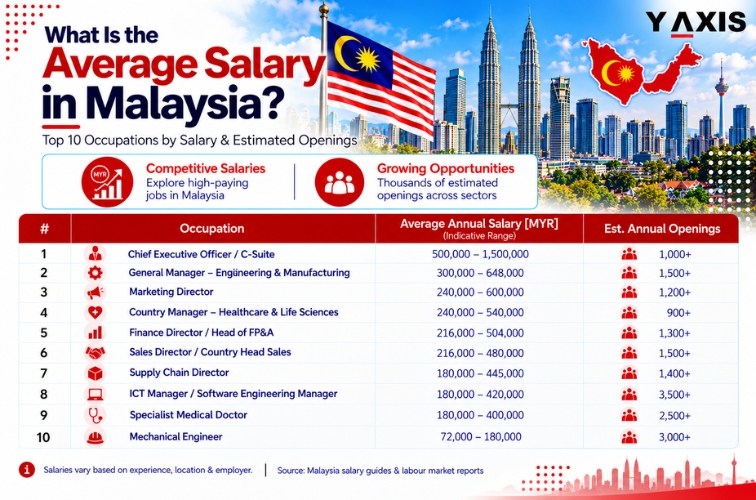
The average (mean) salary in Malaysia is approximately RM 3,650 to RM 3,800 (roughly ₹76,600–79,800) per month for full-time employees, or around RM 44,000 to RM 46,000 (₹9.2–9.7 lakh approx.) per annum, based on official Department of Statistics Malaysia (DOSM) data. The median salary, a more typical figure, is close to RM 2,900 per month. Skilled professionals in technology, finance, and engineering generally earn RM 6,000 to RM 15,000 per month. Your salary in Malaysia will vary widely based on state and sector. Kuala Lumpur, Selangor, and Penang pay more than most other states, and technology, finance, and semiconductor engineering roles command the highest premiums nationwide.
*Want to work in Malaysia? Let Y-Axis guide you through the process.
Top 10 Highest-Paying Occupations in Malaysia
Malaysia's job market spans major sectors like technology, finance, semiconductors, and healthcare. Salaries of professionals in Malaysia hence vary widely based on the sector. Certain high-demand roles create more job opportunities and greater compensation due to persistent skill shortages, especially in technology, engineering, and healthcare.
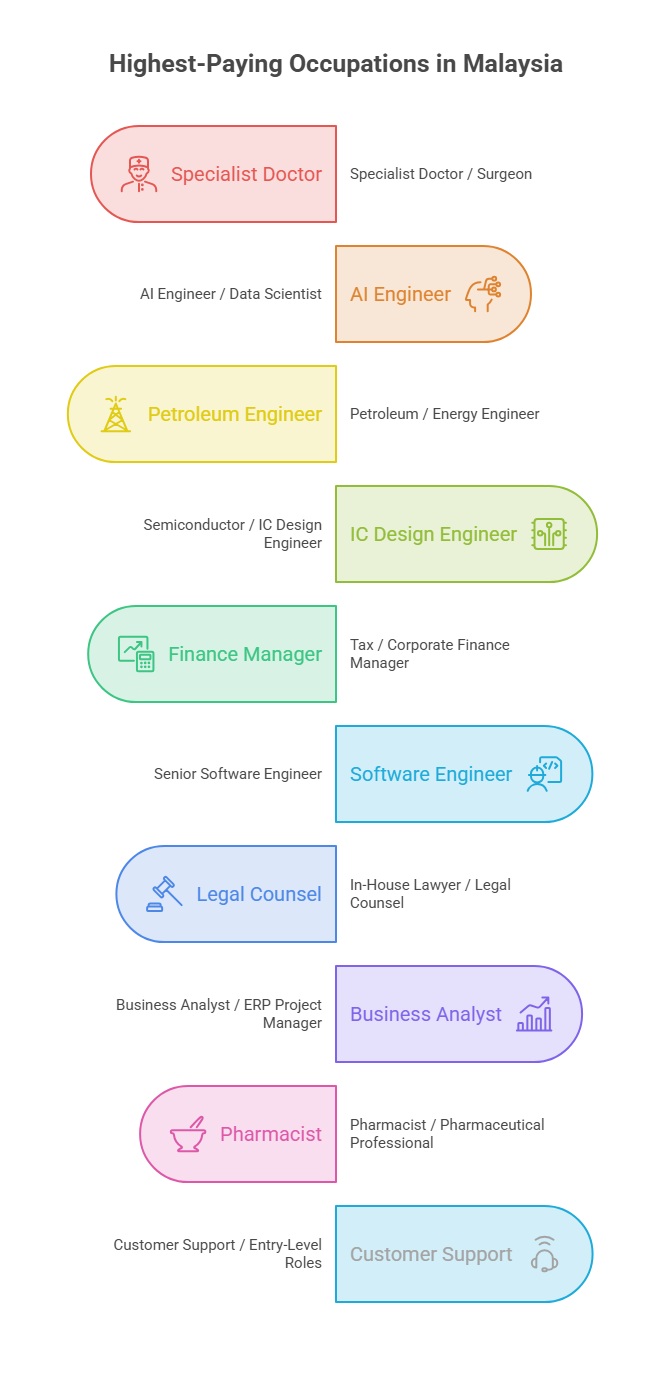
The table below shows ten occupations with strong salaries and steady hiring demand in Malaysia.
|
Occupation |
Average Annual Salary (RM) |
Est. Annual Salary (INR) |
Demand Outlook |
|
Specialist Doctor / Surgeon |
RM 240,000-600,000 |
₹50.4 lakh-1.26 crore+ |
Persistent shortage of specialists, especially outside Klang Valley hospitals |
|
AI Engineer / Data Scientist |
RM 120,000-240,000 |
₹25.2-50.4 lakh+ |
Strong demand across banking, tech and shared-services hubs; AI/ML skills command a premium |
|
Petroleum / Energy Engineer |
RM 120,000-300,000 |
₹25.2-63 lakh+ |
Offshore and technical roles in oil & gas remain well-compensated nationwide |
|
Semiconductor / IC Design Engineer |
RM 120,000-180,000 |
₹25.2-37.8 lakh+ |
Penang and Kulim's chip-manufacturing hub sustains strong senior hiring |
|
Tax / Corporate Finance Manager |
RM 108,000-252,000 |
₹22.7-52.9 lakh+ |
Rising demand as multinational shared-service centres expand in Kuala Lumpur |
|
Senior Software Engineer |
RM 108,000-180,000 |
₹22.7-37.8 lakh+ |
Cloud, cybersecurity and automation skills drive strong hiring in Klang Valley and Penang |
|
In-House Lawyer / Legal Counsel |
RM 96,000-220,000 |
₹20.2-46.2 lakh+ |
Financial services and multinational firms pay above-average legal salaries |
|
Business Analyst / ERP Project Manager |
RM 96,000-180,000 |
₹20.2-37.8 lakh+ |
Digital transformation projects continue to drive steady demand |
|
Pharmacist / Pharmaceutical Professional |
RM 84,000-144,000 |
₹17.6-30.2 lakh+ |
Steady demand across hospitals, pharmacy chains, and pharma manufacturers |
|
Customer Support / Entry-Level Roles |
RM 30,000-48,000 |
₹6.3-10.1 lakh+ |
Common entry point in retail, BPO, and shared-services roles |
Also, read...
Highest Paying Job Opportunities in Malaysia
Average Lifestyle Expenses in Malaysia
Malaysia offers competitive salaries relative to its cost of living, which remains among the more affordable in the region compared with Singapore. Housing costs are followed by groceries, transport, and utilities. Knowing these costs in advance helps you assess whether a salary offer in Malaysia is genuinely competitive.
- Rent (1-bed apartment, city centre, Kuala Lumpur): RM 2,300-3,500 per month
- Rent (1-bed apartment, outside city centre / other cities, e.g. Penang, Johor Bahru): RM 1,200-1,800 per month
- Groceries (single person): RM 600-900 per month
- Utilities (electricity, water, and air-conditioning, ~85 m² apartment): RM 150-250 per month
- Public transport (monthly pass): RM 100-150 per month
- Mobile and internet plan: RM 100-150 per month combined
- Private health insurance (optional top-up over public healthcare, per adult): RM 150-350 per month
- Dining out (casual meal for two): RM 40-70
- Overall monthly budget, single person, excluding rent: RM 1,300-1,900
- Overall monthly budget, single person, including rent (comfortable baseline, Kuala Lumpur): RM 3,500-5,000
Note: Many professionals reduce costs by living in Petaling Jaya, Cyberjaya, or Subang Jaya rather than central Kuala Lumpur, or by working in Penang and Johor Bahru, where salaries remain competitive but rent and daily costs are meaningfully lower.
Also, read...
What are the most in-demand jobs in Malaysia for the next 10 years?
Salary Structure and Take-Home Pay in Malaysia
Malaysia applies a single, federal progressive income tax on residents, withheld monthly through the Monthly Tax Deduction (PCB) system, rather than separate state-level tax rates. Resident chargeable income up to RM 5,000 a year is tax-free, rising through bands of 1% to 30% as income increases, with the top 30% rate applying above RM 2,000,000. Non-residents pay a flat 30% with no personal reliefs. On top of income tax, employees contribute 11% of gross salary to the Employees Provident Fund (EPF), 0.5% to the Social Security Organisation (SOCSO, capped at RM 6,000 monthly wage), and 0.2% to the Employment Insurance System (EIS, also capped at RM 6,000). Foreign employees contribute EPF at a lower 2% rate since October 2025, and are not covered under EIS.
The table below shows illustrative gross monthly salary and approximate take-home pay for a Malaysian tax resident. Figures are indicative only; actual take-home pay depends on personal reliefs, marital status, and children:
|
Gross Monthly Salary |
Mandatory Deductions (Tax + EPF + SOCSO + EIS) |
Approx. Take-Home Pay |
|
RM 4,000 (~RM 48,000/year) |
~RM 518 (~13%) |
~RM 3,482 (~87%) |
|
RM 8,000 (~RM 96,000/year) |
~RM 1,436 (~18%) |
~RM 6,564 (~82%) |
|
RM 12,000 (~RM 144,000/year) |
~RM 2,791 (~23%) |
~RM 9,209 (~77%) |
|
RM 20,000 (~RM 240,000/year) |
~RM 5,671 (~28%) |
~RM 14,329 (~72%) |
Also, read...
What are the eligibility requirements for a Malaysia work visa?
How Malaysia's Average Salary Compares to Other Countries
Malaysia's average salary sits well below Singapore, generally three to four times lower for comparable roles, but ahead of Vietnam, the Philippines, and Indonesia, where typical pay runs 20% to 40% lower than Malaysia's. When evaluating job opportunities in Malaysia compared with other countries, looking at net income after rent and living costs provides a more realistic view of your potential financial benefit. This approach helps professionals better understand how far their income can go compared with opportunities in other parts of the world.
The country is particularly appealing for professionals in sectors such as technology, finance, semiconductors, and healthcare, where demand for skilled workers continues to create strong opportunities. Salaries can also vary significantly depending on state, city, experience, qualifications, and industry.
*Are you looking for step-by-step assistance with overseas immigration? Contact Y-Axis, the world's No. 1 overseas immigration consultancy, for end-to-end assistance!
FAQs
What is the average salary in Malaysia?
The average (mean) gross salary in Malaysia is approximately RM 3,650 to RM 3,800 per month, or RM 44,000 to RM 46,000 per year, based on Department of Statistics Malaysia (DOSM) wage data. This figure is pulled upward by high earners in technology, finance, and senior management. The median salary, a more typical measure, is close to RM 2,900 per month. Skilled professionals in technology, finance, and engineering often earn considerably more than both figures.
What is the difference between average and median salary in Malaysia?
The average (mean) salary adds up all earnings and divides by the number of workers, so a small number of very high earners in technology and finance pull the figure upward. Malaysia's average is about RM 3,650 to RM 3,800 per month. The median is the middle value, meaning half of all workers earn more and half earn less. Malaysia's median is close to RM 2,900 per month, making it a more realistic picture of typical pay nationwide.
Which jobs pay the highest salaries in Malaysia?
The highest-paying roles in Malaysia include specialist doctors, AI and data engineers, petroleum engineers, and semiconductor design engineers, often earning RM 120,000 to RM 300,000 per year or more. Corporate finance managers, senior software engineers, and in-house lawyers also earn well above the national average. These roles cluster around Kuala Lumpur's finance and tech sector and Penang's semiconductor hub, where skilled professionals remain in short supply.
Is there a minimum wage in Malaysia?
Yes. Malaysia applies a single national minimum wage of RM 1,700 per month, in effect since February 2025. Unlike some countries with regional or sector-based minimums, this rate applies nationwide to all employers, including for foreign workers, part-time workers, and gig workers, with limited exemptions such as domestic helpers and apprentices.
How much tax do I pay on my salary in Malaysia?
Malaysia levies a single federal progressive income tax on residents, withheld monthly through the Monthly Tax Deduction (PCB) system. Chargeable income up to RM 5,000 a year is tax-free, then rises through bands from 1% up to 30% for income above RM 2,000,000. On top of income tax, employees also contribute 11% of gross salary to the Employees Provident Fund (EPF), plus smaller contributions to SOCSO and EIS, both capped at a RM 6,000 monthly wage.
Is the average salary in Malaysia enough to live comfortably?
It depends on the state and lifestyle. Outside Kuala Lumpur, RM 2,500 to RM 3,000 per month comfortably covers rent, groceries, transport, and some savings for a single person. In Kuala Lumpur, RM 3,500 or more is a more realistic baseline due to higher rent. Choosing a lower-cost neighbourhood, sharing accommodation, or living in a nearby state can help an average salary stretch considerably further.
Do foreign workers earn more than local workers in Malaysia?
Foreign professionals sponsored on an Employment Pass generally earn salaries set by their Employment Pass category rather than local benchmarks, since the pass requires a fixed minimum monthly salary depending on category. In many technology, finance, and engineering roles, foreign specialists earn comparable or higher pay than local professionals in similar positions, reflecting the specialised skills the role requires.
What is a good salary in Malaysia for a single person?
A good salary for a single person in Kuala Lumpur is generally RM 8,000 or more per month, comfortably covering rent, groceries, transport, and savings. In smaller cities such as Penang, Ipoh, or Johor Bahru, RM 6,000 or more per month is a realistic threshold, since rent and daily costs are considerably lower. Salaries above RM 12,000 per month place you well above the national average in most sectors.
How does Malaysia's average salary compare to other countries?
Malaysia's average salary is generally three to four times lower than Singapore's for comparable roles, but ahead of Vietnam, the Philippines, and Indonesia, where typical pay runs 20% to 40% lower than Malaysia's. However, Malaysia's lower cost of living compared with Singapore offsets much of this gap, so comparing net income after rent and daily costs gives a more accurate picture of the real financial benefit.
What salary do I need to qualify for a work permit in Malaysia?
Malaysia's Employment Pass sets category-based salary thresholds rather than a single fixed figure. Category I requires RM 20,000 or more per month, Category II requires RM 10,000 to RM 19,999, and Category III requires RM 5,000 to RM 9,999 (RM 7,000 or more for manufacturing-related roles). Only basic salary counts toward these thresholds, not allowances or bonuses.
What is the standard working week in Malaysia?
The standard working week in Malaysia is up to 45 hours, following the Employment Act 1955 as amended in 2022, which reduced the previous 48-hour limit. Most office-based roles run a 5-day week of around 8 to 9 hours a day. Overtime is generally paid at 1.5 times the normal hourly rate, depending on the employment contract.
Do Malaysian employers pay a 13th month salary or bonus?
Many Malaysian employers pay an annual bonus roughly equal to one month's salary, though it is not a universal legal requirement outside specific sectors and collective agreements. The amount and timing vary by employer and performance, and it is often written into the employment contract. Always confirm with a prospective employer whether a quoted annual salary already includes a bonus.
Why do salaries vary so much between Malaysian states?
Salaries vary by state mainly due to industry concentration and cost of living. Kuala Lumpur, Selangor, and Penang offer the highest pay because they host major finance, technology, and semiconductor employers. States such as Kelantan, Perlis, and Sabah generally report the lowest wages, reflecting a different mix of industries and a lower cost of living.
Is health insurance included in my Malaysian salary?
Not automatically. Malaysia has subsidised public healthcare available to citizens and permanent residents at low cost, but many employers also provide private group health insurance as part of the employment package. Foreign employees on an Employment Pass should confirm whether their employer provides health coverage or whether they need to arrange private insurance separately.
What is the Employment Pass equivalent for working in Malaysia?
Malaysia's main work authorisation for foreign professionals is the Employment Pass (EP), sponsored by a Malaysia-registered employer through the Expatriate Services Division (ESD). It is issued under three salary-based categories, Category I, II, and III, each with its own minimum salary, validity period, and maximum cumulative tenure.
How much does a data scientist earn in Malaysia?
A data scientist in Malaysia typically earns RM 120,000 to RM 240,000 per year, depending on experience, employer, and state. Entry-level data scientists generally earn toward the lower end of this range, while senior specialists with strong business impact can reach the upper end or more. Kuala Lumpur and Penang offer the strongest demand and highest pay in finance and technology sectors.
What are the mandatory statutory contributions on a Malaysian salary?
Malaysian employees contribute 11% of gross salary to the Employees Provident Fund (EPF) with no income ceiling, 0.5% to the Social Security Organisation (SOCSO), and 0.2% to the Employment Insurance System (EIS), both capped at a RM 6,000 monthly wage. Employers contribute a matching or higher share to each scheme, funding retirement savings, workplace injury cover, and retrenchment support.
Which Malaysian city offers the best salary-to-cost-of-living ratio?
Penang and Johor Bahru generally offer a strong salary-to-cost-of-living ratio, combining competitive pay in technology, semiconductors, and manufacturing with meaningfully lower rent than Kuala Lumpur. Ipoh and Kuching offer somewhat lower salaries but considerably lower living costs, making them attractive for professionals prioritising savings. Kuala Lumpur pays the most in absolute terms but comes with the highest cost of living.
Do salaries in Malaysia increase with experience quickly?
Yes. Salaries in Malaysia typically rise steadily with experience, especially in technology, finance, and engineering, where senior specialists and managers can earn two to four times more than entry-level professionals in the same field. Specialised certifications, such as cloud, cybersecurity, or semiconductor design credentials, can add a further salary premium, particularly in Kuala Lumpur's and Penang's competitive job markets.
What should I check before negotiating a Malaysian job offer?
Before negotiating a Malaysian job offer, gather comparable salary data for your role, state, and experience level, confirm whether the figure quoted is gross or net and whether it includes an annual bonus, and factor in EPF, SOCSO, and EIS contributions alongside income tax. Understanding the total cost of living in your specific city helps you evaluate whether an offer is genuinely competitive before accepting.
Tags:
Average salary in Malaysia
Malaysia salary guide
cost of living in Malaysia
Malaysia income tax
highest paying jobs in Malaysia
work in Malaysia
Malaysia job market
take-home pay Malaysia
Share
Options for you by Y-Axis

Get it on your mobile

Get News alerts

Contact Y-Axis
Latest Article
Popular Post
Trending Article
Posted On October 01 2026
The Borderless Indian