

Posted on September 30 2026
What Is the Average Salary in France?

By , Editor & Director
Updated September 30 2026
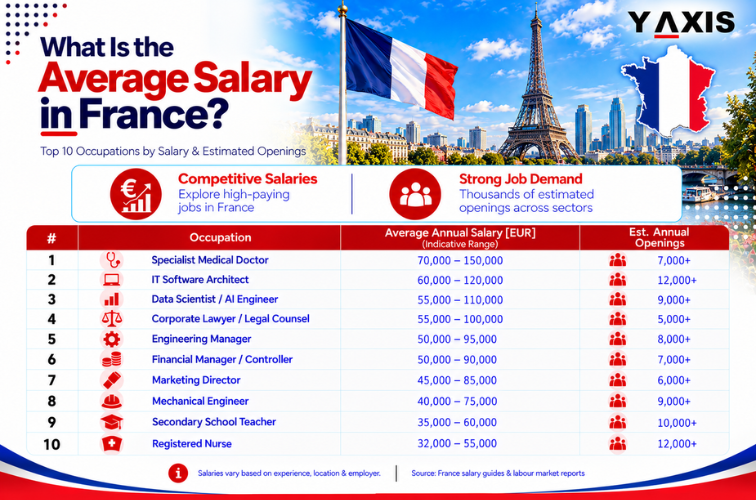
The average salary in France is about €43,200 (roughly ₹47.5 lakh) per year for full-time employees in the private sector. It comes to about €3,602 (₹3.96 lakh approx.) gross per month, or €2,733 net per month after social contributions. These figures come from INSEE, the French national statistics institute. Skilled professionals in medicine, law, finance, and IT often earn €60,000 to €150,000 or more per year. Salaries in France for foreign skilled workers also vary by region, city, and sector. Paris and the wider Île-de-France region pay the most, while Lyon, Toulouse, and Nice also offer competitive salaries.
*Want to work in France? Let Y-Axis guide you through the process.
Top 10 Highest-Paying Occupations in France
France job market mainly comprises sectors such as finance, IT, healthcare, aerospace, and engineering. Salaries for professionals in France vary widely by sector and region. Many high-demand roles in France is currently facing significant skill shortages. This keeps pay competitive, especially in healthcare, IT, and engineering sectors among others.
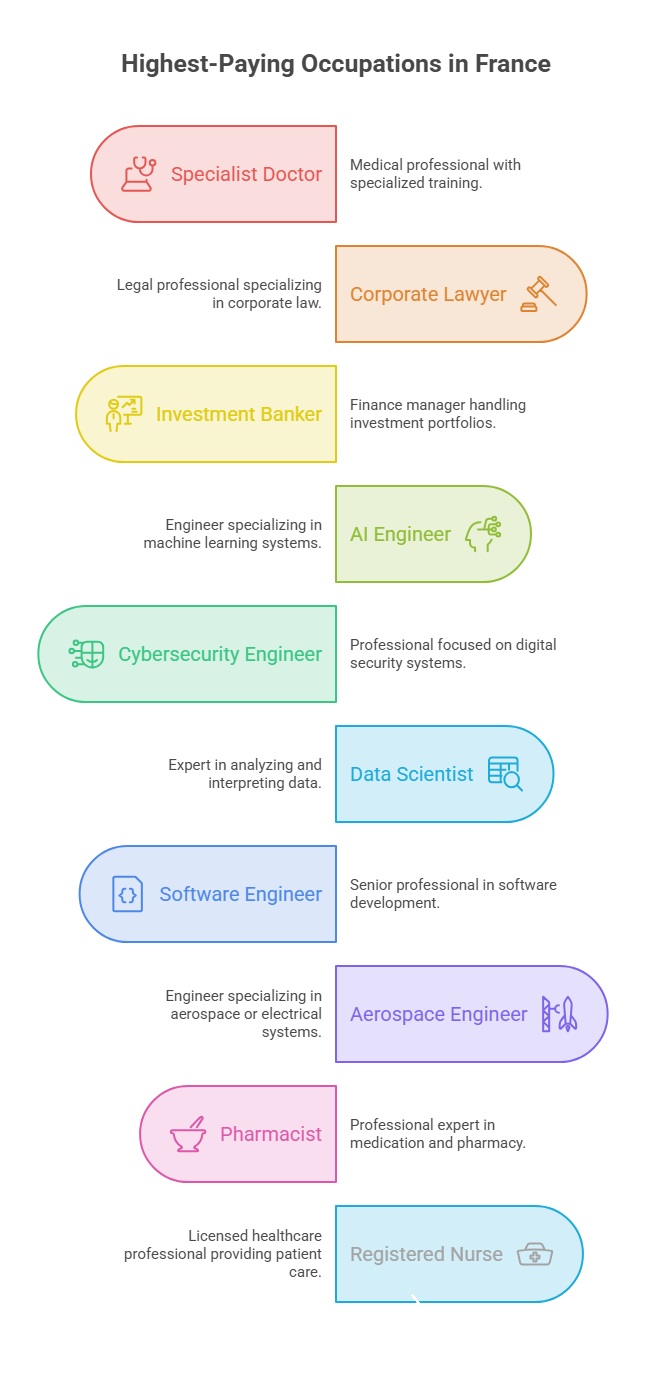
The table below highlights 10 occupations with strong salaries and steady hiring demand in France:
|
Occupation |
Average Annual Salary (EUR) |
Est. Annual Salary (INR) |
Demand Outlook |
|
Specialist Doctor |
€70,000-150,000+ |
₹77 lakh-1.65 crore+ |
Doctor shortages persist in many regions, especially outside large cities |
|
Corporate Lawyer |
€55,000-150,000 |
₹60.5 lakh-1.65 crore+ |
Top Paris law firms pay lawyers well above the national average |
|
Investment Banker / Finance Manager |
€60,000-150,000 |
₹66 lakh-1.65 crore+ |
Paris and La Défense sustain steady hiring in banking, insurance, and asset management |
|
AI / Machine Learning Engineer |
€50,000-95,000 |
₹55 lakh-1.05 crore |
Strong demand across technology, finance, and industry; AI skills command a premium |
|
Cybersecurity Engineer |
€45,000-80,000 |
₹49.5-88 lakh |
Rising demand as businesses and public bodies strengthen digital security |
|
Data Scientist |
€42,000-75,000 |
₹46.2-82.5 lakh |
Steady hiring in finance, retail, energy, and technology companies |
|
Senior Software Engineer |
€45,000-75,000 |
₹49.5-82.5 lakh |
Cloud, backend, and DevOps skills drive hiring in Paris, Lyon, and Toulouse |
|
Aerospace / Electrical Engineer |
€40,000-70,000 |
₹44-77 lakh |
Aerospace, energy transition, and rail projects keep demand high |
|
Pharmacist |
€40,000-60,000 |
₹44-66 lakh |
Steady demand across community pharmacies, hospitals, and the pharma industry |
|
Registered Nurse |
€28,000-40,000 |
₹30.8-44 lakh |
Hospitals and care homes continue to report nursing shortages |
Also, read...
Highest Paying Job Opportunities in France
Average Lifestyle Expenses in France
France offers strong salaries, but living costs vary widely by city. Housing is the largest expense, followed by groceries, utilities, and transport. Knowing these costs in advance helps you judge whether a salary offer in France is truly competitive.
- Rent (1-bed apartment, city centre, Paris): €1,200-1,800 per month
- Rent (1-bed apartment, other major cities, e.g. Lyon, Toulouse): €700-1,000 per month
- Groceries (single person): €250-350 per month
- Utilities (electricity, heating, and water, 1-2 bed flat): €100-180 per month
- Home insurance (required for tenants): €10-25 per month
- Public transport (Paris monthly Navigo pass, all zones): €90.80 per month, with 50% reimbursed by the employer
- Mobile and broadband plan: €25-50 per month combined
- Complementary health insurance (mutuelle), employee share: €20-60 per month
- Dining out (mid-range meal for two): €50-80
- Overall monthly budget, single person, excluding rent: €800-1,200
- Overall monthly budget, single person, including rent (comfortable baseline, Paris): €2,200-3,000
Note: Many professionals reduce costs by living in suburbs outside central Paris. Cities such as Lyon, Toulouse, Nantes, and Lille also offer competitive salaries with much lower rent and daily costs.
Also, read..
France Eases EU Blue Card Rules for Skilled Workers. Check Your Eligibility!
Salary Structure and Take-Home Pay in France
Employee social contributions are deducted first. They usually come to about 22% to 25% of gross pay and fund health insurance, pensions, and unemployment benefits. Income tax is then collected monthly at source by the employer. This is called prélèvement à la source. For one tax share, income up to €11,600 a year is tax-free. The rate of 11% applies from €11,601 to €29,579. The rate of 30% applies from €29,580 to €84,577. The rate of 41% applies from €84,578 to €181,917. The top rate of 45% applies above €181,917. A standard 10% deduction for work expenses is applied before tax. Married couples and families with children pay less, as income is shared across more tax shares under the family quotient system.
The table below shows illustrative gross monthly salary and approximate take-home pay for a single private-sector employee with one tax share. Figures are indicative only; actual take-home pay depends on your job status, collective agreement, family situation, and other income:
|
Gross Monthly Salary |
Mandatory Deductions (Social Contributions + Income Tax) |
Approx. Take-Home Pay |
|
€2,500 (~€30,000/year) |
~€611 (~24%) |
~€1,889 (~76%) |
|
€3,602 (~€43,224/year, France average) |
~€1,059 (~29%) |
~€2,543 (~71%) |
|
€4,500 (~€54,000/year) |
~€1,463 (~33%) |
~€3,037 (~67%) |
|
€6,000 (~€72,000/year) |
~€2,143 (~36%) |
~€3,857 (~64%) |
|
€8,333 (~€100,000/year) |
~€3,199 (~38%) |
~€5,134 (~62%) |
Also, read...
What are the Eligibility Requirements for a France Work Visa?
How France's Average Salary Compares to Other Countries
France pays more than many southern European countries. Its average full-time salary is about €43,200 gross a year. This is close to the UK's median full-time salary of about £39,000 (roughly €45,000). It is lower than Germany's median full-time salary of about €54,000. Switzerland, Ireland, the Netherlands, and Denmark also generally pay more. Spain, Italy, and Portugal generally pay less for similar roles. When comparing job offers, look at net income after social contributions, tax, rent, and living costs. This gives a more realistic view of how far your income will sustain your lifestyle in France.
France is especially attractive for professionals in IT, engineering, aerospace, healthcare, and finance. Paris is one of Europe's leading business and technology hubs. Employees also benefit from a 35-hour legal working week, at least five weeks of paid leave, and strong public healthcare. Salaries can vary significantly by region, city, experience, qualifications, and industry.
*Are you looking for step-by-step assistance with France immigration? Contact Y-Axis, the world's No. 1 overseas immigration consultancy, for end-to-end assistance!
FAQs
What is the average salary in France?
The average gross salary for full-time employees in the French private sector is about €3,602 per month, or €43,224 per year. After social contributions, this comes to about €2,733 net per month. These figures come from INSEE, the French national statistics institute. They are shown in full-time equivalent terms, so part-time pay is converted to a full-time basis for comparison.
What is the difference between average and median salary in France?
The average salary adds up all earnings and divides the total by the number of workers. A small group of very high earners pulls this figure upward. The median is the middle value, so half of all workers earn more and half earn less. In France, the median net salary is €2,190 per month, about 20% lower than the average net salary of €2,733.
Which jobs pay the highest salaries in France?
The highest-paying roles in France include specialist doctors, corporate lawyers, investment bankers, and finance managers. These professionals often earn €60,000 to €150,000 or more per year. AI engineers, cybersecurity engineers, and data scientists also earn well above the national average. Pay is highest in Paris and the Île-de-France region, which host major finance, legal, and technology employers.
Is there a minimum wage in France?
Yes. France has a statutory minimum wage called the SMIC. It is currently €12.31 gross per hour for workers aged 18 and over. For a full-time 35-hour week, this equals €1,867.02 gross per month, or about €1,478 net. The SMIC is reviewed every January. It also rises automatically during the year if inflation passes a set level.
How much tax do I pay on my salary in France?
France first deducts employee social contributions, which are usually about 22% to 25% of gross pay. Income tax is then collected monthly at source. For one tax share, income up to €11,600 a year is tax-free. Rates then rise from 11% to 30% and 41%, and a top rate of 45% applies above €181,917. Couples and families usually pay less under the family quotient system.
Is the average salary in France enough to live comfortably?
Yes, for most single people outside Paris. The average salary leaves about €2,543 per month after social contributions and income tax. This covers rent, bills, groceries, transport, and some savings in cities such as Lyon, Toulouse, or Nantes. In Paris, rent takes a much larger share of income. Shared housing or living in the suburbs helps an average salary go further.
Do foreign workers earn the same as local workers in France?
Yes. French law requires equal pay for equal work, regardless of nationality. Foreign workers must also receive at least the minimum wage and the minimum pay set by their collective agreement. For the Talent Passport – Qualified Employee, the gross salary must be at least €39,582 a year. This means many skilled foreign professionals earn above the national median.
What is a good salary in France for a single person?
A good salary for a single person in Paris is about €45,000 or more gross per year. This covers rent, living costs, and regular savings. In other cities, such as Lyon, Toulouse, or Lille, €35,000 or more per year is a realistic threshold, as rent and daily costs are lower. A gross salary above €60,000 per year places you well above the national average.
How does France's average salary compare to other countries?
France pays more than many southern European countries. Its average full-time salary of about €43,200 gross a year is close to the UK's median of about €45,000. It is lower than Germany's median of about €54,000. Switzerland, Ireland, and the Netherlands also generally pay more. Spain, Italy, and Portugal generally pay less. Comparing net income after tax and rent gives the most accurate picture.
What salary do I need for a France work visa?
It depends on the visa route. The Talent Passport – Qualified Employee needs a gross salary of at least €39,582 a year. The Talent Passport – EU Blue Card needs at least €59,373 a year. Other salaried work visas need at least the French minimum wage (SMIC). Salary thresholds are updated from time to time, so always check the official French government websites.
What is the standard working week in France?
The legal working week in France is 35 hours. Hours worked beyond this are usually paid as overtime, at a higher rate of 25% or 50%, unless a company agreement sets different rates. Maximum working time is generally 48 hours in a week. Full-time employees are entitled to five weeks of paid leave a year, plus public holidays.
Do French employers pay a 13th month salary or bonus?
A 13th month salary is common in France, but it is not required by law. It is usually set by the collective agreement, the employment contract, or company policy. Many employers also pay performance bonuses and profit-sharing. Always check whether a quoted annual salary is spread over 12 or 13 months, and whether it includes bonuses.
Why do salaries vary so much between French regions?
Salaries vary by region mainly due to industry concentration and cost of living. Paris and the Île-de-France region offer the highest pay. This region hosts most major finance, legal, technology, and consulting employers. Many rural regions report lower wages. Rent and living costs in these regions are also lower, so the gap in spending power is smaller.
Is healthcare included in my French salary?
Yes, in part. Your social contributions fund the public health insurance system, Assurance Maladie, which covers a large share of medical costs. Private-sector employers must also offer complementary health insurance, called a mutuelle, and pay at least 50% of its cost. The employee share is deducted from your salary. Check your job offer for the level of cover provided.
What work visas can Indian professionals use to work in France?
Indian professionals can work in France through several routes. The Talent Passport – Qualified Employee suits skilled workers with a master's degree. The Talent Passport – EU Blue Card suits highly qualified professionals with higher salaries. The salaried employee visa covers other jobs with a French employer. The India-France Young Professionals Scheme lets eligible Indians aged 18 to 35 work in France for up to 24 months.
How much does a software engineer earn in France?
A software engineer in France typically earns €38,000 to €55,000 gross per year. Senior software engineers often earn €55,000 to €75,000 or more. Pay depends on experience, technical skills, employer size, and city. Paris offers the highest salaries, while Lyon, Toulouse, Nantes, and Grenoble also have strong demand for software engineers.
What are the mandatory deductions from a French salary?
French employees see two main types of deductions on their payslip. Social contributions cover health insurance, pensions, and unemployment insurance, along with the CSG and CRDS social taxes. Income tax is then withheld at source by the employer. Together, these usually reduce gross pay by about 24% to 38%, depending on salary and family situation.
Which French city offers the best salary-to-cost-of-living ratio?
Toulouse, Lyon, Nantes, and Lille offer a strong balance of salary and living costs. These cities have growing job markets in aerospace, technology, healthcare, and industry. Rent is much lower than in Paris, often by 30% to 50%. This means professionals can often save more each month, even if their gross salary is slightly lower.
Do salaries in France increase with experience?
Yes. Salaries in France rise steadily with experience, especially in technical and management roles. Employees with managerial or professional status, known as cadres, earn an average of about €4,630 net per month. Moving into senior, specialist, or leadership roles usually brings the largest pay rises. Many collective agreements also set pay scales that rise with seniority.
What should I check before negotiating a French job offer?
Before negotiating a French job offer, research salary data for your role and city. Check whether the salary is quoted gross or net, and whether it is paid over 12 or 13 months. Review bonuses, meal vouchers, transport reimbursement, and the mutuelle health cover. Also check your working hours, extra days off (RTT), and the collective agreement that applies to your job.
Tags:
Average salary in France
France salary guide
cost of living in France
France income tax
highest paying jobs in France
work in France
France job market
take-home pay France
Share
Options for you by Y-Axis

Get it on your mobile

Get News alerts

Contact Y-Axis
Latest Article
Popular Post
Trending Article

Posted On September 30 2026
How Can I Get Permanent Residency in Denmark?