

Posted on October 09 2026
What Is the Average Salary in Finland?

By , Editor & Director
Updated October 09 2026
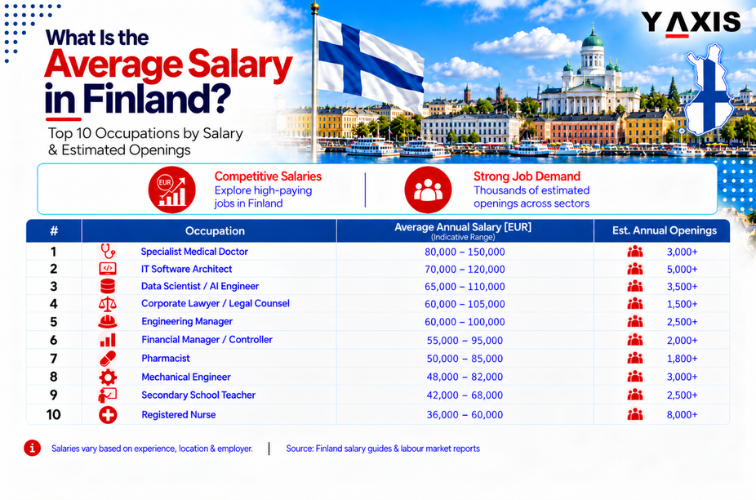
The average salary in Finland is about €51,648 (roughly ₹57 lakh) per year. This equals average gross earnings of €4,304 (₹4.7 lakh approx.) per month for full-time employees. This figure comes from Statistics Finland and includes performance-based bonuses. The median salary is lower, at about €3,615 per month, so half of full-time employees earn less than this. Information and communication pays the highest median salary, at €4,990 per month. Skilled professionals in IT, engineering, healthcare, and finance often earn €55,000 to €100,000 or more per year.
*Want to work in Finland? Let Y-Axis guide you through the process.
Top 10 Highest-Paying Occupations in Finland
Finland job market mainly comprises sectors such as information technology, engineering, manufacturing, healthcare, and clean energy. Salaries vary by sector, region, and experience. Uusimaa, the region around Helsinki, has the highest median pay, at about €3,967 per month. Many skilled roles in IT, healthcare, and engineering face ongoing talent shortages.
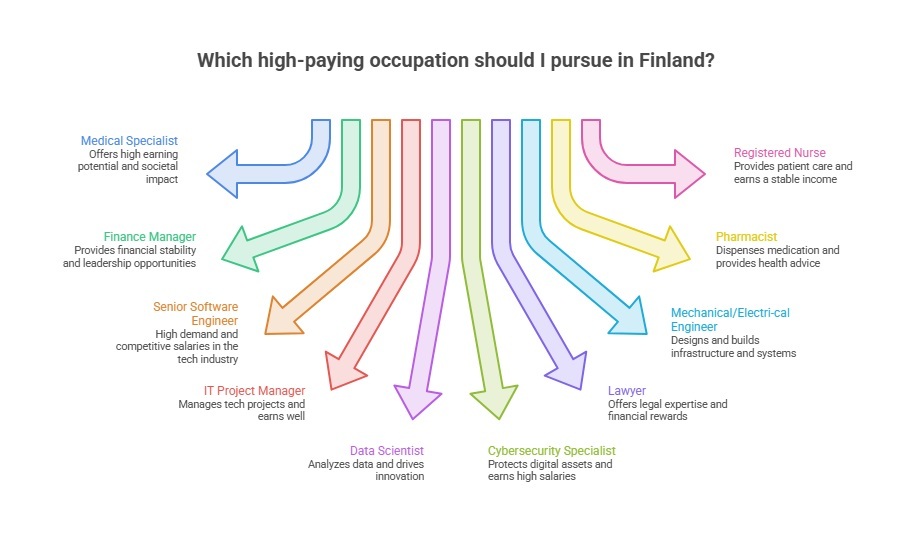
The table below highlights 10 occupations with strong salaries and steady hiring demand in Finland:
|
Occupation |
Average Annual Salary (EUR) |
Est. Annual Salary (INR) |
Demand Outlook |
|
Medical Specialist / Doctor |
€85,000-130,000 |
₹93.5 lakh-1.43 crore |
Strong demand in wellbeing services counties, especially outside major cities |
|
Finance Manager / Financial Controller |
€65,000-100,000 |
₹71.5 lakh-1.1 crore |
Steady hiring in banking, insurance, and large industrial companies |
|
Senior Software Engineer / Software Architect |
€60,000-85,000 |
₹66-93.5 lakh |
High demand across software, gaming, and telecom firms in Helsinki, Espoo, and Tampere |
|
IT Project Manager |
€58,000-82,000 |
₹63.8-90.2 lakh |
Steady demand as companies invest in digital and cloud projects |
|
Data Scientist / AI Specialist |
€55,000-80,000 |
₹60.5-88 lakh |
Growing demand in technology, finance, and research teams |
|
Cybersecurity Specialist |
€55,000-80,000 |
₹60.5-88 lakh |
Rising demand across the public sector, banking, and telecom |
|
Lawyer / Legal Counsel |
€55,000-90,000 |
₹60.5-99 lakh |
Steady demand in corporate law firms and in-house legal teams |
|
Mechanical / Electrical Engineer |
€48,000-72,000 |
₹52.8-79.2 lakh |
Strong demand in manufacturing, energy, and technology industries |
|
Pharmacist |
€42,000-62,000 |
₹46.2-68.2 lakh |
Steady demand across pharmacies, hospitals, and pharmaceutical companies |
|
Registered Nurse |
€36,000-46,000 |
₹39.6-50.6 lakh |
Hospitals and elderly care services continue to recruit nurses from abroad |
Also, read...
Highest Paying Job Opportunities in Finland
Average Lifestyle Expenses in Finland
Finland offers strong salaries in skilled sectors, but living costs vary by city. Rent is the largest expense, especially in central Helsinki. Knowing these costs in advance helps you judge whether a salary offer in Finland is truly competitive.
- Rent (1-bed apartment, central Helsinki): €1,000-1,400 per month
- Rent (1-bed apartment, other areas, e.g. Vantaa, Tampere, Oulu): €700-950 per month
- Groceries (single person): €300-400 per month
- Utilities (electricity, 1-bed flat; water is often included in rent): €40-90 per month
- Home insurance (often required by landlords): €8-15 per month
- Public transport (Helsinki HSL monthly ticket): €65-80 per month
- Mobile and broadband plan: €25-45 per month combined
- Gym membership: €30-60 per month
- Dining out (mid-range meal for two): €70-100
- Overall monthly budget, single person, excluding rent: €900-1,200
- Overall monthly budget, single person, including rent (comfortable baseline, central Helsinki): €2,000-2,600
Note: Many professionals reduce costs by living in outer Helsinki districts, Vantaa, or cities such as Tampere, Turku, and Oulu. These areas offer much lower rent while staying within easy reach of major employers.
Also, read...
Life in Finland for Immigrants: Jobs, Housing, Healthcare & PR
Salary Structure and Take-Home Pay in Finland
Finland deducts social insurance contributions and income tax from your salary. Employees pay 7.30% of gross pay for earnings-related pension (TyEL) and 0.89% for unemployment insurance. Health insurance contributions add about 2%. Income tax has two parts. State income tax is progressive, with rates from 12.64% to 37.50%. Municipal tax is a flat rate set by each municipality, averaging about 7.5%. Members of the Lutheran or Orthodox church also pay church tax. Your employer withholds tax using the rate on your tax card from the Finnish Tax Administration (Vero). Deductions and the earned income tax credit reduce tax for most employees.
The table below shows illustrative gross monthly salary and approximate take-home pay for a single employee with no church tax and an average municipal tax rate. Figures are indicative only; actual take-home pay depends on your municipality, deductions, and other income:
|
Gross Monthly Salary |
Mandatory Deductions (Social Insurance + Income Tax) |
Approx. Take-Home Pay |
|
€2,500 (~€30,000/year) |
~€420 (~17%) |
~€2,080 (~83%) |
|
€3,615 (~€43,380/year, Finland median) |
~€880 (~24%) |
~€2,735 (~76%) |
|
€4,304 (~€51,648/year, Finland average) |
~€1,220 (~28%) |
~€3,084 (~72%) |
|
€5,500 (~€66,000/year) |
~€1,840 (~33%) |
~€3,660 (~67%) |
|
€7,000 (~€84,000/year) |
~€2,640 (~38%) |
~€4,360 (~62%) |
Also, read...
What are the Eligibility Requirements for a Finland Work Visa?
How Finland's Average Salary Compares to Other Countries
Finland's average salary is about €51,648 a year for full-time employees. This is well above Southern European countries such as Spain, Portugal, and Malta. It is comparable to other Nordic countries such as Sweden. Denmark, Germany, and the Netherlands generally pay more. However, Finland offers strong public services funded by taxes, including healthcare and free education. When comparing job offers, assess the net income after tax, rent, and living costs. This gives a more realistic view of how far your income will go.
Finland is especially attractive for professionals in IT, engineering, healthcare, and research. English is widely used in technology companies and international workplaces. Finland is an EU member with a strong focus on work-life balance. Skilled professionals earning at least €3,937 per month can apply for a Specialist residence permit or an EU Blue Card. Salaries can vary significantly by sector, experience, qualifications, and employer.
*Are you looking for step-by-step assistance with Finland immigration? Contact Y-Axis, the world's No. 1 overseas immigration consultancy, for end-to-end assistance!
FAQs
What is the average salary in Finland?
The average gross salary for full-time employees in Finland is about €4,304 per month, or roughly €51,648 per year. This figure comes from Statistics Finland's index of wage and salary earnings. It includes performance-based bonuses and is measured before tax and social insurance contributions. Part-time workers are not included, so the figure reflects full-time pay only.
What is the difference between average and median salary in Finland?
The average salary adds all salaries and divides the total by the number of employees. A small number of high earners pulls it upward. The median is the middle salary, where half of employees earn more and half earn less. In Finland, the median for full-time employees is about €3,615 per month, compared with an average of about €4,304. The median often gives a more realistic benchmark.
Which jobs pay the highest salaries in Finland?
The highest-paying roles in Finland include medical specialists, finance managers, senior software engineers, and IT project managers. These professionals often earn €60,000 to €130,000 per year. Data scientists, cybersecurity specialists, and lawyers also earn well above the national average. By sector, information and communication pays the highest median salary, at about €4,990 per month.
Is there a minimum wage in Finland?
No. Finland does not have a statutory national minimum wage. Instead, minimum pay is set through collective agreements for each industry. Many of these agreements are generally binding. This means all employers in that sector must follow them, even if they are not members of an employers' association. The Finnish Immigration Service also sets minimum salaries for work-based residence permits.
How much tax do I pay on my salary in Finland?
Finnish employees pay state income tax, municipal tax, and social insurance contributions. State tax is progressive, with rates from 12.64% to 37.50%. Municipal tax is a flat rate that averages about 7.5%. Employees also pay 7.30% for pension, 0.89% for unemployment insurance, and about 2% for health insurance. Deductions and the earned income tax credit reduce the total tax for most employees.
Is the average salary in Finland enough to live comfortably?
Yes, for most single people. The average salary of about €4,304 per month leaves roughly €3,080 after tax and social insurance contributions. This covers rent, bills, groceries, and regular savings in most Finnish cities. In central Helsinki, rent takes a larger share of income. Living in Vantaa, Tampere, Turku, or Oulu helps an average salary go further.
Do foreign workers earn the same as local workers in Finland?
Yes. Finnish law prohibits discrimination at work based on nationality or origin. Foreign workers must receive at least the minimum pay set in the collective agreement for their sector. Indian professionals in skilled roles, such as IT, engineering, and research, often earn above the national median. Their pay depends on experience, qualifications, language skills, and the employer.
What is a good salary in Finland for a single person?
A good salary for a single person in Finland is about €4,000 or more gross per month, or €48,000 per year. This covers rent, living costs, and regular savings in most cities. In central Helsinki, €4,500 or more per month is a more comfortable target. A gross salary above about €6,100 per month places you in the top 10% of full-time employees.
How does Finland's average salary compare to other countries?
Finland's average salary of about €51,648 a year is well above Spain, Portugal, and Malta. It is comparable to other Nordic countries such as Sweden. Denmark, Germany, and the Netherlands generally pay more. However, Finland offers strong public services funded by taxes, including healthcare and free education. Comparing net income after tax and rent gives the most accurate picture of spending power.
What do I need to get a work permit in Finland?
Indian nationals usually need a work-based residence permit and a job offer from a Finnish employer. The residence permit for an employed person requires a salary of at least €1,600 per month. Specialists and EU Blue Card applicants need at least €3,937 gross per month. Applications are made online through Enter Finland and processed by the Finnish Immigration Service (Migri).
What is the standard working week in Finland?
The standard full-time working week in Finland is up to 40 hours, or 8 hours a day. Many collective agreements set shorter hours, often 37.5 hours a week. Daily overtime is paid at 50% extra for the first two hours and 100% extra after that. Employees also earn 2 to 2.5 days of paid annual leave for each full month worked.
Do Finnish employers pay holiday bonuses?
Yes, in most sectors. Many collective agreements include a holiday bonus, known as lomaraha. It is usually 50% of the holiday pay for your annual leave. The Annual Holidays Act does not require this bonus, but most collective agreements make it mandatory. Many employers in IT, finance, and industry also pay performance bonuses.
Which sector pays the most in Finland?
Information and communication pays the highest median salary in Finland, at about €4,990 per month. This sector includes software, telecom, and IT services. Financial and insurance activities also pay well, and the top 10% in this sector earn at least €8,444 per month. Accommodation and food service activities pay the least, with a median of about €2,720 per month.
Is healthcare included in my Finnish salary?
Yes, in part. Residents covered by Finnish social security can use public healthcare from wellbeing services counties for low fees. Employers must also provide occupational healthcare, which covers preventive care. Many employers also include general medical treatment. Some employers in IT and finance offer extra private health insurance. Check your job offer to see what is included.
What work visas can Indian professionals use to work in Finland?
Indian professionals can work in Finland through several routes. The residence permit for an employed person suits most jobs with a Finnish employer. The Specialist residence permit is for experts earning at least €3,937 per month. The EU Blue Card suits highly qualified professionals with a degree and a job of at least six months. Researchers and start-up founders have separate permits.
How much does a software engineer earn in Finland?
A software engineer in Finland typically earns €45,000 to €65,000 gross per year. Senior software engineers and architects often earn €60,000 to €85,000 or more. Pay depends on experience, technical skills, and the employer. Companies in Helsinki, Espoo, and Tampere usually offer the highest salaries, along with benefits such as occupational healthcare, lunch benefits, and flexible working.
What are the mandatory deductions from a Finnish salary?
Finnish employees see several deductions on their payslip. Income tax is withheld using the rate on your tax card, which covers state, municipal, and church tax where it applies. Employees also pay 7.30% for earnings-related pension and 0.89% for unemployment insurance. Health insurance contributions are also deducted. Together, these usually reduce gross pay by about 17% to 38%.
Which areas in Finland offer the best salary-to-cost-of-living balance?
Cities such as Tampere, Turku, Oulu, and Jyväskylä offer a good balance of rent and job opportunities. They have growing technology, engineering, and research sectors, but lower rent than Helsinki. Vantaa and outer Helsinki districts also offer lower rent with easy access to the capital. Efficient public transport helps professionals save on daily travel.
Do salaries in Finland increase with experience?
Yes. Salaries in Finland rise steadily with experience, especially in technical and management roles. Average earnings of full-time employees grew by about 3.4% over the latest year, according to Statistics Finland. Managers have seen the fastest long-term earnings growth of any occupational group. Moving into senior or specialist roles brings the largest pay rises.
What should I check before negotiating a Finnish job offer?
Before negotiating a job offer in Finland, research salary data for your role and sector. Check whether the salary meets the collective agreement and residence permit minimums. Review holiday bonuses, occupational healthcare, lunch and commuting benefits, and relocation support. Also check your working hours, annual leave, probation period, and whether the employer will support your residence permit application.
Tags:
Average salary in Finland
Finland salary guide
cost of living in Finland
Finland income tax
highest paying jobs in Finland
work in Finland
Finland job market
take-home pay Finland
Share
Options for you by Y-Axis

Get it on your mobile

Get News alerts

Contact Y-Axis
Latest Article
Popular Post
Trending Article
Posted On October 09 2026
Canada’s Immigration Reset: Why the Next Move May Be About Fit, Not Volume