

Posted on January 23 2026
10 Million Jobs in Europe Over the Next Decade – Freshers, Experienced & Professionals Can Apply

By , Editor
Updated February 02 2026
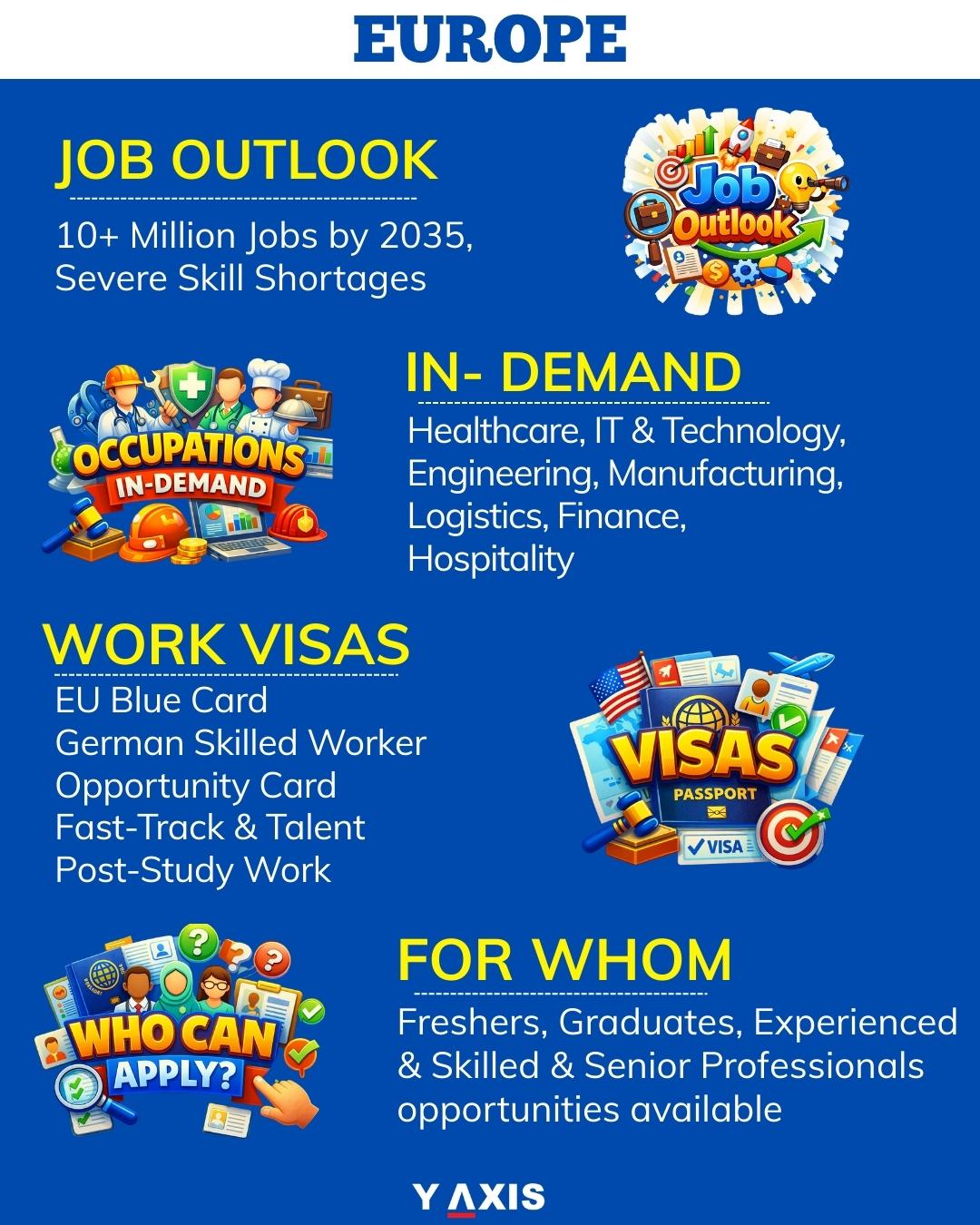
Europe will likely have around 10 million job vacancies in the coming decade, with opportunities available for freshers, mid-level, experienced, and senior professionals. The large-scale demand for skilled workers from abroad is mainly driven by low birth rates, an aging population, expanding industries, and a high rate of retirement across several European countries.
To retain the public service sectors and economic growth in European nations, more international talent will be encouraged from overseas countries, including India. Indians can expect job opportunities at all experience levels across top European sectors such as healthcare, IT and technology, finance, engineering, and logistics. European countries offer streamlined work visa options that come with long-term residency benefits.
If you plan to work abroad but do not want to choose countries like Canada, Australia, or the US, you can explore Europe.
Europe is one of the most attractive and top-ranked destinations for Indians looking to build a successful career abroad.
*Want to work in European countries? Sign up with Y-Axis for complete end-to-end counseling.
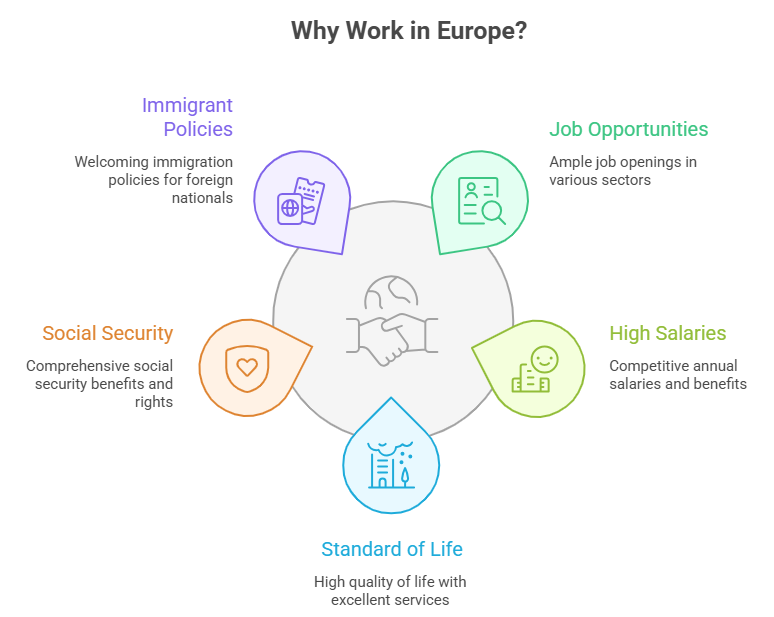
Why Work in Europe?
International professionals, especially Indians, can gain many benefits from working in Europe, including high salaries, global exposure, strong employee protection rights, and, above all, a high quality of life. There is a massive workforce shortage in many countries across Europe due to factors such as an aging population, rising retirement rates, low birth rates, and increased demand for skilled labour in top industries. The European nations are known for their innovation hubs and strong economy, with opportunities for all experience levels.
Here are some reasons why you should consider working in Europe:
- Plenty of job opportunities: All the European countries combined will likely have 10 million job opportunities in the coming decade. Top sectors like Healthcare, IT, engineering, green energy, construction, etc., will experience workforce retirements, leading to new job creation.
- High salaries & employee benefits: The annual salary packages across Europe are highly competitive, ranging from €55,000 to €105,000, based on your job role, industry, and experience level. Skilled professionals in the finance, healthcare, engineering, and IT sectors can benefit from higher salaries and other employee benefits, such as bonuses, allowances, and paid annual leave.
- High standard of living: European countries are known to rank among the top in terms of safety, living conditions, environmental quality, and healthcare and education systems. Individuals living in Europe can enjoy efficient and reliable public transportation, clean cities, and access to other well-maintained public services.
- Social security benefits & employee rights: European countries are known for their labour laws, which provide employees with sick leave, annual paid leave, work-life balance, pension schemes, unemployment benefits, and robust public healthcare facilities, promising long-term financial and social security benefits.
- Immigrant-friendly policies & settlement options: Europe offers streamlined immigration pathways for foreign nationals, including the EU Blue Card, post-study work visa options, and country-specific work visa pathways. Most of these immigration routes lead to permanent residency and, in the long run, to potential citizenship.
*Want to work abroad? Let Y-Axis guide you with the steps.
Job Outlook in Europe for the Next 10 Years
The European Job Market is set to remain positive and strong, with plenty of opportunities across key industries, driven by workforce shortages, skill requirements, and an ageing population. Most European countries are currently facing a decline in the working-age population, which is driving demand for foreign professionals to support public services and economic growth. Over the next 10 years, the European labour market will have plenty of openings that require global talent, with long-term employment options for recent graduates, mid-level and highly experienced specialists across top sectors.
Employment trends in Europe over the next decade
Given below are the top 5 employment trends in Europe over the next 10 years:
Here are the five key employment trends expected to shape Europe’s labour market over the next 10 years:
- Workforce that is driven by immigration: Europe will heavily depend on international skilled workers as countries face high retirement rates and low birth rates. Immigrants will play an important role in shaping the European economy by contributing to healthcare systems, supporting industries, and other service sectors.
- High demand for social services & healthcare: The aging population in European countries will directly increase demand for healthcare professionals, such as nurses, caregivers, medical technicians, allied health professionals, and physiotherapists, making it one of the top sectors to work in over the next decade.
- Technology-driven and digital roles: European countries are said to be making heavy investments in the digital sector for digital transformation, particularly in cloud computing, AI, data analytics, data specialization, and cybersecurity.
- Need for professionals in engineering, skilled trades, and construction: There will be more projects related to infrastructure development, Green energy, and sustainability transformation, which will require skilled engineers, technicians, construction workers, and skilled trades workers.
- More opportunities in semi-urban and regional areas: Alongside the increasing job opportunities in mainland European countries, there will also be a rise in opportunities in rural and semi-urban areas, mainly in regional development projects, logistics, manufacturing, and healthcare.
Read more…
Your guide to the European job market
Employment Opportunities Expected Over the Next Decade in Europe
Europe is projecting more than 10 million job opportunities in the coming decade, a combination of new job creation and the replacement of the existing workforce. Most European countries are currently experiencing an aging workforce, with reduced birth rates and increased retirement rates, leading to a large-scale hiring effort to meet labour market demand.
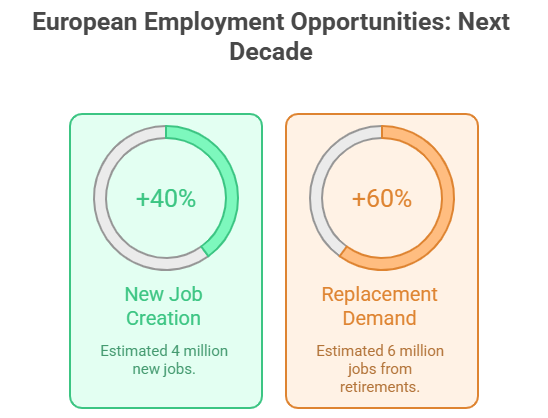
Sectors like technology, green energy, healthcare, social services, engineering, and construction will have the most job openings for skilled overseas professionals over the next decade.
|
Category |
Estimated Jobs |
|
New job creation |
~4 million |
|
Replacement demand (retirements & workforce exits) |
~6 million |
|
Total employment opportunities |
10 million+ |
Also, read…
Top 9 Jobs in demand in Europe to get work visa easily
Who Can Apply for Jobs in Europe?
The job market in Europe offers a varied range of opportunities for skilled foreign professionals at all experience levels, amid reduced birth rates, an ageing population, and persistent labour market shortages. To balance economic growth and the public service sector, Europe will actively hire foreign talent in high-priority sectors such as IT, healthcare, finance, logistics, manufacturing, engineering, and education.
You can apply for jobs in Europe as a recent graduate, a fresher, an experienced professional, or a senior professional.
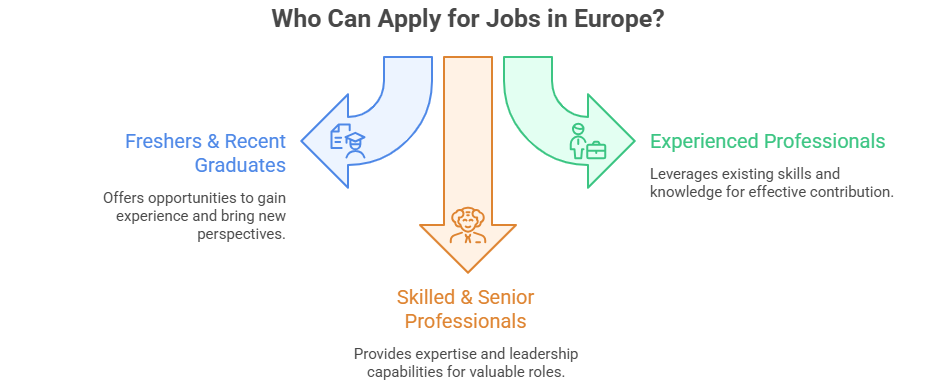
Freshers & Recent Graduates
Recent graduates or freshers from India can apply for junior roles or entry-level positions in high-priority sectors such as hospitality, logistics, business services, engineering support, IT, and customer support. Most European countries also offer post-study work options for international students who graduate from universities across Europe. This gives them a chance to stay in the country and acquire work experience. International graduates with the required qualifications, language skills, and job-specific skills will have a better chance of obtaining employer sponsorship and long-term settlement.
Experienced Professionals
Skilled professionals with 2-7 years of experience in top sectors such as healthcare, IT, finance, engineering, logistics, and education will face strong demand across Europe. Employers in European countries will actively hire skilled professionals for specialised and mid-level roles, which offer high salaries, stable career growth, and employer-sponsored work visas. You must have prior experience and qualifications, and meet the language requirements to gain a competitive edge over other applicants.
Skilled and Senior Professionals
Senior, highly skilled professionals will be required for critical job roles that require a high level of specialization and leadership. Senior professionals are often offered high salaries, long-term job contracts, and fast-track hiring pathways, such as the EU Blue Card or other country-specific work visa options. To avail of these benefits, you must be highly experienced in your niche, have strong academic qualifications, and have global work experience to live, work, and obtain long-term settlement in Europe.
*Want to apply for jobs abroad? Get in touch with experts at Y-Axis to guide you with the steps.
Top 8 European Countries Hiring Foreign Professionals
While there will be high demand for skilled professionals across Europe, not all countries will have the same rate of employment or talent recruitment. While some European countries have high skill shortages, others are already developed and may not face severe labour shortages.
The table below has the list of the top 8 European countries to live, work, and settle in, along with the high-demand sectors and average salaries:
|
Country |
Key In-Demand Sectors |
Average Annual Salary |
|
Germany |
IT, Engineering, Healthcare, Manufacturing, Skilled Trades |
€55,000 – €85,000 |
|
United Kingdom |
IT, Healthcare, Finance, Construction, Education |
£45,000 – £75,000 |
|
Netherlands |
IT, Data & AI, Engineering, Logistics, Finance |
€55,000 – €90,000 |
|
Ireland |
IT, Tech, Pharma, Finance, Healthcare |
€60,000 – €95,000 |
|
France |
Engineering, IT, Healthcare, Aerospace, Construction |
€45,000 – €75,000 |
|
Sweden |
IT, Engineering, Green Energy, Manufacturing |
€50,000 – €80,000 |
|
Spain |
IT, Hospitality, Healthcare, Construction |
€40,000 – €55,000 |
|
Portugal |
IT, Tech Start-ups, Tourism, Services |
€45,000 – €55,000 |
Also, read…
Europe Job Vacancy Guide: What Employers Really Want
Most In-Demand Jobs in Europe
You can find the most in-demand jobs in Europe in healthcare, engineering, IT, technology, finance, skilled trades, social services, and logistics.
The table below has the list of the top in-demand job occupations in Europe, along with the approximate job opportunities in the next 10 years and average annual salaries:
|
Occupation / Industry |
Estimated Job Opportunities (Next 10 Years) |
Average Salary per Year |
|
Healthcare & Social Care |
2,600,000+ |
€50,000 – €80,000 |
|
Information Technology (IT & Tech) |
2,100,000+ |
€60,000 – €90,000 |
|
Engineering (All Streams) |
1,700,000+ |
€55,000 – €85,000 |
|
Skilled Trades & Construction |
1,500,000+ |
€45,000 – €70,000 |
|
Manufacturing & Industrial Jobs |
900,000+ |
€45,000 – €70,000 |
|
Logistics & Transportation |
800,000+ |
€40,000 – €65,000 |
|
Banking, Finance & Business Services |
700,000+ |
€60,000 – €90,000 |
|
Hospitality & Tourism |
700,000+ |
€45,000 – €60,000 |
Note: The figures in the table above are estimates and may vary by European country, job role, and industry type. However, the European labour market is expected to create 10 million jobs over the next 10 years.
Read more…
Highest Paying Jobs in Europe for Indians
Industry-Wise Career Opportunities in Europe
Industries such as IT and technology, healthcare, finance, logistics, and hospitality will offer the most job opportunities in Europe over the coming decade. The new jobs will be due to the retiring workforce, an aging population, infrastructure development, and green energy initiatives across Europe.
The table below has an industry-wise breakdown of the different career opportunities in Europe, along with the high-demand job roles:
|
Industry |
In-Demand Job Roles |
|
Healthcare & Social Care |
Doctors, Nurses, Care Workers, Physiotherapists, Medical Assistants, and Elderly Care Specialists |
|
IT & Technology |
Software Developers, Data Analysts, AI & Machine Learning Engineers, Cybersecurity Specialists, Cloud Engineers |
|
Engineering |
Mechanical Engineers, Electrical Engineers, Civil Engineers, Industrial Engineers, Renewable Energy Engineers |
|
Construction & Skilled Trades |
Electricians, Plumbers, Welders, Carpenters, HVAC Technicians, Construction Supervisors |
|
Manufacturing & Industrial |
Production Engineers, Quality Control Specialists, CNC Operators, Maintenance Supervisors |
|
Finance & Business Services |
Financial Analysts, Accountants, Auditors, Risk Analysts, Business Consultants |
|
Logistics & Transportation |
Supply Chain Coordinators, Logistics Managers, Warehouse Supervisors, Transport Planners |
|
Education & Training |
School Teachers, Language Trainers, Academic Coordinators, Teaching Assistants |
|
Hospitality & Tourism |
Hotel Managers, Chefs, Restaurant Supervisors, Food & Beverage Managers |
|
Retail & Customer Service |
Store Managers, Sales Executives, Customer Service Representatives |
Also, read…
Important information about working in Europe
Work Visas in Europe
To legally work in Europe, foreign nationals require a valid work visa or residence permit, which is generally issued by the European country where they wish to work. The work visa rules vary by country, but most work visas in Europe require a valid employment offer from an employer authorized to hire skilled foreign nationals.
Most countries in Europe follow a standard skilled migration process, along with an EU Blue Card and country-specific work visas. Choosing the right European work visa depends on your qualifications, experience, salary level, job role, occupation, and long-term settlement options.
Europe Work Visas for Indians
While different European countries offer various work visas, the following is a list of the most common work visas in Europe for Indians:
EU Blue Card (For Highly Skilled Professionals)
The EU Blue Card is one of the most widely chosen work visa options in Europe for highly skilled foreign nationals. Countries like France, Germany, Sweden, and the Netherlands, among others, have already implemented the EU Blue Card. With an EU Blue card, you can get benefits like family reunification, long-term residency, job mobility, and PR after meeting the qualifying residency period. To qualify for an EU Blue card, you must have a recognized university degree, skills relevant to the chosen shortage occupation, and a job offer that meets the minimum salary threshold.
*Want to apply for an EU Blue Card? Let Y-Axis guide you with the steps.
Country-Specific Skilled Worker Visas
Each European country has its own set of worker visas depending on its labour market needs. Professionals in the healthcare, IT, construction, engineering, logistics, education, and skilled trades can apply for these work visas. These visa options generally require employer sponsorship, provide renewable residence permits, and can even lead to PR upon eligibility.
Some of the most common work visas in European countries are as follows:
- Germany Skilled Worker Visa
- UK Skilled Worker Visa
- Netherlands Highly Skilled Migrant Visa
- France Talent Passport
- Ireland Critical Skills Employment Permit
Fast-Track & Talent Visas
Most European countries provide fast-track or talent visas for individuals with high salaries, skills, and advanced experience. Talent visas generally come with faster processing, easier access to long-term residence, and other benefits. Talent visas are ideal for tech, finance, research, corporate and, healthcare professionals.
Post-Study Work Options in Europe (For International Graduates)
International students graduating from universities across Europe can either stay in the country to look for employment or apply for a work visa, depending on their country of choice. Most European countries offer post-study residence permits, which allow graduates to seek employment and convert to a longer-duration work visa.
Also, read…
Cost of Living in Europe
Living costs in Europe depend on the city, country, lifestyle, and accommodation choices. Some major European cities, like Paris, Amsterdam, Stockholm, and London, are usually expensive, while Southern and Eastern European countries are affordable. Europe maintains a high quality of life, a strong social security system, and a safe environment for expats.
On average, a single person may need around €1,200-€2,000 per month in Europe, covering basic living expenses such as food, rent, and transportation. Choosing to live in the countryside or in shared accommodation can reduce your monthly costs.
|
Expense Category |
Average Monthly Cost (€) |
|
Rent (1-bedroom apartment, city centre) |
€700 – €1,200 |
|
Rent (1-bedroom apartment, outside city centre) |
€500 – €900 |
|
Groceries & food |
€250 – €400 |
|
Utilities (electricity, heating, water) |
€120 – €180 |
|
Internet & mobile phone |
€50 – €70 |
|
Public transportation |
€70 – €120 |
|
Health insurance / medical expenses |
Mostly covered (public healthcare) |
|
Miscellaneous & personal expenses |
€150 – €250 |
Note: The cost of living in Europe in the above table is approximate and may vary by country, housing type, city, and lifestyle. Eastern & Southern Europe provide an affordable lifestyle, while Western & Northern Europe are expensive.
Also, read…
Is it possible to live in Europe with $2,000 per month?
How to Apply for a Work Visa in Europe from India?
The process for applying for a work visa in Europe from India may vary depending on the country you are applying to. However, the following are the general steps to apply for a European work visa:
Step 1: Check whether you are eligible to work in Europe based on your academic qualifications, language requirements, and work experience.
Step 2: Select the work visa pathway that best suits your requirements (EU Blue card or other country-specific work visa)
Step 3: Apply for jobs in Europe through trusted job search platforms and choose companies that offer visa sponsorship.
Step 4: Get a job offer from an employer in Europe, who will initiate your work or residence permit process.
Step 5: Arrange the required documents for the visa (passport, offer letter, job contract, educational qualifications, proof of funds, work experience, etc.).
Step 6: Apply for a work visa or residence permit in Europe (depending on the country) at the nearest country-relevant embassy.
Step 7: Complete the visa application fee payment as per the chosen country.
Step 8: Schedule and attend the biometric appointment.
Step 9: Fly to the European country of your choice after receiving approval for your work visa.
Also, read…
Want to work in Europe? Here are the top 5 easiest EU countries to get a work visa
When Is the Best Time to Apply for Jobs in Europe?
Now would be a great time to apply for jobs in Europe, as countries across the region are experiencing labour shortages in key industries. Reduced birth rates, an ageing population, and more retirements are among the reasons for a significant demand for skilled foreign workers.
Sectors such as IT and technology, engineering, healthcare and social care, construction, manufacturing, logistics, finance, and hospitality are currently seeking overseas talent at all experience levels, including freshers, experienced, and senior professionals. Employers in Europe are actively recruiting foreign talent, with flexible work visa options and visa sponsorships. You can boost your chances of getting a high-paying job in Europe by applying well in advance.
*Are you looking for step-by-step assistance with overseas immigration? Contact Y-Axis, the world’s No. 1 overseas immigration consultancy, for end-to-end assistance!
FAQs
What does the projection of 10 million jobs in Europe mean?
The 10 million jobs in Europe over the next decade represent the total job opportunities across different European countries. The new opportunities will be a combination of replacing current job roles and creating new jobs. The 10 million job projection in Europe reflects high demand for skilled workers in top sectors and industries, with long-term benefits and continued job prospects for international workers.
Which European countries are expected to hire the most workers?
Some of the European countries expected to hire the most workers include Ireland, Spain, Germany, the Netherlands, the UK, France, and Sweden. These countries will likely have more job opportunities due to factors such as an ageing population and skill shortages in key sectors. These European countries also provide streamlined worker visas and structured immigration pathways for foreign workers to enter and work in the country.
Which sectors will contribute most to Europe’s job growth?
Some of the sectors that will contribute the most to the European job growth are engineering, IT and technology, healthcare and social care, finance, skilled trades, and logistics. Green energy initiatives, public healthcare requirements, infrastructure expansion, and digital transformation are among the main factors driving this demand.
Can freshers apply for jobs in Europe?
Yes, freshers and recent graduates can apply for junior and entry-level roles across Europe. They can apply for jobs in business services, logistics, hospitality, IT support, and engineering support, as there are plenty of opportunities for freshers. International students graduating from European countries can benefit from post-study work visa options that make it easier for them to enter the European workforce.
Are there opportunities for experienced professionals in Europe?
Yes, there are opportunities for experienced professionals in Europe, especially if you have 2-8 years of professional experience. Mid-level professionals in engineering, IT, healthcare, logistics, finance, and construction can get hired by European employers, with competitive salaries, employer-sponsored visa options, and long-term employment options.
Do senior professionals have better chances of employment in Europe?
Yes, senior professionals do have better employment prospects across European countries, especially in leadership and specialist roles. Senior professionals can earn higher salaries, secure fast-track visa and immigration options, and secure long-term employment benefits by working in Europe.
Why is Europe facing labour shortages?
Yes, Europe is currently facing skilled labour shortages due to its ageing population, high retirement rates, and low birth rates. Most European countries require local workers to replace the retiring workforce, particularly in high-demand sectors, where they rely on foreign professionals to maintain their economies.
Is Europe open to hiring foreign workers from India?
Yes, Europe is currently welcoming skilled workers from India, particularly in sectors that are facing workforce shortages. Most European employers offer sponsored work visas and long-term settlement benefits. Indians are considered a major source of skilled and qualified talent.
What work visa options are available for Indians in Europe?
The work visa options in Europe are many, depending on the country you are applying for. While the EU Blue Card is one of the most common work visa options, the type of visa you apply for depends on the European country you choose to work in. Some of the work visas available in Europe include the German Skilled Worker Visa, the UK Skilled Worker Visa, the Ireland Critical Skills Employment Permit, the France Talent Passport, and the Netherlands Highly Skilled Migrant Visa.
Do European work visas allow family members to join?
Yes, most European work visas allow family members, such as the spouse and dependent children, to join you through family reunification. Family members of the primary visa applicant can live, work, and even study in the European country. However, the criteria and requirements vary by country and the work visa you are applying for.
Can jobs in Europe lead to permanent residence?
Yes, in general, jobs or work in Europe can eventually lead to permanent residence after 5 years, provided they meet residency requirements, such as legal, consecutive, and authorized employment with a valid work permit. The EU Blue Card is one of the fastest work visa options for highly specialized individuals to qualify for permanent residency, provided they fulfill the PR requirements. You will be required to meet specific residency, income, and integration requirements to apply for PR, depending on the European country you have chosen.
What salary range can professionals expect in Europe?
Salaries for professionals in Europe vary by country, occupation, job role, location, qualifications, and experience level. On average, skilled professionals can earn between €55,000 and €90,000, depending on their role. Skilled and experienced professionals in top sectors such as healthcare, IT, engineering, and finance can earn higher salaries and receive additional benefits.
Is language proficiency mandatory to work in Europe?
Language proficiency is not mandatory for working in Europe, as most EU countries do not have strict language requirements. However, it is definitely required and beneficial when applying for jobs in European countries and for better integration into Europe. Most job roles in Europe use English as the standard language, and English proficiency is required for English-speaking roles such as those in MNCs, engineering, and IT.
Are post-study work options available in Europe?
Yes, most European countries offer post-study work options for international students to reside and work in the country even after graduation. The PSWVs issued by European countries generally have a validity of 12-18 months. Some of the most common and popular countries that offer post-study work visas include Germany (18 months), the Netherlands (12 months), France (1-2 years), and Ireland (1-2 years). With a post-study work visa, qualifying graduates can convert to long-term work visa pathways.
How does replacement demand impact Europe’s job market?
Replacement demand generally refers to job roles that become available or vacant due to a retiring workforce or the exit of existing workers. Replacement demand will have a significant impact on the European job market, contributing to job opportunities in Europe over the coming decade. This also indicates that there will be continuous recruitment across European countries due to these factors.
Are jobs in Europe concentrated only in major cities?
No, jobs in Europe are not just concentrated in major cities. While a majority of job opportunities will exist in European cities, EU countries are now promoting employment even in regional and semi-urban areas. The European government is now taking initiatives to encourage the intake of skilled foreign workers in cities and rural areas that have a massive demand in the logistics, healthcare, manufacturing, and construction sectors.
Is Europe a good long-term career destination?
Yes, Europe is a good destination if you are looking for long-term career prospects. European countries offer a high quality of life, increasing demand for skilled professionals across top sectors, competitive salaries, and other employee benefits. However, your experience depends on the country you choose, the industry you work in, your job role, the salary offered, and the work culture.
How does Europe compare to other regions for working abroad?
Europe is definitely a good choice for working abroad, as it is known for the high quality of life, social security benefits, strong labour laws, public healthcare, and long-term settlement benefits. Europe can be a better option than other regions, as it offers a streamlined immigration system, a stable career, and plenty of job opportunities for skilled professionals.
When is the best time to apply for jobs in Europe?
Now is the best time to apply for jobs in Europe, as countries are experiencing workforce shortages across sectors such as IT, engineering, healthcare, and construction. The European countries are set to create over 10 million jobs in the coming 10 years, and applying in advance improves your chances of securing a job offer, including employer sponsorship, long-term work, and residence pathways.
Do European jobs offer social security benefits?
Yes, Europe is known for its strong social security system, and European jobs offer benefits such as unemployment benefits, pension schemes, healthcare, and paid leave. These social security benefits are among the key factors that lead to financial stability and a high quality of life for skilled foreign workers.
Tags:
Jobs in Europe
10 Million Jobs in Europe Over the Next Decade
Jobs in Europe for Indians
Work in Europe
high paying jobs in Europe
salaries in Europe
Europe work visa
Europe job outlook
Europe job market
In demand jobs in Europe
Share
Options for you by Y-Axis

Get it on your mobile

Get News alerts

Contact Y-Axis
Latest Article
Popular Post
Trending Article

Posted On April 11 2026
Jobs in Ireland for Indians: How to Land a Job & Apply for a Work Visa