

Don't know what to do ?
Get Free Counseling
Highest Paying Job Opportunities in Turkey
Turkey has a fast-growing economy and acts as a strong bridge between Europe and Asia, making it an attractive destination for international professionals. The country offers excellent career opportunities for skilled workers in IT, engineering, healthcare, construction, education, manufacturing, and tourism.
With rapid digital transformation, large-scale infrastructure projects, and a growing ageing population, Turkey has an increasing demand for experienced foreign professionals. According to labour market data, there are over 80,000 job vacancies across key sectors, and many employers are open to hiring international talent with the right skills and experience.
The average monthly salary in Turkey ranges between TRY 35,000 and TRY 40,000, depending on the job role, industry, and work experience. Senior professionals and specialists can earn significantly higher salaries. In addition to competitive pay, Turkey offers a lower cost of living compared to many European countries, helping professionals save more.
Some of the Highest Paying Jobs in Turkey
| Occupation | Average Salary per Year (TRY) | Approx. Salary per Year (INR) |
|---|---|---|
| Engineering | TRY 600,000 | ₹16,20,000 |
| IT & Software | TRY 720,000 | ₹19,44,000 |
| Marketing & Sales | TRY 650,000 | ₹17,55,000 |
| Human Resources | TRY 540,000 | ₹14,58,000 |
| Healthcare | TRY 850,000 | ₹22,95,000 |
| Teaching | TRY 500,000 | ₹13,50,000 |
| Accounting & Finance | TRY 620,000 | ₹16,74,000 |
| Nursing | TRY 780,000 | ₹21,06,000 |
| Construction & Infrastructure | TRY 580,000 | ₹15,66,000 |
| Data Science & Analytics | TRY 900,000 | ₹24,30,000 |
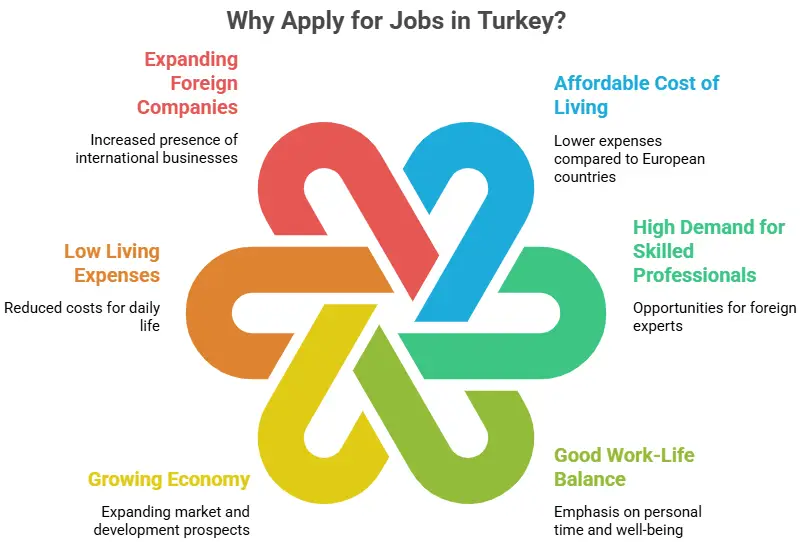
Why Apply for Jobs in Turkey?
- Affordable cost of living compared to Europe
- Strong demand for skilled foreign professionals
- Good work-life balance and paid leave
- Growing economy and infrastructure development
- Low living expenses with competitive salaries
- More foreign companies are starting and expanding their businesses in Turkey
Turkey is well known for industries like construction, manufacturing, IT, tourism, healthcare, energy, and education. Turkish workplaces are modern, professional, and open to international talent.
*Want to work in Turkey? Get expert guidance from Y-Axis
Job Vacancy in Turkey
Turkey currently has 80,000+ job openings across various industries, making it a strong destination for skilled foreign professionals. The highest demand is in IT, engineering, healthcare, construction, tourism, and manufacturing, driven by digital growth, urban development, and expanding business activities.
Nearly 55% of available jobs require skilled or professional-level experience, which creates excellent opportunities for qualified international workers. Employers in Turkey are actively looking for candidates with technical skills, industry experience, and international exposure. With ongoing infrastructure projects, technology adoption, and rising service sector needs, job demand is expected to grow steadily in the coming years.
The below table shows the estimated number of job openings in Turkey by 2030:
| Occupation / Sector | Estimated Openings |
|---|---|
| IT & Software | 50,000 |
| Engineering & Manufacturing | 45,000 |
| Healthcare & Nursing | 40,000 |
| Education & Training | 28,000 |
| Construction & Infrastructure | 35,000 |
| Finance & Business Services | 22,000 |
| Tourism & Hospitality | 30,000 |
| Logistics & Supply Chain | 25,000 |
*Read more.....
Step-by-Step Guide for Job Search in Turkey from India
Step 1: Search for jobs on trusted platforms like LinkedIn, Kariyer.net, Indeed, Glassdoor, and company websites
Step 2: Look for employers who hire foreign workers and provide visa support
Step 3: Prepare a simple CV and cover letter highlighting your skills and experience
Step 4: Apply directly through company portals or recruitment agencies
Step 5: Attend online interviews and explain why you want to work in Turkey
Step 6: After receiving a job offer, your employer helps with Turkey work visa documents
Step 7: Once approved, apply for a residence permit and move to Turkey
Turkey Work Visa
Foreign nationals must apply for a Turkey Work Visa and Work Permit before starting a job in Turkey. To apply, you must first receive a valid job offer from a registered Turkish employer. Your employer plays an important role in the work permit process by submitting required documents to the Turkish authorities. You cannot work in Turkey on a tourist visa. These visas are only for travel and short stays and do not allow employment. Working without the correct permit is illegal and may lead to fines or deportation. The Turkey Work Visa application must be submitted from your home country through the Turkish Embassy or Consulate. Once your visa and work permit are approved, you can legally live and work in Turkey for the employer mentioned in your permit. After arriving in Turkey, you must also complete residence registration as required by law.
Types of Turkey Work Visa
- Work Visa for Skilled Professionals: For qualified professionals with job offers
- Temporary Work Permit: Valid for 1 year (renewable)
- Independent Work Permit: For experienced professionals or entrepreneurs
- Seasonal Work Visa: For short-term jobs (tourism, agriculture)
- Academic / Research Work Visa: For teachers and researchers
Requirements for Turkey Work Visa
- Valid passport
- Completed Turkey Work Visa application form
- Recent passport-size photographs
- Job offer or employment contract from a Turkish employer
- Educational qualification certificates
- Work experience documents
- Updated CV / Resume
- Proof of accommodation in Turkey
- Proof that salary meets Turkish wage standards
- Employer documents submitted to the Ministry of Labour
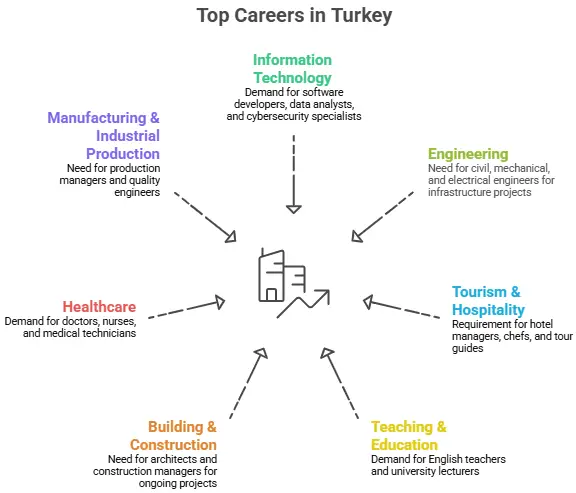
Top Careers in Turkey
Information Technology
Turkey is rapidly adopting new technologies to support business growth and digital services. There is strong demand for software developers, data analysts, cybersecurity specialists, mobile app developers, and cloud engineers. Many IT roles use English as the working language.
Engineering
Turkey is investing heavily in infrastructure, manufacturing, renewable energy, and smart cities. Skilled engineers are needed to design, build, and manage these projects. In-demand roles include civil, mechanical, electrical, industrial, and renewable energy engineers.
Tourism & Hospitality
Tourism is one of Turkey’s biggest industries. The sector needs professionals with good communication and customer service skills. Popular jobs include hotel managers, chefs, tour guides, travel consultants, and hospitality supervisors.
Teaching & Education
Turkey values education and has a strong demand for qualified teachers, especially in private and international schools. In-demand roles include English teachers, kindergarten teachers, vocational trainers, and university lecturers.
Building & Construction
With ongoing housing, commercial, and infrastructure projects, the construction sector is growing fast. Common roles include architects, construction managers, site engineers, building inspectors, and safety officers.
Healthcare
Turkey has a well-developed healthcare system and continues to need skilled professionals. High-demand jobs include doctors, nurses, medical technicians, caregivers, and hospital administrators.
Manufacturing & Industrial Production
Turkey is a major manufacturing hub for automotive, textiles, electronics, machinery, and consumer goods. Companies are looking for production managers, quality engineers, machine operators, and industrial technicians.
Steps to Apply for a Turkey Work Visa
Step 1: Get a valid job offer from a registered employer in Turkey. The employer must agree to sponsor your work permit.
Step 2: Your employer applies for your work permit through the Turkish Ministry of Labour and Social Security (MLSS).
Step 3: Once the employer application is submitted, apply for the Turkey Work Visa at the nearest Turkish Embassy or Consulate in your home country.
Step 4: Fill out the visa application form and pay the required visa fee.
Step 5: Collect all required documents, including your passport, job offer, educational certificates, and work experience proofs.
Step 6: Attend your appointment, submit your documents, and provide biometrics.
Step 7: Wait for visa and work permit approval. After approval, travel to Turkey and complete residence registration.
How Can Y-Axis Help You?
Y-Axis has been providing trusted and personalized immigration services for over 25 years. Our experienced consultants offer end-to-end support to help you successfully migrate and work in Turkey. We guide you at every stage of the Turkey work visa process.
Our services include:
- Identifying and collecting all required documents
- Completing the Turkey work visa document checklist
- Preparing a strong and accurate application package
- Filling visa forms and applications correctly
- Regular updates and follow-ups on your application status
- Interview preparation and guidance
Don't know what to do ?
Get Free Counseling
Looking for Inspiration
Explore what Global Indians have to say about Y-Axis in shaping their future
Frequently Asked Questions