


Don't know what to do ?
Get Free Counseling
Last Updated 27 May 2026
Highest paying Jobs in Belgium
Belgium has a strong job market with around 170,000 vacancies, and a job vacancy rate of about 4 %, showing many companies are hiring actively. The country offers good salaries, with software engineers earning around €60,000–€90,000 a year and nurses earning about €2,800–€4,200 per month. Jobs are mostly in demand in IT, engineering, healthcare, and other skilled fields. With a stable economy, good work-life balance, and a high standard of living, Belgium is a great place for professionals who want stable, well-paid careers.
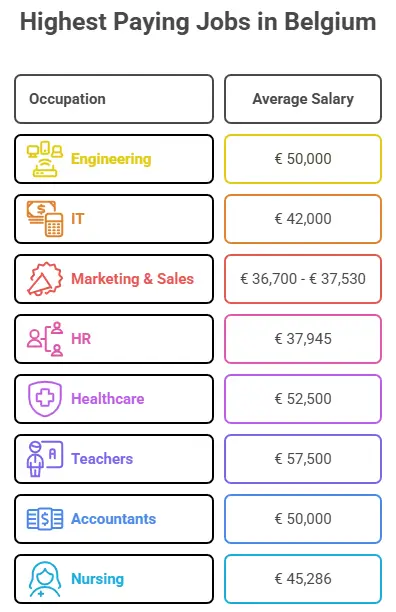
Some of the highest paying jobs in Belgium are listed below:
|
Occupations |
Average Salaries per year |
|
€ 50 000 |
|
|
€ 42 000 |
|
|
€ 36 700 - € 37 530 |
|
|
€ 37 945 |
|
|
€ 52 500 |
|
|
€ 57 500 |
|
|
€ 50 000 |
|
|
€ 45 286 |
Source: Talent Site
Job Openings in Belgium
Belgium has a shortage of skilled professionals. About 72% of companies are finding it hard to hire people, the job vacancy rate was 4.6%. The highest vacancies are in IT, data jobs, engineering, technical work, and logistics. Cybersecurity has the most number of job vacancies, with almost 10,000 jobs. To fix this, Belgium has added more IT jobs to its shortage occupation list, which helps companies hire foreign workers faster for roles like software developers and cybersecurity engineers.
|
Occupation / Sector |
Estimated Job Openings by 2030 |
|
IT & Software / Digital Technology |
100,000+ |
|
Engineering & Manufacturing |
70,000+ |
|
Healthcare & Nursing |
60,000+ |
|
Logistics & Supply Chain / Operations |
40,000+ |
|
Finance & Business Services |
45,000+ |
|
Education & Research |
25,000–30,000 |
|
Construction & Infrastructure |
30,000+ |
Step-by-Step Guide for Job Search in Belgium from India
Step 1: Start searching for jobs in Belgium on trusted websites like LinkedIn, Indeed.be, Glassdoor, EURES, StepStone.be, and Monster.be.
Step 2: Look for companies in Belgium that hire international workers and offer visa sponsorship, especially for skilled roles in IT, engineering, healthcare, logistics, and finance.
Step 3: Prepare a simple, clear, and professional CV and cover letter. Highlight education, work experience, and skills. Using the Europass CV format is recommended since it is commonly accepted in Belgium and across Europe.
Step 4: Apply directly on company websites or through Belgian recruitment agencies that support foreign candidates in finding suitable job openings.
Step 5: Attend online interviews and confidently explain your qualifications, past experience, and why you want to work in Belgium.
Step 6: After you receive a job offer, your employer will help you apply for the Belgium Work Permit (Type B) or a Single Permit, depending on the job and region.
Step 7: Once your work permit and residence approval are issued, plan your travel and move to Belgium to start your career.
Why apply for Job Opportunities in Belgium?
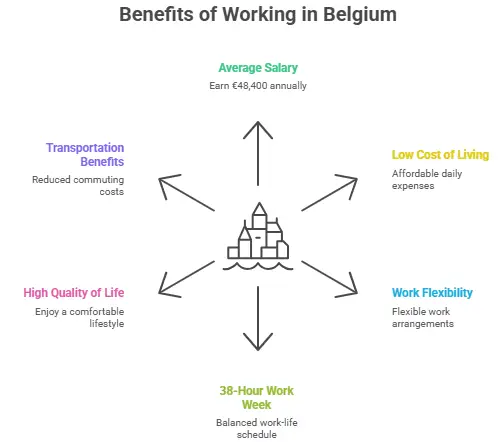
- Earn an average salary of €48,400
- Low cost of living
- Flexibility in work
- Work for 38 hours per week
- High quality of life
- Transportation benefits
Belgium is a booming economy located in the centre of Europe. With a competitive job market, comprehensive social security benefits, historical cities, and delicious cuisine, Belgium remains one of the famous overseas destinations for international workers.
Migrate to Belgium via a Work Visa
If you are willing to work in Belgium as a foreign profession under an employment contract, you must have a work permit. This rule applies to citizens outside the EU, Iceland, Switzerland, Norway, and Liechtenstein.
As a non-EU or EEA national, anyone willing to live and work in Belgium must apply for a Belgium work permit. First, you must apply for a long-stay visa to enter Belgium, and then you must apply for a residence permit with work rights.
Types of Belgium Work Visa
Work Permit Type A
To be eligible for Work permit type A must have held the work permit type B for four years within a ten year stay in Belgium. This work permit is valid for an unlimited period.
Work Permit Type B
To be eligible for Work permit type B, your employer must apply on your behalf for a particular position that cannot be filled by a Belgian or EU national.
Work Permit Type C
If you are a temporary visitor or an asylum seeker who is not allowed to stay in Belgium permanently but willing to work in Belgium, then you must apply for Work permit type C. This work permit is valid for one year.
EU Blue Card
EU Blue Card is for highly skilled workers, this allows them to work for three months in Belgium.
Professional Card
Professional Card is for self-employed specialists working in Belgium for one to five years.
Requirements of Belgium Work Visa
- You need to submit a valid passport
- Before applying for a work visa in Belgium, you should be employed there. The Belgium work permit will allow you to live and work there
- You must first obtain complete health insurance coverage to apply for a Belgium work visa as a foreign worker in the country
- You need to provide medical certificates to prove that you are not having any health issues which can risk public health in Belgium
- You need to provide documents to prove that you will have a place to stay in Belgium
- Provide financial proof to prove that you will be able to manage your expenses during your stay in Belgium
- Proof that you do not hold any criminal record. You should provide Police Clearance Certificate to prove that you are free of any criminal conviction
Top In-Demand Jobs in Belgium
Information Technology (IT): Software Developers and Engineers
The IT sector in Belgium is booming, with a high demand for engineers and software. Companies across industries seek experienced candidates in programming languages like Python, Java, and C++. Knowledge of frameworks and tools like Angular, React, and Docker is also highly in demand.
Healthcare: Nurses and Healthcare Practitioners
The healthcare sector in Belgium is experiencing a shortage of nurses and healthcare specialist. The increasing population and aging healthcare needs are driving this demand. Proficiency in Dutch or French language is often required, depending on the region.
Engineering: Civil Engineers
Belgium’s infrastructure projects, like bridges, road construction, and public transportation systems, require skilled civil engineers. These professionals design, plan, and oversee construction projects.
Education: Teachers and Educators
The education sector in Belgium always requires qualified teachers and educators. There is a more demand for teachers in STEM (Science, Technology, Engineering, and Mathematics) subjects.
Logistics and Supply Chain: Supply Chain Managers
Belgium country has become a logistic hub in European Union, increasing the demand for supply chain managers. These professionals ensure the productive movement of goods and services.
List of Shortage Occupations in Belgium
- Civil engineers
- Civil engineering labourers
- Machine operators
- Professional drivers
- Food and hospitality workers
- Electricians
- Mechanics and repairers
- Welders and flame cutters
- Accountants
- Nursing professionals
- Health professionals not elsewhere classified
- Construction managers and supervisors
- Building construction labourers
- Applications programmers
- Software developers
Steps to apply for Belgium work visa
Step 1: Apply for your Belgium Work Permit
Step 2: Pay the visa fee online
Step 3: Attend the appointment
Step 4: Submit all your documents
Step 5: Register your biometric details
Step 6: Wait for the visa application to get approved
How can Y-Axis help you?
Y-Axis has been providing unbiased and personalized immigration-related assistance for more than 25 years. Our team of experienced immigration experts is here to provide end-to-end support to help you migrate to Belgium. Our services include:
- Resume Marketing services to find the right jobs in Belgium
- Identify and collect all your documents
- Complete the visa documents checklist
- Create your application package
- Fill the various forms and applications accurately
- Updates & follow up
- Interview preparation
Y-Axis snapshot
1M
Successful applicants
1500+
Experienced counselors
25Y+
Expertise
50+
Offices
Don't know what to do ?
Get Free Counseling