


Posted on January 03 2026
What are the most in-demand jobs in New Zealand for the next 10 years?

By , Editor
Updated January 23 2026
High-Paying and In-Demand Jobs in New Zealand
The most in-demand and high-paying jobs in New Zealand for the next 10 years are expected to be across the IT, healthcare, engineering, construction, finance and accounting, education, and agriculture sectors. New Zealand is one of the best countries to work abroad for Indian professionals, known for its excellent work–life balance, safe living environment, high standard of living, and publicly funded healthcare system.
Some of the top in-demand jobs in New Zealand for foreigners include software developers, ICT business analysts, data analysts, registered nurses, doctors, civil and structural engineers, construction managers, accountants, teachers, and agricultural specialists. Ongoing skill shortages, an ageing population, large infrastructure projects, and digital transformation are the key reasons why New Zealand continues to invite skilled migrants from India and other countries.
As one of the most stable economies in the Asia-Pacific region, New Zealand offers competitive salaries, strong job security, and clear pathways from a New Zealand work visa to permanent residence (PR). With structured immigration routes such as the Green List jobs in New Zealand and the Accredited Employer Work Visa, the country remains one of the top destinations for skilled professionals looking to work and settle abroad.
*Want to work in New Zealand? Let Y-Axis guide you with the process.
In-Demand Jobs in New Zealand and Their Average Salaries
New Zealand continues to face skill shortages across several key sectors, creating strong demand for overseas professionals. Industries such as IT, healthcare, engineering, construction, accounting and finance, education, and hospitality are expected to offer consistent job opportunities over the coming years.
The table below highlights some of the most in-demand and high-paying jobs in New Zealand, along with their average annual salaries:
|
Occupation |
Average Salaries per Year (NZD) |
|
Engineering |
NZD 130,000 |
|
IT & Software |
NZD 140,000 |
|
Healthcare |
NZD 150,000 |
|
Marketing & Sales |
NZD 120,000 |
|
Banking & Finance |
NZD 120,000 |
|
Nursing |
NZD 110,000 |
|
Education |
NZD 100,000 |
|
Hospitality |
NZD 105,000 |
|
Skilled Trades |
NZD 115,000 |
*Want to apply for jobs in New Zealand? Avail Y-Axis Resume Marketing Services to find the right one.
In-Demand Jobs in New Zealand for the Next 10 Years
New Zealand continues to face long-term skill shortages across key industries due to an ageing population, infrastructure expansion, and rapid digital transformation. The country consistently reports tens of thousands of job vacancies annually, especially in healthcare, IT, construction, engineering, and primary industries.
The average annual salary in New Zealand ranges between NZD 95,000 and NZD 120,000, depending on the role, industry, experience, and location. According to Immigration New Zealand, many of these occupations are listed on the Green List, offering clear pathways from a New Zealand work visa to permanent residence (PR). To sustain economic growth, New Zealand continues to actively invite skilled foreign professionals, including Indian talent, under employer-sponsored and residence pathways.
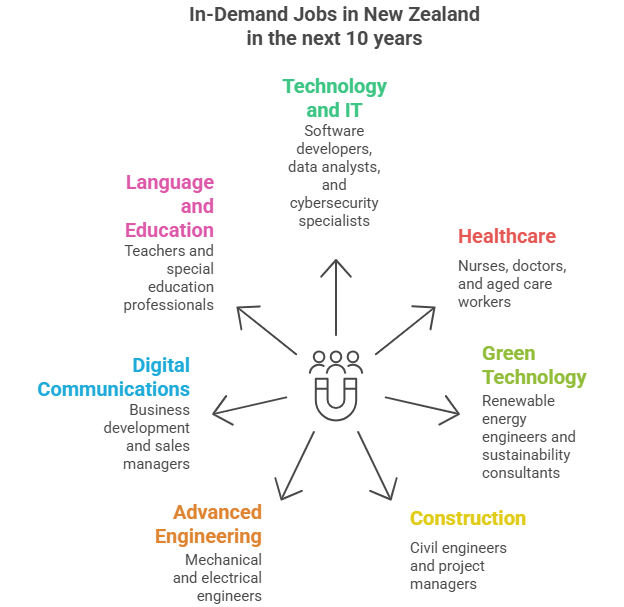
The table below has complete details of job roles that are expected to be in demand in New Zealand over the next 10 years:
|
Sector |
Job Role |
|
Technology and IT |
Software Developers |
|
ICT Business Analysts |
|
|
Data Analysts & Data Scientists |
|
|
Cloud Engineers |
|
|
Cybersecurity Specialists |
|
|
Healthcare |
Registered Nurses |
|
General Practitioners (GPs) |
|
|
Medical Specialists |
|
|
Aged Care & Disability Support Workers |
|
|
Health Services Managers |
|
|
Green Technology & Sustainability |
Renewable Energy Engineers |
|
Environmental Engineers |
|
|
Sustainability & ESG Consultants |
|
|
Climate Change Policy Advisors |
|
|
Construction, Infrastructure & Logistics |
Civil Engineers |
|
Construction Project Managers |
|
|
Quantity Surveyors |
|
|
Site Managers |
|
|
Supply Chain & Logistics Managers |
|
|
Advanced Engineering & Manufacturing |
Mechanical Engineers |
|
Electrical Engineers |
|
|
Industrial Automation Engineers |
|
|
Process & Quality Engineers |
|
|
Digital Communications & Global Business |
Business Development Managers |
|
International Sales Managers |
|
|
HR & Talent Acquisition Specialists |
|
|
Language and Education |
Early Childhood Teachers |
|
Secondary School Teachers (Maths, Science, Technology) |
|
|
Special Education Teachers |
*Want to apply for a New Zealand work visa? Sign up with Y-Axis for end-to-end support with the process.
How to Apply for a Job in New Zealand from India?
To work in New Zealand from India, you must first apply for jobs with accredited New Zealand employers, secure a valid job offer, and then apply for the appropriate New Zealand work visa, most commonly the Accredited Employer Work Visa (AEWV).
Here is a step-by-step process to apply for a job and work visa in New Zealand from India:
Step 1: Apply for jobs with accredited New Zealand employers with the help of Y-Axis Resume Marketing services.
Step 2: Secure a job offer and employment agreement
Step 3: Apply for a New Zealand work visa that matches your role and profile
Step 4: Submit health and character documents, if required
Step 5: Receive your visa decision and plan your move to New Zealand
*Are you looking for step-by-step assistance with overseas immigration? Contact Y-Axis, the world’s No. 1 overseas immigration consultancy, for end-to-end assistance!
FAQs
What are the most in-demand jobs in New Zealand over the next 10 years?
Over the next decade, New Zealand is expected to see strong demand across healthcare, IT, engineering, construction, education, agriculture, and trades. Roles such as nurses, doctors, software developers, civil engineers, electricians, teachers, and aged-care workers are forecast to remain in high demand due to population growth, infrastructure expansion, digital transformation, and an ageing population. Sustainability and renewable energy roles are also emerging rapidly. These occupations align closely with New Zealand’s long-term skill shortage priorities and are expected to offer stable employment and migration opportunities.
Which industries will drive job demand in New Zealand’s future labour market?
Healthcare, construction, infrastructure, information technology, education, agriculture, and renewable energy will drive New Zealand’s future job demand. Healthcare demand is rising due to an ageing population, while construction and infrastructure projects continue nationwide. IT and digital services are expanding as businesses adopt automation and cloud technologies. Agriculture and agri-tech remain central to the economy, while renewable energy and sustainability industries are growing as New Zealand works toward climate goals. Together, these sectors will shape long-term employment trends.
Why is New Zealand facing long-term skill shortages?
New Zealand faces skill shortages due to a combination of factors, including an ageing workforce, low population density, limited domestic talent supply, and growing demand across essential sectors. Many skilled workers are reaching retirement age, while infrastructure growth and healthcare needs continue to rise. Additionally, rapid technological change has increased demand for specialised IT and engineering skills that are not produced quickly enough locally. As a result, New Zealand relies heavily on skilled migrants to fill long-term workforce gaps.
Are healthcare and nursing jobs expected to remain in demand in New Zealand?
Yes, healthcare and nursing jobs are expected to remain in high demand for at least the next decade. New Zealand’s ageing population is increasing the need for nurses, doctors, midwives, aged-care workers, and allied health professionals. Demand is especially strong in public hospitals, regional healthcare services, and aged-care facilities. Workforce shortages, combined with rising healthcare needs, make this sector one of the most stable and future-proof career paths in New Zealand.
Will IT and software development jobs grow in New Zealand in the next decade?
IT and software development jobs are projected to grow strongly in New Zealand over the next 10 years. Demand is high for software developers, cybersecurity specialists, data analysts, cloud engineers, and AI professionals. Businesses across all industries are undergoing digital transformation, increasing reliance on technology. New Zealand’s tech sector is also expanding globally, creating opportunities for both local and international professionals with in-demand digital skills.
Which engineering roles will be most needed in New Zealand in the future?
Civil, structural, electrical, mechanical, and environmental engineers are expected to be in strong demand. Major infrastructure projects, housing development, transportation upgrades, and renewable energy initiatives are driving the need for engineering professionals. Civil engineers, in particular, are critical for road, bridge, and urban development projects. Engineering roles are consistently listed on skill shortage lists and offer long-term employment stability.
Are construction and infrastructure jobs in demand long term in New Zealand?
Yes, construction and infrastructure jobs are expected to remain in demand long term. New Zealand faces ongoing housing shortages, population growth, and infrastructure upgrades, especially in transport and public services. Roles such as construction managers, quantity surveyors, project managers, carpenters, and site supervisors are critical. Government investment in infrastructure ensures sustained demand across the construction sector for many years.
What trades are expected to be in high demand in New Zealand?
Skilled trades such as electricians, plumbers, welders, carpenters, HVAC technicians, and automotive mechanics are expected to remain in high demand. Trades are essential to construction, infrastructure, and maintenance projects nationwide. A shortage of locally trained tradespeople, combined with strong building activity, makes these roles highly sought after. Many trade occupations also offer clear pathways to work visas and residence.
Will renewable energy and sustainability jobs grow in New Zealand?
Yes, renewable energy and sustainability jobs are expected to grow significantly over the next decade. New Zealand’s focus on reducing carbon emissions and increasing renewable energy production is driving demand for environmental engineers, energy analysts, sustainability consultants, and renewable energy technicians. Growth in wind, solar, and hydroelectric projects will create long-term employment opportunities in green industries.
Are teaching and education professionals in demand in New Zealand?
Teaching professionals, particularly early childhood teachers, primary teachers, and secondary teachers in STEM subjects, are in consistent demand. Population growth and regional shortages contribute to long-term demand. Teachers willing to work in regional or rural areas often face stronger job prospects. Education plays a key role in New Zealand’s social development, making teaching a stable career choice.
What agriculture and agri-tech jobs will be in demand in New Zealand?
Agriculture remains a cornerstone of New Zealand’s economy, and demand is strong for farm managers, agricultural technicians, veterinarians, and agri-tech specialists. Innovation in precision farming, automation, and sustainability is increasing demand for technology-focused roles within agriculture. Skilled workers who combine farming knowledge with digital or engineering expertise will be especially valuable over the next decade.
Will logistics and supply chain jobs increase in New Zealand?
Yes, logistics and supply chain roles are expected to grow due to increased trade, e-commerce expansion, and infrastructure development. Demand is rising for supply chain managers, warehouse supervisors, logistics coordinators, and transport planners. Efficient supply chains are essential for New Zealand’s export-driven economy, particularly in agriculture and manufacturing.
Are finance, accounting, and business roles future-proof in New Zealand?
Finance, accounting, and business roles remain relatively stable, especially for professionals with specialised skills. Accountants, auditors, financial analysts, and business advisors are consistently needed across industries. While automation is changing some functions, professionals with strategic, regulatory, and advisory expertise are expected to remain in demand long term.
Which digital and technology skills are most sought after in New Zealand?
High-demand digital skills include software development, cybersecurity, data analytics, cloud computing, AI, machine learning, and DevOps. Employers seek professionals who can support digital transformation, protect data, and optimise business systems. Technology skills that combine technical expertise with problem-solving and communication are particularly valuable.
Are there strong job prospects for migrants in New Zealand over the next 10 years?
Yes, migrants with skills in shortage occupations will continue to have strong job prospects. New Zealand relies on skilled migration to address workforce gaps in healthcare, IT, construction, engineering, and trades. Migrants with relevant qualifications, experience, and English proficiency are well-positioned for long-term employment and residence pathways.
Which jobs in New Zealand offer pathways to work visas and residence?
Jobs listed on New Zealand’s skill shortage lists often provide pathways to work visas and residence. These include healthcare professionals, engineers, IT specialists, construction workers, and tradespeople. Employment in these roles increases eligibility for employer-sponsored visas and long-term settlement options.
Are aged care and disability support roles in long-term demand?
Yes, aged care and disability support roles are among the fastest-growing occupations in New Zealand. An ageing population is increasing demand for caregivers, support workers, and aged-care nurses. These roles are critical to social services and are expected to remain in demand for decades.
What roles are listed on New Zealand’s skill shortage lists?
Skill shortage lists typically include healthcare professionals, engineers, IT specialists, teachers, construction workers, and tradespeople. These lists are regularly updated to reflect labour market needs and guide migration policies. Occupations on these lists often benefit from streamlined visa processes.
How does New Zealand’s ageing population impact future job demand?
An ageing population increases demand for healthcare, aged care, social services, and support roles. It also creates workforce gaps as older workers retire, increasing demand for younger professionals and skilled migrants. This demographic shift strongly influences long-term employment trends.
Which jobs in New Zealand offer the best long-term career stability?
Healthcare, education, engineering, construction, IT, and skilled trades offer the best long-term career stability. These roles address essential societal needs and are less affected by economic cycles. Professionals in these fields can expect consistent demand, competitive salaries, and strong migration opportunities over the next decade.
Tags:
Jobs in New Zealand
Jobs in New Zealand for Indians
Work in New Zealand
New Zealand work visa
in-demand jobs in New Zealand
In demand jobs in New Zealand for the next 10 years
Highest paying jobs in New Zealand
Job opportunities in New Zealand for
Share
Y - Axis services

Get it on your mobile

Get News Alerts

Contact Y-Axis
Latest Article
Popular Post
Trending Article

Posted On February 20 2026
How to Migrate to Germany as a Registered Nurse?