

Posted on October 09 2025
What are the most in-demand jobs in Ireland for the next 10 years?

By , Editor
Updated February 09 2026
The most in-demand jobs in Ireland over the next 10 years will primarily be found in the Tech, skilled trades, healthcare, and green energy sectors. Ireland is known as one of the European countries with a rapidly growing economy, offering a scope for creating numerous job opportunities in the future. Job roles such as nursing, data science, cybersecurity, Automation Engineers, Business Intelligence Analysts, renewable energy specialists, and software development will be among the most sought-after and highly demanded job roles in Ireland over the next 10 years. The growing tech industry, an aging population, a strong presence in the construction and manufacturing sectors, and a prioritization of green and sustainable energy are a few driving factors behind Ireland’s expanding job market.
*Want to work in Ireland? Let Y-Axis guide you with the process.
What are the In-demand Occupations in Ireland?
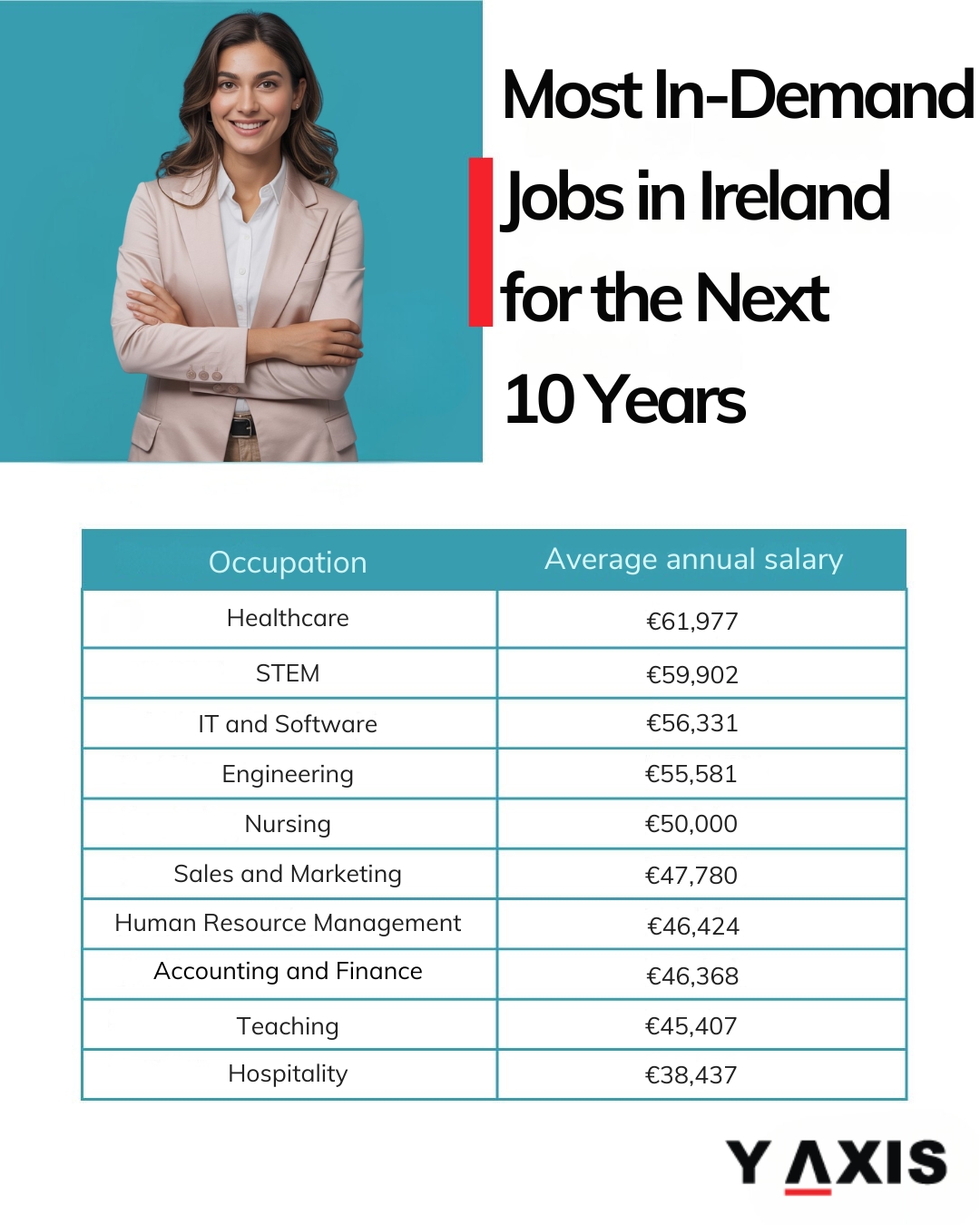
Some of the current in-demand occupations in Ireland include IT and Software, Accounting and Finance, STEM, Healthcare, Hospitality, etc. The table below has the list of the top 10 in-demand occupations in Ireland, along with the average salary offered for each:
|
Occupation |
Average annual salary |
|
IT and Software |
€ 56,331 |
|
Engineering |
€ 55,581 |
|
Accounting and Finance |
€ 46,368 |
|
Human Resource Management |
€ 46,424 |
|
Hospitality |
€ 38,437 |
|
Sales and Marketing |
€ 47,780 |
|
Healthcare |
€ 61, 977 |
|
STEM |
€ 59,902 |
|
Teaching |
€ 45,407 |
|
Nursing |
€ 50,000 |
*Want to look for jobs in Ireland? Avail Y-Axis Resume Marketing Services to find the right one.
In-demand jobs in Ireland for the next 10 years
Ireland currently has over 30,000 job vacancies, with an average annual salary ranging from €44,200 to €59,000, depending on the occupation, job role, and work experience. Over the next 10 years, Ireland is expected to have significant job openings in the IT, Engineering, Healthcare, and green energy sectors, offering competitive salaries and residency benefits.
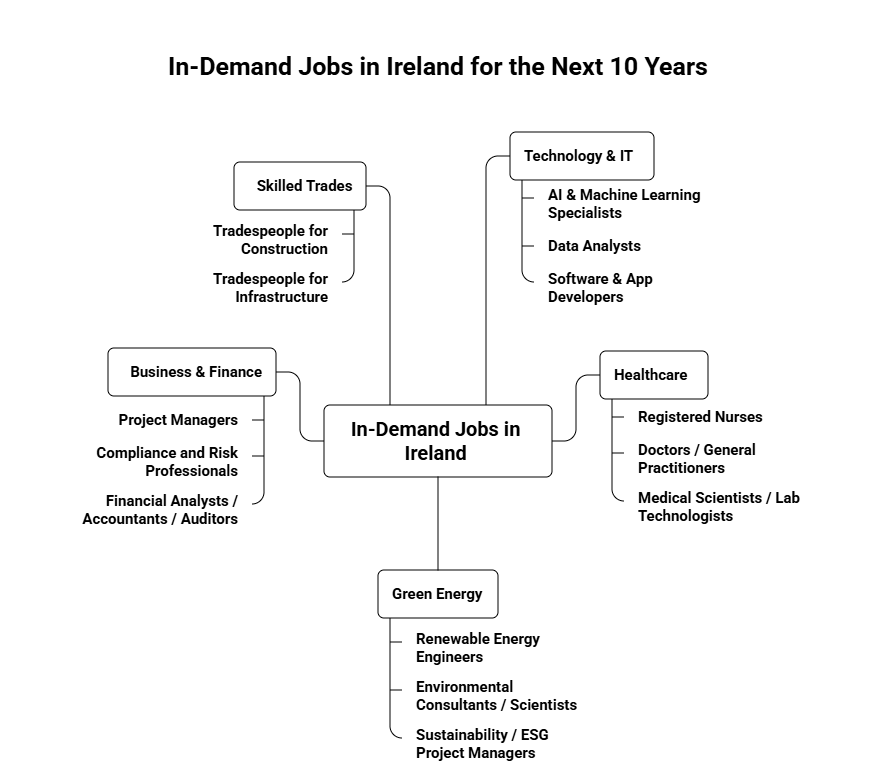
The table below has the list of sectors and jobs that will be in demand in Ireland in the next 10 years:
|
Sector |
Job role |
|
Technology & IT |
AI & Machine Learning Specialists |
|
Data Analysts |
|
|
Software & App Developers |
|
|
Cybersecurity Analysts |
|
|
Cybersecurity Managers |
|
|
Cloud Architects / DevOps Engineers |
|
|
Network Engineers & Systems Administrators |
|
|
Data Scientists |
|
|
Automation Engineers |
|
|
Healthcare |
Pharmaceutical Sciences |
|
Biomedical Scientists |
|
|
Registered Nurses |
|
|
Allied Health Professionals |
|
|
Doctors / General Practitioners |
|
|
Healthcare Assistants / Home-based Care Workers |
|
|
Physiotherapists / Occupational Therapists |
|
|
Medical Scientists / Lab Technologists |
|
|
Green Energy |
Renewable Energy Engineers (solar, wind) |
|
Environmental Consultants / Scientists |
|
|
Energy Systems Modellers / Battery Storage Specialists |
|
|
Sustainability / ESG Project Managers |
|
|
Green Building / Energy Efficiency Specialists |
|
|
Business & Finance |
Project Managers |
|
Compliance and Risk Professionals |
|
|
ESG / Sustainability Analysts |
|
|
Financial Analysts / Accountants / Auditors |
|
|
Business Consultants / Strategy Professionals |
|
|
Tax / Legal / Corporate Services Professionals |
|
|
Skilled Trades |
Tradespeople for the construction and infrastructural needs |
Also, read...
Top in-demand skills in Ireland for the next 10 years
In the next 10 years, employers in Ireland will prioritize candidates with the right skill set, including soft skills, digital skills, and those with skills that are relevant to the top in-demand job roles in Ireland.
The table below has the list of top in-demand sectors in Ireland, along with the list of skills that will be in demand in the next 10 years:
|
Sector |
In-demand skills |
|
Technology / ICT & Digital |
AI / Machine Learning & Data Analytics |
|
Cybersecurity & Network Protection management |
|
|
Cloud Architecture & DevOps |
|
|
Software Engineering & Full-Stack Development |
|
|
Digital Literacy / Tech Adoption Skills |
|
|
Healthcare & Social / Allied Health |
Clinical & Therapeutic Skills |
|
Home & Community Care |
|
|
Telehealth & Digital Health Skills |
|
|
Health Data Analytics & Biostatistics |
|
|
Public Health & Preventive Care Expertise |
|
|
Construction, Infrastructure & Trades |
Green / Sustainable Building Techniques |
|
Project & Site Management |
|
|
Skilled Trades |
|
|
Civil / Structural Engineering |
|
|
Digital Construction Skills |
|
|
Renewable Energy, Environment & Sustainability |
Renewable Energy Systems & Grid Integration |
|
Environmental Management & Compliance |
|
|
Climate Adaptation & Resilience Planning |
|
|
Circular Economy / Resource Efficiency |
|
|
ESG / Sustainability Reporting & Strategy |
|
|
Finance, Business & Professional Services |
Risk Management & Compliance |
|
Data-Driven Decision Making / Business Intelligence |
|
|
Sustainability / ESG Finance |
|
|
Digital & FinTech Skills |
|
|
Leadership / Strategic Management |
|
|
Logistics, Supply Chain & Trade |
Supply Chain Analytics & Optimization |
|
Automation / Robotics in Warehousing |
|
|
E-commerce Operations Skills |
|
|
Sustainable Logistics / Green Transport Planning |
|
|
Trade & Customs Compliance Expertise |
|
|
Soft skills |
Cognitive & Critical Thinking |
|
Interpersonal Skills |
|
|
Innovation & Creativity |
|
|
Continuous Learning |
*Are you looking for step-by-step assistance with overseas immigration? Contact Y-Axis, the world’s No. 1 overseas immigration consultancy, for end-to-end assistance!
FAQs
What are the most in-demand jobs in Ireland over the next decade?
Ireland’s most in-demand jobs over the next 10 years are expected to be in IT, software development, data analytics, cybersecurity, engineering, healthcare, life sciences, finance, construction, and renewable energy. Demand is driven by digital transformation, an ageing population, infrastructure expansion, and Ireland’s position as a European hub for multinational companies. Roles requiring advanced technical skills and specialised expertise are likely to remain in short supply.
Why is Ireland facing skill shortages in key sectors?
Ireland is facing skill shortages due to rapid economic growth, digitalisation, and strong foreign direct investment. Many multinational companies have established European headquarters in Ireland, increasing demand for skilled professionals faster than the local workforce can supply. Additionally, demographic changes, such as retirements in healthcare and engineering, are creating long-term replacement demand across critical sectors.
Which IT roles will be most in demand in Ireland in the future?
IT roles such as software developers, cloud engineers, cybersecurity specialists, data scientists, AI and machine learning engineers, and DevOps professionals are expected to see sustained demand. Ireland’s strong tech ecosystem, supported by global companies and startups, continues to drive the need for professionals who can support digital infrastructure, automation, and advanced analytics.
Are engineering jobs expected to grow in Ireland?
Yes, engineering jobs are expected to grow steadily in Ireland, particularly in civil, mechanical, electrical, biomedical, and environmental engineering. Large-scale infrastructure projects, housing development, renewable energy initiatives, and manufacturing expansion are contributing to long-term demand for qualified engineers across both public and private sectors.
What healthcare jobs will be in demand in Ireland over the next 10 years?
Healthcare roles such as nurses, doctors, healthcare assistants, physiotherapists, occupational therapists, and medical laboratory scientists are projected to remain in high demand. Ireland’s ageing population and ongoing pressure on the healthcare system are driving consistent recruitment needs, including for internationally trained healthcare professionals.
How does Ireland’s ageing population impact job demand?
Ireland’s ageing population is increasing demand for healthcare, social care, and medical support roles. This demographic shift is also creating replacement demand in sectors where experienced professionals are retiring. As a result, healthcare, nursing, allied health professions, and care-related roles are expected to remain critical over the next decade.
Which finance and accounting roles are in demand in Ireland?
Finance and accounting roles such as financial analysts, accountants, auditors, risk and compliance professionals, and fintech specialists are in strong demand. Ireland’s role as a financial services hub, along with regulatory requirements and digital finance growth, is driving demand for professionals with analytical, regulatory, and technology-driven finance skills.
Are life sciences and pharmaceutical jobs growing in Ireland?
Yes, Ireland’s life sciences and pharmaceutical sectors are experiencing long-term growth. Jobs in biopharmaceutical manufacturing, quality control, regulatory affairs, process engineering, and research and development are expected to remain in demand as Ireland continues to attract major pharmaceutical and medical device companies.
What construction jobs will be needed in Ireland in the future?
Construction jobs such as civil engineers, project managers, quantity surveyors, electricians, plumbers, and skilled trades are expected to remain in demand. Ireland’s housing shortage, infrastructure investments, and urban development projects are creating sustained demand for construction professionals over the next decade.
How is renewable energy shaping job demand in Ireland?
Renewable energy is emerging as a key driver of job growth in Ireland. Roles related to wind energy, solar power, environmental engineering, sustainability consulting, and energy project management are expected to increase as Ireland works toward climate targets and expands its green energy infrastructure.
Are data and analytics roles future-proof in Ireland?
Data and analytics roles are considered highly future-proof in Ireland. Businesses across sectors rely on data-driven decision-making, creating demand for data analysts, data engineers, business intelligence specialists, and AI professionals. As automation and artificial intelligence expand, data expertise will remain critical.
What jobs will benefit most from digital transformation in Ireland?
Jobs that support digital transformation, such as software engineering, cybersecurity, cloud computing, IT support, and digital marketing, will benefit the most. Companies are investing heavily in digital tools and platforms, increasing demand for professionals who can design, manage, and secure digital systems.
Will Ireland continue to hire foreign workers for in-demand jobs?
Yes, Ireland is expected to continue hiring foreign workers to fill skill gaps in high-demand occupations. The government supports international recruitment through employment permit systems, especially for roles listed under critical skills. Overseas professionals play a vital role in sustaining Ireland’s workforce growth.
What skills will employers in Ireland prioritise in the future?
Employers in Ireland will prioritise a combination of technical expertise and transferable skills. Digital literacy, problem-solving, adaptability, communication, and the ability to work in multicultural teams are increasingly important. Professionals who continuously upskill are more likely to remain competitive in the evolving job market.
Are fresh graduates able to access in-demand jobs in Ireland?
Fresh graduates can access in-demand jobs in Ireland, particularly in IT, engineering, data, and business services. Entry-level roles, graduate programmes, and internships help employers build future talent pipelines. Graduates with strong technical foundations and practical exposure tend to have better employment prospects.
How does Ireland’s role in the EU affect job demand?
Ireland’s position as an English-speaking EU country makes it attractive to multinational companies seeking access to European markets. This drives long-term demand for professionals in compliance, finance, technology, logistics, and customer support, especially for roles serving EU-wide operations.
What regional areas in Ireland are seeing job growth?
While Dublin remains the largest employment hub, cities such as Cork, Galway, Limerick, and Waterford are experiencing growing demand in technology, life sciences, engineering, and manufacturing. Regional development initiatives are helping distribute job growth beyond the capital.
Will automation reduce job opportunities in Ireland?
Automation may reduce demand for some routine roles, but it is also creating new opportunities in technology, data, engineering, and system management. Jobs that require creativity, complex problem-solving, and human interaction are expected to remain resilient despite automation.
What qualifications help secure long-term employment in Ireland?
Qualifications in IT, engineering, healthcare, finance, and life sciences are particularly valuable for long-term employment in Ireland. Employers also value professional certifications, industry-recognised credentials, and continuous learning that aligns with evolving industry needs.
How can professionals prepare for Ireland’s future job market?
Professionals can prepare by developing in-demand skills, gaining relevant work experience, and staying updated on industry trends. Continuous upskilling, digital proficiency, and flexibility in job roles can significantly improve long-term career prospects in Ireland’s evolving job market.
Tags:
Most in-demand jobs in Ireland
Jobs in Ireland
Work in Ireland
Ireland work visa
jobs abroad
Ireland work permit
salary in Ireland
in-demand jobs in Ireland
High demand jobs in Ireland
High demand jobs in Ireland for foreigners,
Share
Y - Axis services

Get it on your mobile

Get News Alerts

Contact Y-Axis
Latest Article
Popular Post
Trending Article

Posted On February 20 2026
How to Migrate to Germany as a Registered Nurse?