

Posted on December 10 2025
What are the most in-demand jobs in the Netherlands for the next 10 years?

By , Editor
Updated January 24 2026
High-Paying and In-Demand Jobs in the Netherlands
The Netherlands job market is experiencing strong and sustained demand for skilled talent, creating excellent opportunities for those seeking jobs in the Netherlands, especially jobs in the Netherlands for Indians and jobs in the Netherlands from India. Over the next decade, the most high-paying and in-demand jobs in the Netherlands are expected to be concentrated in IT, engineering, healthcare, finance, logistics, and education, industries that form the backbone of the Dutch economy.
The Netherlands is known for its high standard of living, exceptional work–life balance, English-friendly workplaces, and excellent public infrastructure, making it one of the most attractive European destinations for professionals who want to work in the Netherlands. With labour shortages across multiple fields, Dutch employers actively seek global talent possessing skills in demand in the Netherlands, especially in advanced technology and essential services.
*Want to work in the Netherlands? Let Y-Axis help you with the process.
In-Demand Jobs in the Netherlands and Their Average Salaries
Some of the jobs currently in high demand in the Netherlands are found in the IT-BPM sector, healthcare, finance and accounting, construction, logistics, and engineering. These industries continue to expand as the country undergoes digital transformation, increased foreign investment, and workforce modernization.
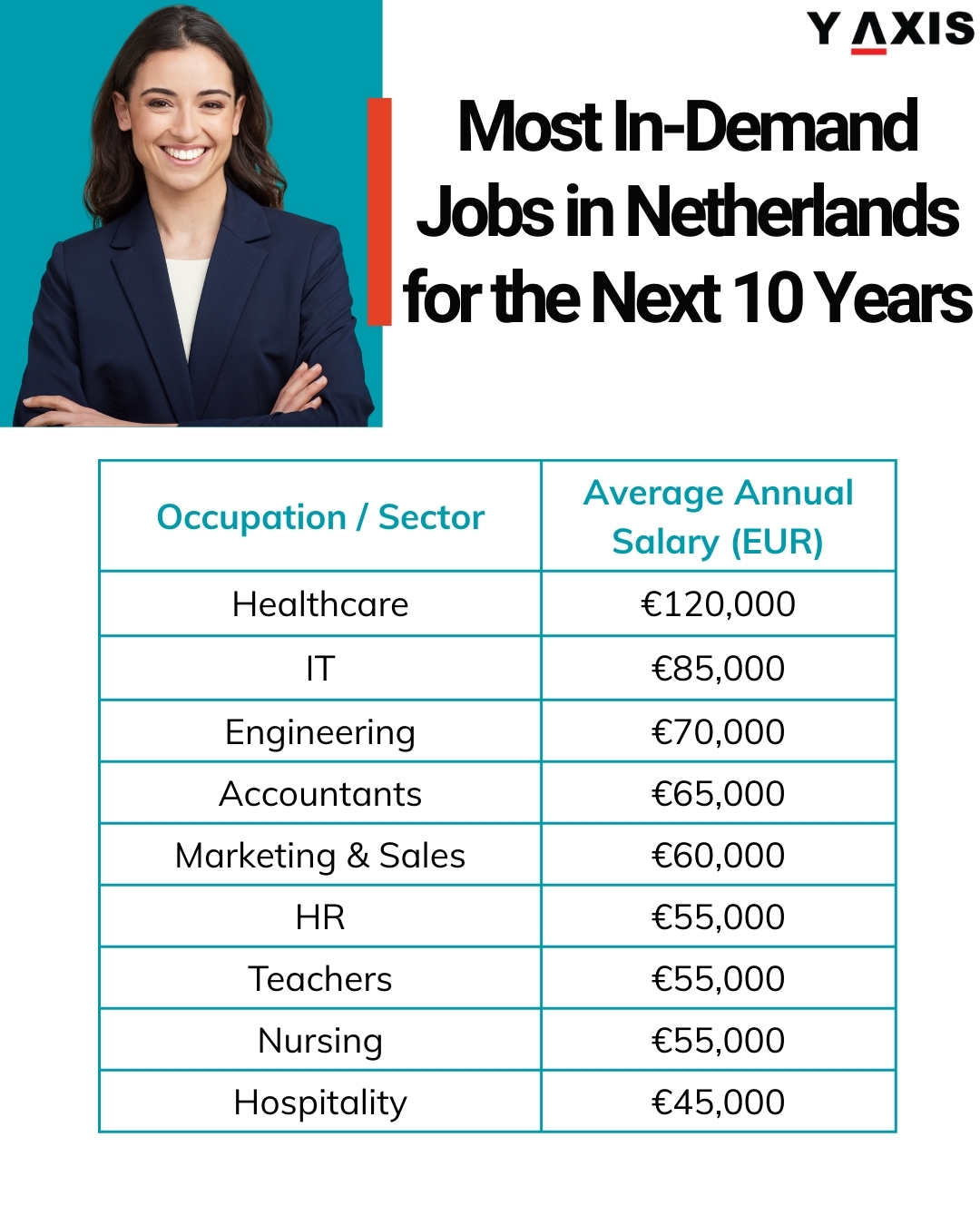
The table below lists the top-paying jobs in the Netherlands along with their average annual salaries:
|
Occupations |
Maximum Salary (EUR) |
|
Engineering |
€ 70,000 |
|
IT |
€ 85,000 |
|
Marketing & Sales |
€ 60,000 |
|
HR |
€ 55,000 |
|
Healthcare |
€ 1,20,000 |
|
Teachers |
€ 55,000 |
|
Accountants |
€ 65,000 |
|
Hospitality |
€ 45,000 |
|
Nursing |
€ 55,000 |
*Want to apply for jobs in the Netherlands? Avail Y-Axis Resume Marketing Services to find the right one.
In-Demand Jobs in the Netherlands for the Next 10 Years
The Netherlands' job market is expected to remain strong over the next decade as the country faces ongoing labour shortages across multiple sectors. The Netherlands currently has around 390,000 job vacancies, with average annual salaries ranging from €45,000 to €70,000, depending on the industry, experience level, and location.
According to labour market forecasts, the Netherlands will continue to need thousands of skilled foreign professionals each year, especially in sectors such as IT, engineering, healthcare, logistics, renewable energy, education, and finance. This presents excellent opportunities for international talent seeking jobs in Netherlands, including jobs in Netherlands for Indians and jobs in Netherlands from India.
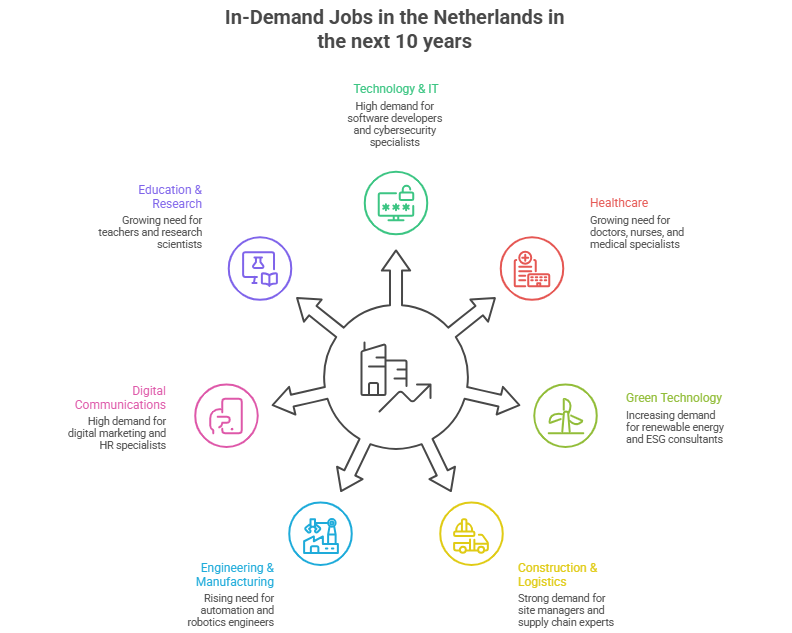
The table below has complete details of job roles that are expected to be in demand in the Netherlands over the next 10 years:
|
Sector |
Job Role |
|
Technology and IT |
Software Developers |
|
AI & Machine Learning Specialists |
|
|
Data Engineers / Data Platform Engineers |
|
|
Cybersecurity Specialists |
|
|
Cloud Architects |
|
|
Software Engineers |
|
|
DevOps Engineers |
|
|
Computer & Information Systems Managers |
|
|
Healthcare |
Doctors |
|
Surgeons (various specialties) |
|
|
Registered Nurses |
|
|
Medical Specialists |
|
|
Medical & Health Services Managers |
|
|
Laboratory Technicians |
|
|
Green Technology & Sustainability |
Renewable Energy Project Managers |
|
Green Construction Engineers |
|
|
ESG (Environmental, Social & Governance) Consultants |
|
|
Environmental Analysts |
|
|
Construction, Infrastructure & Logistics |
Construction Site Managers |
|
Logistics Coordinators / Managers |
|
|
Heavy Vehicle / Transport Supervisors |
|
|
Supply Chain Managers |
|
|
Advanced Engineering & Manufacturing |
Industrial Automation Engineers |
|
Robotics Systems Engineers |
|
|
Quality / Process Improvement Engineers |
|
|
Mechatronics Engineers |
|
|
Digital Communications & Global Business |
Multilingual HR Business Partners |
|
Talent Acquisition Specialists |
|
|
International Sales & Business Development Leads |
|
|
Digital Marketing Specialists |
|
|
Language, Education & Research |
English Teachers |
|
STEM Teachers |
|
|
Translators / Interpreters |
|
|
Research Scientists |
Read more…
Netherlands Job Market: Trends & Job Opportunities
How to Apply for a Job in the Netherlands from India?
To get a job in the Netherlands from India, you must prepare a strong CV that matches Dutch hiring standards, secure a job offer from a Netherlands-based employer, and complete the work visa process under the Highly Skilled Migrant (HSM) Visa, EU Blue Card, or other approved routes. The Netherlands job market is highly competitive, but with the right approach, skilled professionals, especially those looking for jobs in the Netherlands for Indians, can successfully secure roles in IT, engineering, healthcare, logistics, finance, and other high-demand jobs in the Netherlands.
Below is the complete step-by-step process to apply for jobs and work visa in the Netherlands:
Step 1: Get a job offer from a registered Netherlands employer/company with the help of Y-Axis Resume Marketing Services.
Step 2: Receive employer approval for a Netherlands work permit through IND
Step 3: Apply for a Netherlands MVV (work visa) that best aligns with your profile and purpose
Step 4: Attend the visa appointment (if required)
Step 5: Await a decision on your Netherlands work visa
*Are you looking for step-by-step assistance with overseas immigration? Contact Y-Axis, the world’s No. 1 overseas immigration consultancy, for end-to-end assistance!
FAQs
What jobs are expected to be most in demand in the Netherlands over the next decade?
Over the next decade, the Netherlands is expected to see strong demand for professionals in technology, healthcare, engineering, renewable energy, logistics, and life sciences. Software developers, AI specialists, data analysts, cybersecurity experts, nurses, elderly care workers, and mechanical and electrical engineers will remain essential. As the country accelerates digital transformation and sustainability initiatives, new roles will emerge in green energy, climate technology, and automation. Industries like biotech and agriculture-tech will also expand due to the Netherlands’ global leadership in innovation. These trends create long-term, stable career opportunities for both local and international professionals.
Which sectors in the Netherlands will see the fastest job growth in the coming years?
The fastest-growing sectors include information technology, renewable energy, healthcare, logistics, engineering, finance, and life sciences. The tech sector will expand rapidly due to AI adoption, cloud computing, and digital transformation across industries. Healthcare will see sustained growth due to an aging population and increased need for medical services. Renewable energy—particularly wind, solar, and hydrogen—will generate high demand for engineers and technicians. Logistics will evolve as e-commerce and international trade grow. Life sciences and biotech will continue rising due to strong research hubs. These combined sectors will generate thousands of new jobs nationwide.
What future skills will be most valuable in the Netherlands job market?
Future skills that will be highly valuable include digital literacy, programming, data analytics, cloud computing, AI, cybersecurity, automation, robotics, and engineering expertise. Sustainability-related skills—such as renewable energy systems, environmental management, and circular economy design—will also be in demand. Soft skills like problem-solving, leadership, communication, creativity, and adaptability remain crucial. Multidisciplinary skills combining tech and business, such as product management and digital marketing, will provide a competitive edge. With constant technological evolution, continuous learning and upskilling will be essential for long-term career growth in the Netherlands.
How will technology shape job demand in the Netherlands over the next 10 years?
Technology will significantly reshape the Dutch job market, creating new roles while transforming existing ones. Demand for AI developers, software engineers, data scientists, cybersecurity specialists, cloud architects, and automation experts will grow rapidly. Many traditional sectors—healthcare, finance, logistics, manufacturing, and retail—will rely heavily on digital solutions, increasing the need for technically skilled workers. Automation will streamline repetitive tasks, shifting the workforce toward high-skilled, innovation-driven roles. As smart cities, digital infrastructure, and sustainable technologies expand, job opportunities in tech will remain abundant, making the sector one of the strongest drivers of employment.
Which engineering jobs will remain highly sought-after in the Netherlands?
Highly sought-after engineering roles include civil, mechanical, electrical, structural, chemical, and environmental engineers. As the Netherlands invests in infrastructure upgrades, renewable energy projects, smart cities, flood protection systems, and sustainable transportation, engineering talent will remain crucial. Mechanical and electrical engineers will be needed in manufacturing, renewable energy, robotics, and high-tech industries. Civil engineers will play a central role in urban development and climate-resilient construction. Environmental engineers will support sustainability and pollution control initiatives. Overall, engineering will continue to be one of the most reliable, future-proof career paths in the Netherlands.
What healthcare professions will be in highest demand in the Netherlands?
Healthcare professions in highest demand include nurses, general practitioners, elderly care specialists, medical technicians, physiotherapists, and mental health professionals. An aging population and rising healthcare needs are driving continuous growth in hospitals, clinics, long-term care facilities, and home-care services. The demand for specialized medical staff—such as lab technicians, radiographers, and emergency care professionals—will also expand. The Netherlands faces ongoing shortages in healthcare roles, making the sector a stable and attractive option for both local and international candidates. Healthcare jobs offer long-term security, strong career growth, and competitive benefits.
How will the renewable energy transition impact job opportunities in the Netherlands?
The renewable energy transition will create thousands of new jobs across engineering, project management, research, construction, and maintenance. With major investments in offshore wind farms, solar energy, hydrogen technologies, and energy storage, the Netherlands will require skilled technicians, environmental specialists, wind turbine engineers, grid planners, and sustainability analysts. The shift to a low-carbon economy will also boost demand for specialists in circular economy systems, energy efficiency, and eco-design. As the Netherlands pursues aggressive sustainability targets, green energy careers will become some of the most future-proof and sought-after roles in the country.
What roles in IT and digital industries will grow the fastest in the Netherlands?
Fast-growing IT roles include software developers, cybersecurity experts, AI and machine learning engineers, cloud architects, DevOps specialists, data scientists, and digital transformation consultants. The rise of fintech, health-tech, e-commerce, and automation will also fuel demand for UX/UI designers, digital marketers, and product managers. As businesses expand their reliance on digital tools, cybersecurity and cloud engineering will experience especially strong demand. The Netherlands’ position as a European tech hub ensures that IT-related professions will remain among the fastest-growing and highest-paying career paths in the coming decade.
How will automation influence job creation and job shortages in the Netherlands?
Automation will eliminate some repetitive tasks but create new demand for high-skilled roles in engineering, software development, robotics, maintenance, and process optimization. Sectors like manufacturing, logistics, and finance will rely heavily on automated systems, increasing the need for specialists who can design, manage, and troubleshoot advanced technologies. While some administrative and manual jobs may decline, shortages will deepen in technical, digital, and scientific occupations. Automation will reshape—not reduce—the job market, shifting demand toward workers with analytical, technical, and problem-solving skills. Continuous upskilling will be essential for long-term career resilience.
Which logistics and supply chain jobs will be needed most in the future?
High-demand logistics roles will include supply chain planners, warehouse managers, logistics coordinators, route optimization specialists, transport managers, and e-commerce fulfillment experts. Technical roles in automation, robotics maintenance, and data analytics will also grow as warehouses adopt advanced technologies. The Netherlands’ strategic location as Europe’s gateway—supported by major hubs like the Port of Rotterdam and Schiphol Airport—ensures strong long-term demand. With rising global trade, e-commerce expansion, and digital logistics systems, supply chain management will remain one of the most stable and future-proof sectors for employment.
What are the emerging careers in the Netherlands that job seekers should watch for?
Emerging careers include roles in AI, robotics, cybersecurity, renewable energy systems, green hydrogen, biotech research, agri-tech innovation, digital health, and circular economy design. As sustainability becomes a national priority, new jobs will arise in climate adaptation, environmental analysis, eco-friendly construction, and energy-efficient technologies. Creative tech fields—such as AR/VR, gaming, and digital design—are also gaining momentum. These emerging roles reflect the Netherlands’ focus on innovation, environmental responsibility, and technological advancement, creating strong future opportunities for skilled professionals who adapt to evolving industry needs.
How will the Netherlands’ aging population affect future job demand?
An aging population will significantly increase demand for healthcare professionals, elderly care workers, physiotherapists, social workers, and medical technicians. Beyond healthcare, it will also create opportunities in insurance, financial planning, home-care services, and assistive technologies. The labor shortage created by retiring workers will fuel demand in education, logistics, engineering, and technology roles. The demographic shift ensures long-term job stability in sectors supporting both elderly care and economic productivity. As the workforce shrinks, the Netherlands will rely more on skilled international workers to fill critical gaps across industries.
What high-paying jobs will be in strong demand in the Netherlands long term?
High-paying, high-demand roles include software engineers, data scientists, cybersecurity experts, AI specialists, cloud architects, engineers, medical specialists, project managers, and financial analysts. Renewable energy engineers, automation experts, and biotech researchers will also command strong salaries as these sectors grow. Leadership positions in tech, finance, logistics, and sustainability offer excellent compensation packages. Professionals with rare or advanced skills—especially in AI, robotics, green energy, and scientific R&D—will benefit from rising salaries and long-term job security in the Netherlands.
Which Dutch cities will offer the most future job opportunities?
Amsterdam, Utrecht, Rotterdam, Eindhoven, and The Hague will continue offering the strongest job opportunities. Amsterdam remains the hub for technology, finance, creative industries, and international business. Utrecht is growing rapidly in life sciences, healthcare, and tech. Rotterdam leads in logistics, engineering, and maritime innovation. Eindhoven’s “Brainport’’ region is a global center for high-tech manufacturing and research. The Hague offers opportunities in government, security, legal services, and NGOs. These cities will drive most future employment growth due to their innovation ecosystems and strong economic foundations.
What scientific and research-based roles will grow in the Netherlands?
Scientific and research-based roles in life sciences, biotechnology, pharmaceuticals, climate science, agri-tech, and medical research will grow significantly. The Netherlands hosts world-class research institutions and innovation hubs, creating opportunities for laboratory scientists, microbiologists, biochemists, research engineers, clinical trial specialists, and environmental scientists. Increasing investment in sustainable agriculture, biotech innovation, and health research ensures strong demand for scientific talent. Collaboration between universities, startups, and multinational companies will enable continuous innovation and high-value job growth in the research sector.
How will sustainability and climate goals create new jobs in the Netherlands?
Sustainability goals will generate jobs in renewable energy engineering, climate adaptation, environmental consulting, waste reduction, circular economy systems, sustainable construction, and green transport planning. With ambitious climate targets, the Netherlands is investing heavily in offshore wind, hydrogen energy, energy-efficient buildings, and eco-friendly infrastructure. This creates demand for environmental engineers, sustainability analysts, energy auditors, project managers, and carbon reduction specialists. Companies across sectors will need sustainability experts to meet regulatory standards. These trends will make green jobs a major employment driver in the coming decade.
What creative or design-related jobs will remain relevant in the future Dutch economy?
Creative roles such as UX/UI designers, digital marketers, graphic designers, product designers, content creators, and animation specialists will remain in high demand. As companies focus on digital branding, user experience, and online presence, creative professionals will play key roles in shaping digital products and customer engagement. The Netherlands’ strong design culture supports opportunities in architecture, fashion, media, gaming, and creative tech. Emerging fields like AR/VR, interactive media, and digital storytelling will further expand creative career paths.
What opportunities will exist for foreign workers in the Netherlands job market?
Foreign workers will find strong demand in technology, engineering, healthcare, logistics, finance, life sciences, and sustainability fields. Many Dutch companies operate in English, making it easier for international professionals to secure roles. Talent shortages will create opportunities in AI, software development, renewable energy, biotech, and specialized engineering. Highly skilled migrants are welcomed through favorable hiring policies, and international companies frequently seek multicultural talent. With ongoing demographic shifts and economic expansion, foreign workers will continue playing a vital role in the Dutch labor market.
How can job seekers prepare for the most in-demand jobs in the Netherlands?
Job seekers can prepare by developing in-demand technical skills, gaining relevant certifications, and staying updated with industry trends. Strong areas to focus on include programming, data analytics, AI, cloud technologies, engineering skills, and healthcare qualifications. Learning Dutch can improve employability, though many roles are English-friendly. Networking through LinkedIn, job fairs, and Dutch recruitment agencies also helps. Continuous learning, adapting to digital tools, and building a strong professional portfolio will position candidates for long-term success in the Netherlands job market.
Which professions will be least affected by automation in the Netherlands?
Professions requiring human empathy, creativity, critical thinking, and complex decision-making will be least affected by automation. These include healthcare roles like nurses, therapists, and elderly care workers; creative roles such as designers and content creators; and strategic positions in management, consulting, and education. Skilled trades such as electricians, plumbers, and technicians will also remain essential due to hands-on work. While automation may enhance these professions, it cannot fully replace the human element. Workers in these fields will continue to enjoy long-term stability and strong demand.
Tags:
Jobs in the Netherlands
Jobs in the Netherlands for Indians
Work in the Netherlands
Netherlands work visa
in-demand jobs in the Netherlands
In demand jobs in the Netherlands for the next 10 years
Highest paying jobs in the Netherlands
Share
Y - Axis services

Get it on your mobile

Get News Alerts

Contact Y-Axis
Latest Article
Popular Post
Trending Article

Posted On April 02 2026
190 Skilled Jobs in Denmark Eligible for Work Visa (2026) – Check If You Qualify