


Posted on January 31 2026
How can I migrate to Japan as a Software Engineer?

By , Editor
Updated February 07 2026
You can migrate to Japan as a software engineer by securing a job offer that includes a visa sponsorship. Software engineers can migrate to Japan through immigration pathways such as the "Engineer/Specialist in Humanities/International Services" visa, the HSP (Highly Skilled Professional), and the J-Skip Visa. You must have a relevant qualification (bachelor's/master's) in software engineering, with advanced certifications and Japanese language proficiency (N2-N1 level), which is not mandatory but preferred.
*Want to work in Japan? Let the Y-Axis guide you with the process.
Immigration Pathways in Japan for Software Engineers
Immigration pathways in Japan for software engineers include the "Engineer/Specialist in Humanities/International Services" visa, the HSP (Highly Skilled Professional) Visa, and the J-Skip Visa. Software engineers migrating to Japan should have a bachelor's/master's degree in a related field or at least 10 years of professional work experience, in the absence of a degree.
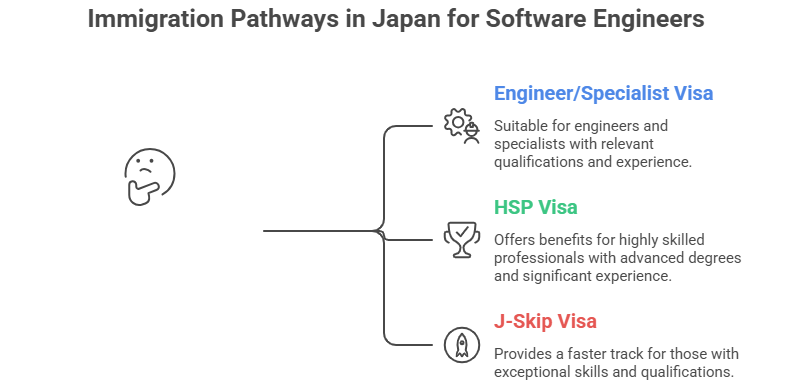
The following are the immigration pathways in Japan for software engineers:
Engineer/Specialist in Humanities/International Services Visa
The Engineer/Specialist in Humanities/International Services visa (Engineer visa) is the most common immigration pathway in Japan for software engineers. You can apply for an Engineer visa to work in the IT and engineering sectors of Japan, with long-term employment support and rapid career growth. Software engineers with prior work experience (10+ years) in technical or professional roles such as software development, system engineering, and IT consulting, or those with a valid Bachelors or Master’s degree can migrate to Japan through an Engineer visa. The visa is valid for up to 1-5 years, allowing you to work and stay in Japan, and can be renewed for future work requirements.
How it works: You need to secure a job offer with visa sponsorship from a Japanese company to initiate the visa application process and obtain a Certificate of Eligibility (CoE), which is an employer-mediated process.
Benefits: Software engineers from abroad can engage in full-time employment in software and IT roles with a renewable work permit and family reunification benefits.
Pathway to PR: Software engineers working in Japan on an Engineer/Specialist in Humanities/International Services visa can transition to PR status in 3 to 5 years through the Highly Skilled Professional points system.
Also, read…
Highly Skilled Professional (HSP) Visa
Software engineers with high educational qualifications, salary, and work experience can apply for a Highly Skilled Professional (HSP) Visa to migrate to Japan. An HSP Visa works on a point-based system, where a high score is granted to software engineers with an exceptional educational background (Master’s/PhD), prior work experience, and globally recognised achievements, high salaries and qualifications. Software engineers need to secure at least 70 points or more under Japan’s points system for HSP visa approval, valid for 5 years.
How it works: Points are calculated based on salary, work experience, education, age, and skills under Japan’s point-based system. You need at least 70 points and a valid job offer to qualify for an HSP visa, which is fast-tracked compared to standard work visas in Japan.
Benefits: Foreign software engineers receive preferential immigration treatment through an HSP visa, which also permits the spouses of visa holders to engage in full-time employment in the country.
Pathway to PR: Software engineers migrating to Japan on an HSP Visa can be eligible to apply for PR within 3 years, and within 1 year for candidates with 80+ points, provided they meet the required criteria.
Also, read…
What are the fast-track hiring options in Japan for Skilled Professionals?
J-Skip Visa (Special Highly Skilled Professional)
The J-Skip Visa is a fast-track immigration pathway for software engineers with top-tier educational qualifications and work experience. Highly paid and experienced software engineers can expedite entry into Japan for long-term work and residence with a simplified PR transition. A J-Skip Visa is issued for 5 years, but can be renewed if the work is extended.
How it works: Software engineers with advanced education/skills and a high salary threshold qualify for a fast-tracked J-Skip visa, provided they have a high-paying job offer in a Japanese organisation.
Benefits: The process of applying for a J-Skip visa as a software engineer is simplified to enable fast-track entry and work in Japan’s skilled-shortage sectors.
Pathway to PR: A J-Skip Visa makes you eligible for Japan PR after 1 year of continuous residence in Japan.
Also, read…
What are the most in-demand jobs in Japan for the next 10 years?
Eligibility Criteria for Software Engineers to Migrate to Japan
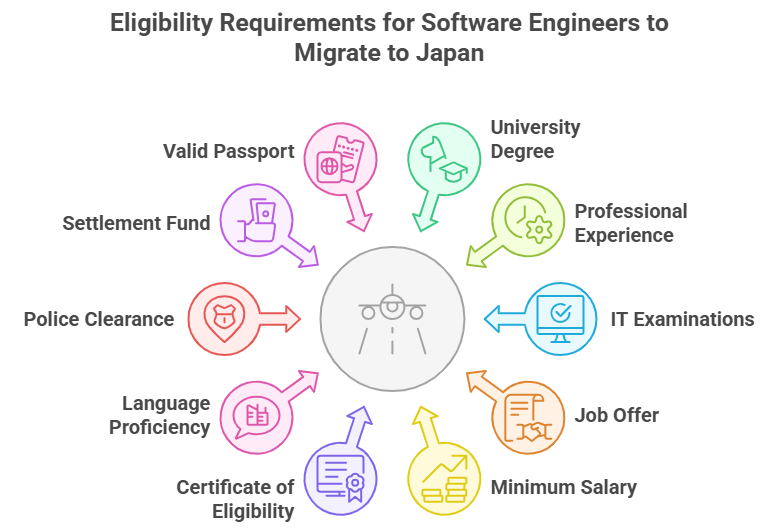
To migrate to Japan as a software engineer, you need to secure a job offer from a Japanese employer with valid visa sponsorship. Software engineers migrating to Japan must have a relevant educational qualification (Bachelor’s/Master's) and at least 10 years of professional work experience. The following are the eligibility criteria for software engineers to migrate to Japan:
- Standard university degree in engineering (Bachelor’s/Master’s).
- At least 10 years of professional work experience. (in the absence of a degree)
- IT examinations under the ITPEC (Information Technology Professional Examination Council) framework (if a university degree is absent).
- Valid job offer with visa sponsorship.
- Minimum salary requirement (must be higher than that of a Japanese national in an equivalent role).
- Certificate of Eligibility (COE).
- Japanese language proficiency (N2-N1 level). (optional)
- Police Clearance record.
- Valid passport.
*Interested in software engineer jobs abroad? Sign-up with Y-Axis for assistance in every step.
How to Apply for Japan Immigration as a Software Engineer?
Software engineers can migrate to Japan by securing a job from a Japanese company that is willing to offer visa sponsorship (for a Specialist in Humanities/International Services visa). You should have relevant educational qualifications, work experience, and proficiency in Japanese to migrate to Japan as a software engineer.
The steps to migrate to Japan as a software engineer are as follows:
Step 1: Check eligibility for different Japan immigration pathways for software engineers (Engineer/Specialist in Humanities/International Services or Highly Skilled Professional visa)
Step 2: Select a suitable immigration pathway in Japan for a software engineer based on educational qualification, work experience, language proficiency, and skills.
Step 3: Secure a valid job offer from a Japanese employer with visa sponsorship.
Step 4: The Japanese employer applies for a Certificate of Eligibility (CoE) on your behalf after job confirmation.
Step 5: Upon receiving the CoE, submit the visa application with the necessary documents, including the CoE, a work experience letter, educational documents, etc.
Step 6: Fly to Japan after visa approval.
Step 7: Receive a Residence Card upon arriving in Japan, confirming your Status of Residence (SOR).
*Are you looking for step-by-step assistance with overseas immigration? Contact Y-Axis, the world’s No. 1 overseas immigration consultancy, for end-to-end assistance!
FAQs
How can I migrate to Japan as a software engineer?
You can migrate to Japan as a software engineer by securing a job with visa sponsorship from a Japanese employer. Applicants should have relevant educational qualifications (Bachelor’s or Master’s degree in engineering or IT), typically 10+ years of work experience, and Japanese language proficiency (JLPT N2 or N1 preferred). Popular immigration pathways include the Engineer/Specialist in Humanities/International Services visa, the Highly Skilled Professional (HSP) visa, and the J-Skip Visa.
What are the immigration pathways in Japan for software engineers?
Japan offers several immigration pathways for software engineers, including the Engineer/Specialist in Humanities/International Services visa, the Highly Skilled Professional (HSP) visa, and the J-Skip Visa. These pathways generally require a relevant degree, professional experience (often 10 years or more), a minimum salary threshold, and adequate language proficiency.
Are software engineers in demand in Japan?
Yes, software engineers are in high demand in Japan due to labour shortages and an ageing population. The country is actively recruiting foreign IT professionals for roles in AI, cloud computing, cybersecurity, data science, and full-stack development, supported by fast-track visa options.
What documents are required to migrate to Japan as a software engineer?
The key documents required include:
- Certificate of Eligibility (CoE)
- Job offer letter from a Japanese employer
- Proof of employer visa sponsorship
- University degree or diploma in engineering or IT
- Work experience letters
- Japanese language proficiency certificates (JLPT, if applicable)
- Valid passport
Is a job offer mandatory to migrate to Japan as a software engineer?
Yes, a job offer is mandatory. A Japanese employer must sponsor your visa and apply for the Certificate of Eligibility (CoE) on your behalf. The CoE is a compulsory document for submitting your work visa application.
What is the average salary of software engineers in Japan?
The average annual salary of a software engineer in Japan ranges between ¥5 million and ¥12 million. Salaries vary based on experience, qualifications, company type, and location. Senior professionals in cities like Tokyo can earn around ¥10 million or more annually.
What is the relocation cost to move to Japan as a software engineer?
The total relocation cost typically ranges from ¥1 million to ¥2 million, covering travel, visa fees, and initial settlement expenses. Housing deposits in cities like Tokyo may range from ¥300,000 to ¥500,000, with an additional ¥200,000–¥500,000 required for furnishing.
How can I apply for permanent residency in Japan after working as a software engineer?
To apply for permanent residency (PR) in Japan, you generally need to live and work in the country for at least 10 years. Software engineers must complete a minimum of 5 years on a standard work visa, while those under the Highly Skilled Professional (HSP) points system may qualify within 1–3 years, subject to points, stable income, and good conduct.
Are there language proficiency requirements for software engineers migrating to Japan?
Japanese language proficiency is not mandatory, especially for international IT roles, but it greatly enhances job prospects and career growth. JLPT N2 or N1 level proficiency is strongly recommended for long-term employment and integration.
Can I apply for a Japanese work permit online as a software engineer?
Yes, the Certificate of Eligibility (CoE) application can be submitted online, but the process must be initiated by your Japanese employer. Once approved, you can apply for the work visa through the Japanese embassy or consulate in your home country.
Tags:
Migrate to Japan
work in Japan
software engineer jobs in Japan
software engineer salary in Japan
salary of a software in Japan
Engineer/Specialist in Humanities/International Services
Certificate of Eligibility
HSP Visa
Share
Y - Axis services

Get it on your mobile

Get News Alerts

Contact Y-Axis
Latest Article
Popular Post
Trending Article

Posted On March 14 2026
What are the New Updates in skilled worker visa programs?