


Posted on December 24 2025
What are the fast-track hiring options in Japan for Skilled Professionals?

By , Editor
Updated January 07 2026
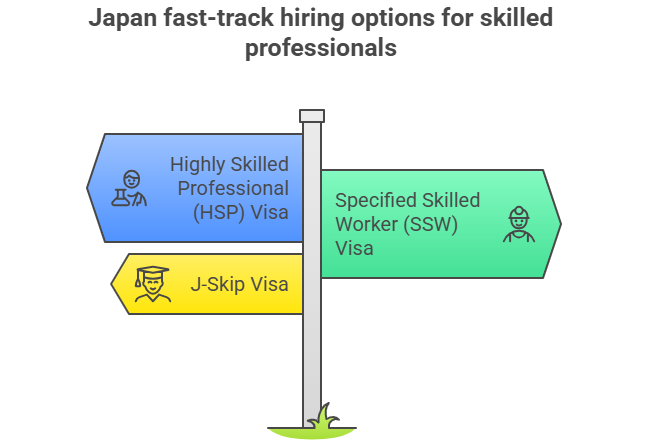
The fast-track hiring options in Japan for skilled professionals include the Highly Skilled Professional (HSP) Visa, the J-Skip visa, and the Specified Skilled Worker (SSW) Visa. Japan offers fast-track hiring options that facilitate faster and streamlined immigration pathways for skilled workers. The country provides fast-track hiring visa pathways to address the workforce and skilled shortages in key industries. There is an increasing demand for skilled workers in high-demand sectors in Japan, including IT, engineering, finance, advanced manufacturing, and research. Through fast-track hiring pathways, Japanese employers can recruit skilled professionals from overseas more quickly, offering them long-term career prospects. Fat-track hiring options in Japan provide faster visa processing, longer residency periods, family benefits, and PR pathways.
*Want to apply for a Japan work visa? Let Y-Axis guide you with the steps.
Fast-track hiring options in Japan for skilled professionals
The fast-track hiring options in Japan for skilled professionals are as follows:
Highly Skilled Professional (HSP) Visa
The Highly Skilled Professional (HSP) visa is for highly skilled and experienced professionals with recognized and advanced qualifications. The HSP visa in Japan operates on a points-based system, rewarding applicants based on specific factors such as age, education, work experience, annual income, and proficiency in the Japanese language. The Highly Skilled Professional (HSP) visa is considered the most common fast-track visa option, as it offers faster permanent residency in one year if you secure 80 or more points, and three years if you secure 70-79 points. The HSP visa is recognized as one of the fastest settlement routes in Japan for skilled workers.
Why select the HSP visa as a fast-track hiring option?
- The HSP visa is one of the fastest ways of securing long-term settlement in Japan, allowing PR in 1-3 years (based on the total points secured in the points-based system)
- The HSP visa offers faster visa processing, as HSP visa applications are reviewed more quickly compared to other work visa options.
- HSP visa holders can get up to 5 years of residence status, eliminating the need for visa renewals
- You get the flexibility to switch job roles and employers, as compared to the traditional work visa options.
- You can bring your dependent family members, allowing your spouse to work full-time in the country without any restrictions.
Japan J-Skip Visa (Special Highly Skilled Professional)
The J-Skip visa is a new fast-track work visa option in Japan for highly skilled professionals. The country introduced the J-1 visa for highly ranked professionals, such as advanced researchers, senior executives, and highly paid technical specialists. To qualify for a J-Skip visa in Japan, individuals must meet specific requirements, including high income thresholds and professional work experience. The J-skip visa is one of the easiest fast-track hiring options as it comes with simple eligibility criteria, offering shorter and faster PR.
Why select the J-Skip visa as a fast-track hiring option?
- The visa does not have a points-based system and comes with straightforward eligibility criteria that involve meeting a salary threshold of ¥20 million and experience levels.
- The visa processing is faster on a priority basis, specifically for top global talent.
- Offers a faster permanent residency pathway for qualifying skilled professionals, compared to the standard 10-year requirement.
- The visa has low chances of rejection as it is issued to top-skilled professionals who fulfill the salary and work experience criteria.
- The visa facilitates faster hiring in technical and critical leadership job roles.
Specified Skilled Worker (SSW) Visa
The Specified Skilled Worker (SSW) visa is one of the most common work visa options in Japan. The SSW visa was designed for skilled foreign workers who can fill workforce shortages in 16 priority sectors in Japan, such as healthcare, aviation, construction, hospitality, manufacturing, food services, and agriculture. The SSW visa has two different categories, known as the SSW (i) for entry-level and mid-level job roles, and SSW (ii) for advanced and highly-skilled job roles.
Why select the SSW visa as a fast-track hiring option?
- The SSW visa applications will be prioritized and processed more quickly, as they are specifically designed to address workforce shortages in critical sectors.
- The eligibility criteria for an SSW visa are simple, requiring candidates to clear the skill and language tests.
- The hiring process is faster, as sectors and recruitment are done to address labour shortages in key industries.
- The employer sponsorship process is streamlined and transparent, with government-recognised support organizations, reducing administrative delays for employers.
- The SSW (i) visa offers long-term career stability for skilled and experienced professionals.
- The Specified Skilled Worker (SSW) visa supports long-term settlement, offering a PR pathway for qualifying workers.
*Are you planning to work in Japan? Sign up with Y-Axis for assistance in every step.
Steps to Apply for Fast-Track Hiring Options in Japan
You can follow the steps given below to apply for the fast-track hiring options in Japan:
Step 1: Choose the right fast-track visa option based on your eligibility and qualifications (HSP visa, SSW visa, or J-Skip visa)
Step 2: Obtain a job offer from a registered employer in Japan and ensure the salary and job role match your visa category
Step 3: Your Japanese employer applies for a Certificate of Eligibility (CoE)
Step 4: Apply for the Japanese work visa after the CoE is issued.
Step 5: Fulfil the visa-specific qualifications and requirements (minimum points for HSP, income & experience for J-Skip visa, and language tests and skills for SSW
Step 6: Await a decision on your Japan work visa application
Step 7: Fly to Japan and start working via the fast-track visa option
*Are you looking for step-by-step assistance with overseas immigration? Contact Y-Axis, the world’s No. 1 overseas immigration consultancy, for end-to-end assistance!
FAQs
What are the fast-track hiring options available in Japan for skilled professionals?
Japan offers several fast-track hiring options to attract global talent, including the Highly Skilled Professional (HSP) visa, J-SKIP (Special Highly Skilled Professional) program, and employer-sponsored work visas with priority processing. These pathways allow faster visa approvals, longer residence periods, and accelerated permanent residency (PR). They are mainly designed for professionals in IT, engineering, research, management, finance, and advanced technical fields. Compared to standard work visas, fast-track options reduce processing time and provide additional benefits such as family work rights and early PR eligibility.
What is Japan’s Highly Skilled Professional (HSP) visa and how does it work?
The Highly Skilled Professional (HSP) visa is a points-based work visa designed to attract highly qualified foreign professionals. Applicants earn points based on education, work experience, salary, age, Japanese language ability, and professional achievements. A minimum of 70 points is required to qualify. The visa offers priority processing, a five-year residence status, and faster access to permanent residency. HSP visas are available under advanced academic research, advanced specialized or technical work, and advanced business management categories.
How does the points-based system for Japan’s HSP visa calculate eligibility?
Japan’s HSP points system evaluates candidates based on academic qualifications, professional experience, annual income, age, Japanese language proficiency, and achievements. Higher education degrees, strong salaries, and specialized expertise earn higher scores. Bonus points may be awarded for Japanese language certifications such as JLPT N1 or N2 and work in priority sectors. Applicants must score at least 70 points to qualify, while scoring 80 points or more allows eligibility for permanent residency after just one year.
What is the minimum salary required to qualify for fast-track work visas in Japan?
There is no fixed minimum salary, but income is a critical factor for fast-track eligibility. For the HSP visa, salaries typically start around ¥3 to ¥5 million annually, depending on age and experience, with higher salaries earning more points. The J-SKIP program targets senior professionals with significantly higher income levels. Employers must ensure compensation aligns with Japanese market standards. A higher salary strengthens visa approval chances and speeds up permanent residency eligibility.
Which professions are eligible for Japan’s fast-track skilled visa programs?
Japan’s fast-track visa programs are open to professionals in high-demand fields such as IT, software development, engineering, AI, robotics, finance, research, consulting, academia, and senior management. Roles requiring advanced skills, technical expertise, or leadership experience are prioritized. Applicants must have relevant qualifications and experience that align with their job role. These programs are not suitable for low-skilled or general labor positions and focus on knowledge-based occupations.
What is J-SKIP in Japan, and how is it different from the HSP visa?
J-SKIP is a special fast-track program introduced to attract top-tier foreign professionals. Unlike the HSP visa, which uses a detailed points system, J-SKIP focuses primarily on high income levels and advanced professional experience. It is designed for senior executives, researchers, and highly paid specialists. J-SKIP offers simplified eligibility, faster processing, and a rapid route to permanent residency, making it ideal for professionals who clearly exceed standard skilled visa requirements.
How long does visa processing take under Japan’s fast-track hiring routes?
Visa processing under fast-track routes is generally faster than standard work visas. The Certificate of Eligibility process typically takes one to two months, depending on employer readiness and documentation. Once issued, visa stamping at a Japanese embassy or consulate usually takes a few days to a few weeks. HSP and J-SKIP applications often receive priority handling, helping skilled professionals relocate more quickly than through traditional visa pathways.
Can foreign IT professionals and engineers use Japan’s fast-track hiring options?
Yes, IT professionals and engineers are among the most sought-after candidates for Japan’s fast-track hiring programs. Roles in software development, AI, cloud computing, cybersecurity, robotics, and systems engineering are highly prioritized. Many professionals in these fields meet HSP eligibility due to strong salaries and specialized expertise. Japan’s growing tech talent shortage has encouraged employers to actively sponsor foreign IT professionals through fast-track visa pathways.
Is Japanese language proficiency mandatory for fast-track visas in Japan?
Japanese language proficiency is not mandatory but offers a significant advantage. Under the HSP visa system, applicants can earn additional points for JLPT certifications, particularly N1 or N2. Many international companies operate in English, especially in IT and research roles. However, basic Japanese skills improve workplace integration, career growth, and long-term settlement prospects. Language ability is an added benefit rather than a strict requirement.
Do fast-track work visas in Japan lead to permanent residency (PR)?
Yes, fast-track work visas offer accelerated access to permanent residency in Japan. While standard PR usually requires ten years of residence, HSP visa holders can apply after three years with 70 points or just one year with 80 points. J-SKIP also provides a shortened PR timeline. This accelerated pathway makes Japan one of the more attractive destinations for skilled professionals seeking long-term settlement.
How soon can skilled professionals apply for Japan PR under the fast-track route?
Skilled professionals can apply for Japan PR within one to three years under fast-track routes. Those scoring 80 points or more under the HSP system may apply after one year, while applicants with 70 points become eligible after three years. Eligibility also depends on tax compliance, stable income, and good conduct. This fast-track PR option significantly reduces the long waiting period compared to standard immigration routes.
Can dependents accompany skilled professionals under Japan’s fast-track visas?
Yes, fast-track visas offer generous family benefits. Spouses and children can accompany the primary visa holder to Japan. Spouses of HSP visa holders are allowed to work full-time without restrictions, unlike standard dependent visas. In some cases, parents may also be invited for childcare or family support. These benefits make Japan’s fast-track options especially appealing for professionals planning long-term relocation with their families.
Are employers required to sponsor fast-track visas in Japan?
Yes, employer sponsorship is mandatory for most fast-track visas in Japan. A Japan-based employer must provide a job offer and apply for the Certificate of Eligibility on behalf of the applicant. The employer must demonstrate compliance with salary standards, business legitimacy, and role relevance. Strong employer support is essential for faster processing and higher approval chances under fast-track hiring programs.
What documents are required for fast-track hiring and work visas in Japan?
Applicants typically need a valid passport, job offer letter, employment contract, educational certificates, work experience letters, salary details, and employer documents. HSP applicants must also submit a points calculation sheet with supporting evidence. Employers provide company registration documents and Certificate of Eligibility forms. Complete and accurate documentation is critical to avoid delays or rejections during the visa process.
Can professionals apply for Japan’s fast-track visas from outside the country?
Yes, professionals can apply for Japan’s fast-track visas from outside Japan. The employer applies for the Certificate of Eligibility within Japan, and once approved, the applicant submits the visa application at a Japanese embassy or consulate in their home country. This allows professionals to secure work authorization before relocating, making overseas applications common and efficient.
How does Japan’s fast-track hiring compare with standard work visas?
Fast-track hiring options provide faster processing, longer residence validity, enhanced family benefits, and accelerated permanent residency compared to standard work visas. Standard visas often require frequent renewals and longer PR timelines, while fast-track visas offer stability and long-term settlement advantages. These options are specifically designed for high-value skilled professionals and senior talent.
What are the advantages of fast-track hiring options for employers in Japan?
Fast-track hiring allows Japanese employers to quickly fill critical skill gaps and compete globally for talent. It reduces recruitment delays, improves workforce stability, and supports innovation-driven industries. Employers benefit from higher retention rates, as fast-track visas encourage long-term settlement. These programs also strengthen Japan’s economy by attracting experienced professionals across key sectors.
Can professionals switch from a standard work visa to a fast-track visa in Japan?
Yes, professionals already working in Japan can switch from a standard work visa to a fast-track visa such as the HSP visa if they meet eligibility criteria. This involves a new application and points assessment. Switching allows access to faster permanent residency, better family benefits, and longer residence periods, making it a strategic move for career growth and settlement.
What are common reasons for rejection of fast-track skilled visas in Japan?
Common reasons for rejection include insufficient points, incomplete documentation, salary inconsistencies, unclear job role relevance, and employer compliance issues. Errors in points calculation or missing supporting evidence can also lead to refusal. Ensuring accurate documentation and strong employer sponsorship significantly improves approval chances for fast-track visas.
Which industries in Japan actively use fast-track hiring for foreign professionals?
Industries that actively use fast-track hiring include IT, software development, AI, robotics, engineering, manufacturing, finance, consulting, academic research, and business management. These sectors face talent shortages and rely heavily on skilled foreign professionals. Technology-driven industries are the largest users, followed by research institutions and multinational corporations offering long-term career and settlement opportunities.
Tags:
Fast track hiring in Japan
work in Japan
Fast-track hiring options in Japan
Japan immigration
Japan visas
Japan work visas
Migrate to Japan
Highly Skilled Professional visa
J-Skip visa
Specified Skilled Worker (SSW) Visa
Jobs in Japan
Share
Y - Axis services

Get it on your mobile

Get News Alerts

Contact Y-Axis
Latest Article
Popular Post
Trending Article

Posted On April 10 2026
Australia Jobs for Skilled Professionals: 500 Roles Eligible for Australia Work Permit