


Posted on February 21 2026
Thailand Offers Indians 60 Days Visa-Free with Optional 30-Day Extension – Plan Your Visit Today

By , Editor
Updated February 25 2026
Highlights: Thailand Upgrades Entry Rules for Indians with 60-Day Visa-Free Stay
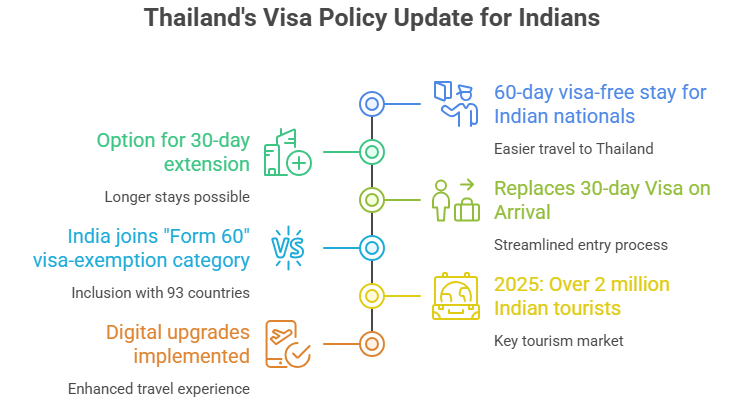
- Thailand has officially upgraded its entry rules for Indian passport holders, introducing a longer visa-free stay to boost tourism and bilateral travel.
- Indian nationals can now stay in Thailand visa-free for up to 60 days, replacing the earlier 30-day Visa on Arrival facility.
- Travellers can apply for a 30-day extension at local Thai immigration offices, allowing a total stay of up to 90 days.
- India has been added to Thailand’s “Form 60” visa-exemption list, which now includes passport holders from 93 countries and territories.
- Indian tourism to Thailand has crossed 2 million visitors in 2025, with the country also streamlining its visa system by reducing Non-Immigrant categories from 17 to 7 (effective August 31, 2025).
*Want to apply for a Thailand tourist visa? Let the Y-axis guide you with the steps.
Thailand Grants Indians 60-Day Visa-Free Stay with 30-Day Extension
Thailand has introduced a significant visa policy update for Indian passport holders, making travel easier and more convenient. Under the revised rules, Indian nationals can now enter Thailand without a visa and stay for up to 60 days, with the option to apply for a further 30-day extension at a local immigration office.
This new rule replaces the earlier 30-day Visa on Arrival facility and officially includes India in Thailand’s “Form 60” visa-exemption category, which currently covers 93 countries and territories. The move is aimed at strengthening tourism and bilateral ties, especially as Indian travel to Thailand continues to grow rapidly.
In 2025 alone, more than 2 million Indian tourists visited Thailand, making India one of the country’s key tourism markets. Alongside the extended visa-free stay, Thailand has also implemented digital upgrades such as the mandatory Thailand Digital Arrival Card (TDAC) and expanded e-visa services across its global embassies.
Whether you’re planning a holiday, attending short-term business meetings, or exploring remote work opportunities, this policy change offers Indian travellers greater flexibility, longer stays, and a smoother entry process.
*Planning to visit Thailand? Sign up with Y-Axis to assist you with the visa process.
What Changes Under the New Thailand Visa Rule?
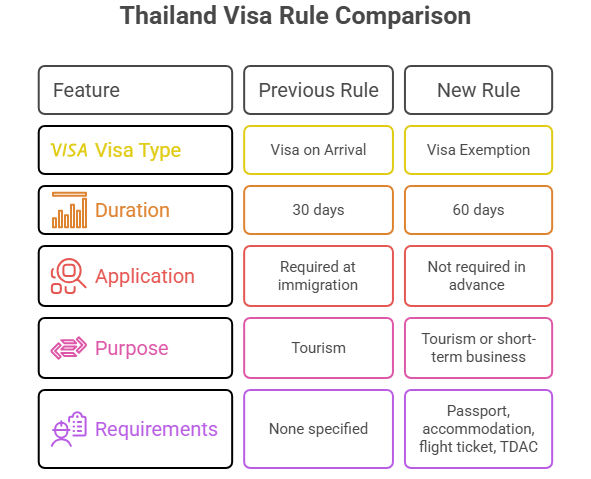
Previously, Indian travellers were eligible for a 30-day Visa on Arrival, which required processing at immigration counters. Under the updated policy, Indians are granted visa exemption for 60 days without needing to apply in advance.
According to the official announcement, Indian nationals may enter Thailand for tourism or short-term business travel without obtaining a prior visa. However, travellers must carry the following:
- Valid passport
- Genuine proof of accommodation for the entire stay
- Confirmed return or onward flight ticket
- Completed Thailand Digital Arrival Card (TDAC), submitted at least three days before travel
The TDAC, which replaced the earlier TM.6 form, has been mandatory since May 1, 2025. Additionally, Thailand expanded its electronic visa services across 94 embassies and consulates worldwide from January 1, 2025
Authorities have also warned against the misuse of extended stays. Overstaying or working without proper authorization may result in penalties.
*Want to visit abroad? Get in touch with experts at Y-Axis to end-to-end support with the steps.
Thailand Visa Update: New Visa Options for Remote Workers and Students
Thailand is not just targeting tourists. The government has introduced reforms to support long-term visitors, students, and remote professionals.
The Destination Thailand Visa (DTV) allows digital nomads and remote workers to stay in the country for extended periods while working for overseas employers. This initiative aims to attract global talent and boost Thailand’s economy.
Additionally, the newly launched Non-Immigrant ED Plus visa supports foreign students pursuing study or combined study-and-work programs in Thailand.
To streamline immigration, Thailand has simplified visa categories from 17 types to 7, making the system more transparent and efficient.
Also, read…
Thailand Introduces Online Work Permit Portal for Foreign Workers
Important Travel Guidelines for Indians Visiting Thailand
While the new 60-day visa-free stay is excellent news for Indian travellers, it is important to understand the entry requirements and compliance rules before planning your trip. Being well-prepared will ensure a smooth arrival and hassle-free stay in Thailand.
Here’s what you should keep in mind:
- Complete the Thailand Digital Arrival Card (TDAC): The TDAC is mandatory for all travellers and must be submitted online at least three days before departure.
- Carry proper documentation: Keep proof of confirmed accommodation, a return or onward flight ticket, and a valid passport with sufficient validity.
- Follow permitted activities: The 60-day visa-free entry is mainly for tourism and short-term business visits. Working without proper authorization is not allowed.
- Apply early for extensions: If you wish to stay longer, apply for the 30-day extension at a Thai immigration office before your initial 60-day stay expires.
- Avoid overstaying: Overstaying can lead to fines, penalties, or future travel restrictions.
With over 2 million Indian visitors in 2025, Thailand remains one of the most popular destinations for Indian travellers. The extended visa-free stay and simplified visa system now offer greater flexibility and convenience.
*Are you looking for step-by-step assistance with overseas immigration? Contact Y-Axis, the world’s No. 1 immigration consultancy!
For recent immigration updates, check out the Y-Axis News Page!
FAQs
Can Indian passport holders travel to Thailand without a visa now?
Yes. Indian passport holders are currently eligible for visa-free entry to Thailand under the newly introduced 60-day visa exemption scheme. This replaces the earlier 30-day Visa on Arrival facility. Under the updated rules, Indian nationals can enter Thailand for tourism or short-term purposes without obtaining a visa in advance. The Thai Embassy has confirmed that this exemption is valid until further notice. However, travellers must meet entry requirements, including proper documentation and compliance with immigration regulations at the port of entry.
How long can Indians stay in Thailand under the new 60-day visa-free rule?
Indian travellers can now stay in Thailand for up to 60 days without a visa under the revised visa-exemption policy. This is a significant extension from the earlier 30-day Visa on Arrival. The 60-day stay is granted for tourism, short-term business visits, and certain permitted activities. Immigration officers may verify travel documents and purpose of visit upon arrival. Travellers must ensure their stay does not exceed the permitted duration unless they apply for an official extension within Thailand through the immigration authorities.
Is the 30-day extension available to Indian travellers after the initial 60-day stay?
Yes. In addition to the 60-day visa-free entry, Indian travellers may apply for a further 30-day extension at a local Thai Immigration Office. The extension is granted at the discretion of immigration authorities and usually requires payment of an extension fee. Travellers must apply before the expiry of their initial 60-day stay. Approval is not automatic, and applicants must provide valid reasons and supporting documentation. It is advisable to apply early to avoid overstaying penalties.
What documents are required for Indians to enter Thailand under the visa-exemption scheme?
Indian travellers entering Thailand under the 60-day visa exemption must carry a valid passport with sufficient validity, genuine proof of accommodation for the entire stay, and a confirmed return or onward flight ticket. They must also complete the mandatory Thailand Digital Arrival Card (TDAC) before travel. Immigration authorities may request proof of sufficient financial means during the stay. It is important to ensure that all documentation is accurate and verifiable to avoid entry refusal at the border.
Is the Thailand Digital Arrival Card (TDAC) mandatory for Indian travellers?
Yes. The Thailand Digital Arrival Card (TDAC) is mandatory for all travellers, including Indian nationals. The TDAC replaced the earlier TM.6 paper form and must be completed online at least three days before travel. This digital system helps Thai immigration authorities streamline arrival procedures. Travellers must provide travel details, accommodation information, and passport data while submitting the form. Failure to complete the TDAC may result in delays or denial of entry at the airport.
Can Indians travel to Thailand for business purposes under the 60-day visa-free entry?
Under the updated rules, visa-exempt entry allows short-term business visits in addition to tourism. This includes attending meetings, conferences, or exploring business opportunities in Thailand. However, it does not permit full-time employment in Thailand. Those intending to work long-term must apply for the appropriate Non-Immigrant visa. Immigration officers have the authority to assess the purpose of travel, so visitors must clearly demonstrate that their activities fall within permitted short-term business categories.
What is the difference between the earlier Visa on Arrival and the new 60-day visa exemption for Indians?
Previously, Indian travellers were eligible for a 30-day Visa on Arrival, which required processing at immigration counters upon entry and payment of a visa fee. Under the new policy, Indians are granted visa-free entry to Thailand for up to 60 days without applying for a visa beforehand. This simplifies travel, reduces paperwork, and eliminates visa-on-arrival processing fees. The updated rule also provides an optional 30-day extension, offering greater flexibility for travellers planning longer stays.
Are remote workers and digital nomads from India eligible under Thailand’s Destination Thailand Visa (DTV)?
Yes. Thailand introduced the Destination Thailand Visa (DTV) to attract digital nomads and remote workers. This visa allows eligible foreign nationals, including Indians, to stay in Thailand for an extended period while working remotely for overseas employers. The DTV is separate from the 60-day visa exemption and requires a formal application process. Applicants must meet eligibility criteria, including proof of remote employment or professional activity. This initiative reflects Thailand’s focus on supporting flexible work lifestyles.
Can Indian students apply for the new Non-Immigrant ED Plus visa in Thailand?
Yes. The Non-Immigrant ED Plus visa allows foreign nationals to stay in Thailand for study purposes, including certain combined study-and-work programs. Indian students wishing to pursue education in Thailand must apply for this visa through the appropriate Thai embassy or consulate. The visa requires proof of admission from a recognized educational institution, financial documentation, and other supporting documents. It is separate from the 60-day visa exemption and is intended for structured academic programs.
Are there any restrictions or conditions Indian travellers must follow during the 60-day visa-free stay in Thailand?
Yes. Travellers must strictly adhere to the permitted activities under the visa exemption, which generally include tourism and short-term business visits in Thailand. Overstaying the approved duration can result in fines, detention, or future travel restrictions. Working without authorization is strictly prohibited. Visitors must maintain valid accommodation records, comply with immigration reporting requirements if applicable, and carry proper identification at all times. Thai authorities have also warned against misuse of the extended stay privilege.
Tags:
Visit Thailand
Thailand visit visa
Thailand tourist visa
Visit abroad
visit visas
Thailand visa-free entry for Indians
overseas immigration news
visit visa news
visit overseas
60-day visa-free stay in Thailand for Indians
Share
Options for you by Y-Axis

Get it on your mobile

Get News alerts

Contact Y-Axis
Latest Article
Related Post
Trending Article

Posted On April 08 2026
New Zealand Funds Transfer Scheme (2026) – Student Visa Proof of Funds Explained