


Posted on April 27 2026
New Zealand Emerges as a Top Study Abroad Destination with 22% Application Growth

By , Editor & Director
Updated May 02 2026
Highlights: New Zealand Reports a Surge in Global Student Enrolments in 2026
- New Zealand is emerging as one of the top destinations for international aspirants, with 22% of prospective applicants now ranking it among their best choices.
- The country has achieved its student acquisition for 2034 nearly a decade earlier, indicating strong global demand.
- The New Zealand government is shifting from awareness to strong student intent, attracting more foreign applicants to the country's higher education.
- The surge in global student enrolments is driven by New Zealand’s quality education, post-study work opportunities, and student-friendly policies.
- New Zealand is set to continue strengthening its international educational standards through greater research opportunities and graduate employability outcomes.
*Want to apply for a New Zealand student visa? Let Y-Axis guide you with the process.
New Zealand Strengthens Its Position as a Top Study Destination with Global Demand Growth
New Zealand is reinforcing its position as one of the most preferred study-abroad destinations this year. Its reputation as a leading global education hub stems from its commitment to high educational quality and international exposure.
According to the latest survey by Education New Zealand, 22% of prospective students now rank New Zealand among their top three study destinations. This recent update has enabled the country to achieve its international students target for 2034, a decade earlier.
The records have highlighted New Zealand’s shift in focus from awareness to active student intent, making it part of the 11 global study markets.
Additionally, destination awareness among international aspirants has risen to 79%, encouraging more students to choose New Zealand for quality education and career outcomes.
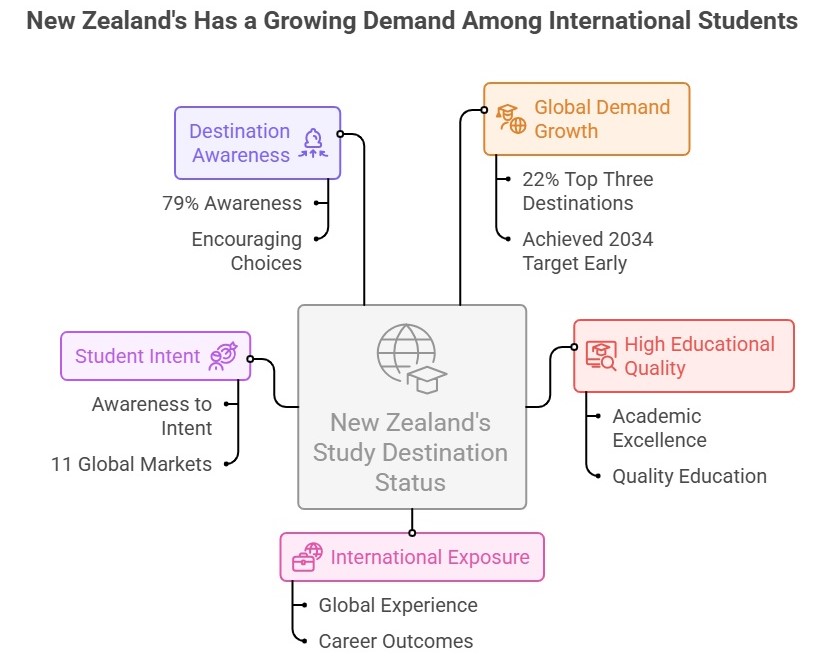
The table below shows key growth indicators contributing to New Zealand’s latest student surge:
| Indicator | Latest Update |
|---|---|
| Students ranking New Zealand in top choices | 22% |
| National preference target achieved | 10 years early |
| Global markets showing rising preference | 11 |
| Destination awareness across source markets | 79% |
| International education target year reached | Early |
Also, read...
New Zealand Funds Transfer Scheme (2026) – Student Visa Proof of Funds Explained
What are the benefits of studying in New Zealand?
New Zealand continues to attract more international students than ever due to its evolving world-class education and strong career prospects.
The major benefits of studying in New Zealand, driving demand among foreign aspirants, are as follows:
- Globally recognized educational standards, high academic quality, research-focused curricula, and internationally valued degrees.
- Higher graduate employability outcomes and post-study work pathways.
- Reliable and supportive campus ecosystems.
- Competitive tuition value and long-term career pathways.
Also, read...
New Zealand introduces pathway visa for smoother student entry. Apply now!
How to Apply for a New Zealand student visa from India?
To apply for a New Zealand student visa from India, you need to secure an Offer of Place from a recognized institution in the country for the course you wish to pursue. Indian students must have sufficient funds (NZD 20,000/year + tuition) and a strong Statement of Purpose (SOP) to select New Zealand as their study abroad destination.
The steps to apply for a New Zealand student visa for Indians are as follows:
Step 1: Apply for a full-time educational course in an accredited New Zealand educational institution.
Step 2: Secure enrollment in a New Zealand institute approved by the New Zealand Qualifications Authority (NZQA).
Step 3: Prepare financial documents to demonstrate sufficient funds for tuition fees and living expenses (at least NZD 20,000 for a full year of study or NZD 1,250 per month).
Step 4: Gather documents like official Letter of Placement, academic certificates/transcripts, Statement of Purpose (SOP), proof of language proficiency and passport for verfication.
Step 5: Create an account on the Immigration New Zealand website to submit your profile/application.
Step 6: Upon processing, you will receive "Approved In Principle" (AIP) for the final procedures.
Step 7: Once the student visa is approved, fly to New Zealand to pursue your educational course.
*Are you looking for step-by-step assistance with overseas immigration? Contact Y-Axis, the world’s No. 1 overseas immigration consultancy
For recent immigration updates, check out the Y-Axis News Page
FAQs
Why is New Zealand suddenly so popular for international students in 2026?
New Zealand has achieved its 2034 international student target nearly a decade early. The surge is driven by world-class education quality, strong post-study work rights, and a student-friendly immigration environment. 22% of global prospective students now rank NZ in their top 3 study destinations — a remarkable jump that reflects growing awareness (now at 79% across source markets).
What post-study work rights does New Zealand offer international graduates?
New Zealand offers strong Post-Study Work Visas (PSWV) for eligible graduates — up to 3 years for degree holders from listed institutions. Recent 2026 changes also introduced a new Short Term Graduate Work Visa. Graduates in priority occupations can transition directly to residence pathways, making NZ one of the most seamless study-to-PR destinations globally.
How much money do I need to show for a New Zealand student visa?
Indian and other international students must demonstrate a minimum of NZD 20,000 per year of study (or NZD 1,250 per month) to cover tuition and living expenses. The 2026 Funds Transfer Scheme has updated the proof-of-funds documentation process. A blocked account, bank statement, or scholarship letter are typically accepted.
Which New Zealand institutions qualify for international student enrolments?
Institutions accredited by the New Zealand Qualifications Authority (NZQA) are eligible — including universities like Auckland, Victoria, and Otago, polytechnics (Te Pūkenga), and private training establishments (PTEs). Selecting a NZQA-approved institution is mandatory to qualify for a student visa and subsequent post-study work rights.
Is New Zealand easier to get into for international students compared to Australia or the UK?
For many applicants, yes. New Zealand's student visa process is known for being relatively straightforward with clear eligibility criteria. Unlike Australia's recent tightening of student visa rules and the UK's strict compliance regime, NZ has been actively expanding its student intake — issuing 295,000 student visa places in 2026 and introducing new pathway visas for smoother entry.
What courses are in highest demand by international students in New Zealand?
High-demand courses with strong graduate employment outcomes include IT and data science, nursing and healthcare, engineering, business management, and early childhood education. These align directly with NZ's 2026 skilled occupation shortages, giving graduates a faster path to residence through the Skilled Migrant Category (SMC) or employer-sponsored routes.
Can I work while studying in New Zealand?
Yes. International students enrolled full-time at a NZQA-accredited institution can work up to 20 hours per week during term time and full-time during scheduled breaks. A partner or spouse of an eligible student may also be entitled to an open work visa, making New Zealand one of the most flexible study-work destinations globally.
How do I apply for a New Zealand student visa step by step?
- Step 1: Get an Offer of Place from a NZQA-approved institution.
- Step 2: Gather documents — offer letter, academic transcripts, SOP, English proficiency proof, passport, and funds evidence.
- Step 3: Create an account on the Immigration New Zealand (INZ) online portal.
- Step 4: Submit your application and pay the visa fee.
- Step 5: Receive an Approved in Principle (AIP) letter.
- Step 6: Complete health and character requirements.
- Step 7: Receive visa grant and travel to NZ.
What English language tests are accepted for a New Zealand student visa?
New Zealand accepts IELTS (Academic), PTE Academic, TOEFL iBT, Cambridge English, and OET (for health-related courses). Minimum scores vary by institution but typically require an IELTS overall band of 5.5–6.5. From late August 2026, English test results are valid for 5 years for SMC-eligible applicants — an important recent policy change.
Can studying in New Zealand lead to permanent residency (PR)?
Yes — and this is one of NZ's biggest selling points. Graduates from eligible institutions in priority occupations can apply for PR through the Skilled Migrant Category (SMC) or employer-sponsored routes. From August 2026, two new SMC pathways launch: the Skilled Work Experience Pathway and the Trades & Technician Pathway. NZ qualifications also earn extra SMC points, making the study-to-PR pipeline stronger than ever.
Tags:
New Zealand immigration
international students in New Zealand
New Zealand student visa
New Zealand visas
migrate to new Zealand
New Zealand immigration news
Immigration New Zealand
Approval in Principle (AIP),New Zealand FTS
study in New Zealand
Share
Options for you by Y-Axis

Get it on your mobile

Get News alerts

Contact Y-Axis
Latest Article
Related Post
Trending Article

Posted On October 15 2026
India-Switzerland Mobility Pact Opens New Work, Study and Travel Opportunities for Indians. Check Your Eligibility!