


Posted on January 08 2026
Italy to grant 500,000 work visas in 2026-28. Apply now!

By , Editor
Updated January 27 2026
Highlights: Italy to Issue 500,000 Work Visas from 2026-2028 for Skilled Foreign Workers
- Italy has approved 5,00,000 work visas for foreign professionals between 2026 and 2028, making it the most extensive legal labour immigration plan in history.
- More than 230,550 visas will be granted to self-employed professionals aiming for long-term employment in the construction, manufacturing, and logistics sectors.
- Approximately 267,000 visas will be secured for seasonal workers in the tourism and agriculture industries, which are facing an acute labour crisis.
- The newly approved quota for work visas from 2026 to 2028 reflects a 452,000 increase in the volume of visa approvals from 2023 to 2025, indicating Italy’s growing dependence on foreign labor.
- The Italian government aims to cease illegal immigration and employment by strengthening legal entry routes in the country.
*Want to apply for an Italy work visa? Let Y-Axis help you with the process.
Italy to Grant 5 Lakh Work Visas under Newly Approved Quota
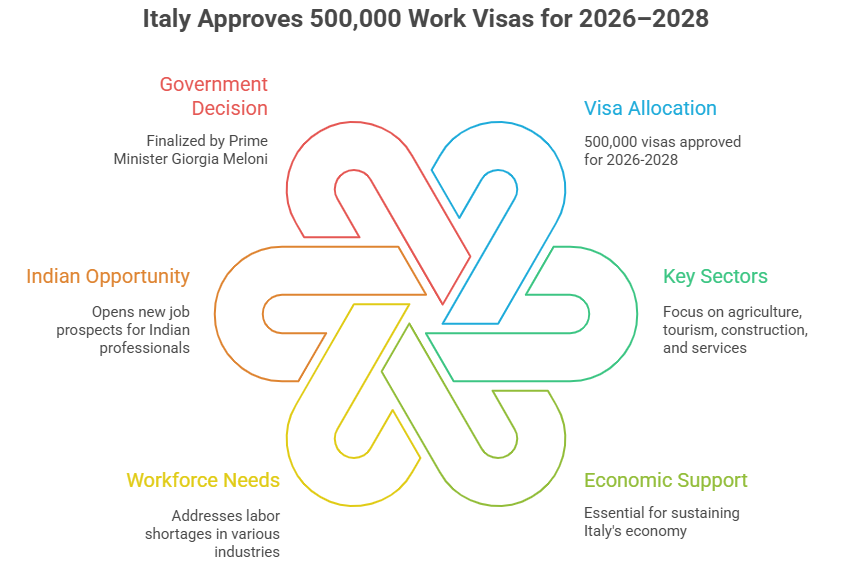
Italy has announced its newly approved quota of 500,000 work visas for foreign nationals, boosting opportunities for Indian workers. The high volume of Italian work visa approvals underscores the country's increasing reliance on professionals from abroad in the construction, manufacturing, and service sectors.
The decision for 5 lakh work visas was announced during a cabinet meeting led by Prime Minister Giorgia Meloni, increasing the net visa approval from 452,000 visas between 2023 and 2025. The Italian government confirmed its rising demand for skilled professionals from abroad to sustain the country's workforce and economy.
*Want to apply for jobs in Italy? Avail Y-Axis Resume Marketing Services to find the right one.
How Italy Plans to Manage Increased Visa Quota for 2026-2028
The Italian work visa quota for 2026-2028 was initiated under its Decreto Flussi (Flow Decree), which manages the number of foreign workers entering the country each year. The government aims to manage work visa approval based on:
- The employer submits a demand for workers to the business associations.
- Frequency of recent work permit approvals submitted.
- Practical labour market crisis and demand for foreign resources.
The Italian Prime Minister’s Office also announces its intention to regulate illegal migration, overstays, and worker exploitation through complaint entry channels. It also aims to improve its relationship with countries, including India, for a structured recruitment process.
The new applications for work visas will be available on the “click day” when employers submit their requests for workers abroad.
*Need help with the Italian work visa application? Sign up with Y-Axis for end-to-end support with the process.
Italy Work Visa Opportunities for Indians
The opportunities for foreign workers, including Indian applicants, are increasing in Italy through newly enhanced work visa quotas. Here is how the success of approval can affect Indian professionals applying to the Italian job market:
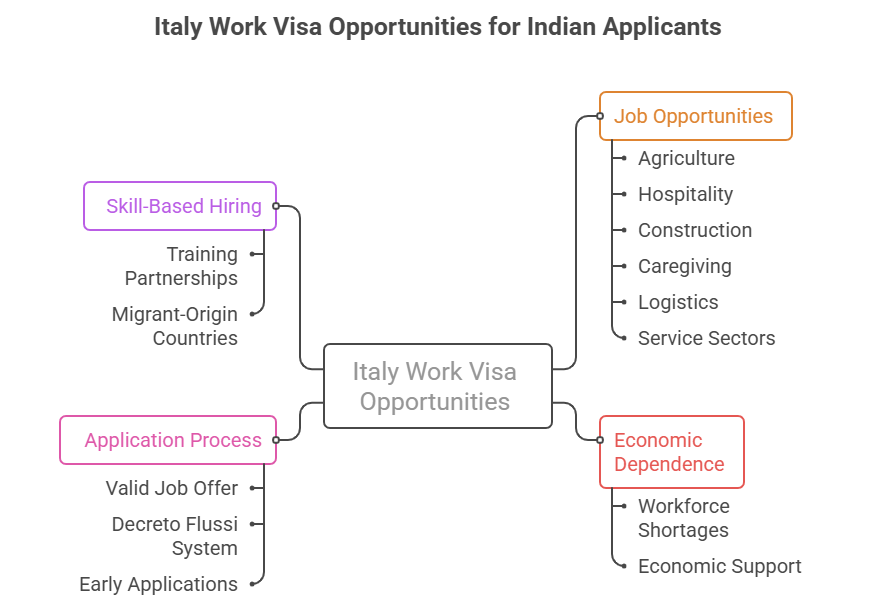
- High opportunities exist for Indian skilled workers in agriculture, hospitality, construction, caregiving, and logistics sectors.
- Italy’s growing reliance on foreign labour to support the country’s economy and workforce.
- Applicants need to secure a valid job offer under the official quota (Decreto Flussi) system from an Italian employer.
- Urgent demand for early applications through legalised channels to address underutilised quotas in the past due to illegal immigration and documentation delays.
- Pre-departure training programs between Italy and source countries, including India, to boost chances of approval.
*Are you looking for step-by-step assistance with overseas immigration? Contact Y-Axis, the world’s No. 1 overseas immigration consultancy!
For recent Schengen immigration updates, check out the Y-Axis Schengen News Page!
FAQs
What is Italy’s new work visa plan approved by the government?
Italy has approved a large-scale labour migration plan that will allow nearly 500,000 non-EU workers to enter the country over the next three years. This decision is part of Italy’s long-term workforce strategy to address labour shortages caused by an ageing population and declining birth rates. The plan authorises both seasonal and non-seasonal work visas under Italy’s regulated migration framework. By expanding legal work pathways, the government aims to support economic growth while reducing irregular migration and labour exploitation across key industries.
How many work visas will Italy issue under the new three-year quota?
Under the approved plan, Italy will issue approximately 500,000 work visas between 2026 and 2028. The visas will be distributed annually, with quotas released each year through official migration decrees. The total includes visas for seasonal workers, non-seasonal employees, and certain self-employed categories. This is one of Italy’s largest legal migration intakes to date and reflects increasing reliance on foreign labour to sustain industries struggling to recruit domestic workers.
Who is eligible to apply for Italy’s new work visas?
The work visas are primarily intended for non-EU nationals who have secured a valid job offer from an Italian employer. Eligibility depends on the category of work, such as seasonal agriculture, tourism, construction, caregiving, or skilled employment. Applicants must meet specific requirements, including employment contracts, accommodation arrangements, and background checks. Employers play a key role in initiating applications under Italy’s quota-based system, making employer sponsorship essential for most applicants.
Which sectors will benefit most from Italy’s expanded work visa quotas?
The expanded quotas mainly target sectors experiencing severe labour shortages. Agriculture and tourism are expected to receive a significant share of seasonal visas, especially during peak harvest and travel seasons. Other sectors such as construction, logistics, healthcare support, domestic work, and caregiving are also expected to benefit. These industries have consistently struggled to fill vacancies with local workers, making migrant labour critical to maintaining productivity and service continuity.
Why has Italy decided to increase the number of work visas?
Italy’s decision is driven by structural labour shortages, an ageing workforce, and declining population growth. Many industries face persistent vacancies that cannot be filled locally, impacting economic output. The government views controlled labour migration as essential to sustaining businesses, supporting tax revenues, and ensuring long-term economic stability. By expanding legal migration channels, Italy also aims to reduce illegal employment and improve oversight of foreign labour recruitment.
How does this new visa plan differ from previous Italian migration quotas?
Compared to previous three-year migration plans, the new quota represents a noticeable increase in permitted entries. Earlier plans allowed fewer workers and often failed to meet actual labour market needs. The updated quota reflects a more realistic assessment of workforce demand and signals a policy shift toward long-term labour migration planning. It also emphasises improved coordination between employers, government authorities, and labour market requirements.
What is the role of the Decreto Flussi in Italy’s work visa system?
The Decreto Flussi is Italy’s official migration decree that sets annual limits for foreign workers entering the country. It defines how many work visas can be issued, which sectors are eligible, and the application procedures employers must follow. The new three-year visa plan will be implemented through yearly Decreto Flussi announcements, making it a central mechanism for regulating labour migration into Italy.
When can employers apply for these new Italian work visas?
Employers typically apply for work visas during specific application windows announced by the Italian government each year. These periods are often referred to as “click days,” when applications must be submitted online within a limited timeframe. Dates vary annually and are released ahead of the quota year. Due to high demand, applications are often processed on a first-come, first-served basis, making early preparation crucial.
Are there challenges or criticisms of Italy’s work visa system?
Despite high quotas, critics argue that not all authorised visas translate into actual employment. Administrative delays, complex paperwork, and employer withdrawal can prevent workers from arriving. Some experts also point out gaps between labour demand and visa allocation timing. However, the government maintains that expanding legal pathways is a step toward improving labour market efficiency and reducing irregular employment.
Can Italy’s expanded work visa plan reduce illegal migration?
Italian authorities believe that increasing legal work opportunities will help curb irregular migration by offering safer, regulated entry routes. When workers have access to legal visas and contracts, they are less vulnerable to exploitation and undocumented employment. While legal migration alone cannot eliminate illegal entry, the government sees this plan as part of a broader strategy combining border control, employer accountability, and lawful labour mobility.
Tags:
Italy work visa
work in Italy
work visa in Italy
Italian work visa for Indians
Italy work visa quota for 2026-2028
jobs in Italy
Overseas immigration
Schengen news
Italy immigration news
Visa for Italy
Immigration Italy
Italian Work Visa
Share
Options for you by Y-Axis

Get it on your mobile

Get News alerts

Contact Y-Axis
Latest Article
Related Post
Trending Article
Posted On April 09 2026
Canada credential recognition target 2026-27 fast-track skilled workers