

Posted on May 04 2026
India Citizenship Amendment Rules 2026: OCI Digital Process, Minor Passport Rules & More

By , Editor & Director
Updated May 11 2026
Highlights: India Rolls Out New Citizenship Rules to Improve OCI Registration for Faster Processing
- The Union Home Ministry has amended the Citizenship (Amendment) Rules, 2026, introducing a full digital shift for Overseas Citizen of India (OCI) card registration, renunciaThe key changes introduced by the Citizenship (Amendment) Rules, 2026 are:tion, and record-keeping.
- All OCI applications must now be submitted electronically through the official portal replacing the previous paper-based process.
- A new electronic OCI (e-OCI) option will now allow registered applicants to receive a digital OCI registration instead of a physical card.
- A minor is no longer permitted to hold both an Indian passport and any foreign passport at the same time.
- Applicants whose OCI or citizenship applications are rejected can now raise their concern before a higher authority.
*Want to understand how these new changes affect your OCI status and Indian citizenship application? Sign up with Y-Axis to speak with an expert today.
India's New Citizenship Amendment Rules To Affect Indian Citizenship Status
The Union Home Ministry published the Citizenship (Amendment) Rules, 2026, in a gazette notification on Thursday, April 30, 2026. The changes amend the Citizenship Rules, set up in 2009. The new rules introduce a comprehensive set of reforms such as OCI card registration, digital record-keeping, minor passport eligibility, and biometric opt-in for fast-track immigration.
The most significant shift is the move to a fully online OCI application and renunciation process. All applications under Section 7A of the Citizenship Act must now be filed electronically through the Indian government portal. This replaces the paper-based system that created duplicate submission concerns earlier.
Additionally, the government has also introduced the electronic OCI (e-OCI), allowing OCI holders to receive digital registration. The official government register of OCI holders will also be maintained digitally from now on.
The amended rules now include a clear proviso which states that a minor child cannot hold an Indian passport and a passport of any other country at the same time. This formalises and strengthens a restriction that was previously part of the application declaration process.
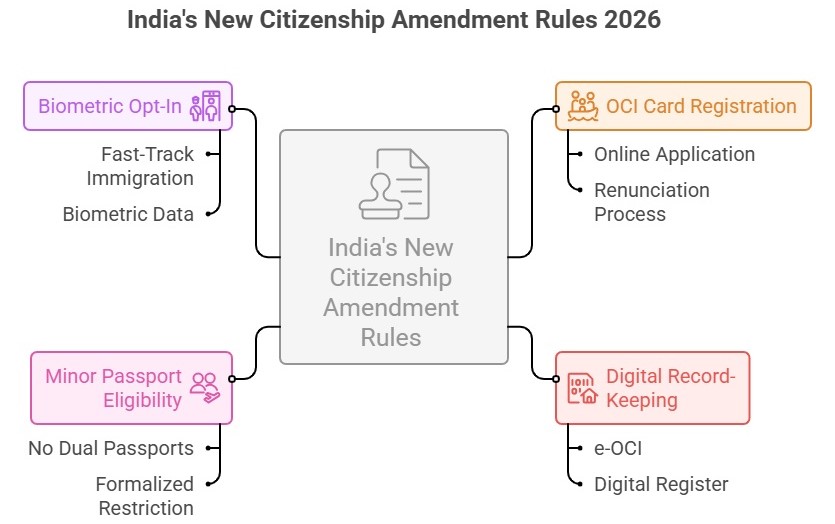
The key changes introduced by the Citizenship (Amendment) Rules, 2026 are:
| Change / Feature | What It Means for You |
|---|---|
| Online OCI Application Portal | All OCI applications must now be submitted through the official online portal. |
| Electronic OCI (e-OCI) | You may receive a digital OCI registration instead of (or along with) a physical card. |
| Digital Renunciation Process | OCI renunciation is now online, but you still need to submit your physical card to the nearest Indian Mission. |
| Minor Passport Rule | Children cannot hold both an Indian and foreign passport at the same time. |
| No Duplicate Documents | You no longer need to submit documents in duplicate, simplifying the process. |
| Fast Track Immigration Programme | Opt-in biometric data sharing enables faster immigration processing in the future. |
| Right to Appeal / Revision | Rejected applications can now be reviewed by a higher authority. |
| Right to Be Heard | You can present your case before a final decision is made. |
| Naturalisation Review (Section 15A) | Applications must be decided only after giving the applicant a fair hearing. |
| Digital OCI Register | The government will now maintain OCI records digitally. |
Applicants Affected by the New Citizenship Amendment Rules 2026
- OCI card applicants registering for the first time, who must now apply exclusively through the government online portal.
- Existing OCI cardholders who wish to renounce their OCI status.
- Parents of minor children holding or applying for Indian passports.
- OCI applicants who wish to opt in to the Fast Track Immigration Programme.
- Individuals whose OCI or citizenship applications have been rejected.
- Applicants for citizenship by naturalisation under Section 15A.
Also, read...
UK Opens India Young Professionals Visa Ballot on Feb 17. Get Ready to Apply!
What the Citizenship (Amendment) Rules, 2026 Mean for OCI Cardholders Abroad
For the large diaspora of Overseas Citizens of India living in countries such as the USA, UK, Canada, Australia, and the UAE, these changes have the following implications:
- The entire OCI application and renunciation process is now digital, removing the need to physically submit paper documents to the Indian consulate.
- Holders can now receive an e-OCI (electronic OCI registration) in addition to or instead of a physical card.
- In cases of OCI cancellation by the government, the physical card must be returned.
- OCI cardholders who want faster immigration clearance at Indian airports and ports of entry can consent to biometric collection during registration to be automatically enrolled in the Fast Track Immigration Programme.
- If an OCI application is rejected, the applicant now has a formal right to challenge that decision before an authority.
*Are you looking for step-by-step assistance with overseas immigration? Contact Y-Axis, the world's No. 1 overseas immigration consultancy!
For recent immigration updates, check out the Y-Axis News Page!
FAQ's
What are the Citizenship (Amendment) Rules, 2026?
The Citizenship (Amendment) Rules, 2026 are official changes notified by India's Union Home Ministry on April 30, 2026. They amend the Citizenship Rules, 2009 and introduce a range of reforms affecting Overseas Citizens of India (OCI) cardholders and citizenship applicants. The key changes include a mandatory digital OCI application process, the introduction of electronic OCI (e-OCI) registration, a new restriction on minor children holding dual passports, biometric consent for fast-track immigration, and formal rights to appeal rejected decisions.
How do I apply for an OCI card under the new 2026 rules?
All OCI card applications must now be submitted electronically through the official government portal at https://ociservices.gov.in. The previous requirement to submit paper documents in duplicate has been removed. Applicants must fill in Form XXVIII online through the designated portal. Physical submissions to Indian consulates are no longer the required method for initial registration.
What is an e-OCI card and how is it different from a physical OCI card?
An e-OCI (electronic OCI) is a new form of OCI registration introduced under the 2026 rules. Instead of receiving a physical OCI card, registered individuals may now be issued an electronic OCI registration. The government will also maintain the official register of OCI holders digitally. Both physical OCI cards and e-OCI registrations are valid under the new framework.
Can a minor child hold both an Indian passport and a foreign passport under the new rules?
No. Under the Citizenship (Amendment) Rules, 2026, a minor child cannot hold an Indian passport and a passport of any other country at the same time. This rule applies at any point during the child's minority. Previously, parents were required to submit a declaration that the child does not hold a foreign passport — the new rules formalise this as a hard restriction.
What happens if an OCI card application is rejected? Can I appeal?
Yes. The new rules introduce a formal right of challenge. If an OCI or citizenship application is rejected, the affected person can now challenge the decision before an authority that is one rank higher than the original decision-maker. In all cases of revision or review, the applicant must be given a reasonable opportunity to present their case before a final decision is made.
What is the Fast Track Immigration Programme opt-in under the new OCI rules?
The 2026 rules introduce a voluntary opt-in to the Fast Track Immigration Programme during OCI registration. By consenting to the collection of their biometric information at the time of OCI registration, applicants allow their data to be shared for fast-track applications or used for automatic enrolment in the programme. This is designed to speed up immigration processing at Indian airports and ports of entry for OCI cardholders.
How does OCI card renunciation work under the new rules?
OCI renunciation applications must now also be submitted electronically through https://ociservices.gov.in. After submitting the renunciation application online, the individual must surrender the original physical OCI card to the nearest Indian Mission, Post, or Foreigners Regional Registration Officer. If the physical card cannot be returned, the government can still declare it officially cancelled. For e-OCI holders, the government can cancel the digital registration in its records.
Who is eligible for an OCI card under the current rules?
The OCI scheme allows Persons of Indian Origin (PIOs) to register as Overseas Citizens of India if they were citizens of India on or after January 26, 1950, or were eligible to become citizens on that date. The scheme also covers those whose parents or grandparents were Indian citizens. However, individuals who are or have been citizens of Pakistan or Bangladesh — or whose parent, grandparent, or great-grandparent was a citizen of those countries — are not eligible for OCI registration.
What are the new rules for citizenship by naturalisation applications under Section 15A?
The 2026 rules introduce a new requirement for review applications under Section 15A (citizenship by naturalisation). The Central Government must now dispose of any review application after giving the affected person a reasonable opportunity to present their case. This ensures applicants are not rejected without being heard, improving procedural fairness in the naturalisation process.
How can Y-Axis help with OCI card applications and Indian citizenship matters?
Y-Axis is one of India's largest overseas immigration consultancies with over two decades of experience. Our experts can help you understand the new Citizenship (Amendment) Rules, 2026, check your OCI card eligibility, prepare and submit your application through the new digital portal, and guide you through the appeal process if your application is rejected. Call us at +91-7670800000 or email info@y-axis.com to speak with a consultant today.
Need help with OCI card or Indian citizenship process? Contact Y-Axis today.
Call: +91-7670800000
Email: info@y-axis.com
Tags:
Citizenship Amendment Rules 2026
OCI card India 2026
OCI digital application
e-OCI card
Indian citizenship rules
minor passport dual citizenship
OCI renunciation online
Home Ministry citizenship notification
Indian passport rules for minors
Share
Options for you by Y-Axis

Get it on your mobile

Get News alerts

Contact Y-Axis
Latest Article
Related Post
Trending Article

Posted On September 11 2026
New Zealand expands post-study work opportunities for graduates with new visa eligibility from November 16. Apply Now!