

Posted on December 18 2025
Germany, Ireland and UAE Gain Popularity Among Indian Students in 2026 — Apply now!

By , Editor
Updated December 26 2025
Highlights: Germany, Ireland and UAE Lead New Study Abroad Choices for Indians in 2026
- Indian students are likely to explore alternatives like Germany, Ireland, and the UAE in 2026 as visa and immigration rules tighten across the US, UK, Canada, and Australia.
- Germany has emerged as a top alternative, with Indian student interest rising from 13.2% in 2022 to over 32% in 2024–25, driven by affordable education and strong post-study options.
- Ireland is seeing growing demand from Indian students, supported by English-taught programs and clear post-study employment pathways.
- The UAE is gaining popularity, with Indians making up around 42% of its international student population, due to global university campuses and proximity to India.
- Higher costs, visa caps, and dependent restrictions in the Big Four are pushing students to prioritise ROI, affordability, and career outcomes.
*Want to study abroad? Talk to experts at Y-Axis to guide you with the process
Study Abroad Trends: Indian Students Turn to Germany, Ireland and UAE as Big Four Tighten Visa Rules
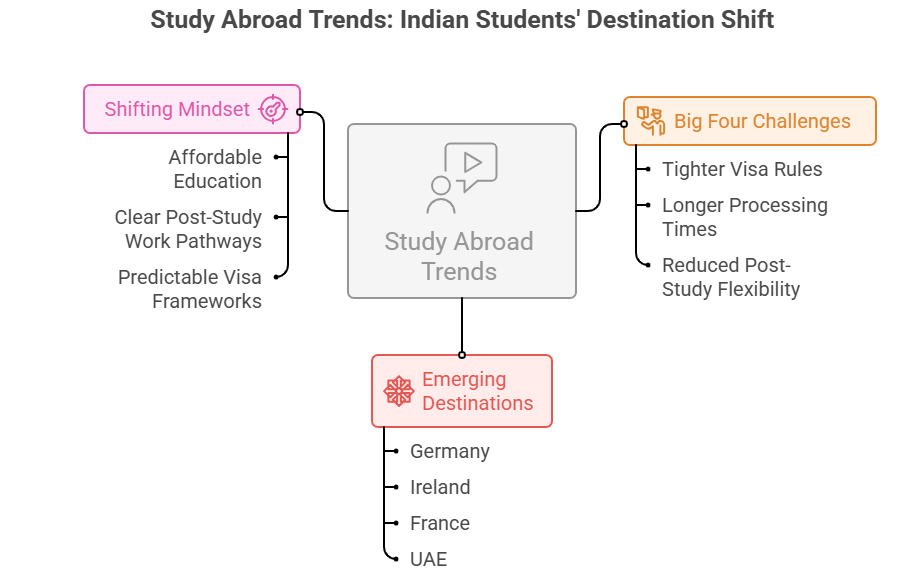
Indian students are increasingly reassessing traditional study-abroad destinations as tighter immigration and student visa policies reshape global education mobility. Stricter rules across the United States, United Kingdom, Canada, and Australia, often referred to as the “Big Four”, have led to longer processing times, higher compliance requirements, and reduced post-study flexibility.
As a result, Germany, Ireland, France, and the United Arab Emirates (UAE) are witnessing a noticeable surge in interest from Indian students. These destinations are gaining traction for their affordable education models, clearer post-study work pathways, and more predictable visa frameworks. The shift signals a changing mindset among Indian families, who are now prioritising return on investment (ROI), career outcomes, and long-term stability over legacy destination preferences.
Why Indian Students Are Moving Beyond the Big Four in 2026
- Stricter policies in the Big Four—the US, UK, Canada, and Australia—have led to longer visa processing times and reduced post-study work flexibility, prompting students to explore alternatives.
- Germany, Ireland, France, and the UAE are gaining preference due to affordable education models and clearer career pathways after graduation.
- Germany has seen a sharp rise in Indian student interest, increasing from 13.2% in 2022 to 32.6% in 2024–25, with nearly 60,000 Indian students currently enrolled.
- The UAE has emerged as a strong regional hub, with Indians making up around 42% of its international student population, supported by global university campuses and proximity to India.
- Indian families are focusing more on return on investment (ROI), choosing destinations that offer predictable post-study employment opportunities and transparent work visa pathways.
*Planning your studies abroad? Avail Y-Axis FREE career counselling services to make the right choice!
Why Germany, Ireland and the UAE Are Gaining Ground among Indian Students
As visa rules tighten across traditional destinations, Indian students are increasingly turning to Germany, Ireland, and the UAE, countries that combine affordable education, policy stability, and clearer post-study career pathways. These destinations are no longer niche alternatives; they are becoming mainstream choices for students focused on return on investment (ROI), employability, and long-term career clarity.
|
Country |
Why It’s Gaining Popularity |
Key Stats & Insights |
|
Germany |
Low or no tuition fees, strong STEM & engineering programs, clear post-study work routes |
Indian student interest rose from 13.2% (2022) to 32.6% (2024–25); around 60,000 Indian students enrolled; high appeal in Tier II & III cities due to ROI |
|
Ireland |
English-taught programs, strong tech & finance job market, post-study job search period |
India became the largest source country in 2023–24; Indian enrolments grew by nearly 50% YoY; up to 2 years post-study job search |
|
UAE |
Global university branch campuses, proximity to India, and a fast-growing job market |
Indians form ~42% of international students; strong demand in business, technology, and logistics; lower overall study and living costs |
Germany appeals to students seeking cost-effective, long-term career pathways, especially in engineering and technology. Ireland attracts those who prefer English-medium education with strong job prospects in Europe’s tech ecosystem. Meanwhile, the UAE is emerging as a regional education hub, offering globally recognised degrees closer to home with faster entry into the workforce.
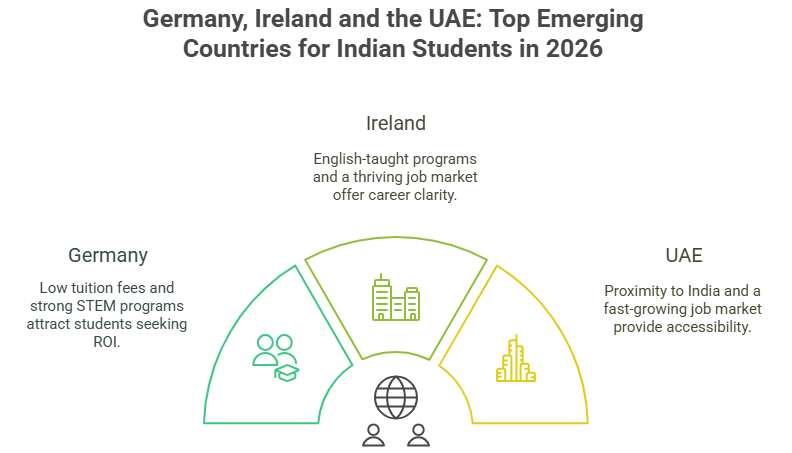
Together, these destinations reflect a broader change in how Indian students choose where to study—less driven by legacy prestige, and more by affordability, stability, and outcomes.
*Want to apply for a student visa? Sign up with Y-Axis to guide you with the steps.
How Y-Axis Supports Your Study Abroad Journey
Y-Axis offers end-to-end guidance for Indian students planning to study abroad, helping them make informed decisions at every stage, from choosing the right destination to planning post-study career pathways. With decades of experience in overseas education and immigration, Y-Axis ensures students and families navigate global education systems with clarity and confidence.
Y-Axis study abroad services include:
- Free study destination and course assessment based on academic profile, budget, and career goals
- University shortlisting and application support across leading global education hubs
- Student visa assistance, including documentation, application filing, and interview preparation
- Post-study work and migration guidance, helping students plan long-term career and settlement options
- Career-focused counselling, aligned with global job market demand and ROI considerations.
*Are you looking for step-by-step assistance with overseas immigration? Contact Y-Axis, the world’s No. 1 overseas immigration consultancy!
For recent immigration updates, check out the Y-Axis News Page!
FAQs
Why are Indian students increasingly choosing Germany, Ireland, and the UAE?
Indian students are increasingly choosing Germany, Ireland, and the UAE due to clearer visa rules, affordable education, and stronger post-study career pathways. While traditional destinations like the US, UK, Canada, and Australia have tightened student visa norms, these countries offer more predictable policies, industry-aligned courses, and growing job markets. Germany attracts students with low or no tuition fees, Ireland benefits from strong tech hiring, and the UAE offers proximity to India with expanding global campuses. These combined factors are driving a clear shift in student preferences.
What changes in visa and immigration rules in the US, UK, Canada, and Australia are impacting Indian students?
The US, UK, Canada, and Australia have introduced stricter student visa policies, including tighter financial requirements, reduced post-study work options, caps on international student numbers, and increased scrutiny of dependents. Canada has limited study permits, the UK has restricted dependent visas, Australia has raised financial thresholds, and the US continues to have high visa rejection rates. These changes have created uncertainty for Indian students, prompting many to explore destinations with more stable, transparent, and student-friendly immigration frameworks.
How have stricter student visa rules in the Big Four affected Indian study-abroad plans?
Stricter student visa rules in the Big Four have significantly altered Indian students’ study-abroad plans. Many students now prioritise destinations offering certainty in visa approvals, post-study work rights, and long-term residence options. Rising education costs and unpredictable immigration policies have increased financial risk, making families more cautious. As a result, students are diversifying their choices and considering countries that provide affordable education, clearer employment pathways, and smoother transitions from study to work and residence.
What makes Germany an attractive study destination for Indian students?
Germany is highly attractive to Indian students due to its low tuition costs, strong public universities, and high demand for skilled professionals. Many universities charge minimal or no tuition fees, making education more affordable. Germany also offers generous post-study work options and clear pathways to permanent residence through employment. With strong demand in engineering, IT, healthcare, and manufacturing, graduates have good career prospects. Stable immigration policies further enhance Germany’s appeal for students seeking long-term opportunities.
Why is the UAE seeing a sharp rise in interest among Indian students?
The UAE is witnessing rising interest from Indian students due to the rapid expansion of international university campuses, flexible visa options, and strong employment opportunities. Leading global universities have established campuses in Dubai and Abu Dhabi, offering internationally recognised degrees closer to home. The UAE also provides a safe environment, tax-free income potential, and growing demand for skilled professionals. Smoother transitions from student visas to work and long-term residence make the UAE an increasingly attractive study destination.
Are post-study work and career pathways clearer in Germany, Ireland, and the UAE compared to the Big Four?
Yes, post-study work and career pathways are generally clearer in Germany, Ireland, and the UAE compared to the Big Four. Germany offers extended job-seeker visas and structured permanent residence routes, Ireland provides post-study work permits for graduates in key sectors, and the UAE has introduced long-term residence options such as the Golden Visa. In contrast, frequent policy changes in traditional destinations have created uncertainty, making alternative countries more appealing for long-term career planning.
Which Indian cities are showing the strongest shift toward Germany, Ireland, and the UAE?
Cities such as Delhi NCR, Mumbai, Bengaluru, Hyderabad, Pune, and Chennai are showing the strongest shift toward Germany, Ireland, and the UAE. These cities have a high concentration of students pursuing STEM, IT, and management programs aligned with global job markets. Tech-focused hubs like Bengaluru and Hyderabad show growing interest in Germany and Ireland, while students from major metro cities increasingly prefer the UAE for its regional business and employment opportunities.
What should Indian students consider before choosing alternatives to the US, UK, Canada, and Australia?
Before choosing alternatives to the Big Four, Indian students should consider course recognition, language requirements, post-study work rights, cost of living, and long-term career prospects. Evaluating local job markets and visa transition options is essential. Students should also ensure that degrees are internationally recognised and aligned with industry demand. Careful research helps students choose destinations that match their academic goals, budget, and future employment or settlement plans.
How are cost, affordability, and predictable visa systems influencing study-abroad choices?
Cost, affordability, and predictable visa systems play a major role in shaping study-abroad decisions. Rising tuition fees and living expenses in traditional destinations have made students more cautious. Countries offering affordable education, transparent visa rules, and stable post-study work options are gaining preference. Models such as low-tuition public universities, clear graduate work permits, and predictable immigration policies reduce financial risk and provide greater confidence to students and families.
Is the shift away from the Big Four a long-term trend or a temporary change?
The shift away from the Big Four appears to be a long-term trend rather than a temporary change. While these destinations remain popular, repeated tightening of student and immigration policies has encouraged diversification. Alternative destinations are strengthening their education ecosystems, employment prospects, and residence pathways. Unless traditional destinations restore clarity and flexibility in student and post-study visa policies, Indian students are likely to continue exploring countries that offer stability, affordability, and clearer career outcomes.
Tags:
Study abroad
to study abroad destinations
Study in Germany
Study in the UAE
Study in Ireland
UAE student visa
Germany student visa
Ireland student visa
apply for a student visa
overseas immigration news
Canada student visa
Share
Options for you by Y-Axis

Get it on your mobile

Get News alerts

Contact Y-Axis
Latest Article
Related Post
Trending Article

Posted On April 02 2026
Canada Introduces Eight Major Immigration Changes from April 1, Impacting PR Applicants and Newcomers. Check Your Eligibility Now!