


Posted on December 22 2025
Canada vs Australia vs Germany: Which Is the Best Country to Settle Abroad in 2026?

By , Editor
Updated December 26 2025
Highlights: Best Countries for Overseas Settlement in 2026: Canada vs Australia vs Germany
- Canada plans to welcome around 380,000 new permanent residents in 2026, reinforcing its long-term commitment to skilled migration and settlement.
- Australia continues to offer approximately 185,000 permanent residency places each year, with strong demand for globally skilled professionals across key sectors.
- Germany remains one of Europe’s fastest relocation destinations, with many skilled work visas processed within 3 to 6 months under updated immigration reforms.
- All three countries provide strong earning potential for skilled professionals, particularly in IT, healthcare, engineering, and STEM occupations.
- International students also benefit from clear post-study work options, enabling smoother transitions from education to permanent residency for 2025–26 intakes.
*Want to migrate abroad? Sign up with Y-Axis for end-to-end support with the process!
Which Country Is Right for You in 2026? Canada vs Australia vs Germany
With multiple countries offering strong migration pathways in 2026, choosing the right destination matters.
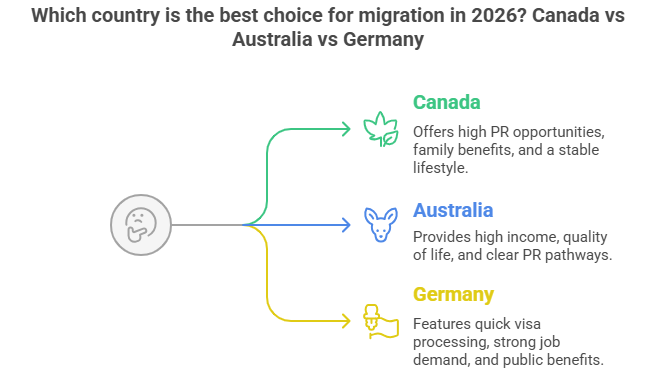
This comparison highlights how Canada, Australia, and Germany stack up across key settlement factors.
|
Factor |
Canada |
Australia |
Germany |
|
PR Opportunities (2026) |
~380,000 PR admissions planned, with a strong focus on skilled migration |
~185,000 PR places annually under the Migration Program |
Multiple skilled pathways under reformed immigration laws |
|
Average Annual Income |
₹48–50 lakhs for skilled professionals |
₹50+ lakhs in high-demand roles |
₹35+ lakhs, with strong public benefits |
|
Visa Processing Time |
6–12 months for most PR routes |
8–12 months, depending on visa type |
3–6 months for many skilled work visas |
|
Job Demand Sectors |
IT, healthcare, education, STEM, skilled trades |
IT, healthcare, engineering, construction, education |
Engineering, IT, healthcare, research |
|
Language Requirement |
IELTS/CELPIP is usually required |
IELTS/PTE required |
Often, there is no language test at the entry stage |
|
Student to PR Pathway |
Strong post-study work → Express Entry / PNP |
Clear post-study work leading to PR |
Study → job search visa → PR |
|
Family Benefits |
Free schooling, healthcare, and child benefits |
Healthcare access, family inclusion |
Subsidised healthcare, education |
|
Lifestyle & Work Balance |
Stable, family-friendly |
High quality of life, strong work-life balance |
Structured work culture, strong labour protections |
Also, read…
Germany, Ireland and UAE Gain Popularity Among Indian Students in 2026 — Apply now!
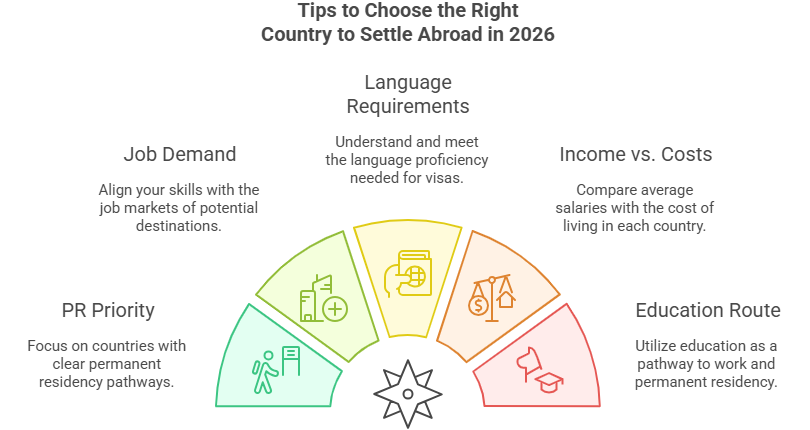
Tips to Choose the Right Country to Settle Abroad in 2026
- Set your PR priority first: If long-term permanent residency is your main goal, countries with structured PR systems like Canada and Australia offer clearer planning pathways.
- Align your skills with job demand: Canada and Australia focus on IT, healthcare, education, and trades, while Germany strongly recruits engineers, IT professionals, healthcare workers, and researchers.
- Understand language requirements early: English tests are mandatory for most Canada and Australia visas, whereas Germany offers several skilled routes with minimal or no language requirement at entry.
- Compare income with living costs: Australia and Canada offer higher average salaries, while Germany balances moderate earnings with affordable education and strong public services.
- Leverage education as a migration route: All three countries allow international students to move from study to work and eventually to PR, making education a strategic option for 2026.
*Are you looking for step-by-step assistance with overseas immigration? Contact Y-Axis, the world’s No. 1 overseas immigration consultancy!
For recent immigration updates, check out the Y-Axis News Page!
FAQs
Which country offers the highest number of PR opportunities in 2026?
Canada offers the highest number of permanent residency opportunities in 2026, with plans to welcome approximately 380,000 new permanent residents. This reflects Canada’s long-term immigration strategy focused on economic growth, labour market stability, and demographic sustainability. Skilled professionals, international graduates, and family applicants benefit from structured pathways such as Express Entry, Provincial Nominee Programs, and family sponsorship. Compared to other popular destinations, Canada’s transparent PR targets and predictable immigration planning make it one of the most accessible countries for overseas settlement in 2026.
Is Australia still a strong option for skilled migration in 2026?
Australia continues to be a strong destination for skilled migration in 2026, offering around 185,000 permanent residency places annually. The country actively invites global talent through its points-based migration system, prioritising occupations in IT, healthcare, engineering, construction, and education. Australia’s stable economy, competitive salaries, and high quality of life further enhance its appeal. Skilled migrants also benefit from state nomination programs, regional migration incentives, and clear pathways from temporary work visas to permanent residency.
Why is Germany becoming a popular relocation destination for professionals?
Germany is emerging as a preferred relocation destination due to its fast visa processing, strong labour protections, and high demand for skilled workers. Recent immigration reforms have simplified entry requirements, allowing many skilled professionals to secure work visas within 3 to 6 months. Germany actively recruits engineers, IT professionals, healthcare workers, and researchers to address workforce shortages. While salaries are moderate compared to Canada and Australia, Germany compensates with subsidised education, affordable healthcare, and a strong social security system.
Which country has the fastest visa processing time for skilled workers?
Among Canada, Australia, and Germany, Germany generally offers the fastest visa processing for skilled workers. Many work visas, including those under reformed skilled migration routes, are processed within 3 to 6 months. Canada and Australia typically require longer timelines, averaging between 6 and 12 months depending on the visa category and applicant profile. Germany’s streamlined procedures, employer-driven applications, and digitalisation of immigration services have significantly reduced processing delays, making it attractive for professionals seeking quicker overseas relocation.
What are the highest-paying countries among Canada, Australia, and Germany?
Australia and Canada rank among the highest-paying destinations for skilled professionals, with average annual salaries ranging from ₹48 to ₹50+ lakhs in high-demand roles. IT specialists, healthcare professionals, engineers, and STEM experts often receive competitive compensation packages. Germany offers comparatively lower average salaries, typically around ₹35 lakhs annually, but offsets this with strong public benefits, lower education costs, and extensive social security coverage. Income potential should therefore be assessed alongside cost of living and benefits.
Which sectors have the strongest job demand across these countries?
IT, healthcare, engineering, and STEM fields show strong job demand across Canada, Australia, and Germany in 2026. Canada also faces shortages in education, skilled trades, and construction, while Australia prioritises infrastructure-related roles, healthcare, and technology professionals. Germany places a strong focus on engineering, IT, manufacturing, healthcare, and research roles. Migrants with skills aligned to these sectors benefit from faster visa approvals, better employment prospects, and stronger pathways to long-term settlement.
Are language tests mandatory for migration to these countries?
Language proficiency tests are typically mandatory for migration to Canada and Australia. Applicants are usually required to submit IELTS, CELPIP, or PTE scores to meet visa eligibility and points requirements. Germany, however, offers several skilled migration routes where language proficiency is not required at the entry stage, particularly for job-based visas. While basic German language skills improve long-term integration and PR prospects, initial migration is often possible without formal language certification.
Which country offers the easiest student-to-PR pathway?
Canada offers one of the clearest and most structured student-to-PR pathways among the three countries. International students can transition from post-study work permits to permanent residency through Express Entry or Provincial Nominee Programs. Australia also provides post-study work options leading to PR, particularly through skilled migration and state nomination pathways. Germany enables students to move from study to a job search visa and later apply for PR, making education a strategic migration route across all three destinations.
What family benefits can migrants expect in these countries?
Migrants in Canada benefit from free public schooling, universal healthcare, and child benefit programs that support family settlement. Australia offers healthcare access, family inclusion in visa applications, and strong education standards. Germany provides subsidised healthcare, affordable education, generous parental benefits, and strong labour protections. These family-friendly policies make all three countries attractive for long-term settlement, particularly for migrants relocating with spouses and children in 2026.
How should migrants choose between Canada, Australia, and Germany in 2026?
Choosing the right country depends on individual priorities such as PR timelines, job demand, language requirements, income expectations, and family benefits. Canada suits migrants seeking long-term settlement with structured PR pathways. Australia appeals to those prioritising high salaries and quality of life. Germany is ideal for professionals seeking faster, job-led relocation with strong public benefits. Evaluating skills, career goals, and lifestyle preferences is essential for making the right migration decision in 2026.
Tags:
Migrate abroad
migrate overseas
overseas immigration news
Overseas immigration
Migrate to Germany
Migrate to Australia
migrate to Canada
Canada immigration
German immigration
Australia immigration
Best countries to settle abroad in 2026
Share
Options for you by Y-Axis

Get it on your mobile

Get News alerts

Contact Y-Axis
Latest Article
Related Post
Trending Article

Posted On April 02 2026
Canada Introduces Eight Major Immigration Changes from April 1, Impacting PR Applicants and Newcomers. Check Your Eligibility Now!