


Don't know what to do ?
Get Free Counseling
Switzerland Job Market in 2026–30
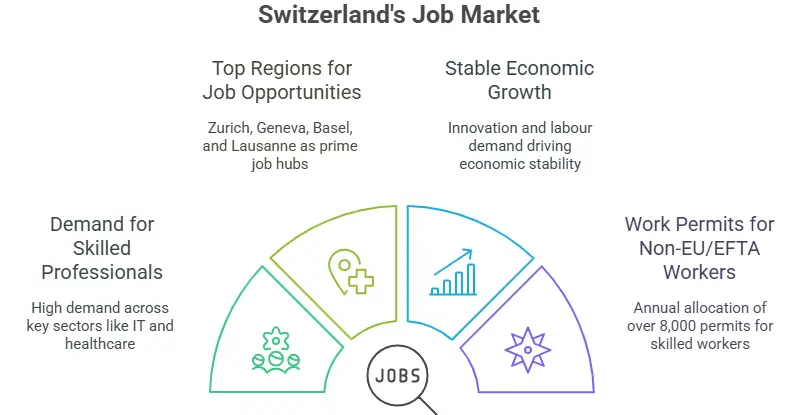
- Strong demand for skilled professionals across IT, engineering, healthcare, finance, and hospitality
- Zurich, Geneva, Basel, and Lausanne remain the top regions for job opportunities
- Switzerland’s economy shows stable growth supported by innovation and high labour-market demand
- Allocates over 8,000 work permits annually for non-EU/EFTA skilled workers
Job Outlook in Switzerland
Understanding the current job outlook is essential for professionals planning to work in Switzerland. The country offers strong employment opportunities across multiple sectors, driven by its stable economy, innovation-focused industries, and high demand for skilled talent. Key regions such as Zurich, Geneva, Basel, and Lausanne continue to serve as major job hubs, especially in IT, engineering, healthcare, finance, hospitality, and pharmaceuticals.
Switzerland continues to attract international talent each year through its skilled-worker permit quotas. Offering excellent work-life balance, world-class infrastructure, and competitive salaries, Switzerland remains a top choice for individuals seeking rewarding career opportunities in one of Europe’s most advanced economies.
*Want to work in Switzerland? Let Y-Axis guide you with the process.
General employment trends for the year
Employment opportunities in Switzerland closely align with the demand for highly specialised skills across key sectors. Staying updated on the skills and qualifications valued by Swiss employers is essential for job seekers. The country’s stable economic environment, strong innovation culture, and globally competitive industries significantly shape labour-market trends. Switzerland’s ageing population and evolving workforce demographics also create rising demand in healthcare, research, and engineering. Additionally, government initiatives supporting digitalisation, sustainability, and advanced manufacturing continue to drive growth in specific sectors, opening new opportunities for skilled international professionals.
Factors influencing job creation or reduction in Switzerland
Job creation and reduction in Switzerland are influenced by several key factors, including national economic performance, technological advancements, industry innovation, demographic changes, and government labour policies. Switzerland’s strong export-driven economy, digital transformation, and growth in sectors such as IT, pharmaceuticals, finance, and healthcare contribute to expanding job opportunities. At the same time, global market conditions, geopolitical developments, and automation can impact hiring trends. Swiss employers continue to seek highly qualified talent from around the world to fill specialised roles, offering competitive salaries and a broad range of career opportunities across various industries.
In-Demand Industries and Occupations in Switzerland
Some of the most in-demand jobs in Switzerland along with their average annual salaries are listed in the table below. These sectors continue to hire skilled foreign professionals due to talent shortages, strong economic growth, and Switzerland’s high demand for specialised expertise.
|
Occupations |
Average Salary per year (CHF) |
|
Engineering |
CHF 135,000 |
|
Information Technology (IT) |
CHF 130,000 |
|
Healthcare |
CHF 150,000 |
|
Marketing & Sales |
CHF 120,000 |
|
Banking & Finance |
CHF 170,000 |
|
Nursing |
CHF 105,000 |
|
Education |
CHF 110,000 |
|
Hospitality |
CHF 95,000 |
|
Skilled Trades |
CHF 90,000 |
Read more…
Highest Paying Jobs in Switzerland for Indians
Workforce Demands in Different Regions of Swiss
Details of the workforce demands and job opportunities across Switzerland’s major regions and economic hubs are given below. Switzerland continues to attract skilled professionals from around the world due to its strong economy, high-quality work environment, and consistent demand for specialised talent across IT, engineering, healthcare, finance, pharmaceuticals, and hospitality. Understanding regional labour-market needs helps job seekers identify the best cities in Switzerland for employment and career growth.
Examination of Job Market Differences across Swiss Regions
Switzerland remains one of Europe’s strongest and most stable job markets, offering high-paying job opportunities across multiple industries. Cities such as Zurich, Geneva, Basel, Lausanne, and Bern serve as major employment hubs, each with unique strengths.
- Zurich leads in finance, IT, banking, and consulting.
- Geneva is known for international organisations, diplomacy, hospitality, and trade.
- Basel dominates pharmaceuticals, biotechnology, and chemical industries.
- Lausanne and Bern offer strong demand in engineering, research, education, and public administration.
Skilled professionals benefit from Switzerland’s competitive salaries, excellent work-life balance, and high demand for foreign talent in specialised sectors.
Areas with Notable Job Opportunities in Switzerland
Switzerland offers strong employment opportunities across its major regions, with thousands of job vacancies available for skilled professionals. Key economic hubs such as Zurich, Geneva, Basel, Lausanne, and Bern consistently report high demand across IT, engineering, healthcare, finance, hospitality, biotechnology, and pharmaceuticals. Below is a Switzerland-specific overview of job opportunities by region, along with average annual salaries for foreign workers.
|
Region |
Job Vacancies |
Average Annual Salary (CHF) |
|
Zurich |
18,000+ |
1,30,000 |
|
Geneva |
10,000+ |
1,25,000 |
|
Basel |
8,500+ |
1,40,000 |
|
Lausanne (Vaud) |
6,500+ |
1,20,000 |
|
Bern |
5,000+ |
1,15,000 |
|
Zug |
3,500+ |
1,50,000 |
|
St. Gallen |
3,000+ |
1,05,000 |
|
Lucerne |
2,800+ |
1,10,000 |
|
Ticino |
2,400+ |
95,000 |
|
Aargau |
2,600+ |
1,10,000 |
|
Fribourg |
1,800+ |
1,05,000 |
|
Neuchâtel |
1,500+ |
1,15,000 |
|
Schwyz |
1,200+ |
1,20,000 |
Also, read…
What are the most in-demand jobs in Switzerland for the next 10 years?
Impact of Technology and Automation in Switzerland
Switzerland’s job market is undergoing rapid transformation driven by innovation, digitalisation, and automation. These advancements are reshaping employment trends and increasing the demand for highly skilled professionals across multiple high-growth industries.
Technological advancements and automation shaping the Swiss job market
Switzerland, known globally for its innovation and research leadership, has seen significant growth in advanced technologies such as AI, robotics, automation, fintech, biotech, and pharmaceutical sciences. These developments are redefining job roles and creating strong demand for specialised professionals. Industries such as IT, engineering, finance, and life sciences rely heavily on digital transformation, pushing employers to seek talent with advanced technical capabilities. As automation increases across Swiss manufacturing, healthcare, and financial services, the labour market places greater emphasis on continuous learning, digital skills, and adaptability to meet evolving workforce needs.
Potential opportunities and challenges for workers in the evolving landscape
Switzerland’s evolving economy presents both promising opportunities and important challenges for workers. On the opportunity side, skilled professionals with expertise in technology, software engineering, data science, cybersecurity, pharmaceuticals, biotechnology, finance, and advanced manufacturing are highly sought after. These fields offer excellent career growth, high salaries, and stability.
However, as automation expands, routine-based roles face increased competition, making reskilling and upskilling essential for long-term employability. Professionals must stay updated with emerging trends, digital tools, and specialised training to remain competitive in the Swiss labour market. Despite challenges, Switzerland continues to offer strong job prospects for qualified international talent.
Skills In-Demand in Switzerland
Swiss employers seek highly skilled professionals who can support the country’s innovation-driven economy. The following are some of the most in-demand skills in Switzerland, especially for foreign professionals looking to secure high-paying jobs.
Key skills sought by employers in Switzerland
- STEM (Science, Technology, Engineering, Mathematics)
- Technical and engineering skills
- IT and software development
- Data analytics and data science
- Artificial intelligence and automation skills
- Robotics and manufacturing technologies
- Project management
- Management and leadership skills
- Communication and interpersonal skills
- Problem-solving and critical thinking
- Creativity and innovation
- Financial analysis and risk management
- Customer service and support
- Digital literacy and computer proficiency
- Marketing and digital marketing
- Sales and business development
- Adaptability and flexibility
- Collaboration and teamwork
- Multilingual proficiency (German/French/Italian + English)
- Emotional intelligence
- Time management and organisational skills
These skills reflect Switzerland’s strong demand for specialised talent across IT, engineering, finance, healthcare, pharmaceuticals, biotechnology, and hospitality.
Importance of upskilling or reskilling for job seekers
Upskilling and reskilling play a critical role in helping professionals remain competitive in Switzerland’s fast-evolving job market. As the Swiss economy embraces digital transformation, automation, and advanced technologies, workers must continuously update their skills to stay relevant.
Reskilling helps employees adapt to new tools, technologies, and job roles, ensuring they remain effective in their positions. Upskilling goes a step further by enhancing expertise and enabling career growth in high-demand sectors. By investing in continuous learning, professionals improve their job security, support organisational innovation, and position themselves for future opportunities in Switzerland’s dynamic labour market.
*Want to apply for jobs abroad? Avail Y-Axis Resume Marketing services to find the right one.
Remote Work and Flexible Arrangements in Switzerland
Remote work in Switzerland is becoming increasingly common as many employers adopt flexible work models to support better work–life balance, productivity, and employee wellbeing. Switzerland’s strong digital infrastructure and highly skilled workforce make remote and hybrid work a sustainable option across various industries.
Remote Work Options for Foreign Professionals
While Switzerland does not currently offer a specific Digital Nomad Visa, many employers provide remote or hybrid work opportunities to attract and retain top talent. Foreign professionals wishing to work remotely from Switzerland must still obtain an appropriate residence permit, as long-term remote work is not permitted on tourist status. Employer-sponsored permits such as the L Permit or B Permit allow individuals to live and work legally in the country.
Remote workers employed by Swiss companies may enjoy greater flexibility, including partial work-from-home options, depending on company policy and industry norms.
Exploration of the Continuing Trend of Remote Work
Many companies in Switzerland have embraced hybrid work arrangements, allowing employees to divide their time between office and remote environments. This shift supports greater workplace flexibility, employee satisfaction, and improved work–life balance. Swiss employers recognise that flexible work structures can enhance innovation, productivity, and retention, especially in competitive sectors like IT, finance, biotech, research, and consulting.
Remote work also enables Swiss companies to expand their talent pool by hiring highly skilled professionals from across the globe. As digital transformation advances, more Swiss roles continue to support remote or hybrid options, aligning with global trends and employee expectations for flexible working arrangements.
Implications for Both Employers and Employees in Switzerland
Remote and hybrid work models in Switzerland offer significant advantages for both employers and employees as the country continues to embrace flexible workplace practices.
For employers, remote work expands access to a broader and more diverse talent pool, allowing companies to recruit highly skilled professionals from within Switzerland and beyond. This enhances their ability to fill specialised roles, promote diversity and inclusion, and improve employee wellbeing. Flexible working arrangements also support better retention rates and strengthen Switzerland’s reputation as a progressive, people-centric work environment.
Employees benefit greatly from remote work in Switzerland, as it offers greater control over their schedules and supports a healthier work–life balance. The flexibility of working from home or hybrid setups enables professionals to be more productive, creative, and innovative. Remote roles also expand career opportunities by allowing workers to access positions beyond their local region. This shift helps reduce stress, improve job satisfaction, and enhance overall wellbeing while maintaining Switzerland’s high standards of professional excellence.
Government Policies and Initiatives
The Swiss government continues to implement policies that support economic growth, promote innovation, and ensure that skilled foreign workers can contribute to Switzerland’s labour market needs.
Overview of Government Programs or Policies Influencing Employment
Switzerland’s immigration and labour policies are designed to maintain a highly skilled workforce while addressing talent shortages in essential sectors. The country follows a structured system that allows employers to hire qualified foreign professionals—particularly in industries such as IT, engineering, pharmaceuticals, biotechnology, healthcare, finance, and hospitality—when no suitable local or EU/EFTA candidate is available.
The government also supports employment growth through initiatives focused on digitalisation, research and development, vocational training, and innovation. These programs strengthen Switzerland’s global competitiveness and create consistent demand for specialised talent.
Work permits for non-EU/EFTA nationals are issued under a controlled quota system, ensuring that foreign workers with strong qualifications and relevant experience can enter the workforce where they are most needed. Switzerland’s commitment to maintaining a balanced, future-ready labour market makes it an attractive destination for skilled professionals seeking long-term career opportunities.
Challenges and Opportunities for Job Seekers in Switzerland
Job seekers aiming to work in Switzerland may encounter specific challenges, but with the right strategies and preparation, they can successfully navigate the Swiss job market and secure rewarding opportunities.
Challenges Faced by Job Seekers
Finding a job in Switzerland can be competitive, especially for foreign nationals. Some common challenges include:
- Strict work permit regulations, especially for non-EU/EFTA nationals
- High competition in top industries such as IT, finance, and engineering
- Language requirements, as many roles require proficiency in German, French, or Italian
- Limited professional networks for newcomers
- Preference for Swiss or EU candidates in certain sectors
- Differences in workplace culture and expectations
- Job seekers with strong qualifications, relevant experience, and language skills have significantly better chances of securing employment in Switzerland.
Tips and Strategies for Navigating the Swiss Job Market Successfully
- Stay updated and build new skills through courses, certifications, and continuous learning
- Improve language proficiency—German, French, or Italian depending on the region
- Customize your CV and cover letter to Swiss standards, highlighting relevant experience
- Use Swiss job portals, recruitment agencies, and company career pages to find openings
- Build professional networks through LinkedIn, industry associations, and business events
- Seek internships, part-time roles, or volunteer opportunities to gain local experience
- Attend workshops, training sessions, and professional webinars to enhance career growth
- Connect with industry professionals for informational interviews
- Maintain a strong LinkedIn profile showcasing skills, achievements, and certifications
- Understand Swiss workplace culture, including punctuality, professionalism, and clear communication
- These strategies help job seekers stand out and align with employer expectations in Switzerland.
Summary of Switzerland Job Outlook
Switzerland’s job outlook remains strong, driven by its stable economy, advanced industries, and continuous demand for skilled professionals. Key areas of growth include technology, engineering, pharmaceuticals, biotechnology, healthcare, banking, finance, hospitality, and research.
The technology sector continues to expand, increasing the need for software developers, cybersecurity experts, data scientists, and IT specialists. Healthcare and life sciences remain major employers due to Switzerland’s world-leading pharmaceutical and biotech ecosystem.
Overall, Switzerland is regarded as one of Europe’s most attractive destinations for skilled job seekers seeking high-paying jobs, excellent work–life balance, and long-term career opportunities.
Don't know what to do ?
Get Free Counseling
Looking for Inspiration
Explore what Global Indians have to say about Y-Axis in shaping their future
Frequently Asked Questions