


Don't know what to do ?
Get Free Counseling
Last Updated 10 September 2026
Italy Job Market: Trends and Opportunities
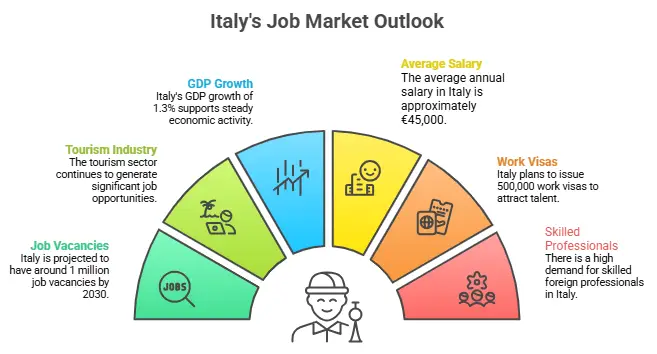
- Italy is expected to have around 1 million job vacancies by 2030
- As of Q1 2026, Italy's job vacancy rate stood at 1.7% (ISTAT)
- The tourism industry continues to create lakhs of job opportunities
- Italy's GDP grew by 0.5% in 2025, with growth forecast at 0.7% for 2026 (ISTAT, June 2026)
- The average annual salary in Italy is around €45,000
- Italy to issue 497,550 work visas for non-EU workers between 2026 and 2028, including 164,850 in 2026 alone (Decreto Flussi, DPCM October 2, 2025)
- High demand for skilled foreign professionals
- Italy's unemployment rate fell to 5.1% in January 2026 — the lowest on record — down from 6.5% in 2024 (ISTAT)
Work visas (2026-2028): 497,550 (164,850 in 2026) │ Unemployment rate: 5.1% (Jan 2026, record low) │ GDP growth: 0.7% (2026 forecast) │ Job vacancy rate: 1.7% │ EU Blue Card threshold: ~€38,000/year
*Looking to work in Italy? Get top consultation from experts at Y-Axis.
Job Outlook in Italy
Italy’s job outlook for the coming years looks positive, especially due to labor shortages and planned workforce expansion. The country is facing a growing need for workers across multiple sectors, including tourism, construction, healthcare, manufacturing, agriculture, and services. To address this gap, Italy is opening its doors wider to skilled foreign professionals.
Understanding the Job Outlook for Job Seekers and Employers
For job seekers, Italy offers a work environment that values quality work, employee comfort, and job satisfaction. Italian companies usually follow a clear hierarchy with defined roles and responsibilities. The work culture is social and flexible, and employees benefit from a healthy work-life balance.
Common employee benefits in Italy include:
- Meal vouchers
- Healthcare benefits
- Paid holidays and parental leave
- 13th-month salary (tredicesima) typically paid in December as an extra month's pay
- 14th-month bonus (quattordicesima) paid in June
The standard work week in Italy is 40 hours. Workdays usually begin at 9:00 a.m. and end around 6:30 p.m., with short breaks during the day.
For employers, Italy’s job market is evolving to meet long-term workforce needs. Companies are actively looking for foreign talent to fill roles that cannot be met by the local workforce alone.
*Also, read...
Top In-Demand Jobs in Italy for the Next 10 Years
Italy’s Multi-Year Work Visa Plan
Italy has announced plans to issue 500,000 work visas between 2026 and 2028. This is part of a long-term strategy to manage labor shortages and support economic growth. Unlike short-term hiring programs, this is a multi-year workforce plan, allowing employers and foreign professionals to plan accordingly.
This initiative is implemented through Italy’s existing immigration system known as Decreto Flussi. Under this system, the Italian government sets quotas for non-EU workers based on industry and visa type. The 2026–2028 plan is an expanded version, with higher visa quotas announced in advance rather than year by year.
Why This Plan Is Important
- It shows Italy’s long-term commitment to hiring foreign workers
- It provides clarity and stability for employers and job seekers
- It creates more opportunities for professionals from countries like India
- It supports key sectors facing worker shortages
For Indian professionals and businesses, this plan opens a clear pathway to work opportunities in Italy, provided eligibility and visa requirements are met.
Skilled professionals don't have to wait for a Decreto Flussi quota slot. The EU Blue Card offers a quota-free route for non-EU professionals with a recognised degree and a job offer meeting Italy's 2026 salary threshold of approximately €38,000/year gross — a faster option for qualified Indian applicants than competing for a capped Decreto Flussi place.
In-demand Jobs in Italy
Italy is a country that draws many people from around the world due to its stunning scenery, famous cuisine, and high standard of living. For foreigners who are looking to start their career, obtain the necessary skills and job experience, or observe new challenges, Italy offers many opportunities. The table below shows the most in-demand jobs in Italy and their average annual salary:
| Occupation | Average annual salary |
|---|---|
| IT and Software | € 53,719 |
| Engineering | € 77,500 |
| Accounting and Finance | € 109,210 |
| Human Resource Management | € 40,000 |
| Hospitality | € 50,000 |
| Sales and Marketing | € 97,220 |
| Healthcare | € 69,713 |
| STEM | € 65,500 |
| Teaching | € 48,225 |
| Nursing | € 72,000 |
Also, read...
Highest paying job opportunities in Italy for Indians
Most In-Demand Skills in Italy
Employers in Italy look for candidates who have both technical knowledge and soft skills. Along with job-specific skills, companies prefer professionals who can communicate clearly, adapt to change, work well in teams, and manage their time effectively. These skills help employees perform better and support long-term career growth.
| Job Sector | Key Skills in Demand |
|---|---|
| Information Technology (IT) | Digital literacy, technology skills, analytical skills, problem-solving, critical thinking |
| Engineering | Problem-solving skills, analytical thinking, adaptability, teamwork, time management |
| Healthcare & Nursing | Communication skills, teamwork, adaptability, customer service skills, time management |
| Finance & Accounting | Analytical skills, critical thinking, attention to detail, communication skills |
| Business & Management | Leadership and management skills, decision-making, communication, problem-solving |
| Marketing & Sales | Communication skills, creativity and innovation, customer service skills, adaptability |
| Human Resources | Communication skills, leadership skills, teamwork, problem-solving |
| Hospitality & Services | Customer service skills, communication, teamwork, time management |
| Education & Training | Communication skills, leadership, adaptability, critical thinking |
*Willing to migrate to Italy? Y-Axis will help you in step by step process.
Identification of Key Skills Sought by Employers
It is important for job seekers to understand what employers look for when reviewing job applications. Along with technical knowledge, many employers value soft skills. These include the ability to work well with others, communicate clearly, adapt to new situations, and solve problems. Such skills show that a candidate can fit into a team, handle challenges, and add value to the workplace.
Importance of Upskilling or Reskilling for Job Seekers
As technology continues to change, workers need to update their skills regularly. Many jobs now require new tools, software, and digital knowledge. Job seekers must learn new skills and stay updated with the latest technology in their field to remain competitive. This can be challenging, especially for workers who are not familiar with new technologies. However, learning and improving skills helps workers stay relevant, find better job opportunities, and grow in their careers. Continuous learning is key to long-term success in today’s job market.
Flexible Work Options and the Rise of Remote Jobs in Italy
Growing Trend of Remote Work
Remote work has become more common across many industries. With better internet access and digital tools, employees can now work from different locations, including from home or even from another country. Technology has also made it easier for people to start their own businesses or work as freelancers and gig workers. This flexibility gives workers more control over how and where they work.
Impact on Employers and Employees
Remote and flexible work arrangements affect both employers and employees. Employers are required to clearly inform workers about basic job details from the first day of employment. This includes information about salary, working hours, holidays, job location, and work conditions. Clear communication helps build trust and ensures a smooth working relationship. For employees, flexible work options improve work-life balance and offer greater freedom in managing personal and professional responsibilities.
Government Policies and Initiatives Shaping Job Growth in Italy
Overview of Government Policies Influencing Employment
Italy’s job market has faced several challenges over the years. These include low participation of women in the workforce, high youth unemployment, slow wage growth, and a rise in informal and unsafe jobs. These issues became more serious during the COVID-19 pandemic.
To address these challenges, the Italian government has taken steps to improve employment conditions. In early 2021, Prime Minister Mario Draghi announced plans to reform and strengthen the labour market through investments under Italy’s National Recovery and Resilience Plan (NRRP). The NRRP's EU-funded spending window closes in mid-2026, so Italy is now in the final implementation phase of these reforms rather than the early planning stage described above. This plan aims to modernize the economy, improve job quality, support skill development, and create more stable employment opportunities across sectors.
How Policy Changes May Impact the Job Market
Government policy changes can strongly affect the job market. When the demand for professionals is high compared to the supply, wages usually increase. Higher wages can improve living standards, but they can also increase hiring costs for employers. This may lead some companies to slow down hiring, which can balance wage growth over time.
Through careful planning, investment, and labour reforms, Italy aims to create a more balanced job market. These policies are expected to support long-term job growth, improve productivity, and create better working conditions for both local and foreign workers.
Tax Benefits for Relocating Professionals
Skilled foreign workers who relocate their tax residence to Italy may qualify for the Impatriate Tax Regime (Legislative Decree 209/2023): 50% of Italian employment income is exempt from tax for 5 years, up to €600,000/year (rising to 60% exemption if relocating with a minor child). On an €80,000 salary, this can save roughly €11,000-15,000 a year in tax. Eligibility requires not having been an Italian tax resident in the prior 2 years and committing to stay at least 2 years.
*Want to apply for jobs abroad? Avail Y-Axis Resume Marketing Services to find the right one.
Challenges and Opportunities for Job Seekers in the Italy
Discussion on the challenges faced by job seekers
The services sector manages the economy with a strong focus on corporate, transportation, and retail sales. Managed by the manufacturing of luxury items like fashion, furniture and cars, industry also reports for a fair amount of Italy's output. Italy is one of the world's largest manufacturers of wine, olive oil and fruit in terms of agriculture.
The number of multinational companies may be smaller in Italy than in other European countries, but strong Italian brands include automobiles, such as Lamborghini and Ferrari, and fashion designers Armani, Prada, Gucci, and Versace.
*Want to prepare professional resume? Choose Y-Axis resume services.
Tips and strategies for navigating the job market successfully
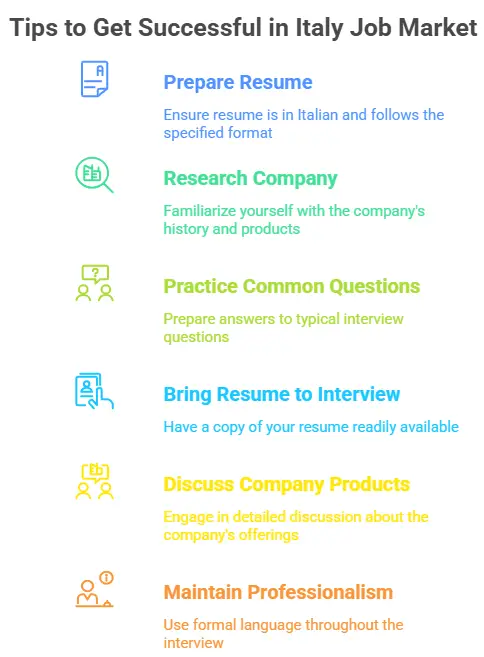
The interview process in Italy can seem challenging to foreigners, but it can be easy to navigate with a little preparation. Sometimes, the interviewer will start by asking some common questions about your experience and qualifications. Always have a copy of your resume in hand so that you can refer to it during the discussion. Also be familiar with the company's history and speak more about their products or services in detail.
When it comes to writing a resume for an Italian job application, the most crucial thing to know is that your application should generally be in Italian. The exception: multinational companies and Milan-based finance, fashion, and tech firms increasingly accept English-language CVs, particularly for senior or specialist roles. Apart from that, the structure of your CV should in the following format:
- Start with your name, phone number, address, and email address.
- List the names of the schools and the dates you attended.
- Mention work experience, starting with the most recent position first.
- List your strengths and skills, as well as any additional information that might be relevant.
- Don’t use informal language.
Summary of Italy Job Outlook
Working abroad can be an exciting opportunity for candidates who want to explore new career paths. Italy, located in Southern Europe, offers many job opportunities across different industries. Key sectors such as tourism, retail, finance, IT, and business services continue to provide career options for skilled professionals.
Italy offers a positive work environment with a strong focus on work-life balance and employee well-being. Job seekers who are planning to work in Italy can benefit by understanding the local work culture, lifestyle, and job application process. Being well-prepared helps candidates find suitable jobs and build successful long-term careers in Italy.
*Searching for Jobs in Italy? Find the right one with the help of Y-Axis resume marketing services
Y-Axis snapshot
1M
Successful applicants
1500+
Experienced counselors
25Y+
Expertise
50+
Offices
Don't know what to do ?
Get Free Counseling
Looking for Inspiration
Explore what Global Indians have to say about Y-Axis in shaping their future