


Don't know what to do ?
Get Free Counseling
China Job Market
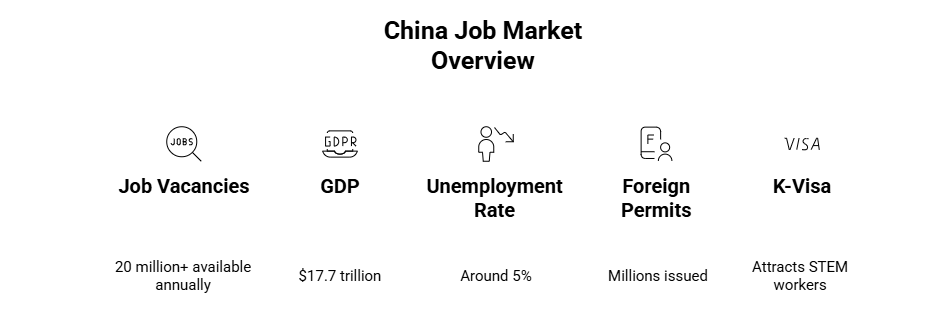
- Over 20 million+ job vacancies are available across various sectors every year
- The country’s GDP is $17.7 trillion, making it the second-largest economy in the world
- The unemployment rate has stayed around 5% in recent years
- Millions of work permits and residence permits have been issued to foreign professionals
- The new K-Visa attracts highly skilled workers in IT, engineering, and STEM fields
*Planning to work abroad? Y-Axis will guide you step-by-step.
Job Outlook in China
Understanding the job outlook for job seekers and employers
China has one of the world’s most dynamic and fast-growing job markets, offering strong opportunities for skilled foreign professionals. The country continues to attract global companies and foreign investment, creating stable employment opportunities across advanced industries. China is known for its strong infrastructure, modern lifestyle, innovative technology sector, and large-scale industrial ecosystem. With rising demand for STEM professionals, IT experts, teachers, engineers, and healthcare workers, China provides excellent career growth for skilled workers.
General employment trends for the year
China’s employment landscape is evolving rapidly, especially in high-tech, engineering, AI, EV manufacturing, and education sectors. Digital transformation, AI expansion, and automation continue to create new roles. Service industries, e-commerce, logistics, and healthcare are expanding fast. Remote work options are increasing in global companies. Skilled workers with technical expertise, digital skills, and English communication abilities have a higher advantage in the job market.
Factors influencing job creation or reduction
Job creation in China is influenced by economic growth, global trade demand, digital innovation, new technologies, and government policies. Factors like international trade agreements, AI expansion, semiconductor development, EV production, and infrastructure projects drive job growth. On the other hand, automation and economic slowdowns may reduce demand for low-skilled roles. The shift toward high-tech industries increases opportunities for skilled foreign workers.
In-Demand Industries and Occupations in China
China’s fast-growing economy creates strong demand for skilled professionals across multiple industries. With rapid development in technology, engineering, manufacturing, healthcare, and education, many sectors face a shortage of qualified workers. Foreign professionals with the right skills, experience, and qualifications can find excellent career opportunities and competitive salaries. The table below highlights the top in-demand occupations and their average annual salary ranges.
|
Occupations |
Salary (annually) |
|
Engineering |
180,000 – 300,000 CNY |
|
IT & Software |
200,000 – 350,000 CNY |
|
Marketing & Sales |
220,000 – 350,000 CNY |
|
Human Resource Management |
180,000 – 260,000 CNY |
|
Healthcare |
200,000 – 320,000 CNY |
|
Teachers |
120,000 – 200,000 CNY |
|
Accounting & Finance |
250,000 – 380,000 CNY |
|
Manufacturing & Industry |
150,000 – 250,000 CNY |
|
Nursing & Medical Support |
140,000 – 220,000 CNY |
Job Vacancies in China
China continues to generate large-scale job opportunities due to rapid industrial expansion, digital transformation, and government-led development programs. Key sectors such as manufacturing, IT, artificial intelligence, healthcare, construction, and logistics are driving employment growth.
National initiatives like “Made in China 2025,” smart city development, high-speed rail expansion, and advanced manufacturing projects are creating millions of jobs across major cities and industrial zones. These programs are increasing demand for skilled professionals, including engineers, IT specialists, and healthcare workers. The below table shows the estimated number of job openings in China by 2030:
|
Occupation |
Estimated number of Job by 2030 |
|
Healthcare |
2,000,000 |
|
Nursing |
1,500,000 |
|
Manufacturing |
2,200,000 |
|
IT & Software |
1,200,000 |
|
Engineering |
1,000,000 |
|
Construction |
1,400,000 |
|
Logistics & Supply Chain |
900,000 |
|
Teaching & Education |
800,000 |
|
Accounting & Finance |
600,000 |
Workforce Demand in China
Examination of the job market in China
China’s job market is vast and diverse, offering strong opportunities for skilled professionals across major cities like Beijing, Shanghai, Shenzhen, Guangzhou, and Hangzhou. Each city specializes in different economic sectors such as finance, IT, manufacturing, research, logistics, EV technology, robotics, education, and international trade. These industries create a strong demand for foreign workers with technical expertise, English skills, and global experience.
Top cities Providing Excellent Career Opportunities
Cities such as Beijing, Shanghai, Shenzhen, Guangzhou, Tianjin, and Suzhou offer high-paying roles across IT, engineering, AI, healthcare, teaching, manufacturing, finance, HR, marketing, and logistics. China’s focus on innovation, R&D, green energy, EV technology, and advanced manufacturing creates a continuous demand for skilled professionals. The multicultural work environment and strong economic growth attract foreign talent, especially in STEM fields.
Impact of Technology and Automation in China
Technological advancements and automation shaping the job market
China is a global leader in technology, robotics, AI, machine learning, and industrial automation. These advancements are reshaping the workforce and creating new job opportunities in IT, engineering, smart factories, semiconductor manufacturing, and energy sectors. Automation increases productivity and creates high-value job roles requiring analytical, technical, and problem-solving skills. China’s heavy investment in innovation allows foreign workers to access advanced tech industries.
Potential opportunities and challenges in the evolving landscape
Technology-driven industries offer huge opportunities for skilled workers in AI, big data, cloud, EV technology, manufacturing, healthcare, and STEM. China’s strong infrastructure and global trade position attract international talent. However, workers must continuously reskill and upskill to match the fast-evolving job environment. Foreign workers with strong technical, digital, and engineering skills have a clear advantage in securing high-paying roles.
Skills In-Demand in China
Key skills sought by employers in China
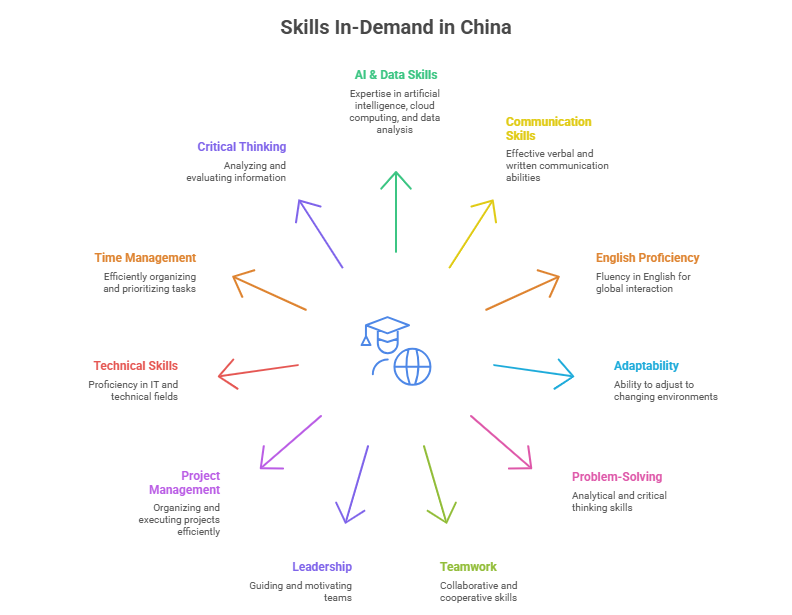
- Digital literacy
- AI, cloud, and data-related skills
- Communication skills
- English language proficiency
- Adaptability and flexibility
- Problem-solving and analytical skills
- Teamwork and collaboration
- Leadership skills
- Project management
- Technical and IT skills
- Time management
- Critical thinking
Why Continuous Learning Matters for Job Seekers?
Job seekers need continuous upskilling due to rapid technological changes, automation, and industry innovation. Learning new tools, gaining certifications, and improving language skills increases employability. Upskilling helps workers stay competitive, while reskilling allows them to shift to high-demand careers. Constant learning supports job stability, better career growth, and long-term success in a fast-changing job market.
How Flexible Work Benefits Companies and Employees in China?
Remote and hybrid work models are growing quickly across sectors like IT, education, digital marketing, and customer support. These flexible arrangements help employees manage work–life balance while giving companies access to global talent. Many employers use hybrid systems to improve productivity and reduce operational costs. For workers, flexible schedules lead to higher efficiency, better job satisfaction, and more international job opportunities. These modern work models also support inclusion, mental well-being, and stronger global collaboration, making them beneficial for both employees and organizations.
China’s New K-Visa Policy and Talent Recruitment Initiatives
The introduction of the China K-Visa has become a major part of the country’s strategy to attract highly skilled foreign professionals. This visa is designed for experts in fields like AI, engineering, IT, robotics, EV technology, and scientific research. The policy offers easier work visa approvals, faster processing, and smoother pathways to long-term residence. Along with the K-Visa, talent-friendly zones, simplified residency rules, and supportive government programs encourage global professionals to work and settle in China. These initiatives boost innovation, create new jobs, and strengthen the country’s position as a leading destination for skilled international talent.
Tips to help you find the right Job in China
- Create a clear, skills-focused China-style CV
- Improve your English and basic Mandarin
- Gain certifications in in-demand skills
- Build a professional network online
- Keep learning and upgrading skills
- Research employers and job roles
- Prepare for virtual interviews
- Maintain a strong LinkedIn presence
Summary of China Job Outlook
China’s job outlook is highly promising, offering excellent opportunities for skilled professionals across IT, engineering, education, manufacturing, finance, HR, healthcare, and logistics. The country provides strong career growth, competitive salaries, world-class infrastructure, and a high standard of living. With its booming economy, advanced technology, and rising demand for foreign talent, China is one of the best destinations for Indians looking to build a successful global career.
*Looking for jobs in China? Talk to Y-Axis for expert guidance.
Don't know what to do ?
Get Free Counseling
Looking for Inspiration
Explore what Global Indians have to say about Y-Axis in shaping their future
Frequently Asked Questions