


Don't know what to do ?
Get Free Counseling
Last Updated 08 September 2026
Belgium Job Outlook: Trends and Opportunities
Belgium remains a top destination for skilled professionals seeking career opportunities in Europe. The country has around 146,000 job vacancies and a job vacancy rate of 3.8%, highlighting strong demand for workers across various sectors. Industries such as IT, healthcare, engineering, logistics, manufacturing, and construction continue to face labour shortages and are actively recruiting qualified talent.
Belgium offers competitive salaries, with average annual earnings of around €49,000, along with excellent healthcare, social benefits, and a good work-life balance. Its strong economy, central European location, and demand for skilled workers make it an attractive option for Indian professionals looking to work and build a long-term career abroad.
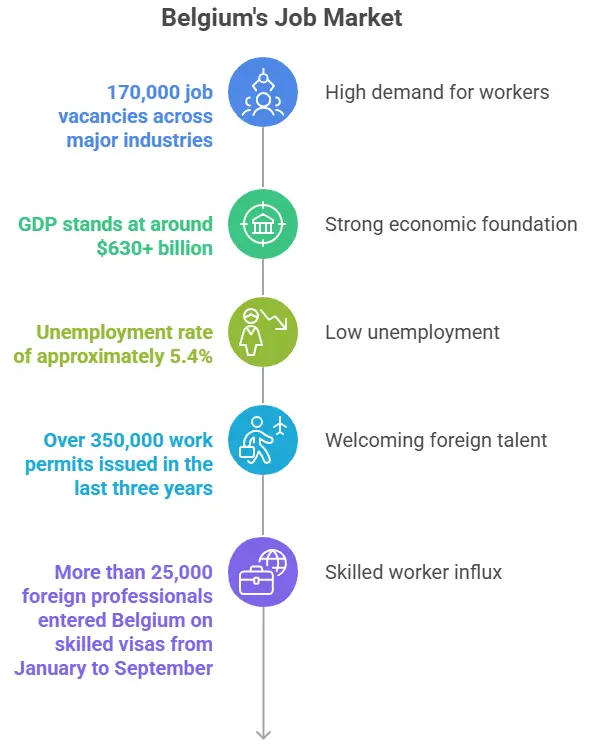
- Belgium records 170,000 job vacancies across major industries
- The country’s GDP stands at around $630+ billion
- Belgium maintains an unemployment rate of approximately 5.4%
- Over 350,000 work permits issued in the last three years
- More than 25,000 foreign professionals entered Belgium on skilled visas from January to September
*Planning to migrate overseas? Y-Axis will guide you in the step-by-step process.
Job Market in Belgium
Belgium has a strong and modern job market that offers many opportunities for skilled foreign workers. The country is a major hub for industries such as IT, engineering, pharmaceuticals, logistics, and renewable energy. It is also home to the European Union institutions, NATO, and many international companies, where English is commonly used in the workplace.
With a job vacancy rate of 3.8%, which is higher than the EU average, many Belgian employers are looking for skilled workers to fill open positions. Belgium also offers competitive salaries, strong employee rights, quality healthcare, and a good work-life balance. These benefits make Belgium an attractive destination for Indian professionals looking to work and build a successful career in Europe.
Job Vacancies in Belgium
According to Statbel, Belgium had around 146,000 unfilled job vacancies at the end of 2025. The demand for skilled workers is growing due to digital transformation, healthcare needs, and major infrastructure and development projects across cities such as Brussels, Antwerp, and Ghent. Industries including IT, healthcare, engineering, logistics, finance, construction, and research continue to offer strong employment opportunities for both local and international professionals.
| Sector | Demand Outlook | In-Demand Jobs |
|---|---|---|
| IT & Software | Very High | Software Developers, Data Analysts, Cybersecurity Specialists, Cloud Engineers |
| Healthcare & Nursing | Very High | Nurses, Care Assistants, Medical Technicians |
| Engineering & Manufacturing | High | Mechanical Engineers, Electrical Engineers, Industrial Engineers, Technicians |
| Logistics & Supply Chain | High | Supply Chain Planners, Warehouse Managers, Mechanics |
| Finance & Business Services | High | Accountants, Auditors, Risk and Compliance Specialists |
| Construction & Infrastructure | High | Site Engineers, Electricians, HVAC Technicians, Welders |
| Education & Research | Moderate | STEM Teachers, Researchers, Pharmaceutical R&D Professionals |
*Read more...
Belgium Shortage Occupation List
Belgium regulates work permits by region, and each region publishes its own shortage occupation list. If your job is on the list, your employer can get your permit approved faster without proving that no local candidate was available (no labour-market test).
- Flanders: a revised list of 21 medium-skilled shortage occupations applies from 1 January 2026. Nurses, care assistants, engineering technicians, welders and CNC operators remain on the list.
- Wallonia: 56 shortage occupations (list effective October 2025), including industrial electricians, maintenance managers and vehicle mechanics.
- Brussels-Capital: maintains a separate shortage list (last revised mid-2025) with fast-track work authorisation for listed roles.
Highly qualified professionals like IT specialists, engineers, finance experts and healthcare staff with degrees — do not need to be on a shortage list. They qualify through the highly skilled or EU Blue Card routes described below.
In-Demand Occupations and Average Salaries in Belgium
Belgium’s average gross salary is €4,076 per month (about €49,000 per year), according to Statbel. The national minimum wage is €2,189.81 per month from April 2026. Typical gross annual salaries for in-demand occupations:
| Occupation | Salary (Gross, Per Year) | Approx. INR |
|---|---|---|
| IT & Software | €55,000 – €65,000 | ₹60–72 lakh |
| Engineering | €50,000 – €60,000 | ₹55–66 lakh |
| Healthcare (Specialists) | €70,000+ | ₹77 lakh+ |
| Nursing | €40,000 – €55,000 | ₹44–60 lakh |
| Accounting & Finance | €55,000 – €65,000 | ₹60–72 lakh |
| Marketing & Sales | €45,000 – €55,000 | ₹50–60 lakh |
| Human Resources | €45,000 – €52,000 | ₹50–57 lakh |
| Logistics & Supply Chain | €40,000 – €50,000 | ₹44–55 lakh |
| Teaching | €42,000 – €48,000 | ₹46–53 lakh |
*Want to work in Belgium? Contact Y-Axis for complete guidance.
How to Get a Job in Belgium from India: Step-by-Step
Step 1: Check if your occupation is listed as a shortage occupation in Belgium or meets the salary requirements for highly skilled workers.
Step 2: Create a professional Europass CV and prepare a job-specific cover letter.
Step 3: Apply for jobs through Belgian job portals such as VDAB, Actiris, Le Forem, EURES, and LinkedIn. You can also apply directly to multinational companies that hire English-speaking professionals.
Step 4: Secure a job offer from a Belgian employer.
Step 5: Your employer will apply for a Single Permit or EU Blue Card on your behalf.
Step 6: After your work permit is approved, apply for a long-stay Type D visa through the Belgian Consulate or VFS in India.
Step 7: Travel to Belgium and register with the local municipal authority within eight working days of arrival.
Step 8: Receive your residence card and begin working in Belgium.
Step 9: After completing five years of legal residence in Belgium, you may be eligible to apply for permanent residence.
General Employment Trends for the Year
Belgium’s job market is evolving with strong demand across IT, engineering, healthcare, logistics, finance, and green energy. Digital transformation is driving roles in:
- Automation
- Artificial Intelligence
- Data analytics
- Cloud computing
- Cybersecurity
Flexible work models, hybrid roles, and remote positions are growing, encouraging continuous upskilling and multilingual competency.
Factors Influencing Job Creation or Reduction in Belgium
- Economic growth & industrial expansion
- Increased digitalization and automation
- Immigration reforms & work permit policies
- EU policies & market regulations
- Global supply chain trends
- Green energy initiatives and climate laws
These elements collectively shape Belgium’s workforce trends.
Opportunities for Foreign Professionals in Belgium
Belgium offers good job opportunities for skilled workers from other countries. People with experience in IT, engineering, logistics, scientific research, and healthcare are especially needed because Belgian companies often struggle to find enough local talent in these fields.
Most foreign professionals move to Belgiumz through two main permits: the EU Blue Card, which is for highly skilled workers, and the Work Permit B, which employers apply for when they want to hire a non-EU worker. Knowing Dutch or French is not always required, but it makes it much easier to get a job, communicate at work, and settle in the country.
Impact of Manufacturing and Industry in Belgium
Manufacturing and industry are important to Belgium’s economy. In 2024, the country produced about €195 billion in industrial goods, and manufacturing made up about 10–11% of the total GDP. The sector also provides many jobs, with around 19% of workers employed in industry. Belgium exports a lot of what it makes, especially chemicals, plastics, and medicines, which together form about one-third of all exports.
Although industry’s share of the economy has decreased over the years as services grew, manufacturing is still a key pillar. A few large companies produce most industrial output, which means global market changes can affect Belgium quickly. Overall, manufacturing remains vital for jobs, exports, and economic strength.
Growth Opportunities & Challenges for Professionals in Belgium
Belgium’s job market is growing steadily, especially in technology, engineering, and sustainability sectors. Recent studies show that more than 50% of Belgian companies plan to hire skilled workers, and STEM-related roles are among the fastest-growing. The country also ranks high in work–life balance and average salaries compared to many EU nations. At the same time, Belgium faces skills shortages, with about 70% of employers saying they struggle to find qualified candidates, especially those with digital and multilingual abilities. This creates strong opportunities but also brings certain challenges for professionals.
Opportunities:
- Expansion in tech-focused roles
- Strong demand for STEM profiles
- Attractive salaries and work-life balance
- Growth in green energy and sustainability jobs
Challenges:
- High competition in skilled occupations
- Requirement of multilingual skills (Dutch/French/English)
- Need for continuous upskilling
Skills In-Demand in Belgium
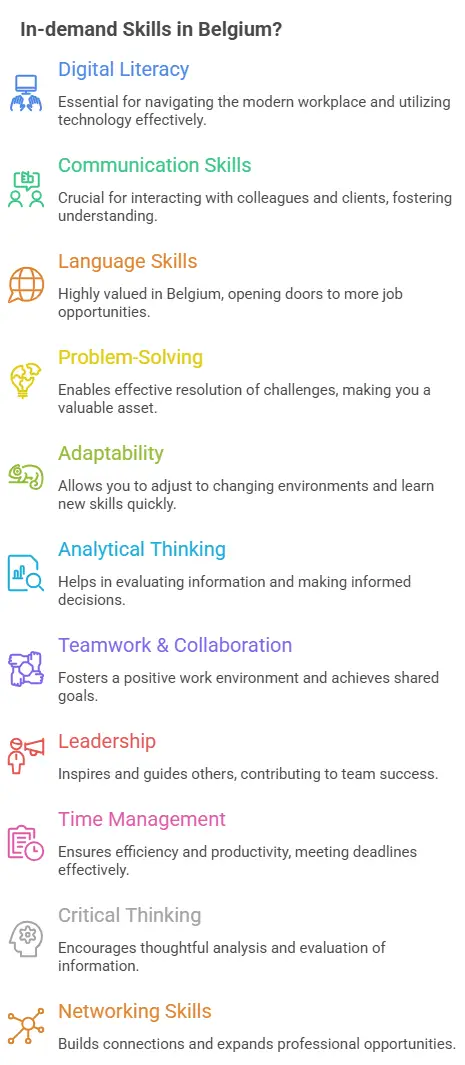
Belgium is facing a shortage of skilled workers, and many companies say they cannot find the right talent. Recent reports show that about 70% of employers struggle to fill jobs, mainly because they need people with strong digital, communication, and language skills. Also, candidates who know more than one language (Dutch, French, or English) have a much higher chance of getting hired in Belgium. Because of this, employers look for professionals who can learn quickly, work well with others, and adapt to different situations. The most in-demand skills include:
- Digital literacy
- Communication skills
- Dutch/French/English language skills
- Problem-solving
- Adaptability
- Analytical thinking
- Teamwork & collaboration
- Leadership
- Time management
- Critical thinking
- Networking skills
Flexible Work Options and Remote Job Opportunities in Belgium
Remote and hybrid work models have become standard in Belgium. Companies increasingly offer:
- Flexible work hours
- Hybrid work arrangements
- Remote-first roles in IT, finance, and consulting
These options improve work-life balance and allow foreign professionals to access Belgian jobs from abroad.
Tips and Strategies to Get a Job in Belgium
- Prepare a professional resume and cover letter
- Improve language proficiency (Dutch/French/English)
- Gain industry-relevant certifications
- Build a strong LinkedIn profile
- Network through events and professional groups
- Research roles and employers carefully
- Stay updated with Belgium’s job trends
- Prepare well for interviews
Summary of Belgium Job Outlook
Belgium offers a stable, high-quality job market with excellent opportunities for global talent. With strong economic growth, low unemployment, high living standards, and increasing demand across multiple sectors, Belgium remains a top destination for skilled professionals. Foreign workers with in-demand skills and multilingual ability can expect strong career prospects, competitive salaries, and long-term growth opportunities.
*Planning to move to Belgium? Contact Y-Axis, world’s number one immigration consultancy for end-to-end support.
Y-Axis snapshot
1M
Successful applicants
1500+
Experienced counselors
25Y+
Expertise
50+
Offices
Don't know what to do ?
Get Free Counseling
Looking for Inspiration
Explore what Global Indians have to say about Y-Axis in shaping their future