
Latest Job Openings in Germany for Skilled Professionals
Germany's job market presents remarkable opportunities for skilled professionals, with over 770,301 current job vacancies across the country. This impressive figure reflects Europe's strongest labor market, backed by a stable 4.2% unemployment rate in 2024 and projected GDP growth of 1.5% in 2025.
The numbers tell a compelling story. Germany plans to welcome 90,000 skilled workers annually, creating substantial employment opportunities for international talent. The Skilled Immigration Act, effective since March 2020, has simplified entry procedures for non-EU professionals with recognized qualifications. This legislative framework specifically addresses critical skill shortages across multiple sectors.
Whether you're exploring international opportunities or specifically targeting jobs in Germany for Indians, understanding the unspoken employer expectations can provide a significant advantage. German companies often have requirements that don't appear in job postings from higher technical proficiency than stated to cultural competencies that determine hiring decisions.
The following sections reveal what German employers expect but rarely advertise. You'll discover the hidden requirements, sector-specific insights, and insider knowledge that can help you successfully secure employment in Germany's competitive yet promising job landscape.
Germany's Job Market - The Big Picture
Germany operates Europe's most stable employment ecosystem heading. Understanding this economic landscape becomes essential for professionals considering work opportunities in this industrial powerhouse.
Current employment rate and economic growth
Germany maintains its position as the European Union's economic leader through consistent market stability. The steady economic foundation creates favorable conditions for both domestic and international job seekers across multiple industries.
Economic expansion continues across key sectors, particularly those experiencing acute skill shortages. This sustained growth directly translates into job creation, with increasing emphasis on digital competencies and specialized technical knowledge. Companies actively seek professionals who can contribute to Germany's evolving economic structure.
Why Germany is hiring more foreign professionals
Demographics drive Germany's urgent need for international talent. An aging population combined with declining birth rates creates significant workforce gaps that domestic training cannot fill quickly enough.
German businesses struggle to meet staffing requirements with local talent alone. The skills shortage has become particularly acute in:
- Technical fields requiring specialized expertise
- Healthcare sectors addressing demographic demands
- Engineering roles supporting industrial innovation
- IT positions driving digital transformation
This workforce challenge has prompted the government to implement welcoming immigration policies specifically designed to attract qualified international professionals.
Key cities with the most job opportunities
Berlin serves as Germany's startup capital and tech hub, offering numerous positions for international talent. The city combines cultural appeal with competitive salaries, particularly attractive for younger professionals.
Munich provides substantial opportunities in engineering and manufacturing, hosting major German corporation headquarters. The city's industrial base creates steady demand for technical professionals.
Hamburg's shipping and logistics industry offers stable employment opportunities, while Frankfurt's financial sector attracts professionals from around the globe.
For Indian professionals specifically, Düsseldorf and Stuttgart provide both professional opportunities and established international communities. These cities offer supportive networks that help newcomers adjust to German workplace culture and professional expectations.
*Note: Choose your target city based on industry concentration and existing international professional communities.
Top Industries Hiring in Germany
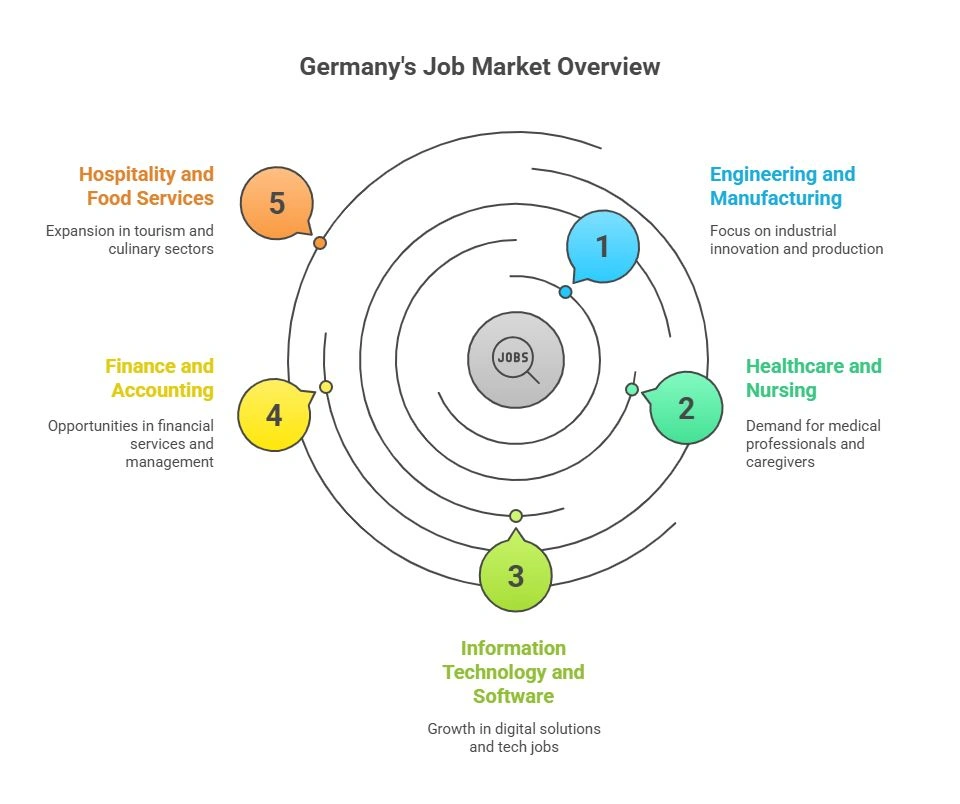
Germany's strongest sectors actively recruit skilled professionals, creating substantial employment opportunities across key industries. Here's where the demand is highest and what's driving this growth.
Engineering and Manufacturing
German engineering excellence drives consistent job creation in this sector. Annual salaries range from €40,000 to €90,000, with BMW alone advertising 212 Engineering/R&D positions. Mechanical, civil, electrical, and automotive engineering lead the demand as Germany transitions toward automation, e-mobility, and sustainable production.
The country's manufacturing precision and production capabilities position it as a global engineering leader. This creates sustained employment opportunities for both domestic and international professionals seeking technical roles.
Healthcare and Nursing
Germany's aging population has created critical staffing shortages in healthcare. Currently, around 31,000 care facility positions remain vacant, with projections indicating a need for more than 500,000 skilled healthcare workers by 2030.
Nursing opportunities exist across multiple settings:
- Hospitals
- Nursing homes
- Ambulatory care
Monthly salaries range between €2,500 and €3,500. International nurses find Germany particularly attractive due to clear pathways for career advancement and permanent residency.
Information Technology and Software
The IT sector represents Germany's most promising job market with over 109,000 unfilled positions in 2025. The industry generated €307 billion turnover, demonstrating significant economic impact.
High-demand IT roles:
- Software developers
- Cybersecurity specialists
- Data scientists
- IT security experts
Average annual salaries for software developers reach approximately €60,000, making IT jobs particularly attractive for skilled foreign professionals.
Finance and Accounting
Approximately one-third of financial institutions plan new hires, particularly in risk management, compliance, and IT. Frankfurt ranks among the world's top 10 financial centers, creating a thriving environment for finance professionals.
Germany's fintech sector attracted €1.1 billion in venture capital investments, generating numerous opportunities across the financial industry despite recent market fluctuations.
Hospitality and Food Services
Tourism drives substantial growth in this sector. Germany welcomed 53.8 million European tourists in 2023, who spent €46.0 billion. The hospitality industry projects USD 61.08 billion by 2030, with record-high 496.1 million overnight stays recorded in 2024.
Demand for skilled hotel managers has increased by 15% compared to last year, with annual salaries ranging from €25,000 to €65,000.
What Employers Don't Advertise (But You Should Know)
German job postings often present a polished version of reality. The actual requirements and expectations can differ significantly from what's written in the advertisement.
Hidden expectations in job descriptions
"Basic knowledge" in German job postings typically means intermediate to advanced proficiency. Employers assume candidates possess substantial industry knowledge even for entry-level positions. Many companies expect relevant certifications that aren't explicitly mentioned in the job description.
Note: Research the company's actual technology stack and tools before applying. Job descriptions frequently understate the technical complexity involved.
Unspoken Language Requirements
English proficiency alone rarely suffices for most positions. Even roles advertised as "English-speaking" involve regular interaction with German colleagues and clients. The working language of your immediate team may differ from what's stated in the job posting.
Key language considerations:
- A2-B1 German level for basic workplace integration
- B2-C1 for client-facing roles or team leadership
- Industry-specific vocabulary requirements
- Regional accent variations in different German states
Cultural fit and soft skills that matter
German employers evaluate cultural compatibility as rigorously as technical skills. Pünktlichkeit (punctuality) and Zuverlässigkeit (reliability) serve as fundamental competencies rather than nice-to-have qualities.
The workplace values that determine hiring decisions:
- Structured approach to problem-solving
- Direct communication without unnecessary pleasantries
- Analytical thinking over creative brainstorming
- Team collaboration rather than individual leadership
- Efficiency and precision in task execution
Trial periods and probation clauses
Nearly all employment contracts include a 6-month Probezeit (probation period) with simplified termination procedures. Employers use this time to assess performance against criteria that often remain unstated during the interview process.
Note: The probation period works both ways – use this time to evaluate whether the company culture aligns with your career goals and working style.
Salary Negotiation Norms in Germany
Salary discussions occur late in the interview process, typically after the second or third meeting. German employers expect candidates to justify salary requests with concrete market research and documented qualifications.
Negotiation strategies that work:
- Present salary ranges based on industry benchmarks
- Emphasize additional qualifications and certifications
- Focus on benefits like extra vacation days or flexible scheduling
- Avoid emotional appeals or pressure tactics
- Document your research with specific salary surveys
How to Prepare for Germany's Job Market
Success in Germany's evolving employment landscape requires strategic preparation and understanding of what employers actually seek in qualified candidates.
Skills German Employers Value Most
Technical proficiency in cybersecurity, AI, machine learning, and cloud computing dominates IT sector requirements. Healthcare professionals need specialized clinical expertise, while engineering roles demand knowledge in robotics, automation, and sustainable mobility. Critical thinking, adaptability, and problem-solving capabilities remain universally valued across all industries.
German companies prioritize practical experience alongside formal qualifications. Candidates who demonstrate hands-on expertise often receive preference over those with theoretical knowledge alone.
Language Requirements That Matter
Most German companies expect functional German language skills beyond what job postings indicate. Healthcare professions require B1 or B2 level proficiency as mandatory. Even "English-friendly" positions typically need A2-B1 German for effective team integration and career advancement.
Language Proficiency Levels:
- A2: Basic communication for daily workplace interactions
- B1: Intermediate level for most professional environments
- B2: Advanced proficiency required for healthcare and technical roles
Your language skills directly impact employability and relationship-building with colleagues, customers, and regulatory authorities.
Certification and Training Options
The Berufsbildungswerk (BBW) provides specialized vocational training in technology, healthcare, and logistics. German employers increasingly value micro-certifications and practical skills over traditional degrees. IT professionals benefit significantly from AWS, Azure, and CISSP certifications.
The recognition grant offers financial support of up to €600 for recognition procedures and €3,000 for training. This program helps international professionals validate their qualifications according to German standards.
Remote Work and Hybrid Models
Hybrid work arrangements have become standard across most German companies. This model balances flexibility with in-person collaboration, reflecting Germany's emphasis on work-life harmony. Remote-first approaches are expanding, enabling companies to recruit talent from across Germany and Europe.
Remote workers must use secure access tools compliant with Germany's strict data privacy regulations. Understanding GDPR requirements becomes essential for remote employment success.
Government Support for International Workers
The Federal Employment Agency provides free counseling, placement services, and recruitment assistance. Key government initiatives include African Skills 4 Germany, FIT for German Climate Businesses, and Triple Win. The THAMM Plus project creates specific pathways for professionals from Egypt, Morocco, and Tunisia.
These programs follow IRIS standards, ensuring ethical recruitment practices and worker protection.
Getting Started with Your Germany Job Search
Germany offers exceptional career opportunities for skilled professionals who understand what employers truly value. The robust job market, supportive immigration policies, and critical skill shortages create a favorable environment for international talent seeking long-term career growth.
Success depends on preparation beyond basic qualifications. German employers expect stronger language skills than advertised, cultural adaptability, and technical expertise that often exceeds job description requirements. The probation period works both ways – while companies evaluate your performance, you can assess whether the role aligns with your career goals.
Key sectors offer the strongest opportunities:
- Engineering and manufacturing with salaries ranging €40,000 to €90,000
- Healthcare with critical staffing needs and clear residency pathways
- Information technology with over 109,000 unfilled positions
- Finance and accounting in major financial centers
- Hospitality with growing demand for skilled managers
Government support programs specifically assist international professionals. The Federal Employment Agency provides free counseling and placement services. The Skilled Immigration Act has simplified visa processes, with processing times for Indian professionals reduced from nine months to just two weeks.
Before applying for positions:
- Develop German language proficiency to at least A2-B1 level
- Obtain relevant technical certifications for your field
- Research cultural expectations of German workplace environments
- Prepare for unspoken requirements beyond job descriptions
The hybrid work models and digital transformation expanding across German companies create additional opportunities for talented professionals. While securing employment requires thorough preparation, the benefits – competitive compensation, career advancement opportunities, and quality of life – justify the effort.
Germany's approach to addressing workforce needs through welcoming policies and structured support programs demonstrates serious commitment to international talent. With proper preparation and understanding of employer expectations, you can successfully build a career in one of Europe's strongest job markets.
Ready to explore opportunities in Germany? Research specific company cultures and regional job markets to identify the best fit for your career goals.
Frequently Asked Questions
What are the top industries hiring in Germany ?
The industries with the most job openings in Germany include engineering and manufacturing, healthcare and nursing, information technology and software, finance and accounting, and hospitality and food services. These sectors are experiencing significant growth and facing skill shortages, creating numerous opportunities for both domestic and international professionals.
How important is German language proficiency for job seekers?
German language proficiency is crucial for most job opportunities in Germany. While some multinational companies may use English, many roles require at least basic German skills (A2-B1 level) for better integration and career advancement. In healthcare professions, B1 or B2 level proficiency is often mandatory. Improving your German language skills can significantly enhance your employability and daily interactions in the workplace.
What are some hidden expectations in German job descriptions?
German employers often have unspoken expectations not explicitly stated in job listings. These may include higher technical proficiency than advertised, substantial industry knowledge, and relevant certifications even for entry-level positions. Additionally, employers value punctuality, directness, and strong analytical thinking skills. It's important to research thoroughly and prepare for these hidden expectations when applying for jobs in Germany.
Are there government programs supporting foreign workers in Germany?
Yes, Germany offers several government programs to support foreign workers. The Federal Employment Agency provides free counseling and placement services. Initiatives like African Skills 4 Germany, FIT for German Climate Businesses, and Triple Win are designed to assist international talent acquisition. Additionally, the THAMM Plus project creates pathways for trainees and skilled workers from specific countries. These programs aim to facilitate ethical recruitment and protect workers' rights.
What are the latest visa and work permit updates?
Germany has simplified entry for foreign professionals through the Skilled Immigration Act. The EU Blue Card salary threshold for shortage occupations is €43,759.80 annually. IT specialists with three years of experience can now obtain an EU Blue Card without a university degree. A new Opportunity Card allows skilled professionals to seek employment in Germany for up to one year without a prior job offer. Processing times for Indian professionals have been significantly reduced from nine months to just two weeks.