
Europe Job Vacancy Guide: What Employers Really Want
Job opportunities are expanding across multiple countries, with organizations helping you find employment and secure long-term visas in Eastern European nations like Poland, Czech Republic, Lithuania, and Ukraine. You can find positions ranging from entry-level to experienced roles offering competitive salaries like €50,000 per annum.
What makes Europe attractive for job seekers?
You're looking at 46 member states with diverse employment opportunities. Certain industries are actively recruiting international talent, especially from countries like India. Employers now value a specific combination of technical expertise, cultural adaptability, and language skills.
With the right information and approach, you can make your European career goals a reality.
How to Start Your Job Search in Europe
Finding a job in Europe requires a strategic approach. Over 70% of job opportunities across Europe are never publicly advertised, making networking a crucial component of your search strategy.
Where to find job vacancy in Europe
The European job market offers multiple dedicated platforms where you can discover opportunities. EURES (European Job Mobility Portal) stands out as a resource with millions of verified vacancies. This official European Commission portal provides job listings and information about living conditions in different countries.
Best platforms for jobs in Europe for Indians
Indian professionals seeking opportunities in Europe can access specialized resources. Currently, there are over 227,000 jobs for Indians posted on Europe job portals. When searching from India, focus on platforms like EURES, LinkedIn EU, and Indeed EU which connect international talent with European employers.
How to filter by country and industry
Most European job platforms offer filtering options to streamline your search. On major sites like EuroJobs, you can filter positions by both country (Sweden, Ireland, Netherlands, etc.) and category (Accountancy, IT, Healthcare).
To refine your search effectively, use customizable job alerts on platforms like EURES to receive notifications about positions matching your criteria. Industry-specific portals can help you target particular sectors – JobFluent for startups in Spain, Europe Language Jobs for multilingual positions, or Wellfound for tech roles across the continent.
What are the key skills employers want in 2025?
European employers are looking for a specific blend of technical and interpersonal abilities. Currently, 80% of employers and nearly 4 in 5 SMEs in the EU struggle to find candidates with the right skills and qualifications. Understanding what they need will help you stand out when applying for European positions.
What soft skills are most in demand?
Communication ranks as the most emphasized skill across European industries, particularly for roles that require explaining complex ideas to different audiences. According to a Bain & Company study, 60% of European hiring managers rank emotional intelligence, adaptability, and communication among their top priorities when evaluating candidates.
Attention to detail and critical thinking remain essential requirements, especially in data, engineering, and finance positions. You'll need to demonstrate these abilities through specific examples in your applications.
Which technical skills should you focus on?
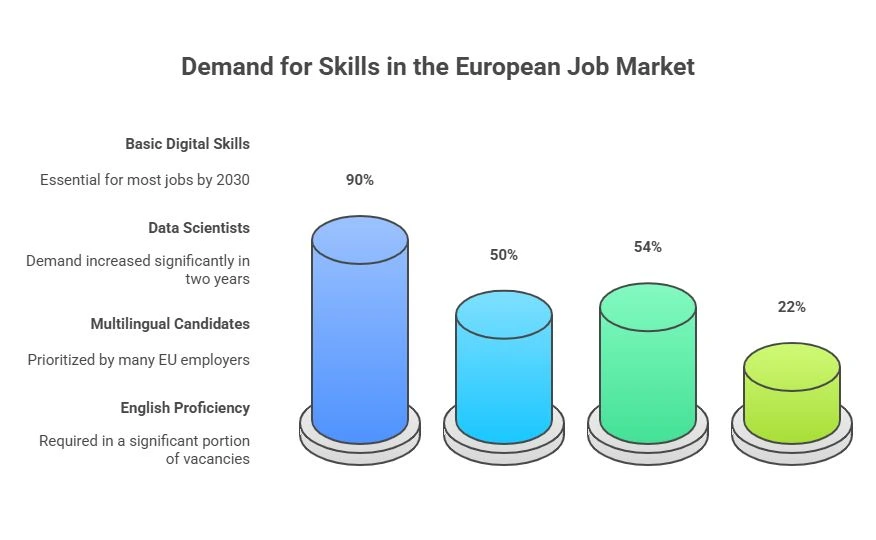
Digital transformation continues to drive growth across Europe. A European Commission report states that by 2030, 90% of jobs will require basic digital skills. Employers are actively seeking professionals skilled in data analysis, artificial intelligence, cloud computing, and cybersecurity.
The demand for data scientists has increased by 50% over the past two years alone. If you have experience in these areas, make sure to highlight it prominently in your CV.
How important is speaking multiple languages?
In Europe's diverse job market, language proficiency opens many doors. Eurostat data shows that 54% of EU employers prioritize multilingual candidates, particularly for positions in customer service, sales, and international business.
English proficiency was explicitly required in 22% of all vacancies across Europe, making it the sixth most required skill overall. For management and professional positions, one in two advertised roles required English knowledge.
Why does cultural adaptability matter?
Working in Europe's diverse environment demands flexibility. Research shows that diverse teams improve problem-solving capacity and productivity. Deloitte research confirms that working in multicultural settings significantly boosts creativity.
Cultural adaptability the ability to rapidly learn and conform to organizational cultural norms as they change often proves more valuable than cultural fit. You can demonstrate this through examples of working with international teams or adapting to new work environments.
What should you know about European application processes?
Getting your application right makes all the difference in Europe's competitive job market. Many applicants lose opportunities due to simple errors that you can easily avoid with proper preparation.
How should you format your CV for European employers?
European employers prefer concise CVs typically one to two pages that highlight relevant achievements rather than listing all responsibilities. The European/Europass CV format presents information in a standardized layout that emphasizes qualifications and skills. Make sure your CV includes language proficiency levels using the Common European Framework (CEFR) standards. You should quantify your achievements with metrics whenever possible to demonstrate your impact.
What makes a cover letter effective in Europe?
A well-crafted cover letter serves as your personal introduction not a repeat of your CV. Keep it concise with short paragraphs for better readability. Structure your letter logically: first paragraph for motivation, second for qualifications, and third explaining why the company is right for you. Research the employer thoroughly and reference specific aspects of their organization to show genuine interest.
What mistakes should you avoid?
Submitting generic applications is the most common pitfall among foreign job seekers. Failing to follow application instructions explicitly outlined in job postings often leads to immediate disqualification. Many candidates underestimate the importance of networking, which remains a powerful tool in the European job market. Don't ignore cultural differences in communication styles, which vary significantly across European countries.
How can you demonstrate cultural fit?
European employers value adaptability and cultural awareness alongside technical skills. Prepare to demonstrate your understanding of local work values through specific examples. Research communication norms beforehand some cultures prefer direct communication while others use more indirect approaches. Highlighting multilingual abilities significantly enhances your application, demonstrating both communication skills and dedication to integration.
What are the legal requirements for working in Europe?
Understanding legal requirements is essential after securing a job offer in Europe.
What rules apply to Indian citizens seeking European jobs?
Your right to work depends entirely on the host country's regulations. The EU Blue Card offers a practical pathway for Indian professionals, designed for highly skilled workers with university degrees and at least 5 years of relevant experience. This specialized permit allows residence and work across 25 participating EU countries (except Denmark and Ireland).
Are completely free recruitment jobs in Europe real?
Completely free recruitment is mostly a misconception. Although visa sponsorship exists, costs typically involve application fees (€60-€200), health insurance premiums, and document translation expenses. Visa sponsorship simply means an employer supports your work visa application.
How can you get employer sponsorship?
You need a job offer before applying for a work visa. The employer must be registered to sponsor workers and comply with local immigration laws. The process is straightforward in Germany—qualified candidates with employment contracts can apply for permits themselves.
What documents do you need for a foreign job vacancy?
Essential documents typically include:
• Valid passport (valid 6+ months beyond intended stay)
• Official job offer/employment contract
• Work permit application form
• Health insurance proof
• Professional qualifications
• Police clearance certificate
Processing times generally range from 2 weeks to 3 months depending on the country.
Frequently Asked Questions
Which European countries offer the most job opportunities?
Germany leads with over 1 million open positions, followed by Russia with 945,000 vacancies, and the United Kingdom with 781,000 vacancies. These countries face challenges such as aging workforces and high demand in sectors like manufacturing, logistics, and healthcare.
What skills are most in demand for European jobs?
Employers are seeking a combination of technical and soft skills. Technical skills in high demand include data analysis, artificial intelligence, cloud computing, and cybersecurity. Soft skills like communication, emotional intelligence, adaptability, and critical thinking are equally important.
How important is multilingual ability for job seekers in Europe?
Multilingual ability is highly valued in the European job market. About 54% of EU employers prioritize multilingual candidates, especially for positions in customer service, sales, and international business. English proficiency is particularly important, being required in 22% of all vacancies across Europe.
What are the key steps to apply for a job in Europe as a foreign candidate?
Start by tailoring your CV to European standards, typically keeping it to 1-2 pages. Write a concise cover letter that demonstrates your genuine interest in the company. Research the employer thoroughly and highlight your cultural adaptability. Networking is crucial, as 70% of job opportunities in Europe are not publicly advertised.
What is the EU Blue Card, and who is eligible for it?
The EU Blue Card is a work permit designed for highly skilled non-EU nationals. It allows residence and work across 25 participating EU countries (except Denmark and Ireland). To be eligible, candidates typically need a university degree and at least 5 years of relevant work experience. This permit is particularly useful for Indian professionals seeking employment in Europe.