


Posted on July 21 2026
Visa Sponsorship Jobs in Japan – In-Demand Jobs, Top Employers & How to Apply

By , Editor
Updated July 25 2026
Japan is facing a shortage of workers because of its ageing population and low unemployment rate of around 2.6%. Many companies are finding it difficult to hire enough employees. To solve this problem, Japan is hiring more foreign workers. The country now has a record 2.6 million foreign workers, and this number has been increasing every year. The Japanese government has also announced ¥5.5 billion to attract and support international talent.
There are many job opportunities in industries such as IT, healthcare, manufacturing, construction, and hospitality. Japan is expected to face a shortage of nearly 789,000 IT professionals by 2030. For Indian professionals, this is a great opportunity to build a career in Japan. Many Japanese employers offer visa sponsorship jobs, where the company helps you get a work visa. These jobs provide good salaries, a safe working environment, and opportunities to apply for permanent residency in the future.
Want to work in Japan? Sign-up to Y-Axis for complete guidance and support
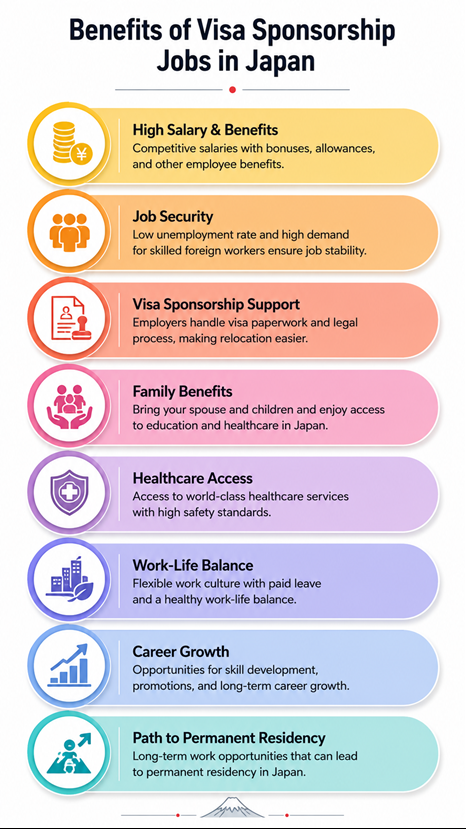
Why Apply for Jobs in Japan with Visa Sponsorship?
- Competitive salaries: Skilled professionals earn between ¥4 million and ¥15 million per year, depending on the role and experience.
- Huge demand for workers: With 118 job openings for every 100 job seekers, employers are actively recruiting foreign talent.
- Permanent residency pathways: The Highly Skilled Professional visa allows PR in as little as 1–3 years.
- Family sponsorship: Most work visas allow you to bring your spouse and children on dependent visas.
- World-class healthcare: All workers join Japan's national health insurance, covering 70% of medical costs.
- High quality of life: Japan offers excellent public transport, safety, cleanliness, and modern infrastructure.
- Strong economy: Japan is the world's fourth-largest economy with globally respected companies.
- Career growth: Working with Japanese and multinational companies adds strong value to your global career profile.
What are Visa Sponsorship Jobs in Japan?
Visa sponsorship jobs in Japan are jobs where a Japanese employer supports your work visa application. In Japan, you cannot apply for a work visa on your own; you first need a job offer from a company in Japan. Once you accept the job offer, your employer applies for a Certificate of Eligibility (COE) on your behalf at the Immigration Services Agency of Japan. The COE confirms that you meet the requirements for a work visa. After receiving the COE, you apply for the work visa at the Japanese embassy or consulate in your country.
Sponsored employment gives you legal work status, social insurance benefits, and a pathway to long-term residence. Any foreign professional with the right qualifications, skills, or experience can apply, including Indian graduates and skilled workers.
In-Demand Jobs in Japan with Sponsored Visa
Japan has a high demand for skilled foreign workers across several industries because of its growing labour shortage. Many employers offer visa sponsorship to qualified international candidates, especially in sectors such as IT, engineering, healthcare, manufacturing, construction, hospitality, education, logistics, and agriculture. The table below highlights the major hiring sectors, popular job roles, and the average annual salary offered.
|
In-Demand Sector |
In-Demand Roles |
Average Annual Salary (JPY) |
|
Information Technology (IT) |
Software Engineer, Data Scientist, AI Engineer, Cloud Engineer, Cybersecurity Analyst, Full-Stack Developer |
¥8,500,000 |
|
Engineering |
Mechanical Engineer, Electrical Engineer, Civil Engineer, Industrial Engineer, Quality Engineer, Design Engineer |
¥5,600,000 |
|
Healthcare |
Registered Nurse, Caregiver (Kaigo), Physiotherapist, Medical Laboratory Technician, Radiographer, Pharmacist |
¥4,800,000 |
|
Manufacturing |
Factory Worker, Automotive Technician, CNC Machine Operator, Production Supervisor, Quality Inspector, Machine Operator |
¥4,000,000 |
|
Construction |
Civil Engineer, Welder, Carpenter, Electrician, Plumber, Construction Supervisor |
¥4,600,000 |
|
Hospitality & Tourism |
Hotel Staff, Front Desk Executive, Housekeeping Supervisor, Restaurant Manager, Chef, Tour Guide |
¥4,000,000 |
|
Education |
English Teacher, Assistant Language Teacher (ALT), University Lecturer, Preschool Teacher, International School Teacher, Language Instructor |
¥4,500,000 |
|
Logistics & Transportation |
Truck Driver, Delivery Driver, Warehouse Supervisor, Logistics Coordinator, Forklift Operator, Supply Chain Executive |
¥4,500,000 |
|
Agriculture & Food Processing |
Farm Worker, Greenhouse Worker, Livestock Worker, Food Processing Worker, Fruit Picker, Agricultural Technician |
¥3,400,000 |
*Also, read…
What are the most in-demand jobs in Japan for the next 10 years?
Highest Paying Job Opportunities in Japan
Japan rewards specialized skills generously. Professionals in technology, finance, healthcare, and management earn some of the highest salaries in Asia. Salaries in Tokyo are typically 15–35% higher than the national average.
|
Job Title |
Average Annual Salary (JPY) |
Average Annual Salary (INR) |
|
C-Level Executive |
¥30,000,000 |
₹1.77 crore |
|
Surgeon / Specialist Doctor |
¥25,000,000 |
₹1.48 crore |
|
Investment Banker |
¥20,000,000 |
₹1.18 crore |
|
Airline Pilot |
¥18,000,000 |
₹1.06 crore |
|
Fund Manager |
¥16,000,000 |
₹94.4 lakh |
|
IT Director |
¥15,000,000 |
₹88.5 lakh |
|
Software Engineering Manager |
¥13,000,000 |
₹76.7 lakh |
|
AI/ML Engineer |
¥12,000,000 |
₹70.8 lakh |
|
Management Consultant |
¥12,000,000 |
₹70.8 lakh |
|
Cloud Architect |
¥12,000,000 |
₹70.8 lakh |
|
Legal Counsel |
¥12,000,000 |
₹70.8 lakh |
|
Cybersecurity Specialist |
¥11,000,000 |
₹64.9 lakh |
|
Data Scientist |
¥10,000,000 |
₹59 lakh |
|
Pharmaceutical R&D Scientist |
¥10,000,000 |
₹59 lakh |
|
University Professor |
¥9,500,000 |
₹56 lakh |
*Read more…
Top Companies Offering Sponsored Visa Jobs in Japan
Many leading companies in Japan hire international professionals and provide visa sponsorship for eligible candidates. These companies recruit skilled workers in areas such as IT, engineering, manufacturing, finance, e-commerce, AI, and telecommunications. The table below lists the major hiring industries, top employers, and the common roles they sponsor.
|
Industry |
Top Companies |
Common Sponsored Roles |
|
Information Technology (IT) |
Rakuten, Fujitsu, IBM Japan, SmartNews, Money Forward, Preferred Networks |
Software Engineer, Data Scientist, AI Engineer, Cloud Engineer, IT Consultant, Full-Stack Developer |
|
E-commerce & Online Services |
Amazon Japan, Rakuten, Mercari, Yahoo Japan, Zozo, MonotaRO |
Software Engineer, Product Manager, Operations Manager, Data Analyst, UX Designer, Business Analyst |
|
Automotive & Manufacturing |
Toyota, Honda, Nissan, Denso, Mitsubishi Motors, Suzuki |
Mechanical Engineer, Automotive Engineer, Production Engineer, Quality Engineer, R&D Specialist, Design Engineer |
|
Electronics & Technology |
Sony, Panasonic, Hitachi, Toshiba, Canon, NEC |
Electronics Engineer, Embedded Systems Engineer, Hardware Engineer, Research Engineer, Product Designer, Systems Engineer |
|
Telecommunications & FinTech |
SoftBank, PayPay, NTT DOCOMO, KDDI, LINE Yahoo, Rakuten Mobile |
Software Engineer, Data Analyst, Network Engineer, FinTech Specialist, Cybersecurity Analyst, Cloud Engineer |
|
Finance & Banking |
Goldman Sachs Japan, Morgan Stanley Japan, Nomura, MUFG Bank, SMBC, Mizuho Bank |
Financial Analyst, Investment Banker, Risk Analyst, Software Engineer, Data Analyst, Compliance Specialist |
*Read more...
Japan Job Outlook in 2026-2030
Eligibility Requirements for Visa Sponsorship Jobs in Japan
To qualify for a visa sponsorship job in Japan, you must meet the following requirements:
- Have a valid passport that remains valid for the duration of your stay in Japan.
- Receive a confirmed job offer from a Japanese employer willing to sponsor your work visa.
- Hold a bachelor's degree or higher for most professional work visas, or have 10 years of relevant work experience (3 years for certain international service roles).
- Have relevant work experience, especially if you do not have a university degree.
- Meet the language requirements. Japanese is not required for all jobs, but Specified Skilled Worker (SSW) visas require at least JLPT N4. From April 2026, some customer-facing roles require JLPT N2. Many IT and finance jobs are available in English.
- Pass a sector-specific skills test if you are applying under the SSW visa category.
- Meet the health requirements, including a medical certificate if required.
- Have a clean criminal record and meet Japan's character requirements.
- Obtain a Certificate of Eligibility (COE) issued by Japan's Immigration Services Agency before applying for the work visa.
Documents Required for a Sponsored Work Visa in Japan
You will generally need the following documents when applying for a sponsored work visa:
- Valid passport – Proof of your identity and nationality.
- Completed visa application form – Official application for the work visa.
- Passport-size photographs – Required for visa and COE processing.
- Job offer letter or employment contract – Proof of your sponsored job in Japan.
- Certificate of Eligibility (COE) – Issued by Japanese immigration and arranged by your employer.
- Educational certificates – Proof of your degree or diploma.
- Work experience letters – Evidence of your professional experience.
- Updated resume (CV) – Details of your education, skills, and work history.
- Company registration documents – Submitted by your sponsoring employer.
- JLPT language test results (if applicable) – Required for SSW and certain other roles.
- Medical certificate (if applicable) – Proof that you meet the health requirements.
- Police clearance certificate (if applicable) – Proof of a clean criminal record.
How to Get a Visa Sponsorship Job in Japan?
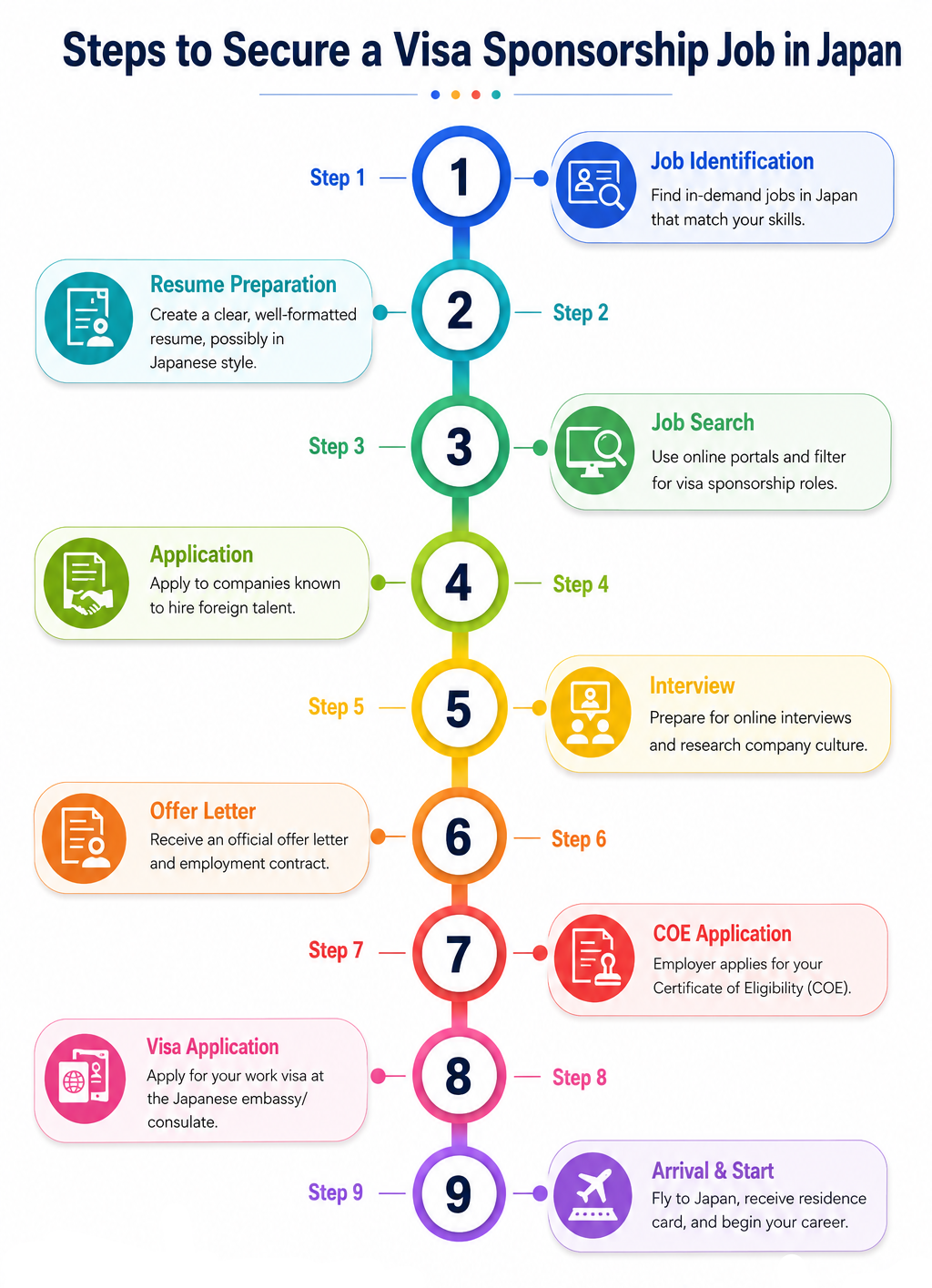
Step 1: Identify jobs in demand in Japan that match your skills, such as IT, engineering, healthcare, or one of the SSW sectors.
Step 2: Create a clear, well-formatted resume. For Japanese companies, a Japanese-style resume (rirekisho) may also help.
Step 3: Use portals like Japan Dev, Daijob, GaijinPot Jobs, and LinkedIn. Filter for "visa sponsorship available" roles.
Step 4: Apply to companies known to hire foreign talent, such as Rakuten, Mercari, and multinational firms in Japan.
Step 5: Most interviews for overseas candidates happen online. Prepare well and research the company culture.
Step 6: Once selected, you will get an official offer letter and employment contract.
Step 7: Your employer applies for your Certificate of Eligibility (COE) in Japan. This usually takes 1–3 months.
Step 8: With the COE, apply for your work visa at the Japanese embassy or consulate in India. Visa issuance usually takes about 5 working days.
Step 9: Fly to Japan, receive your residence card at the airport, and start your new career.
*Searching for jobs in Japan? Find the right one with the help of Y-Axis resume marketing services.
Work Visa Options for Foreign Workers in Japan
|
Visa Type |
Purpose |
Validity |
|
Engineer / Specialist in Humanities / International Services |
Main professional work visa for IT, engineering, business, translation, and teaching roles |
1, 3, or 5 years; renewable |
|
Highly Skilled Professional (HSP) |
Points-based visa for top talent; offers fast-track PR in 1–3 years |
5 years; leads to indefinite status |
|
Specified Skilled Worker (SSW) Type 1 |
Skilled workers in 16 sectors including caregiving, construction, agriculture, and food service |
Up to 5 years total |
|
Specified Skilled Worker (SSW) Type 2 |
Advanced skilled workers; allows family and indefinite renewals |
Renewable indefinitely |
|
Intra-Company Transferee |
Employees transferred to a Japanese branch of their company |
Up to 5 years |
|
Skilled Labor |
Specialized roles such as foreign cuisine chefs |
1, 3, or 5 years |
|
Instructor / Professor |
Teachers at schools and universities |
1, 3, or 5 years |
|
Nursing Care |
Qualified foreign nurses and care workers |
1, 3, or 5 years |
|
Business Manager |
Entrepreneurs and business owners in Japan |
1, 3, or 5 years |
|
J-Skip / J-Find |
Special tracks for high earners and graduates of top global universities |
Varies |
*Are you looking for step-by-step assistance for overseas immigration? Contact Y-Axis, the leading visa and immigration consultancy in India!
FAQs
What are visa sponsorship jobs in Japan?
Visa sponsorship jobs in Japan are jobs where a Japanese employer supports your work visa application. Since you cannot get a Japanese work visa without a job offer, the employer applies for your Certificate of Eligibility (COE) and provides supporting documents. Once the COE is approved, you can apply for your work visa at the Japanese embassy and legally work in Japan.
Can Indians get visa sponsorship jobs in Japan?
Yes, Indians can get visa sponsorship jobs in Japan. Japan has a record 2.6 million foreign workers and faces severe labour shortages. Indian professionals are in demand in IT, engineering, healthcare, and manufacturing. Many Japanese companies hire directly from India, especially for software and engineering roles, and English-speaking positions are increasingly common at multinational and tech companies.
Which companies sponsor foreign workers in Japan?
Top companies sponsoring foreign workers include Rakuten, Mercari, Google Japan, Amazon Japan, IBM Japan, Toyota, Sony, Panasonic, Fujitsu, SoftBank, Goldman Sachs Japan, and Morgan Stanley Japan. Tech companies and startups like Money Forward, SmartNews, and Preferred Networks also actively recruit international talent and often mention "visa sponsorship available" in their job postings.
Which jobs are easiest to get with visa sponsorship in Japan?
Jobs under the Specified Skilled Worker (SSW) visa are among the easiest, as they need no university degree—only a skills test and basic Japanese (JLPT N4). These include caregiving, food service, construction, agriculture, and manufacturing roles. For graduates, IT jobs are the easiest professional route because of Japan's shortage of over 220,000 IT professionals.
What are the highest-paying sponsorship jobs in Japan?
The highest-paying jobs include C-level executives (¥30 million+), surgeons and doctors (¥20–40 million), investment bankers (¥15–35 million), airline pilots, and senior tech roles like AI engineers, IT directors, and cloud architects (¥10–25 million). Technology and finance offer the best combination of high pay and easier visa sponsorship for foreign professionals.
What qualifications are required for visa sponsorship jobs in Japan?
For professional work visas, you typically need a bachelor's degree in a field related to the job. If you do not have a degree, 10 years of relevant work experience may be accepted (3 years for some international service roles). For SSW visas, no degree is needed—you must pass a sector skills test and a basic Japanese language test.
Do I need work experience to get a job in Japan?
Not always. Fresh graduates with a relevant bachelor's degree can qualify for the Engineer/Specialist in Humanities visa, and many Japanese companies hire new graduates. However, work experience makes your profile stronger and is mandatory if you do not hold a degree. For senior and high-paying roles, employers usually expect 3–5 years of relevant experience.
Is IELTS required for Japan work visas?
No, IELTS is not required for Japanese work visas. Japan has no English language requirement for immigration. Instead, some visas require Japanese language ability—the SSW visa requires JLPT N4, and some customer-facing roles require JLPT N2. Many IT and multinational jobs are English-only, though learning basic Japanese greatly improves your job prospects and daily life.
How long does Japan work visa processing take?
The Certificate of Eligibility (COE) takes about 1–3 months, with the common Engineer/Humanities category averaging around 2 months. After the COE is issued, the visa application at the Japanese embassy usually takes about 5 working days. In total, plan for 2–4 months from job offer to arrival, and start early to avoid delays.
Can family members accompany me to Japan?
Yes, most professional work visa holders can bring their spouse and children on a Dependent visa. Highly Skilled Professional visa holders enjoy extra benefits, including bringing parents in some cases. However, SSW Type 1 workers cannot bring family members, while SSW Type 2 workers can. Dependents can also work part-time with permission from immigration.
Can visa sponsorship lead to permanent residency in Japan?
Yes. Normally, you can apply for permanent residency after 10 years in Japan. However, the Highly Skilled Professional points system offers a fast track—PR in 3 years with 70 points, or just 1 year with 80 points. Points are based on education, salary, age, and experience. Many Indian tech professionals qualify for this fast track.
What industries hire foreign workers in Japan?
Manufacturing is the largest employer of foreign workers (24.7% of the total), followed by services, wholesale and retail, IT, healthcare, construction, hospitality, education, logistics, and agriculture. The most acute shortages are in IT, nursing and caregiving, construction, and food service, making these the best sectors for finding visa sponsorship jobs.
How can I find visa sponsorship jobs in Japan?
Use job portals like Japan Dev, Daijob, GaijinPot Jobs, and LinkedIn, filtering for "visa sponsorship" roles. Apply directly on career pages of companies known to hire foreigners, such as Rakuten and Mercari. Recruitment agencies specializing in bilingual placements also help. Y-Axis job search services can support you in finding and applying to suitable roles.
Are healthcare jobs in demand in Japan?
Yes, healthcare is one of Japan's most critical shortage areas due to its rapidly ageing population. Nurses and caregivers are in high demand, with job-to-applicant ratios above 3:1 in some regions. Caregivers can enter through the SSW visa with a skills test and JLPT N4. Foreign-trained nurses need to pass Japan's national nursing exam.
Are IT jobs available in Japan for foreigners?
Yes, IT is the best sector for foreign professionals. Japan faces a shortage of over 220,000 IT professionals, projected to reach 789,000 by 2030. Software engineers, data scientists, AI specialists, and cloud architects are heavily recruited. Many tech companies like Rakuten and Mercari use English as their working language, so Japanese is often not mandatory.
Can fresh graduates apply for jobs in Japan?
Yes, fresh graduates with a bachelor's degree can apply for the Engineer/Specialist in Humanities visa if the job matches their degree field. Japanese companies traditionally hire new graduates every year. Graduates of top global universities can also use the J-Find visa to stay in Japan for up to two years while job hunting.
What is the average salary in Japan?
The national average salary in Japan is about ¥4.78 million per year (around ₹28 lakh), while full-time professionals average about ¥6.18 million (around ₹36 lakh). IT professionals earn ¥7.5–15 million, and salaries in Tokyo are 15–35% higher than the national average. Exchange rates may vary, so INR values are approximate.
What documents are required for a Japan work visa?
You need a valid passport, visa application form, photographs, job offer letter or employment contract, Certificate of Eligibility (COE), educational certificates, resume, and work experience letters. Depending on the visa, you may also need JLPT results, a medical certificate, and a police clearance certificate. Your employer submits company documents for the COE application in Japan.
Can I change employers in Japan on a sponsored visa?
Yes, you can change employers as long as your new job matches your visa category. You must notify the Immigration Services Agency within 14 days of changing jobs. If the new role falls under a different category, you must apply for a change of status. SSW workers can also change employers within their approved sector.
How can Y-Axis help me get a job in Japan?
Y-Axis provides end-to-end support for your Japan career plans, including professional resume writing, job search assistance through dedicated job search services, visa and COE application guidance, documentation support, and interview preparation. With decades of experience helping Indian professionals move abroad, Y-Axis guides you from career counselling to successfully starting your job in Japan.
Tags:
Visa sponsorship jobs in Japan 2026
Japan work visa sponsorship for Indians
Japan work visa jobs
Japan work visa for foreign workers
In-demand jobs in Japan with visa sponsorship
Japan employer-sponsored jobs
Japan jobs for foreign workers
Share
Options for you by Y-Axis

Get it on your mobile

Get News alerts

Contact Y-Axis
Latest Article
Popular Post
Trending Article

Posted On October 16 2026
Australia Updates Health Insurance Guidance for Visa Holders: What You Need to Know