


Posted on July 09 2026
Visa Sponsorship Jobs in Hungary: In-Demand Roles, Top Employers & Work Permits

By , Editor & Director
Updated July 12 2026
Hungary has become one of Central Europe's most active job markets for foreign professionals. With an unemployment rate of around 4.5% and an ageing workforce, Hungarian employers face serious labour shortages in manufacturing, IT, engineering, healthcare, construction, and logistics. Major global companies such as Audi, BMW, Mercedes-Benz, Bosch, and Samsung SDI have set up large plants in Hungary, while Budapest hosts business service centres for Morgan Stanley, BlackRock, Citi, and TCS.
To fill skill gaps, Hungarian employers sponsor work and residence permits for qualified foreign workers. In 2026, the average gross salary in Hungary crossed HUF 772,200 per month (around INR 2.4 lakh), and salaries in IT, engineering, and finance are much higher.
From June 6, 2026, Hungary stopped accepting new Guest Worker Residence Permit applications. For Indian professionals, the main routes now are the EU Blue Card, the Hungarian Card, and intra-corporate transfers. This article explains the jobs in demand, salaries, top employers, eligibility, and the step-by-step process to get a sponsored job in Hungary.
Why Apply for Jobs in Hungary with Visa Sponsorship?
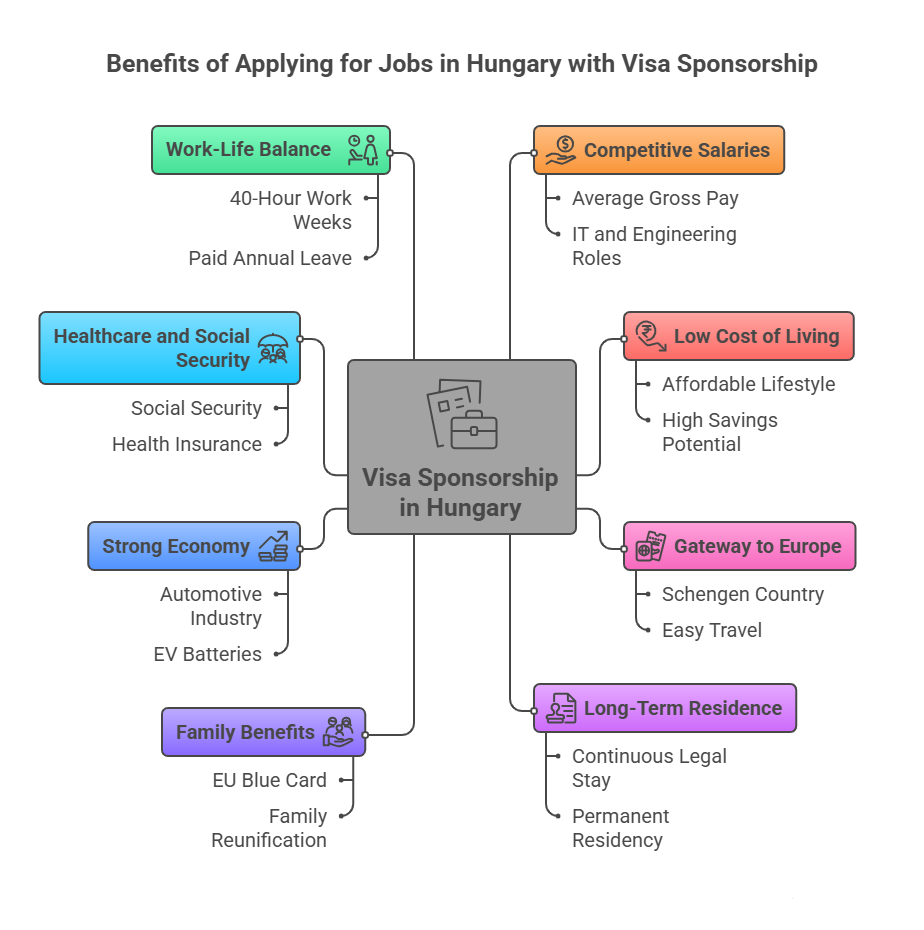
- Competitive salaries: Average gross pay is HUF 772,200 per month (2026), with IT and engineering roles paying far more.
- Low cost of living: Hungary is one of the most affordable countries in the European Union, so savings potential is high.
- Gateway to Europe: Hungary is a Schengen country, allowing easy travel across 29 European countries.
- Pathway to long-term residence: Eligible workers can apply for long-term residence after continuous legal stay in Hungary.
- Family benefits: EU Blue Card and other permit holders can bring their spouse and children through family reunification.
- Strong economy: Hungary attracts large investments in automotive, EV batteries, electronics, and shared services.
- Healthcare and social security: Sponsored employees are covered under Hungary's social security and health insurance system.
- Work-life balance: Standard 40-hour work weeks, paid annual leave of at least 20 days, and 13 public holidays.
*Also, read...
What are the most in-demand jobs in Hungary for the next 10 years?
What are Visa Sponsorship Job Opportunities in Hungary?
Visa sponsorship jobs are positions where a Hungarian employer supports your work and residence permit application so you can legally live and work in Hungary. The employer signs a preliminary employment agreement, files paperwork with the National Directorate-General for Aliens Policing (OIF), and in most cases proves that no local worker was available for the role.
Hungary uses a single permit system, which combines the work permit and residence permit into one application. Non-EU citizens, including Indians, can apply once they have a confirmed job offer. Highly qualified professionals typically apply through the EU Blue Card, while professionals with specific qualifications can use the Hungarian Card. Sponsored employment gives you legal status, social security coverage, and a path to long-term residence in Europe.
*Want to work in Hungary? Talk to experts at Y-Axis to help you with the process.
In-Demand Visa Sponsorship Jobs in Hungary
The occupations below face consistent labour shortages in Hungary. Salary figures are approximate gross annual amounts.
| Sector | In-Demand Job Roles | Average Annual Salary (HUF) |
|---|---|---|
| Information Technology (IT) | Software Developer, Data Scientist | HUF 18,000,000–26,000,000 |
| Engineering & Automotive | Mechanical Engineer, Electrical Engineer, Civil Engineer | HUF 10,000,000–15,000,000 |
| Healthcare | Doctor / General Physician, Registered Nurse | HUF 7,000,000–28,000,000 |
| Finance & Shared Services | Accountant, Financial Analyst | HUF 9,000,000–12,000,000 |
| BPO & Customer Support | Multilingual Customer Support Executive | HUF 7,000,000–9,000,000 |
| Manufacturing | CNC Machine Operator, Welder | HUF 6,500,000–8,000,000 |
| Construction & Skilled Trades | Electrician | HUF 7,000,000–8,500,000 |
| Logistics & Transportation | Truck Driver, Warehouse Worker | HUF 5,500,000–8,000,000 |
| Hospitality | Chef / Cook | HUF 6,000,000–8,000,000 |
*Want to apply for jobs in Hungary? Sign up with Y-Axis for expert guidance.
Highest Paying Jobs in Hungary
Salaries in Hungary have risen sharply, with average gross earnings up by around 9% year on year. IT, healthcare, finance, and engineering offer the highest pay, especially in Budapest. The table below shows approximate gross annual salaries in Hungarian Forint (HUF) and Indian Rupees.
| Job Title | Average Annual Salary (HUF) | Average Annual Salary (INR) |
|---|---|---|
| IT Director | HUF 30,000,000 | ₹93.0 lakh |
| Software Architect | HUF 27,000,000 | ₹83.7 lakh |
| Medical Specialist / Surgeon | HUF 26,000,000 | ₹80.6 lakh |
| Data Scientist | HUF 24,000,000 | ₹74.4 lakh |
| Cybersecurity Specialist | HUF 23,000,000 | ₹71.3 lakh |
| Senior Software Engineer | HUF 21,600,000 | ₹67.0 lakh |
| Finance Manager | HUF 21,000,000 | ₹65.1 lakh |
| Cloud / DevOps Engineer | HUF 20,000,000 | ₹62.0 lakh |
| Pharmaceutical R&D Scientist | HUF 19,000,000 | ₹58.9 lakh |
| SAP / ERP Consultant | HUF 18,000,000 | ₹55.8 lakh |
| Engineering Project Manager | HUF 17,000,000 | ₹52.7 lakh |
| Dentist | HUF 16,500,000 | ₹51.2 lakh |
| Legal Counsel | HUF 16,000,000 | ₹49.6 lakh |
| Business Analyst | HUF 14,000,000 | ₹43.4 lakh |
*Read more…
Highest Paying Jobs in Hungary for Indians
Top Companies Offering Visa Sponsorship Jobs in Hungary
The companies below are major employers in Hungary that are known to hire international talent. Sponsorship is decided case by case, so always confirm with the employer during the application process.
| Company Name | Industry | Common Sponsored Roles |
|---|---|---|
| Audi Hungaria (Győr) | Automotive | Mechanical Engineers, Electrical Engineers, Production Engineers |
| Mercedes-Benz Manufacturing (Kecskemét) | Automotive | Production Engineers, Quality Specialists |
| BMW Group Plant Debrecen | Automotive / EV | EV Production Specialists, Automation Engineers |
| Robert Bosch | Automotive / Electronics | Software Developers, R&D Engineers |
| Samsung SDI | EV Batteries | Battery Technicians, Process Engineers |
| Richter Gedeon | Pharmaceuticals | Research Scientists, Chemists, QA Specialists |
| MOL Group | Oil, Gas & Energy | Petroleum Engineers, Finance Professionals |
| Morgan Stanley (Budapest) | Finance / IT | Analysts, Software Developers, Risk Specialists |
| BlackRock (Budapest) | Finance / Technology | Data Analysts, Software Developers, Finance Professionals |
| Citi Solutions Center | Banking / Shared Services | Finance Analysts, Compliance Specialists, Operations Analysts |
| IBM Hungary | IT Services | Cloud Engineers, Consultants, Technical Support Specialists |
| EPAM Systems | IT / Software | Software Engineers, DevOps Engineers, Test Engineers |
| Deutsche Telekom IT Solutions | IT / Telecom | Software Developers, System Administrators |
| Tata Consultancy Services (Budapest) | IT / BPO | IT Consultants, Multilingual Service Professionals |
| Ericsson Hungary | Telecom R&D | R&D Engineers, Network Specialists |
*Also, read...
Hungary Job Outlook: Trends & Job Opportunities
Eligibility Requirements for Visa Sponsorship Jobs in Hungary
- Valid Passport: A passport valid for at least 3 months beyond your planned stay, with blank pages for the visa.
- Job Offer: A confirmed job offer or preliminary employment agreement from a Hungarian employer is mandatory before applying.
- Educational Qualification: A bachelor's degree or higher for the EU Blue Card. IT professionals can qualify with 3+ years of relevant experience instead of a degree.
- Work Experience: Most employers expect 2–3 years of relevant work experience. Senior roles generally require more.
- Salary Threshold: EU Blue Card applicants need a minimum gross salary of HUF 1,001,048 per month (2026), approximately INR 3.1 lakh.
- Language Requirement: No mandatory IELTS for the visa. Employers usually require good English skills, while Hungarian is helpful but not essential at multinational companies.
- Health Requirements: Full health insurance coverage in Hungary and, if requested, a medical fitness certificate.
- Character Requirements: A clean criminal record. A police clearance certificate may be requested.
- Visa Requirements: Proof of accommodation in Hungary, sufficient financial resources, and a completed visa application with biometric data submitted at the Hungarian consulate.
*Looking to apply for jobs abroad? Let Y-Axis guide you with the process.
Documents Required for a Sponsored Work Visa in Hungary
- Valid Passport: Identity and travel document required for the visa and residence permit.
- Job Offer Letter / Employment Contract: Proof of confirmed employment with a Hungarian employer.
- Sponsorship Documents: Employer's preliminary agreement and company registration documents filed with the OIF.
- Educational Certificates: Evidence that you meet the qualification requirements for the job.
- Work Experience Letters: Proof of your professional experience and relevant skills.
- Medical Certificate / Health Insurance: Confirms you meet the health requirements and have valid health insurance coverage.
- Police Clearance Certificate: Demonstrates that you have a clean criminal record.
- Language Test Results (if applicable): Some employers may require proof of English language proficiency.
- Passport-size Photographs: Required for the visa and residence permit application.
- Proof of Accommodation: A rental agreement or employer-provided accommodation confirmation in Hungary.
How to Get a Visa Sponsorship Job in Hungary?
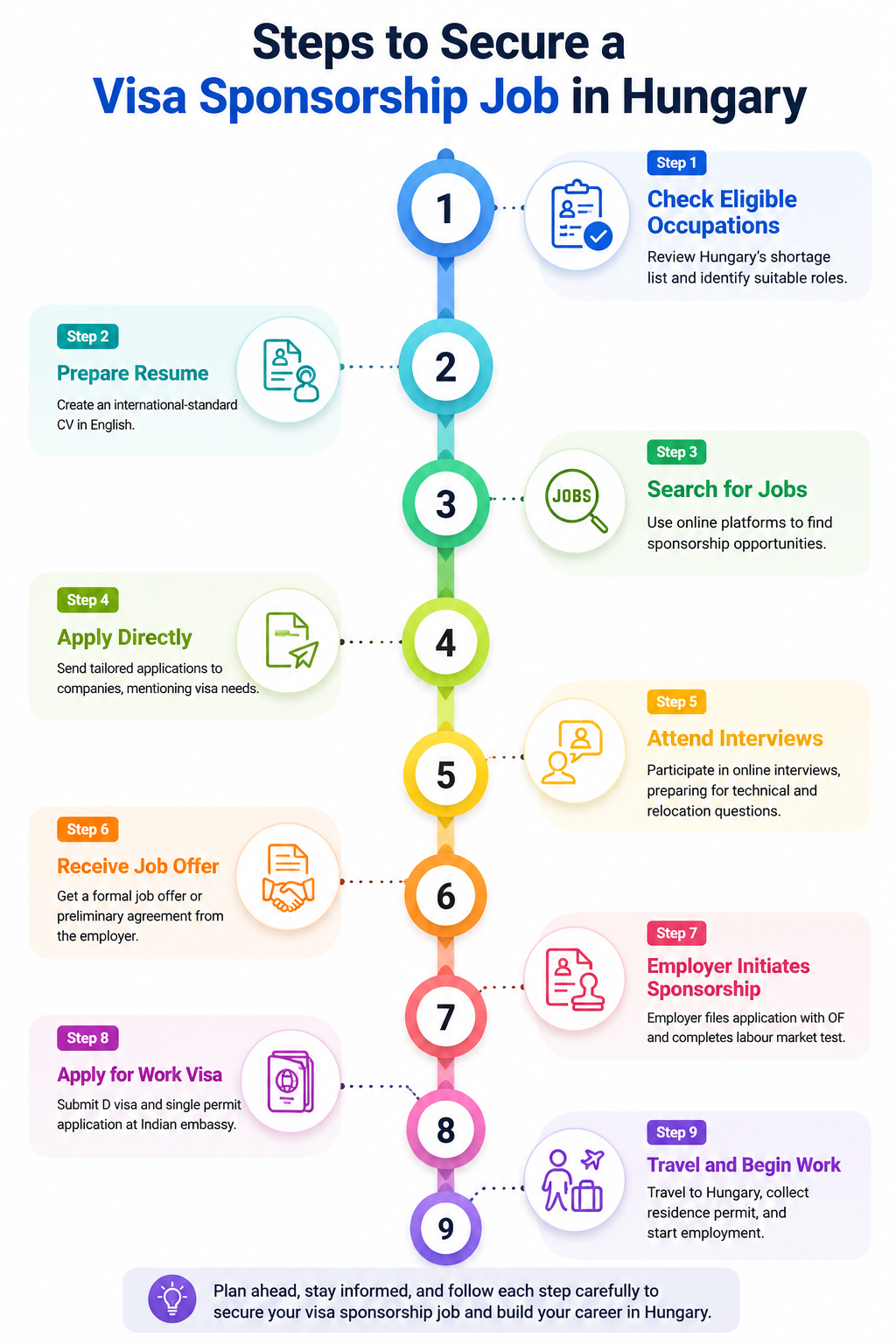
Step 1: Check eligible occupations
Review Hungary's shortage occupations and check which permit route fits your profile. Indian professionals should target roles that qualify for the EU Blue Card or Hungarian Card.
Step 2: Prepare an international-standard resume
Create a Europass or EU-style CV in English. Highlight technical skills, certifications, and measurable achievements.
Step 3: Search for sponsorship jobs
Use LinkedIn, EURES, Profession.hu, and company career pages. Filter for English-speaking roles and employers known to hire foreign workers.
Step 4: Apply directly to employers
Send tailored applications to multinationals and shared service centres. Mention clearly that you will need visa sponsorship.
Step 5: Attend interviews
Most interviews for international candidates happen online. Prepare for technical rounds and questions about relocation.
Step 6: Receive job offer
Once selected, the employer issues a job offer or preliminary employment agreement, which is the base document for your permit.
Step 7: Employer initiates sponsorship
Your employer files the application with the National Directorate-General for Aliens Policing (OIF) and completes the labour market test where required.
Step 8: Apply for work visa
Submit your D visa and single permit application at the Hungarian embassy or consulate in India with all documents and biometrics. Decisions on the combined procedure are normally issued within 70 days.
Step 9: Travel and begin employment
After approval, travel to Hungary, collect your residence permit card, register your address, and start work.
*Looking to apply for jobs in Hungary? Avail Y-Axis Resume Marketing services to find the right one.
Work Visa Options for Foreign Professionals in Hungary
| Visa Type | Purpose | Validity |
|---|---|---|
| EU Blue Card | For highly qualified professionals with a recognised degree (or at least 3 years of relevant IT experience) and a minimum monthly salary of HUF 1,001,048. | Up to 4 years, renewable |
| Hungarian Card | For professionals in eligible occupations specified by government decree, as well as professional sportspersons and film industry workers. | Up to 3 years, extendable |
| Residence Permit for Employment | General employer-sponsored work permit. As of current regulations, new applications are generally limited to eligible nationals of Armenia, Georgia, and the Philippines. | Up to 2 years, extendable |
| Intra-Corporate Transfer (ICT) Permit | For managers, specialists, and trainees transferred to the Hungarian branch of the same multinational company. | Up to 3 years (up to 1 year for trainees) |
| Seasonal Work Permit | For temporary employment in seasonal sectors such as agriculture and tourism. | Up to 6 months |
| White Card (Digital Nomad) | For remote workers employed by foreign companies or serving clients outside Hungary with a minimum monthly income of EUR 3,000. This is not an employer-sponsored work permit. | 1 year, extendable by an additional year |
| Guest Worker Residence Permit | Closed to new applications from June 6, 2026. Existing permit holders may continue to renew their permits, subject to eligibility. | Maximum total stay of 3 years |
*Are you looking for step-by-step assistance with overseas immigration? Contact Y-Axis, the world’s No. 1 overseas immigration consultancy, for end-to-end assistance!
FAQs
What are visa sponsorship jobs in Hungary?
Visa sponsorship jobs are positions where a Hungarian employer supports your work and residence permit so you can legally work in Hungary. The employer signs an employment agreement, files documents with the immigration authority (OIF), and proves a local worker was not available. Once approved, you receive a single permit that combines work and residence rights in one document.
Can Indians get visa sponsorship jobs in Hungary?
Yes. Indian professionals can work in Hungary mainly through the EU Blue Card, the Hungarian Card, or intra-corporate transfers. Note that from June 6, 2026, Hungary stopped new Guest Worker Permit applications, and the standard employment permit is limited to a few nationalities. Skilled Indians with degrees and strong experience still qualify through the Blue Card route.
Which companies sponsor foreign workers in Hungary?
Major employers known to hire international talent include Audi Hungaria, Mercedes-Benz, BMW Group, Bosch, Samsung SDI, Richter Gedeon, MOL Group, Morgan Stanley, BlackRock, Citi, IBM, EPAM Systems, Deutsche Telekom IT Solutions, TCS, and Ericsson. Multinationals and Budapest-based shared service centres are the most open to sponsoring qualified foreign professionals, especially in IT, engineering, and finance.
Which jobs are easiest to get with sponsorship in Hungary?
For Indian applicants, highly skilled roles are the most practical because they fit the EU Blue Card route. Software developers, data scientists, cloud engineers, mechanical and electrical engineers, and finance professionals at shared service centres are hired most often. Multilingual customer support roles at Budapest business centres also regularly go to foreign candidates with strong English skills.
What are the highest-paying sponsorship jobs in Hungary?
IT directors, software architects, medical specialists, data scientists, and cybersecurity experts top the pay scale, earning HUF 23–30 million per year (INR 71–93 lakh). Senior software engineers earn around HUF 21.6 million (INR 67 lakh), while finance managers and cloud engineers earn HUF 20–21 million. Salaries in Budapest are typically higher than in other Hungarian cities.
What qualifications are required for a Hungary work visa?
For the EU Blue Card, you need a bachelor's degree or higher relevant to the job. IT professionals can qualify with at least three years of relevant experience instead of a degree. Your gross salary must be at least HUF 1,001,048 per month in 2026. Other permits require qualifications that match the job offered by your Hungarian employer.
Do I need work experience for jobs in Hungary?
Most Hungarian employers expect two to three years of relevant experience for sponsored roles, and senior positions require more. IT applicants without a degree need at least three years of professional experience to qualify for the EU Blue Card. Fresh graduates can apply, but they face more competition and must still meet the salary threshold for their permit category.
Is IELTS required for a Hungary work visa?
No. Hungary does not ask for IELTS or any language test as part of the work visa process. However, most employers require good spoken and written English, and some may ask for proof of proficiency. Hungarian language skills are not essential at multinational companies, but learning the basics helps with daily life and long-term integration in Hungary.
How long does Hungary work visa processing take?
Under the single application procedure, Hungarian authorities normally decide within 70 days, and many cases finish in 30 to 60 days. After approval, the D visa is usually issued within 15 days at the consulate. Overall, plan for two to three months from application to arrival. Delays can happen if documents are incomplete or additional checks are needed.
Can family members accompany me to Hungary?
Yes, in most skilled categories. EU Blue Card and Hungarian Card holders can bring their spouse and dependent children through family reunification. Your family members receive residence permits linked to yours, and children can attend Hungarian schools. You must show adequate income, accommodation, and health insurance for the family. Guest worker categories did not allow family reunification.
Can visa sponsorship lead to permanent residency in Hungary?
Yes, for skilled categories. EU Blue Card holders can qualify for EU long-term residence after five years in the EU, including two years in Hungary. Other eligible workers can apply for national residence status after years of continuous legal stay. Guest worker permits do not lead to permanent residency. Time spent working legally in Hungary counts toward your residence history.
What industries hire foreign workers in Hungary?
IT and software, automotive and EV battery manufacturing, healthcare, engineering, construction, logistics, shared services and finance, and hospitality hire the most foreign workers. Budapest's business service centres employ thousands of international staff in finance, HR, and customer support roles, while factories in Győr, Kecskemét, and Debrecen need engineers and skilled technicians.
How can I find visa sponsorship jobs in Hungary?
Search on LinkedIn, EURES (the EU job portal), Profession.hu, and the career pages of multinationals such as Bosch, IBM, and Morgan Stanley. Filter for English-speaking roles and mention your visa needs early in the process. Y-Axis job search services can also match your profile with Hungarian employers open to hiring international candidates.
Are healthcare jobs in demand in Hungary?
Yes. Hungary faces shortages of doctors, nurses, and caregivers because many local professionals have moved to Western Europe for higher pay. Specialists and surgeons are among the country's top earners. Foreign healthcare workers need to have their qualifications recognised and may need Hungarian language skills for patient-facing public roles, though private clinics can be more flexible.
Are IT jobs available for foreigners in Hungary?
Yes, IT is the strongest sector for foreign professionals. Budapest hosts development centres for EPAM, IBM, Ericsson, Morgan Stanley, and many startups. Developers, data scientists, DevOps engineers, and cybersecurity specialists are in constant demand. The EU Blue Card even allows IT professionals to qualify with three years of experience instead of a university degree.
Can fresh graduates apply for jobs in Hungary?
Fresh graduates can apply, but sponsored roles usually favour experienced candidates. Graduates with in-demand skills in software development, data, or engineering have the best chances, especially at shared service centres hiring for English-speaking roles. You must still meet the EU Blue Card salary threshold. Studying in Hungary first and switching to a work permit is another popular route.
What is the average salary in Hungary?
In 2026, the average gross salary in Hungary is HUF 772,200 per month, about INR 2.4 lakh, and the average net salary is around HUF 541,200. The minimum wage is HUF 322,800 gross, and the guaranteed minimum for skilled roles is HUF 373,200. IT, finance, and engineering professionals earn well above these averages, particularly in Budapest.
What documents are required for a Hungary work visa?
You need a valid passport, job offer letter or employment contract, employer sponsorship documents, educational certificates, work experience letters, medical certificate or health insurance proof, police clearance certificate, passport photos, and proof of accommodation in Hungary. Some employers may ask for English test results. All documents may need certified translation into Hungarian or English.
Can I change employers in Hungary on a sponsored visa?
Yes, but with conditions. Hungarian work permits are tied to a specific employer, so a job change requires a new application or approval from the immigration authority. EU Blue Card holders need approval for employer changes during the first 12 months, after which the rules relax. Always update your permit before starting with a new employer to remain legal.
How can Y-Axis help me get a job in Hungary?
Y-Axis provides end-to-end support: international resume writing, LinkedIn profile optimisation, guided job search targeting Hungarian employers, visa and work permit application assistance, documentation guidance, and interview preparation. Our experts track the latest Hungarian immigration rules, including the 2026 permit changes, and recommend the right route, whether the EU Blue Card, Hungarian Card, or intra-corporate transfer.
Tags:
Visa sponsorship jobs in Hungary 2026
Hungary work visa sponsorship for Indians
Hungary work permit jobs
In-demand jobs in Hungary with visa sponsorship
Hungary employer-sponsored jobs
Hungary jobs for foreign workers
Hungary work visa for skilled
Share
Options for you by Y-Axis

Get it on your mobile

Get News alerts

Contact Y-Axis
Latest Article
Popular Post
Trending Article
Posted On October 09 2026
Canada’s Immigration Reset: Why the Next Move May Be About Fit, Not Volume