

Posted on December 16 2025
Top In-Demand Jobs in Italy for the Next 10 Years

By , Editor
Updated December 27 2025
Italy’s job market will change significantly over the next 10 years due to digital growth, an ageing population, green energy projects, automation, and rising healthcare needs. While GDP growth is expected to stay below 1%, the employment situation is improving, with unemployment around 6% and thousands of new jobs created each year.
Italy also faces major worker shortages as many employees retire. As a result, millions of job openings are expected in the coming years, especially in skilled and technical roles. Government and EU investments are driving demand in technology, renewable energy, manufacturing, healthcare, logistics, and tourism.
Skilled foreign professionals are needed in IT, engineering, healthcare, and business services. Italy offers a good work-life balance, access to the EU job market, and long-term residence options. Fast-growing roles include software developers, data analysts, engineers, nurses, renewable energy specialists, logistics managers, and finance professionals.
Planning to work in Italy? Y-Axis can guide you with job search and work visa support.
List of Top Job Opportunities in Italy for the Next 10 Years
Italy is investing heavily in digital transformation, Industry 4.0, healthcare services, green energy, and infrastructure modernization. Skilled professionals can find excellent career opportunities across the following sectors:
|
Sector |
Job Roles |
|
Information Technology (IT) |
Software Developers, Data Analysts, Cybersecurity Specialists, Cloud Engineers |
|
Engineering & Manufacturing |
Mechanical Engineers, Electrical Engineers, Automation Engineers, Production Managers |
|
Healthcare |
Doctors, Nurses, Caregivers, Medical Technicians |
|
Renewable Energy & Sustainability |
Solar Engineers, Energy Managers, Environmental Specialists |
|
Automotive & Industrial Design |
Automotive Engineers, CAD Designers, Quality Engineers |
|
Logistics & Supply Chain |
Logistics Managers, Warehouse Supervisors, Supply Chain Analysts |
|
Finance & Business Services |
Accountants, Financial Analysts, Auditors, Tax Consultants |
|
Tourism & Hospitality |
Hotel Managers, Chefs, Travel Consultants, Operations Managers |
|
Construction & Infrastructure |
Civil Engineers, Site Managers, Quantity Surveyors |
|
Education & Research |
University Lecturers, Researchers, Language Trainers |
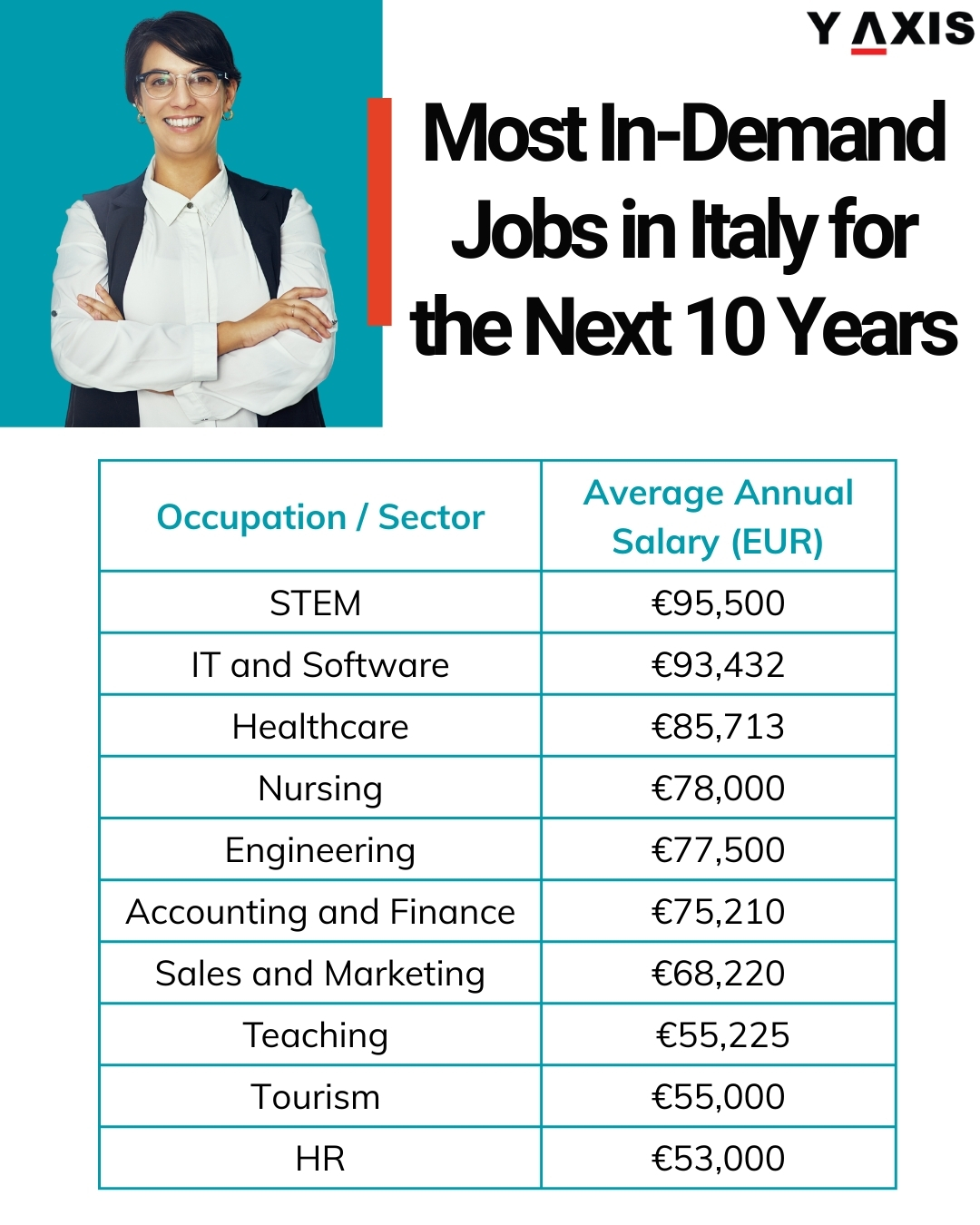
Highest Paying Jobs in Italy
Below are some of the highest-paying job sectors in Italy:
|
Occupation |
Average annual salary |
|
IT and Software |
€ 93,432 |
|
Healthcare |
€ 85,713 |
|
Engineering |
€ 77,500 |
|
Accounting and Finance |
€ 75,210 |
|
Nursing |
€ 78,000 |
|
Sales and Marketing |
€ 68,220 |
|
STEM |
€ 95,500 |
|
Human Resource Management |
€ 53,000 |
|
Tourism |
€ 55,000 |
|
Teaching |
€ 55,225 |
Top In-Demand Skills in Italy
Italy prefers professionals with a mix of technical expertise, industry knowledge, and language skills. The most in-demand skills include:
|
Category |
Skills |
|
IT & Digital Skills |
Software Development, Data Analytics, Cybersecurity, Cloud Computing |
|
Engineering & Technical Skills |
Automation, CAD Design, Industrial Maintenance, Quality Control |
|
Business & Management Skills |
Project Management, Financial Planning, Operations Management |
|
Language & Communication |
English proficiency, Italian language basics, Client Communication |
|
Soft Skills |
Problem-solving, Adaptability, Team Collaboration, Time Management |
Italy’s Job Outlook for the Next 10 Years
Italy’s employment outlook remains positive, supported by EU recovery funds, digital innovation programs, and workforce modernization. Demand will continue to rise in technology, healthcare, renewable energy, manufacturing, logistics, and tourism.
The country is actively addressing labour shortages by welcoming skilled foreign professionals, especially in technical and healthcare roles. Professionals with certifications, experience, and multilingual skills will have better long-term prospects.
Salary Trends in Italy Over the Next Decade
Salaries in Italy are expected to grow steadily between 2025–2035, especially in high-demand sectors like IT, engineering, healthcare, renewable energy, and finance. Northern cities generally offer higher salaries due to strong industrial presence and international companies.
Employers may also provide benefits such as social security coverage, paid leave, healthcare access, relocation assistance, and work-life balance protections under Italian labor laws.
Companies That Actively Hire Foreign Professionals in Italy
Italy hosts many multinational and domestic companies that regularly hire skilled international workers.
|
Sector |
Companies Hiring Foreign Workers |
|
Automotive & Manufacturing |
Ferrari, Fiat (Stellantis), Lamborghini |
|
IT & Technology |
IBM Italy, Accenture Italy, Reply |
|
Energy & Utilities |
Enel, Eni, Terna |
|
Finance & Consulting |
UniCredit, Deloitte Italy, PwC Italy |
|
Logistics & Transport |
DHL Italy, MSC, Amazon Italy |
|
Healthcare |
Humanitas, San Raffaele Hospital, GVM Care |
|
Tourism & Hospitality |
Hilton Italy, Marriott Italy, Accor |
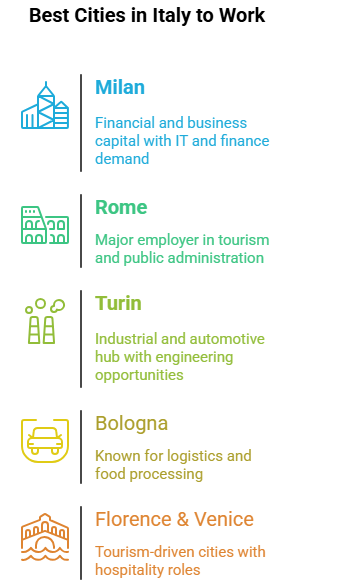
Cities in Italy with Fastest Job Growth
- Milan: Italy’s financial and business capital. Strong demand in IT, finance, consulting, fashion, and corporate services.
- Rome: Major employer for tourism, public administration, IT services, and education.
- Turin: Industrial and automotive hub with opportunities in manufacturing, engineering, and R&D.
- Bologna: Known for logistics, food processing, manufacturing, and academic research roles.
- Florence & Venice: Tourism-driven cities with steady demand in hospitality, cultural services, and management roles.
Building a Successful Career in Italy
Italy offers long-term career opportunities for skilled professionals seeking EU exposure, stable employment, and quality of life. To succeed, focus on updating technical skills, learning basic Italian, obtaining EU-recognised certifications, and preparing an Italy-standard CV.
Understanding Italy’s labour market needs and aligning your profile with high-demand sectors will significantly improve your job prospects. With expert guidance and proper planning, building a successful career in Italy is highly achievable.
*Planning to settle in Italy? Contact Y-Axis, the world’s number one immigration consultancy, with job search support, resume preparation, and visa guidance.
FAQs
What are the most in-demand jobs in Italy for the next 10 years?
Over the next decade, Italy will see strong demand for healthcare professionals, IT specialists, engineers, skilled trades workers, logistics staff, and renewable energy experts. An aging population will increase the need for nurses, caregivers, and medical technicians, while digital transformation will drive demand for software developers and cybersecurity professionals. Construction, manufacturing, tourism, and agriculture will also face persistent labor shortages. Jobs that combine technical skills, adaptability, and basic Italian language proficiency will offer the best long-term career prospects in Italy.
Which industries will drive job growth in Italy over the next 10 years?
Healthcare, technology, construction, renewable energy, logistics, manufacturing, and tourism will drive job growth in Italy over the next decade. Healthcare will expand due to demographic changes, while technology roles will grow with digitalization initiatives. Construction and infrastructure projects supported by EU funding will boost employment. Manufacturing remains central to Italy’s economy, especially in automotive and machinery. Tourism and hospitality will continue to create jobs, particularly in seasonal and service roles.
What technology jobs will be most in demand in Italy in the next decade?
Italy’s most in-demand technology jobs will include software developers, IT consultants, cybersecurity analysts, data analysts, cloud engineers, and AI specialists. As businesses modernize operations and adopt automation, demand for digital skills will continue to rise. Companies are especially seeking professionals experienced in ERP systems, cybersecurity compliance, and data-driven decision-making. Tech roles are concentrated in major cities like Milan, Rome, and Turin, but remote work is expanding opportunities nationwide.
Which healthcare jobs will be in highest demand in Italy over the next 10 years?
Healthcare jobs in high demand will include nurses, caregivers, doctors, physiotherapists, medical technicians, and elderly care professionals. Italy’s aging population is creating sustained pressure on hospitals, clinics, and home-care services. Demand is especially strong for long-term care workers and nursing staff. Foreign-trained healthcare professionals are increasingly important to filling workforce gaps, particularly in public healthcare and elderly care facilities.
What are the highest-paying in-demand jobs in Italy for the next 10 years?
High-paying in-demand jobs in Italy include doctors, specialized surgeons, engineering managers, IT architects, cybersecurity experts, and senior project managers. Professionals in renewable energy engineering and advanced manufacturing also earn competitive salaries. While average wages in Italy are lower than some EU countries, skilled professionals in shortage occupations can command higher pay, especially in northern regions such as Lombardy and Emilia-Romagna.
Which jobs in Italy will have the most skill shortages over the next decade?
Italy will face major skill shortages in healthcare, IT, engineering, construction, manufacturing, logistics, and agriculture. Caregivers, nurses, skilled trades workers, and technical specialists are particularly scarce. These shortages are driven by an aging workforce, low birth rates, and increasing demand for specialized skills. As a result, foreign workers will play a critical role in meeting labor market needs over the next 10 years.
What skilled trade jobs will be in demand in Italy for the next 10 years?
Skilled trades such as electricians, plumbers, welders, mechanics, HVAC technicians, carpenters, and construction supervisors will remain in high demand. Infrastructure upgrades, housing projects, and industrial maintenance are key drivers. These jobs offer stable employment, competitive wages, and long-term relevance. Skilled trades are especially needed in northern Italy, where construction and manufacturing activities are concentrated.
Which engineering jobs will be most needed in Italy in the coming decade?
Engineering roles in high demand will include mechanical engineers, electrical engineers, civil engineers, automation engineers, and environmental engineers. Italy’s strong manufacturing base, infrastructure development, and renewable energy expansion are driving demand. Engineers with experience in Industry 4.0, automation, robotics, and sustainability will have the best opportunities. Engineering remains a cornerstone of Italy’s industrial growth.
What are the most in-demand IT jobs in Italy for the next 10 years?
In-demand IT jobs include software developers, system administrators, cybersecurity analysts, cloud specialists, data analysts, and IT project managers. Organizations across Italy are investing in cloud computing, digital security, and data management. IT professionals with international experience and certifications are especially attractive to employers. Demand is strongest in urban and industrial hubs, but remote IT roles are increasing.
Which jobs in Italy will be best for foreign workers over the next decade?
Jobs best suited for foreign workers include healthcare roles, caregiving, construction, manufacturing, agriculture, logistics, hospitality, and IT. Italy relies heavily on non-EU workers to fill shortages in these sectors. Many of these roles are included in Italy’s annual work permit quotas, making them accessible to international candidates with relevant skills and experience.
What jobs in Italy will offer long-term career stability in the next 10 years?
Long-term stable careers include healthcare professionals, engineers, IT specialists, skilled trades workers, teachers, and public-sector employees. These roles are essential to Italy’s economy and less affected by economic fluctuations. Continuous demand and skill shortages ensure consistent employment opportunities across regions and industries.
Which in-demand jobs in Italy will require a university degree over the next decade?
Jobs requiring a university degree include engineers, IT professionals, doctors, architects, economists, researchers, and educators. Many regulated professions also require recognition of foreign qualifications. A degree improves earning potential, career progression, and access to professional roles in Italy’s competitive labor market.
What in-demand jobs in Italy will not require a degree in the next 10 years?
In-demand jobs without degree requirements include caregivers, skilled trades workers, warehouse staff, drivers, hospitality employees, agricultural workers, and technical assistants. Vocational training, certifications, or work experience are often sufficient. These roles are critical to Italy’s workforce and provide steady employment opportunities for foreign workers.
Which remote and digital jobs will grow in Italy over the next decade?
Remote and digital jobs expected to grow include software development, digital marketing, data analysis, IT consulting, online customer support, and content creation. Italy’s digital nomad visa and expanding remote work culture are attracting global talent. These roles offer flexibility while remaining in strong demand.
What are the fastest-growing jobs in Italy expected over the next 10 years?
Fast-growing jobs include renewable energy technicians, healthcare workers, IT professionals, logistics specialists, and digital marketing experts. Growth is driven by EU funding, green transition goals, and digitalization initiatives. These roles are expected to expand steadily and offer long-term employment prospects.
Which in-demand jobs in Italy are likely to sponsor work visas in the next decade?
Jobs most likely to sponsor work visas include healthcare professionals, engineers, IT specialists, skilled trades workers, agricultural labourers, and seasonal hospitality staff. Employers sponsor visas through Italy’s annual quota system, particularly for shortage occupations where the local labour supply is insufficient.
What jobs in Italy will be suitable for international students over the next 10 years?
International students will find opportunities in IT, engineering, finance, research, hospitality management, and manufacturing. Internships and post-study work experience significantly improve employability. Graduates with Italian language skills and in-demand qualifications have stronger chances of long-term employment and visa sponsorship.
Which green and renewable energy jobs will grow in Italy in the next decade?
Green jobs such as renewable energy engineers, solar and wind technicians, environmental consultants, sustainability managers, and energy efficiency specialists will grow rapidly. Italy’s commitment to EU climate goals is driving investment in clean energy and sustainability projects, creating long-term job opportunities.
What skills will be most important for in-demand jobs in Italy over the next 10 years?
Key skills include technical expertise, digital literacy, problem-solving, adaptability, teamwork, and communication. Italian language proficiency significantly improves job prospects. Employers also value candidates who can work in multicultural environments and adapt to evolving industry needs.
How can foreign professionals prepare for in-demand jobs in Italy over the next decade?
Foreign professionals can prepare by developing in-demand technical skills, learning Italian, gaining relevant certifications, and understanding Italy’s labour market needs. Aligning experience with shortage occupations and staying updated on industry trends improves employability. Early preparation increases chances of long-term career success in Italy.
Tags:
Italy jobs
Jobs in Italy
careers in Italy
Work in Italy
Italy job market
Italy skills in-demand
Career in Italy
Companies in Italy
Italy work opportunities
High demand jobs Italy
Share
Options for you by Y-Axis

Get it on your mobile

Get News alerts

Contact Y-Axis
Latest Article
Popular Post
Trending Article

Posted On April 01 2026
Study vs Work Abroad – Which is Better for Indians in 2026?