

Posted on December 09 2025
What Are the Most In-Demand Jobs in France for the Next 10 Years?

By , Editor
Updated December 29 2025
In-Demand Jobs in France for the Next 10 Years
France’s job market is expected to grow steadily over the next decade, driven by advancements in technology, renewable energy, healthcare, engineering, tourism, AI, digital transformation, and green mobility. As one of Europe’s strongest economies, France continues to attract global talent. Skilled foreign professionals with expertise in IT, engineering, energy, healthcare, AI, cybersecurity, finance, robotics, and advanced manufacturing, along with English and basic French skills, will have excellent long-term career opportunities.
List of Top Job Opportunities in France for the Next 10 Years
|
Sector |
Top Job Roles |
|
Information Technology (IT) |
Software Developers, Cybersecurity Experts, Data Scientists, AI/ML Engineers, Cloud Architects, DevOps Engineers |
|
Renewable Energy & Sustainability |
Solar Engineers, Wind Turbine Technicians, Energy Auditors, Environmental Consultants |
|
Engineering & Manufacturing |
Mechanical Engineers, Electrical Engineers, Automation Engineers, Industrial Engineers |
|
Healthcare & Life Sciences |
Nurses, Doctors, Pharmacists, Physiotherapists, Medical Technicians |
|
Tourism & Hospitality |
Hotel Managers, Chefs, Travel Consultants, Guest Relations Specialists |
|
Logistics & Supply Chain |
Supply Chain Analysts, Transport Coordinators, Warehouse Managers |
|
Biotechnology & Pharma |
Lab Technicians, Research Scientists, Quality Assurance Specialists |
|
Finance & Business Services |
Accountants, Financial Analysts, Compliance Officers, Risk Managers |
|
Construction & Infrastructure |
Civil Engineers, Project Managers, Architects |
|
Education & Training |
Teachers (STEM, Languages), Academic Coaches, Trainers |
*Planning to work in France? Y-Axis can guide you with your job search and visas.
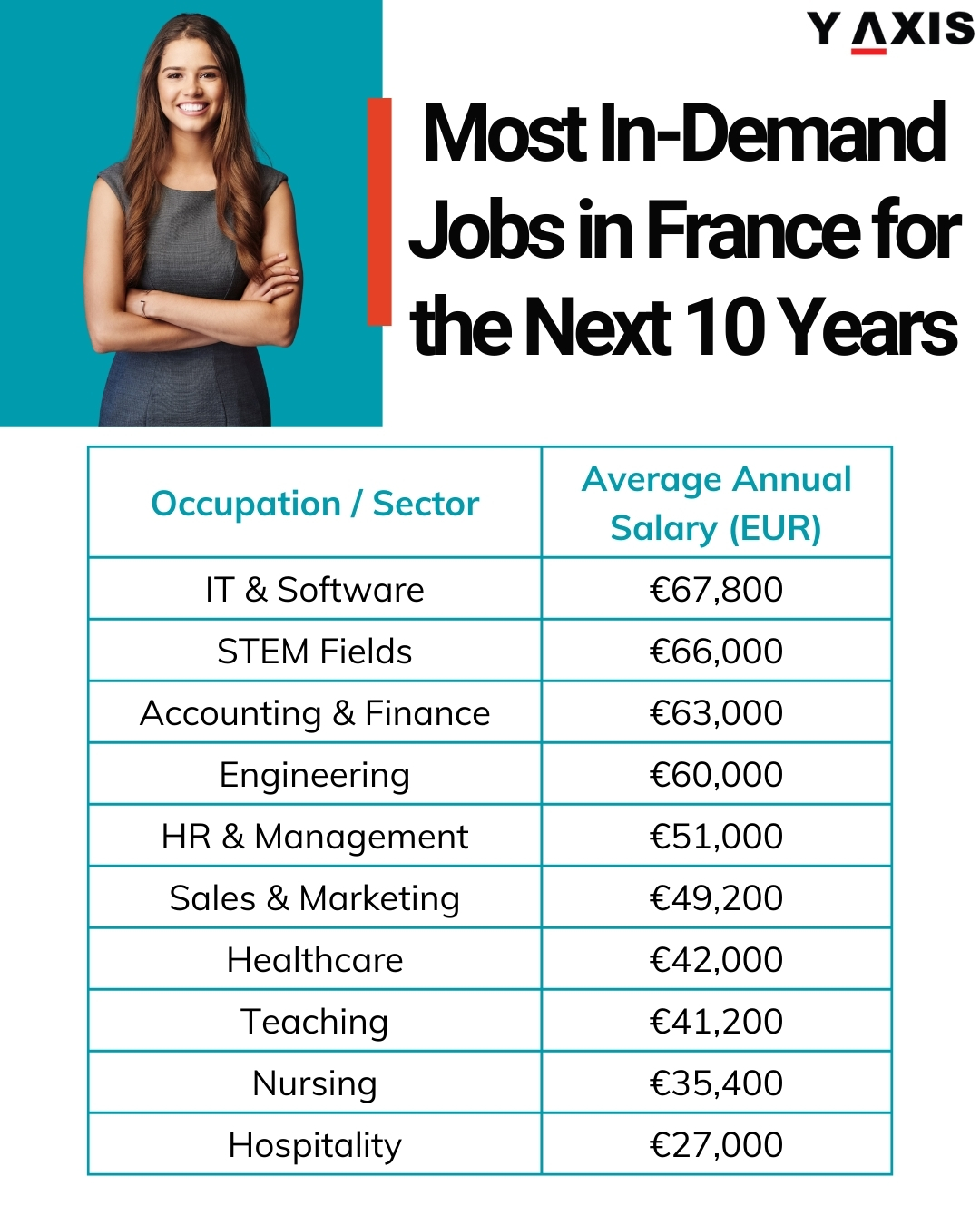
Highest Paying Jobs in France
France offers strong salary packages across IT, engineering, healthcare, and high-tech fields due to demand for skilled professionals. The table below shows some of the highest-paying jobs in France:
|
Occupation |
Average Annual Salary (EUR) |
|
IT & Software |
€67,800 |
|
Engineering |
€60,000 |
|
Accounting & Finance |
€63,000 |
|
HR & Management |
€51,000 |
|
Hospitality |
€27,000 |
|
Sales & Marketing |
€49,200 |
|
Healthcare |
€42,000 |
|
STEM Fields |
€66,000 |
|
Teaching |
€41,200 |
|
Nursing |
€35,400 |
Top In-Demand Skills in France for the Next 10 Years
As France moves toward a more digital, sustainable, and innovation-driven economy, employers are increasingly seeking professionals with advanced technical expertise and strong soft skills. The rise of AI, automation, renewable energy, and healthcare demands has reshaped the skill requirements across multiple sectors. Job seekers who develop future-focused skills, especially in technology, engineering, healthcare, and business operations, will have a significant advantage in the French job market over the next decade.
|
Category |
Key Skills |
|
IT & Digital |
AI/ML, Cybersecurity, Cloud Computing, Big Data, Software Engineering |
|
Engineering & Energy |
Automation, Robotics, CAD, Electric Mobility Systems, Sustainable Engineering |
|
Healthcare |
Patient Care, Diagnostics, Elderly Care, Telemedicine |
|
Business & Finance |
ERP Tools, Compliance, Audit, Financial Analysis |
|
Soft Skills |
French/English communication, Leadership, Teamwork, Analytical Thinking |
|
Operational Skills |
Logistics Management, Supply Chain Planning, Safety Protocols |
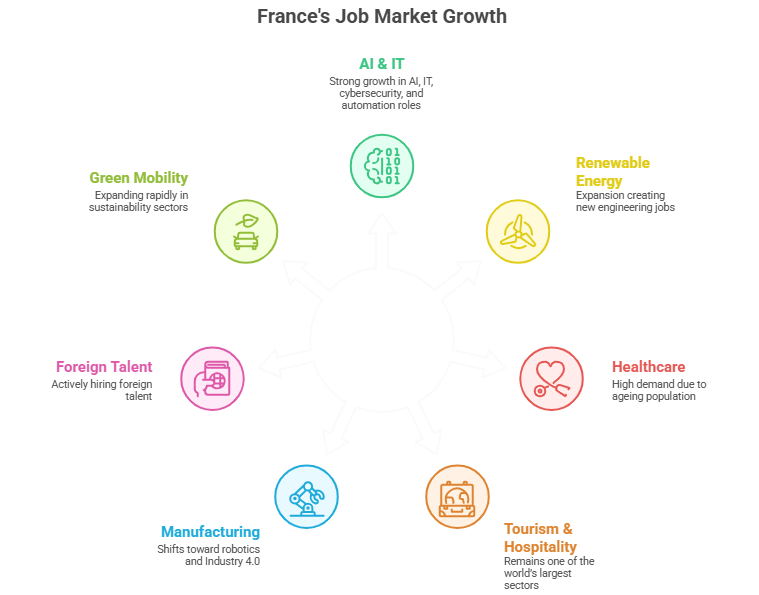
France’s Job Outlook for the Next 10 Years
- Strong growth in AI, IT, cybersecurity, and automation roles
- Renewable energy expansion is creating new engineering jobs
- High healthcare demand due to an ageing population
- France’s tourism and hospitality sector remains one of the world’s largest
- Manufacturing shifts toward robotics and Industry 4.0
- Large companies and startups are actively hiring foreign talent
- Green mobility and sustainability sectors are expanding rapidly
Job Vacancy in France for the next 10 years
France is expected to see steady job growth over the next decade, driven by strong demand in healthcare, engineering, IT, hospitality, and business services. With an ageing population, digital transformation, and expanding green industries, the country will continue to rely on both local and international talent. Below is an estimated breakdown of job vacancies across major sectors in France for the coming 10 years.
|
Occupation |
No. of Jobs |
|
Hospitality |
1,00,000 |
|
Healthcare |
70,000 |
|
Engineering |
40,000 |
|
IT & Software |
40,000 |
|
Nursing |
40,000 |
|
Marketing & Sales |
20,000 |
|
Teaching |
15,000 |
|
Accounting & Finance |
8,000 |
|
Human Resources & Management |
5,000 |
Salary Trends Over the Next Decade
- IT, AI, and engineering professions will continue to see salary growth
- Cybersecurity and cloud computing are expected to be the top-paying roles
- Healthcare salaries rising to address shortages
- Renewable energy jobs will remain competitive
- Paris, Lyon, Toulouse, and Marseille offer some of the highest salaries
Companies That Hire Foreign Professionals in France
|
Sector |
Companies Hiring International Talent |
|
Tech & IT |
Capgemini, Dassault Systèmes, Atos, Ubisoft |
|
Aerospace & Engineering |
Airbus, Safran, Thales Group |
|
Renewable Energy & Energy |
EDF, TotalEnergies, Engie |
|
Biotech & Pharma |
Sanofi, Pierre Fabre, Novartis France |
|
Finance & Banking |
BNP Paribas, Société Générale, Crédit Agricole |
|
Healthcare |
Public Hospitals, Ramsay Santé, Korian |
|
Logistics & Manufacturing |
Renault, PSA Group, Michelin |
|
Construction & Infrastructure |
Vinci, Bouygues Construction, Eiffage |
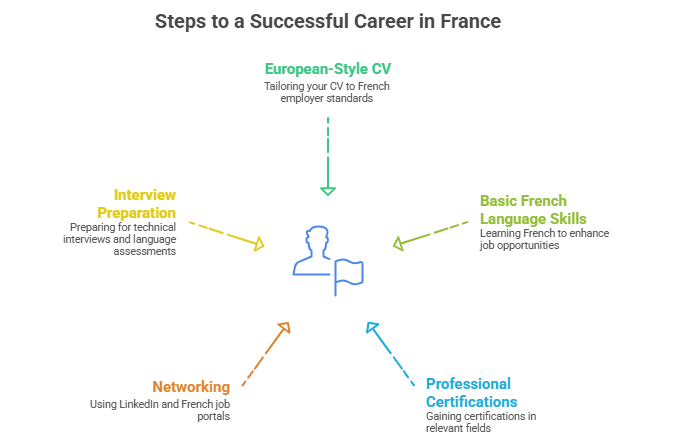
Building a Successful Career in France
- Create a European-style CV tailored to French employers
- Learn basic French for better job opportunities
- Gain certifications in IT, engineering, healthcare, or finance
- Network using LinkedIn and French job portals
- Prepare for technical interviews and language assessments
*Looking for jobs in France? Y-Axis can help with job search support, resume preparation, and visa guidance.
FAQs
What are the most in-demand jobs in France for the next 10 years?
The most in-demand jobs in France over the next decade include roles in IT, engineering, healthcare, renewable energy, hospitality, and logistics. Jobs such as software developers, cybersecurity experts, nurses, doctors, engineers, and supply chain specialists will see strong growth. Digital transformation, an ageing population, and sustainability projects are the main drivers. Skilled foreign workers with technical capabilities and basic French language skills will have excellent opportunities.
Does France require foreign professionals?
Yes, France needs foreign professionals because several key industries are facing long-term worker shortages. Sectors such as healthcare, IT, engineering, hospitality, and construction do not have enough local talent to meet rising demand. Many experienced workers are retiring, and France requires skilled international employees to fill these gaps. Foreign professionals also support digital innovation, green energy projects, and modern industry development, helping the country remain competitive and economically strong.
Which sectors will grow the fastest in France by 2035?
The fastest-growing sectors in France will be IT, artificial intelligence, cybersecurity, renewable energy, electric mobility, healthcare, biotechnology, and logistics. These fields are expanding due to major investments in digital transformation and the green transition. Construction, transport, and smart manufacturing will also grow as France upgrades infrastructure and adopts Industry 4.0 technologies. Together, these developments are expected to create strong long-term job demand across multiple industries.
What IT jobs will be most in demand in France?
The most in-demand IT jobs in France include software developers, cloud engineers, data scientists, cybersecurity experts, DevOps engineers, and AI specialists. Companies are digitizing their operations and need experts who can build secure, scalable systems. France is also investing heavily in AI and automation, creating new opportunities for professionals skilled in advanced technologies. IT roles offer strong salaries, job security, and long-term career growth for both local and foreign workers.
Which engineering careers will be needed most in France?
Engineering careers that will be most needed in France include mechanical, electrical, civil, industrial, and automation engineers. Renewable energy and electric mobility projects are also creating demand for specialized engineers. France’s major infrastructure upgrades, transportation projects, and industrial modernization efforts require skilled professionals who can manage technical systems. Engineers with experience in CAD, robotics, sustainable design, and manufacturing processes will find strong job opportunities in the coming years.
Why is healthcare one of the most in-demand sectors in France?
Healthcare is one of the most in-demand sectors because France has an ageing population and many healthcare professionals are retiring. Hospitals and care facilities face shortages of nurses, doctors, physiotherapists, and medical technicians. The need for elderly care, rehabilitation services, and telemedicine is growing. To meet these needs, France is actively hiring international healthcare workers. Professionals with the right qualifications and basic French skills can find stable, high-demand roles.
Which soft skills are important for working in France?
Important soft skills for working in France include communication, teamwork, adaptability, time management, and leadership. French workplaces value professionalism, respect, and clear communication. Being able to work well in multicultural teams is especially important in global companies. Basic French language skills are also useful for building good relationships with colleagues and customers. These soft skills complement technical abilities and help foreign professionals succeed in French work environments.
What language skills do I need to work in France?
While English is used in many international companies, basic French is highly recommended for working in France, especially in healthcare, education, hospitality, and customer service. Speaking French improves communication, job opportunities, and social integration. IT and engineering professionals may find roles with limited French requirements, but learning the language still helps career growth. Knowing both English and French makes foreign professionals more competitive and confident in the French job market.
Are IT and tech jobs well paid in France?
Yes, IT and tech jobs are among the highest-paying roles in France. Professionals working in software development, AI, data science, cybersecurity, and cloud computing often earn between €4,500 and €6,800 per month, depending on experience and location. Senior specialists may earn higher salaries. The strong demand for digital skills, combined with France’s investment in innovation, ensures competitive pay and excellent job security for IT professionals across the country.
Is France good for foreign workers?
France is a good destination for foreign workers because it offers strong wages, good working conditions, and job opportunities in many sectors. The country invests heavily in innovation, education, and sustainability, creating demand for skilled professionals. Large international companies also operate in France, providing English-friendly work environments. With basic French skills and relevant qualifications, foreign workers can build successful long-term careers in IT, healthcare, engineering, finance, hospitality, and more.
What career opportunities are available in France for professionals who speak English?
Professionals who speak English can find strong job opportunities in France across IT, engineering, aviation, digital marketing, hospitality, customer service, and multinational companies. Many global organizations and international schools actively hire candidates with good English skills. Cities like Paris, Lyon, and Toulouse offer the highest number of roles. While some positions accept English-only communication, learning basic French greatly improves job prospects. Candidates with strong technical or professional expertise are particularly valued.
What are the salary trends in France for the next decade?
Salary trends in France show strong growth for professionals in IT, AI, engineering, renewable energy, and healthcare. Roles in cybersecurity, cloud computing, and advanced technologies are expected to see some of the highest salary increases. Healthcare salaries will rise due to shortages and increasing demand for care services. Salaries in Paris, Lyon, Marseille, and Toulouse are generally higher because of larger companies and strong economic activity.
Which companies in France hire foreign professionals?
Many well-known companies in France hire foreign professionals, including Capgemini, Dassault Systèmes, Airbus, Safran, Thales, EDF, TotalEnergies, Sanofi, BNP Paribas, Renault, Michelin, and Vinci. These companies operate globally and require skilled workers in IT, engineering, energy, pharmaceuticals, finance, logistics, and manufacturing. Foreign professionals with relevant qualifications and experience have strong chances of being recruited for technical and specialized roles.
What qualifications do I need to work in France?
To work in France, you typically need a recognized degree or diploma in your field, relevant work experience, and technical skills related to the job. Many employers value certifications in IT, engineering, finance, or healthcare. Some regulated professions, such as nursing or teaching, may require additional approval or licensing. Basic French skills help with communication and job integration. A strong CV and professional references also improve job opportunities.
Is France a good country for IT professionals?
Yes, France is a very good country for IT professionals. The country is investing heavily in digital transformation, artificial intelligence, cybersecurity, and cloud technologies. This has created high demand for software developers, AI engineers, data analysts, and IT security specialists. Salaries are competitive, and job stability is strong. Many tech startups and global companies operate in cities like Paris, Lyon, and Lille, giving IT professionals excellent career opportunities.
Which cities in France offer the best job opportunities?
The best cities for job opportunities in France include Paris, Lyon, Toulouse, Marseille, Lille, and Bordeaux. Paris offers the most roles in IT, finance, marketing, and business services. Toulouse is known for aviation and engineering, while Lyon offers strong opportunities in biotechnology, IT, and manufacturing. These cities have growing economies, modern infrastructure, and large companies, making them ideal locations for foreign professionals seeking long-term careers.
What job opportunities can students and fresher graduates find in France?
Students and fresh graduates in France have good job prospects, especially in IT, engineering, business services, digital marketing, logistics, and hospitality. Many companies offer internships, apprenticeships, and graduate programs designed to train new talent. Universities and engineering schools also provide strong industry connections. Basic French skills are helpful, but some international roles allow English-speaking graduates. Overall, young professionals have strong opportunities to start their careers in France.
Is it easy to get a work visa for France?
The ease of getting a work visa for France depends on your skills, qualifications, and job offer. Workers in high-demand fields such as IT, engineering, healthcare, and research have a better chance of approval. The Talent Passport Visa and EU Blue Card are popular options for skilled professionals. Having the required documents, experience, and employer sponsorship makes the process smoother. Basic French language skills also help with integration and job success.
What skills will be most valuable in France by 2035?
By 2035, valuable skills in France will include AI, machine learning, cloud computing, cybersecurity, robotics, renewable energy engineering, telemedicine, logistics management, and financial analysis. Soft skills such as communication, teamwork, leadership, and problem-solving will remain important. France’s shift toward sustainability, digital transformation, and modernized infrastructure means professionals with future-focused skills will be in high demand. Continuous upskilling will be essential for long-term career success.
How can foreign professionals build a successful career in France?
Follow the below steps to build a successful career in France:
• Prepare a European-style CV that matches French hiring standards.
• Learn basic French to improve communication and job opportunities.
• Get relevant certifications in fields like IT, engineering, healthcare, or finance.
• Apply for jobs in high-demand sectors where skills are needed.
• Use LinkedIn and French job portals to network and increase visibility.
• Understand French workplace culture and adapt to local expectations.
• Be open to relocating to major cities like Paris, Lyon, or Toulouse for better roles.
• Stay committed to upskilling to support long-term career growth in France.
Tags:
jobs in France
in-demand jobs France
France job market
careers in France
France employment trends
France high demand professions
France labour shortage
work opportunities France
French healthcare jobs
French IT jobs
France construction jobs
Share
Options for you by Y-Axis

Get it on your mobile

Get News alerts

Contact Y-Axis
Latest Article
Popular Post
Trending Article

Posted On April 01 2026
Study vs Work Abroad – Which is Better for Indians in 2026?