

Posted on May 14 2026
Master’s in Canada with Dependent Visa: How to Bring Your Spouse and Children While You Study?

By , Editor & Director
Updated May 17 2026
Pursuing a Master's in Canada with a dependent visa is one of the smartest ways to study abroad without leaving your family behind. Under the latest IRCC 2026 rules, spouses of full-time Master's students enrolled in programs of 16 months or longer can apply for an open work permit, and dependent children can study in Canadian public schools. With the right paperwork, proof of funds, and program choice, your entire family can move to Canada together. Canada continues to be one of the world's most family-friendly study destinations. As per IRCC (Immigration, Refugees and Citizenship Canada), the country hosts over 1 million international students, and a significant portion of them are pursuing Master's programs in Canada. What makes Canada stand out is its progressive dependent visa policy that allows international students to bring their spouse and children along during their studies.
*Want to pursue master’s in Canada? Contact Y-Axis for complete guidance
What is a Canada Dependent Visa for International Students?
A Canada Dependent Visa allows the close family members of an international student to stay with them in Canada while they study. This visa is mainly for the student’s spouse or common-law partner and dependent children.
If you are studying in Canada on a valid study permit, your family members can also move to Canada and stay there during your course period.
When you study for a Master’s degree in Canada, your dependents can receive several benefits, such as:
- They can live with you in Canada during your studies.
- Your spouse or partner may apply for an open work permit, which allows them to work for most employers in Canada.
- Your children can study in Canadian public schools without needing a separate study permit in many cases.
- In some provinces, your family may also get access to public healthcare services.
- Your dependents can travel in and out of Canada while their visa is valid.
Canada is considered one of the most family-friendly study destinations because it allows international students to bring their families and also gives work and education opportunities to their dependents.
*Need guidance to apply for Canada Dependent Visa? Get expert advice from Y-Axis
Why Choose a Master's in Canada with Dependent Visa?
Canada offers a strong return on investment for students bringing their families. Here is why thousands of Indian and global students choose this route every year:
- World-Class Education: Canada has 10 universities in the QS World Rankings Top 250, including the University of Toronto, McGill University, and UBC.
- Spouse Can Work Full-Time: Under the January 21, 2025 IRCC update, spouses of Master's students (programs of 16+ months) are eligible for an open work permit.
- Free Schooling for Children: Dependent children under 18 can attend Canadian public schools free of cost in most provinces.
- Pathway to Permanent Residency: A Master's degree plus a Canadian Post-Graduation Work Permit (PGWP) can lead to PR through Express Entry or Provincial Nominee Programs (PNP).
- Universal Healthcare: Eligible dependents can access provincial healthcare plans, which significantly reduces medical costs.
- Safe and Multicultural Environment: Canada is ranked among the top 10 safest countries in the world (Global Peace Index), making it ideal for families.
Who is Considered a Dependent in Canada?
According to Canada’s immigration department, Immigration, Refugees and Citizenship Canada (IRCC), a dependent is a close family member who can accompany you to Canada while you study.
The following family members are usually considered dependents:
Spouse or Common-Law Partner
This includes:
- Your legally married husband or wife, or
- Your common-law partner, which means a person you have lived with continuously for at least 12 months in a relationship similar to marriage.
You must show proof of your relationship, such as:
- Marriage certificate
- Joint bank account statements
- Rental agreements
- Photos or relationship documents
Dependent Children
Dependent children include:
- Children below 22 years of age who are unmarried and not in a common-law relationship.
- Children above 22 years of age may also qualify if they are financially dependent on their parents because of a physical or mental condition that started before they turned 22.
To prove the relationship with your children, you may need documents such as:
- Birth certificates
- Adoption papers
- Medical documents
Canada requires proper documents to confirm family relationships before approving dependent visas.
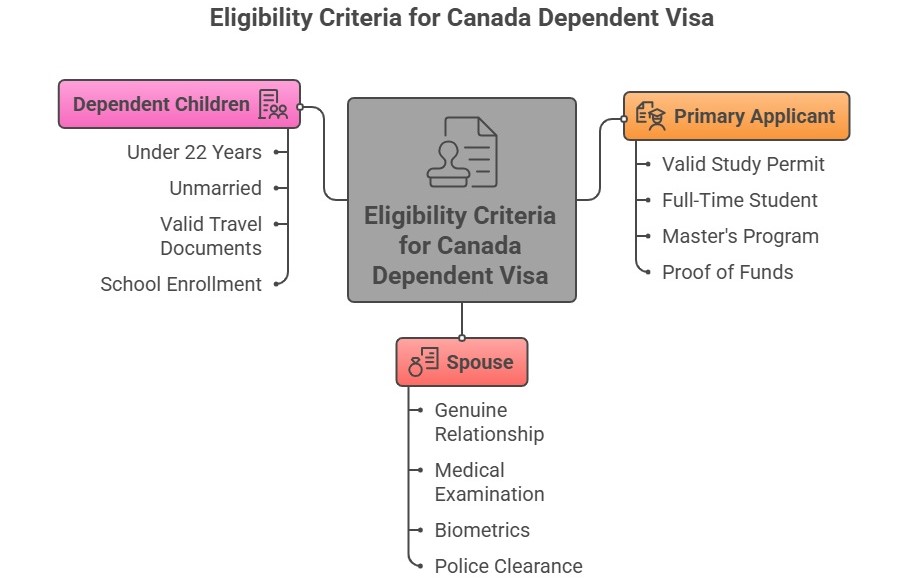
Eligibility Criteria for Canada Dependent Visa
To bring your spouse and children to Canada while pursuing your Master's, both you and your dependents must meet specific eligibility conditions.
For the Primary Applicant (You):
- Must hold a valid Canadian study permit or be provisionally approved.
- Must be a full-time student at a Designated Learning Institution (DLI).
- Must be enrolled in a Master's program of 16 months or longer (mandatory for spouse work permit eligibility).
- Must show sufficient proof of funds to support yourself and your family.
For Your Spouse:
- Must prove a genuine relationship (marriage certificate or common-law evidence).
- Must submit medical examination and biometrics.
- Must show no criminal record (police clearance certificate).
For Dependent Children:
- Must be under 22 years and unmarried.
- Must have valid travel documents.
- Must be enrolled (or to be enrolled) in school if of school age.
*Check your eligibility to Canada through the Y-Axis Canada CRS Score Calculator.
Spouse Open Work Permit (SOWP) Canada 2026 – Key Changes
This is the most important update for couples planning a Master's in Canada together. Effective January 21, 2025, IRCC restructured the Spouse Open Work Permit (SOWP) policy. As of 2026, only certain dependents qualify.
Spouses Eligible for an Open Work Permit in 2026:
- Spouses of students enrolled in a Master's program of 16 months or longer
- Spouses of students enrolled in a Doctoral (PhD) program
- Spouses of students enrolled in specified professional programs (e.g., Doctor of Medicine, Doctor of Pharmacy, Bachelor of Engineering, Law programs)
Spouses NOT Eligible:
- Spouses of students in Master's programs shorter than 16 months
- Spouses of students in diploma or certificate programs
- Spouses of students in undergraduate programs (unless in eligible professional fields)
Documents Required for Canada Dependent Visa
Both the spouse and children's applications require a detailed set of documents.
For Spouse:
- Valid passport with at least 6 months validity
- Completed application forms IMM 1294 / IMM 5257
- Recent passport-size photographs
- Marriage certificate with translation if not in English/French
- Proof of relationship photos, joint bank statements, communication records
- Police clearance certificate
- Medical examination report from an IRCC-approved panel physician
- Proof of funds joint or sponsor-backed
- Copy of student's study permit and admission letter
- Statement of purpose (SOP) explaining the move
For Dependent Children:
- Valid passport
- Birth certificate
- Recent photographs
- Letter from previous/new school if applicable
- Custody documents if parents are divorced/separated
- Vaccination records
- Medical examination report
*Read more...
Canada immigration news - Latest Canada Visa Updates
Proof of Funds for Family – 2026 Update
IRCC requires international students to show that they can financially support themselves and their accompanying family members for at least the first year.
As of 2026, IRCC has moved to a dynamic, cost-of-living-based model. The required proof of funds is updated annually.
Approximate Funds Required (Outside Quebec) – 2026:
|
Number of People |
Estimated Funds Required (CAD) |
|
Student (single) |
CAD 22,895 |
|
Student + 1 family member |
CAD 28,502 |
|
Student + 2 family members |
CAD 35,040 |
|
Each additional family member |
+ approx. CAD 7,000 |
Acceptable Proof of Funds:
- Bank statements (last 4–6 months)
- Guaranteed Investment Certificate (GIC) of at least CAD 22,583
- Education loan sanction letter
- Scholarship letters
- Sponsor affidavits and bank proof
- Proof of paid tuition fees
*Also read....
All you need to know about an immigrant's life in Canada
Step-by-Step Process to Apply for a Canada Dependent Visa
Follow this proven path to bring your family to Canada along with your Master's program.
Step 1: Receive Offer Letter from a DLI Get admission into a 16+ month Master's program at a Designated Learning Institution.
Step 2: Obtain Provincial Attestation Letter (PAL) Mandatory for most study permit applications in 2026.
Step 3: Arrange Proof of Funds. Open a GIC, gather bank statements, or arrange loan/scholarship documents.
Step 4: Complete Medical Examinations & Biometrics for yourself and each accompanying family member.
Step 5: Apply together, submit your study permit application along with your spouse's open work permit and your children's visitor/study documents on the IRCC portal.
Step 6: Pay Application Fees
- Study Permit: CAD 150
- Open Work Permit: CAD 155
- Biometrics: CAD 85 per person (or CAD 170 per family)
Step 7: Attend Biometrics Appointment At your nearest Visa Application Centre (VAC).
Step 8: Wait for Decision Track status online and respond to any IRCC document requests.
Step 9: Receive Approval & Travel on arrival, your spouse gets the open work permit, and children get their visitor/study records at the port of entry.
Canada Dependent Visa Processing Time & Fees
The processing time and application fees for a Canada Dependent Visa can vary depending on the type of application, the country from which you apply, and the number of applications being processed by Immigration, Refugees and Citizenship Canada (IRCC). In most cases, international students apply together with their spouse and children so the family can travel to Canada at the same time. Applicants may also need to provide biometrics, medical examinations, and supporting documents, which can affect the overall processing time.
Below is the estimated processing time and government fee for different dependent visa applications in 2026:
|
Application Type |
Approx. Processing Time |
Government Fee |
|
Study Permit |
8 – 12 weeks |
CAD 150 |
|
Spouse Open Work Permit |
8 – 12 weeks |
CAD 155 |
|
Dependent Child Visitor Record |
4 – 8 weeks |
Included with study permit |
|
Biometrics (per person) |
1 – 2 weeks |
CAD 85 |
Top Universities in Canada with 16+ Months Master’s Programs
International students who plan to bring their spouse and children to Canada often prefer Master’s programs that are 16 months or longer. Longer programs can provide better opportunities for dependents, including eligibility for a spouse open work permit and a longer stay in Canada. Many top Canadian universities offer Master’s programs in engineering, management, business, science, and technology that meet this duration requirement. However, program lengths may vary depending on the course structure, internship options, or study mode.
Before applying, students should always check the official university website to confirm the exact duration and eligibility requirements of the program.
|
University |
Popular Master’s Programs |
Approximate Duration |
|
University of Toronto |
MEng, MBA, MSc |
16–24 months |
|
University of British Columbia (UBC) |
MA, MSc, MEng |
16–24 months |
|
McGill University |
MSc Management, MEng |
16+ months |
|
University of Waterloo |
MEng, MMath, MASc |
16–24 months |
|
University of Alberta |
MSc, MEng |
16–24 months |
|
McMaster University |
MBA, MEng, MSc |
16+ months |
|
Queen's University |
MMA, MFin, MEng |
16+ months |
|
York University (Schulich) |
MBA, MF, MMgt |
16+ months |
Tips for a Successful Canada Dependent Visa Application
To maximize approval chances, follow these expert-backed tips:
- Choose a 16+ month Master's program to make your spouse eligible for an open work permit.
- Apply together for all family members at the same time.
- Maintain clear, consistent financial documentation.
- Submit a strong Statement of Purpose (SOP) showing ties to home country and study goals.
- Provide strong proof of genuine relationship—photos, chats, joint bank accounts, travel together.
- Complete medical exams upfront to save 2+ weeks of processing time.
- Submit high-quality, non-blurry scans to avoid rejections.
- Apply at least 4–6 months before
Common Reasons for Canada Dependent Visa Rejection
Many dependent visa applications are rejected because of missing documents, incorrect information, or not meeting visa requirements. To improve your chances of approval, it is important to avoid common mistakes during the application process.
Here are some common reasons why dependent visa applications may be refused:
- Not showing enough proof that you can financially support yourself and your family in Canada.
- Submitting weak or unclear relationship documents, such as missing marriage certificates or birth certificates.
- Applying for a spouse open work permit when the student’s program is less than 16 months long.
- Not completing medical tests or biometric appointments on time.
- Providing incomplete travel history or not showing strong reasons to return to your home country after studies.
- Differences or incorrect information in the applications submitted by family members.
To avoid rejection, make sure all documents are accurate, complete, and match across all applications before submission.
Conclusion
Pursuing a Master's in Canada with a dependent visa is more than just a study plan, it is a long-term family-building decision. With Canada's progressive immigration policies, spouse open work permits, free schooling for children, and clear PR pathways, your entire family can experience world-class education and a bright future together. The key is choosing a 16+ month Master's program, preparing strong documents, and applying through a trusted consultant.
*Planning to study in Canada with your family? Y-Axis can guide you step-by-step from choosing the right Master’s program to helping your spouse and children apply for dependent visas. Speak to our experts today.
FAQs
Can I bring my spouse to Canada while pursuing a Master's degree?
Yes, you can bring your spouse to Canada while studying for a Master's degree. Your spouse can apply for an open work permit if your program is 16 months or longer at a designated learning institution. The open work permit allows your spouse to work full-time for any employer in Canada. You must apply together with valid marriage proof, financial documents, and complete medical checks. This benefit makes Canada one of the best study destinations for married international students.
Can I take my children with me when I study in Canada?
Yes, you can take your dependent children with you when you study for a Master's in Canada. Children under 22 years and unmarried qualify as dependents under Canadian immigration rules. They can attend public schools in Canada free of cost while you study. You must include your children in your study permit application and submit their valid passports, birth certificates, and medical reports. This is a great chance to give your kids a global education early.
Is a Master's program of 16 months mandatory for spouse open work permit?
Yes, as per the latest IRCC rules effective January 21, 2025, the Master's program must be at least 16 months long for your spouse to qualify for an open work permit. If your program is shorter than 16 months, your spouse cannot get a work permit but can still apply for a visitor visa. Always check the program length on the official university page before applying. This rule applies to most public and private institutions across Canada.
What is the proof of funds required for a Canada dependent visa in 2026?
In 2026, IRCC uses a dynamic, cost-of-living-based model for proof of funds. A single student needs around CAD 22,895 per year. For a student with one family member, the amount is about CAD 28,502, and CAD 35,040 for two family members. Tuition fees are extra. You can show bank statements, GICs, education loans, or sponsor letters. Always check the latest amounts on the official IRCC website before applying for your Canada study and dependent visa.
Can my spouse work full-time on a dependent visa in Canada?
Yes, your spouse can work full-time in Canada if they hold a valid open work permit. The spouse open work permit is granted only if you are pursuing a Master's program of 16 months or longer or a doctoral degree. Your spouse can work for any employer in any field, including part-time or full-time roles. The work permit is valid for the same period as your study permit. This helps families share living costs and gain Canadian work experience.
Can my dependent children study in Canadian schools for free?
Yes, dependent children of international students can study in Canadian public schools from kindergarten to grade 12 free of cost in most provinces. They do not need a separate study permit while you hold a valid study permit. You must enroll them in a school near your residence after arrival. Some provinces may require minor administrative fees or proof of address. This is a major benefit for families moving to Canada together for higher studies and long-term settlement.
How long does it take to process a Canada dependent visa?
In 2026, the processing time for a Canada dependent visa is generally 8 to 12 weeks, depending on the visa office and country. Spouse open work permits and study permits are usually processed together. Biometrics may take an extra 1 to 2 weeks. Apply early, especially before the Fall intake in September. Submitting complete documents, clear scans, and upfront medical reports can speed up the process. Y-Axis can help you avoid common errors that delay your visa decision significantly.
What are the fees for a Canada dependent visa application?
The fees for a Canada dependent visa in 2026 include CAD 150 for the study permit, CAD 155 for the spouse open work permit, and CAD 85 per person for biometrics, or CAD 170 for a family. Additional costs include medical exams, document translations, and Visa Application Centre service charges. Each fee is paid online through the IRCC portal. Make sure to keep payment receipts handy, as they are needed during the application submission and biometrics appointment for all family members.
Can my parents come to Canada on a dependent visa with me?
No, parents are not considered dependents under Canadian immigration rules for international students. Only your spouse, common-law partner, and dependent children under 22 qualify as dependents. However, your parents can apply for a visitor visa or the Super Visa, which allows them to stay in Canada for up to five years per visit. Once you become a Canadian permanent resident, you may sponsor your parents under the Parents and Grandparents Program (PGP) if eligibility conditions are met.
Can I switch my Master's program after arriving in Canada?
You can switch your Master's program after arriving in Canada, but this can affect your spouse's open work permit if the new program is shorter than 16 months. If your new program does not meet the 16-month rule, your spouse may lose work permit eligibility. Always notify IRCC of changes in your program or school. To stay safe, choose a long-term, recognized Master's program at a Designated Learning Institution from the start to protect your family's status.
Can my spouse study in Canada while on a dependent visa?
Yes, your spouse can study in Canada while on a dependent visa. If the program is six months or shorter, no separate study permit is needed. For programs longer than six months, your spouse must apply for a study permit. With an open work permit, your spouse can also work and study at the same time, which is a great opportunity. Many spouses use this time to upskill, gain Canadian credentials, and improve future immigration chances under Express Entry.
What is the difference between a dependent visa and a visitor visa?
A dependent visa allows your spouse and children to live in Canada for the full length of your studies, while a visitor visa is usually short-term, up to six months. Dependent visa holders can study, work (with permits), and access healthcare. Visitor visa holders cannot work and have limited study rights. If you plan a long stay during your Master's, the dependent visa is the better option. Visitor visas are usually used for short family visits during studies or breaks.
Is Canadian healthcare free for dependents of international students?
Healthcare for dependents depends on the province where you live. Provinces like British Columbia, Alberta, Saskatchewan, Manitoba, Newfoundland, and Quebec offer provincial healthcare to international students and their dependents under certain conditions. Other provinces, such as Ontario, require private health insurance. Some universities also provide student health plans that cover dependents at lower costs. Always check your province's healthcare rules before arrival. Healthcare access is a major reason families prefer Canada over other study-abroad destinations for long-term living.
Can my spouse apply for permanent residency after my Master's?
Yes, your spouse can apply for permanent residency after your Master's through several pathways. If your spouse gains Canadian work experience on the open work permit, they may qualify under the Canadian Experience Class. You can also include your spouse and children as dependents in your own PR application through Express Entry or Provincial Nominee Programs. A Canadian Master's degree gives you extra points under the Comprehensive Ranking System, increasing your family's chances of getting permanent residency in Canada.
Do I need IELTS for a Canada dependent visa?
The primary applicant, that is, the student, needs to show English proficiency through IELTS, PTE, or TOEFL for the study permit. However, dependents like your spouse and children do not need IELTS for the dependent visa. Strong English skills can still help spouses get better jobs in Canada under the open work permit. Some employers may also ask for proof of language ability. Improving English before moving to Canada is highly recommended, even when IELTS is not strictly required.
Can I include my unborn child in the dependent visa application?
No, you cannot include an unborn child in the dependent visa application. However, once your child is born, you can apply for their dependent visa or visitor record from inside or outside Canada. If your child is born in Canada, they automatically receive Canadian citizenship. You will need to provide the birth certificate, your study permit, and proof of relationship. Many international students plan their family addition during their stay in Canada to gain this important citizenship benefit for their child.
Can I extend my spouse's open work permit in Canada?
Yes, you can extend your spouse's open work permit, but only if your study permit is also extended. The spouse's permit is always tied to the length of your study permit. If you continue your studies or move to a PGWP, your spouse can apply to extend their work permit accordingly. Apply for the extension before the current permit expires to maintain status. Y-Axis experts can help you plan visa extensions smoothly so your family stays together without legal interruptions.
What happens to my family if my study permit is rejected?
If your study permit is rejected, the visa applications of your spouse and children connected to it are also affected. Spouse open work permits and dependent visas are issued only when the primary study permit is approved. You can reapply with stronger documents or request a reconsideration. Many rejections happen due to weak financial proof, unclear study plans, or incomplete documents. Working with experienced consultants like Y-Axis greatly reduces such risks and helps you build a strong family application.
Do my dependents need to give biometrics for Canada?
Yes, every applicant aged 14 to 79 must provide biometrics for any Canadian visa, including dependent visas. This includes fingerprints and a photograph taken at an authorized Visa Application Centre. The biometrics fee is CAD 85 per person or CAD 170 for a family. Biometrics are valid for ten years and are linked to your application. Always book biometrics appointments early, as slots fill up quickly during peak seasons like June, July, and August before the Fall intake in September.
Can my spouse apply for a PR through Express Entry while in Canada?
Yes, your spouse can apply for permanent residency through Express Entry while living in Canada on an open work permit. Canadian work experience earned during your Master's significantly boosts their Comprehensive Ranking System (CRS) score. Your spouse can be the primary applicant if they have stronger profile points. Alternatively, you can apply as the main applicant and add your spouse as a dependent. This dual flexibility is one of the biggest reasons families choose to study and settle in Canada.
Are there scholarships available to help with family expenses in Canada?
Yes, several Canadian universities and the Canadian government offer scholarships that can ease your financial burden when studying with family. Popular options include the Vanier Canada Graduate Scholarships, Banting Postdoctoral Fellowships, and university-specific Master's scholarships. While these scholarships are awarded to the student, they help cover tuition and living costs for the whole family. Always apply early and check eligibility on official university websites. Combining scholarships with a spouse's open work permit income makes living in Canada much more affordable.
Can my children apply for Canadian citizenship after living in Canada?
Children born in Canada automatically become Canadian citizens by birth. Children who move to Canada on a dependent visa can apply for Canadian citizenship once they become permanent residents and meet residency rules, generally living in Canada for at least 1,095 days within five years. Most families who start with a Master's and move to PR can apply for citizenship within six to seven years. Canadian citizenship offers global travel freedom, voting rights, and full access to public benefits.
Is it cheaper to study in Canada with family compared to other countries?
Yes, Canada is often more affordable than the USA, UK, or Australia for international students bringing family. Lower tuition fees, free public schooling for children, the spouse's open work permit, and access to provincial healthcare reduce the total cost of living. Many cities like Winnipeg, Regina, and Halifax offer lower rents compared to Toronto or Vancouver. Combined with strong PR pathways, Canada gives families excellent long-term value, making the Master's investment worthwhile for both education and future settlement.
Y-Axis snapshot
1M
Successful applicants
1500+
Experienced counselors
20Y+
Expertise
50+
Offices
📞 Call: +91-7670800000
📩 Email: info@y-axis.com
🌐 Visit: https://www.y-axis.com
Tags:
Canada dependent visa
Canada spouse open work permit
Canada dependent visa for students
study in Canada with family
Canada student spouse visa
Canada dependent child visa
Canada SOWP 2026
Canada master’s with dependent visa
Share
Options for you by Y-Axis
Get it on your mobile

Get News alerts

Contact Y-Axis
Latest Article
Popular Post
Trending Article
Posted On September 24 2026
What Is the Average Salary in Switzerland?