

Posted on July 31 2026
Life in Malaysia for Immigrants: Jobs, Visas, Cost of Living & PR

By , Editor & Director
Updated August 01 2026
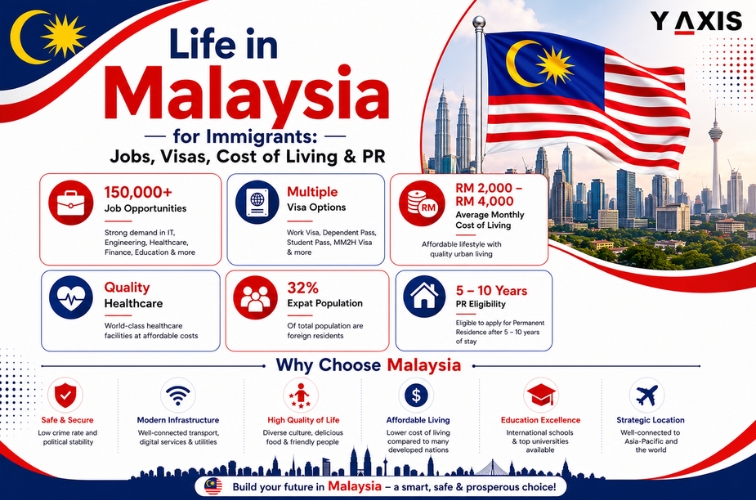
Life for immigrants in Malaysia is shaped by a genuinely low unemployment rate, a fast-growing digital economy and shared-services sector, and one of the largest existing Indian-origin communities in Southeast Asia. Malaysia significantly overhauled its Employment Pass framework effective June 1, 2026, raising minimum salary thresholds across all three categories while, for the first time, opening dependent visa access to Category III professionals. Kuala Lumpur and Cyberjaya offer the strongest job markets in IT, global business services, and finance, while Penang leads in semiconductor manufacturing and Johor Bahru benefits from its proximity to Singapore. Malaysia suits immigrants who want an easier cultural transition and a considerably lower cost of living than Singapore or the Gulf, though the path to permanent residence remains slow and largely discretionary.
Some quick facts about Malaysia are as follows:
|
Population |
Approximately 34.4 million (2026) |
|
Capital |
Kuala Lumpur (Putrajaya is the administrative capital) |
|
Official Language |
Bahasa Malaysia (English widely used in business and government) |
|
Currency |
Malaysian Ringgit (MYR/RM) |
|
Popular Immigrant Hubs |
Kuala Lumpur, Penang, Johor Bahru, Cyberjaya, Petaling Jaya/Subang Jaya |
|
Economy |
Unemployment around 2.9-3%, among the lowest in Southeast Asia; strong in manufacturing, digital economy/shared services, oil & gas, and finance |
|
Typical Route to Long Stay |
Employer-sponsored Employment Pass (Category I, II or III), under the revised salary framework effective June 1, 2026 |
|
Permanent Residence |
Discretionary and rare for skilled migrants; Residence Pass-Talent (10-year renewable) and MM2H Platinum are the closest structured alternatives |
*Want to settle in Malaysia? Sign up with Y-Axis for end-to-end assistance.
Why Choose Malaysia to Migrate Abroad?
Malaysia runs one of Southeast Asia's most stable, low-unemployment economies, with a genuine shortage of skilled workers in IT, shared services, and manufacturing.
Here is why you should choose a life in Malaysia:
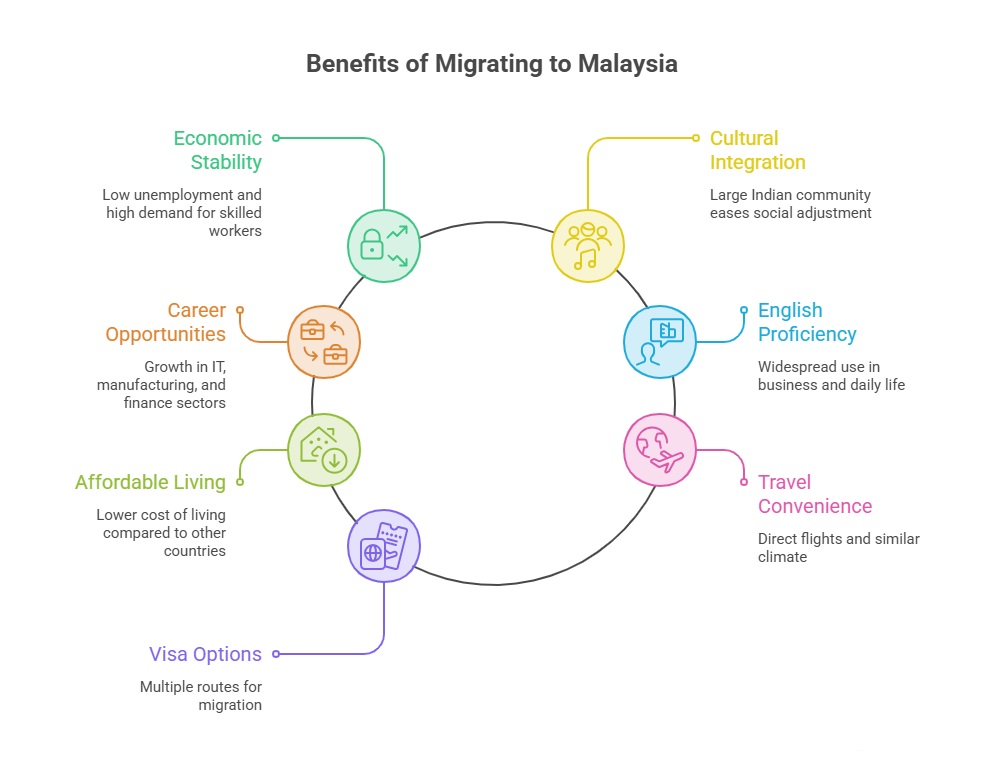
- One of Southeast Asia's lowest unemployment rates, consistently around 2.9-3%.
- A large, well-established Indian-origin community (around 7% of the population), easing cultural and social integration.
- Strong and growing demand in IT and global business services (GBS/shared services), semiconductor manufacturing, and finance.
- English is widely used in business, government offices, and daily city life, even though Bahasa Malaysia is the national language.
- Cost of living considerably lower than Singapore, the UK, or the Gulf, especially outside Kuala Lumpur.
- Direct flights from most major Indian cities, plus a similar tropical climate and comparable cuisine.
- Multiple structured visa routes: Employment Pass, Residence Pass-Talent (RP-T), and Malaysia My Second Home (MM2H).
*Want to work in Malaysia? Let Y-Axis assist you with the process.
Can I Move to Malaysia as an Indian Immigrant?
Most Indian nationals move to Malaysia through employer-sponsored Employment Passes. From June 1, 2026, Malaysia significantly revised its Employment Pass framework under the Thirteenth Malaysia Plan (RMK-13), raising minimum salaries across all categories and introducing new maximum cumulative stay limits.
Here is what you need to do to migrate to Malaysia:
Step 1: Secure a confirmed job offer from a Malaysia-registered company
Step 2: Confirm your role and salary meet the revised 2026 Employment Pass thresholds for your category
Step 3: Your employer registers with the Expatriate Services Division (ESD)/MYXpat Centre and applies for your Employment Pass
Step 4: For Category II and III roles, your employer must submit a mandatory Local Succession Plan
Step 5: Undergo a medical examination and arrange private health insurance
Step 6: Apply for your Single Entry Visa at a Malaysian consulate in India before travelling, if required
Step 7: Apply for Dependent Passes for your spouse and children once your Employment Pass is approved
Also, read...
Jobs in Malaysia for Indians: How to Find a Job & Apply for a Work Visa
Best Visa Options to Live in Malaysia
Malaysia offers several passes based on your role, salary, and career stage. The table below shows the main options for skilled workers and their route to long-term residence.
|
Visa Type |
Best For |
Duration |
Long-Term Pathway |
|
Employment Pass Category I |
Senior executives and leadership roles; RM 20,000+/month |
Max 10 years cumulative; no succession plan required |
Does not lead directly to PR; eligible for RP-T after 3 years |
|
Employment Pass Category II |
Managerial/professional roles; RM 10,000-19,999/month |
Max 10 years cumulative; succession plan required |
Does not lead directly to PR |
|
Employment Pass Category III |
Technical/skilled roles; RM 5,000-9,999/month (RM 7,000-9,999 in manufacturing) |
Max 5 years cumulative; succession plan required |
Does not lead to PR; dependents now allowed since June 2026 |
|
Residence Pass-Talent (RP-T) |
Experienced professionals with 3+ years on EP Category I or II; RM 15,000+/month |
10 years, renewable |
Employer-free; spouse can work; strengthens (but doesn't guarantee) a future PR case |
|
MM2H (Malaysia My Second Home) |
Retirees, investors, remote workers; SEZ/Silver/Gold/Platinum tiers |
5-20 years, renewable |
Platinum tier only structured route toward PR eligibility |
Also, read...
Best Areas to Live in Malaysia
Malaysia's job market and living conditions vary significantly by state and city. Choosing the right area can influence your career opportunities, cost of living, housing expenses, and overall quality of life.
The table below highlights the major Malaysian areas and their best qualities for settlement abroad:
|
Area |
Best For |
Sightseeing Attractions |
Average Rent |
Job Market |
How Much You Can Save |
|
Kuala Lumpur |
Finance, IT & corporate HQs |
Petronas Towers, Batu Caves, Bukit Bintang |
RM 1,800-3,000/mo (1BR) |
Strongest, largest employment pool |
Moderate, highest cost of living |
|
Penang (George Town) |
Semiconductor & electronics manufacturing |
George Town UNESCO heritage zone, Penang Hill |
RM 1,200-2,000/mo (1BR) |
Strong, dense manufacturing hub |
Good savings potential |
|
Johor Bahru |
Manufacturing, logistics & Singapore-linked roles |
Legoland Malaysia, Danga Bay |
RM 1,000-1,800/mo (1BR) |
Growing, boosted by Singapore spillover |
Good savings potential |
|
Cyberjaya |
IT & shared services (GBS), digital economy |
Cyberjaya Lake Gardens, tech park campuses |
RM 1,200-2,000/mo (1BR) |
Very strong, MDEC-driven tech hub |
Good savings potential |
|
Petaling Jaya/Subang Jaya |
IT, MNC regional offices |
Sunway Lagoon, Empire Shopping Gallery |
RM 1,200-2,200/mo (1BR) |
Strong, close to KL job market |
Good savings potential |
Also, read...
Highest Paying Jobs in Malaysia for Indians
Cost of Living in Malaysia
Malaysia's cost of living changes by city. Kuala Lumpur costs the most, though Malaysia overall remains considerably more affordable than Singapore or the Gulf.
Below is a breakdown of average monthly expenses for a single adult in Kuala Lumpur:
|
Rent (1BR apartment, city centre) |
RM 1,800-3,000/month |
|
Utilities (electricity, water, internet) |
RM 150-300/month |
|
Groceries |
RM 400-700/month |
|
Public Transport |
MRT/LRT plus Grab typically costs RM 200-400/month |
|
Private Health Insurance |
RM 150-400/month per adult (no mandatory national scheme for Employment Pass holders) |
|
Dining Out (per meal) |
RM 10-30 |
|
Mobile & Internet |
RM 100-150/month |
|
Entertainment & Leisure |
RM 200-400/month |
Also, read...
Malaysia to Launch Direct Hiring Platform for Foreign Workers – Check If You’re Eligible!
Is Malaysia Expensive Compared to Singapore or the Gulf?
No. Malaysia is considerably more affordable than Singapore, the UAE, or the UK, while still offering strong salaries in IT, shared services, and manufacturing.
Salaries for skilled foreign professionals in Malaysia are proportionally strong against the local cost of living, so many immigrants build meaningful savings, particularly outside Kuala Lumpur.
Cities like Penang, Johor Bahru, and Cyberjaya cost noticeably less than Kuala Lumpur. This makes Malaysia a strong choice for immigrants who prioritise cultural familiarity, community, and savings potential over the higher salaries (and higher costs) of Singapore or the Gulf.
Work in Malaysia
Malaysia's job market runs on IT and shared services, semiconductor manufacturing, oil & gas, and finance, supported by both multinational employers and a fast-growing domestic digital economy.
The table below shows some of the most in-demand jobs in Malaysia for immigrants.
|
Occupation |
Average Annual Salary |
Demand Level |
Average Savings |
|
IT & Digital Economy / Shared Services (GBS) |
RM 96,000-300,000+ |
Very High |
RM 20,000-45,000/year |
|
Semiconductor & Electronics Manufacturing |
RM 84,000-216,000 |
Very High |
RM 18,000-35,000/year |
|
Oil & Gas / Energy |
RM 120,000-300,000 |
High |
RM 22,000-40,000/year |
|
Finance & Shared Services |
RM 96,000-240,000 |
High |
RM 18,000-32,000/year |
|
Healthcare (Specialist Doctors) |
RM 144,000-300,000+ |
Moderate-High |
RM 20,000-38,000/year |
|
Academia & Research |
RM 96,000-180,000 |
Moderate |
RM 14,000-24,000/year |
Settling in Malaysia
Once you arrive in Malaysia, you need to find housing, arrange private health insurance, enrol children in school, and set up banking.
Here is a quick overview of what to expect during your first weeks in the country:
|
Housing |
Healthcare |
Education for Children |
Banking & Financial Essentials |
|
Search via PropertyGuru, iProperty, or Mudah; competitive rental market in KL and Cyberjaya |
Purchase private health insurance; no mandatory national scheme for Employment Pass holders |
Enrol in international schools (KL, Penang, JB) or local private schools |
Open an account with Maybank, CIMB, or Public Bank |
|
Landlords typically ask for 2-3 months' deposit |
Private hospitals in KL and Penang offer high-quality, English-speaking care |
International schools charge RM 20,000-60,000/year; local private schools cost less |
A valid Employment Pass and employment letter are usually required to open an account |
|
Allow 2 to 4 weeks to secure a rental in Kuala Lumpur or Cyberjaya, given demand |
Register with an insurer soon after arrival, especially before dependents arrive |
Apply for school places early; popular international schools have limited seats |
Basic accounts can typically be opened within a few days once documents are ready |
Permanent Residence in Malaysia
Permanent residence in Malaysia follows one of the least predictable timelines in Asia. Legal residence on an Employment Pass counts toward strengthening a future case, but Malaysia's PR itself remains discretionary and is granted sparingly to skilled migrants.
The table below shows the main routes and their approximate timelines:
|
Stage |
Requirement |
Approx. Timeline |
|
Employment Pass Holder |
Valid Category I, II or III pass; renewable while employed and within the cumulative cap |
Ongoing; capped at 5 years (Category III) or 10 years (Categories I & II) |
|
Residence Pass-Talent (RP-T) |
3+ years on Employment Pass Category I or II; RM 15,000+/month |
10 years, renewable |
|
MM2H Platinum |
Qualifying fixed deposit and property purchase |
20 years, renewable; only MM2H tier eligible for PR consideration |
|
Permanent Residence (PR) |
Discretionary approval by the Ministry of Home Affairs; historically granted sparingly to skilled migrants without exceptional ties |
No fixed timeline; can take many years, or may not be granted |
|
Malaysian Citizenship |
Requires PR plus continuous residence and demonstrated integration, including Bahasa Malaysia proficiency |
Discretionary; typically 10+ years after PR |
Also, read... Can I get a Malaysia work visa without a job offer?
Dependent Benefits for Immigrants in Malaysia
Malaysia allows eligible Employment Pass holders to bring immediate family members. This applies once dependent visa rules are met.
Here are the benefits of securing a Malaysia dependent visa:
- Spouses and children of Employment Pass holders can generally join through Dependent Passes once the principal applicant's pass is approved
- Since June 2026, Category III Employment Pass holders can bring dependents for the first time — a right previously limited to Category I and II holders
- Spouses on a Dependent Pass may separately apply for a Dependent Pass Endorsement to work, subject to approval
- Children of visa holders can enrol in local public/private schools or international schools
- Family members can open local bank accounts once they hold a valid pass
Practical Settlement Checklist for Indians Moving to Malaysia
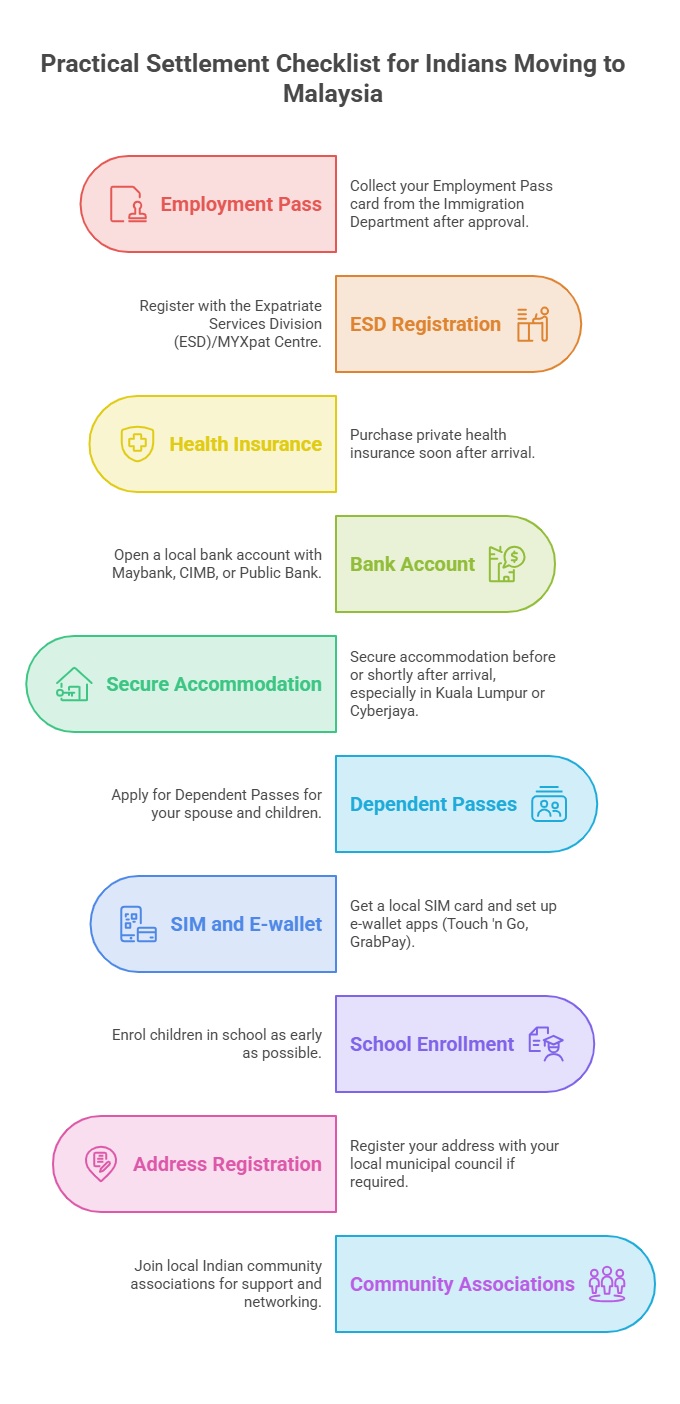
Moving to Malaysia involves a few key steps. Complete them in order to avoid delays.
Follow the steps below for a smooth move to Malaysia:
Step 1: Collect your Employment Pass card from the Immigration Department after approval
Step 2: Register with the Expatriate Services Division (ESD)/MYXpat Centre
Step 3: Purchase private health insurance soon after arrival
Step 4: Open a local bank account with Maybank, CIMB, or Public Bank
Step 5: Secure accommodation before or shortly after arrival, especially in Kuala Lumpur or Cyberjaya
Step 6: Apply for Dependent Passes for your spouse and children
Step 7: Get a local SIM card and set up e-wallet apps (Touch 'n Go, GrabPay)
Step 8: Enrol children in school as early as possible
Step 9: Register your address with your local municipal council if required
Step 10: Join local Indian community associations for support and networking
*Are you looking for step-by-step assistance with overseas immigration? Contact Y-Axis, the world's No. 1 overseas immigration consultancy!
FAQs
What is the easiest way for Indians to move to Malaysia?
Most Indians move to Malaysia through an employer-sponsored Employment Pass (EP), as Malaysia does not offer an independent job-seeker visa. Before applying, ensure your job offer and salary meet the latest Employment Pass salary requirements introduced from June 1, 2026.
What changed in Malaysia's Employment Pass rules in 2026?
Malaysia introduced major Employment Pass reforms from June 1, 2026. The key changes include:
- Category I: Minimum salary increased to RM 20,000+ per month
- Category II: Salary range increased to RM 10,000–19,999 per month
- Category III: Salary range increased to RM 5,000–9,999 per month
- Categories I and II have a maximum cumulative employment period of 10 years
- Category III has a maximum cumulative employment period of 5 years
- Succession plans are mandatory for Categories II and III
Can Category III Employment Pass holders bring their families to Malaysia?
Yes. Since the June 2026 reforms, Category III Employment Pass holders can apply for Dependent Passes for their spouse and dependent children. Previously, this benefit was available only to Category I and II Employment Pass holders.
How can I get permanent residency in Malaysia?
Malaysia grants Permanent Residency (PR) on a discretionary basis, with no guaranteed timeline. Alternatives include:
- Residence Pass-Talent (RP-T): A renewable 10-year residence pass available after at least three years in an EP Category I or II position.
- Malaysia My Second Home (MM2H) Platinum: The only MM2H category currently eligible for PR consideration.
Is healthcare free for immigrants in Malaysia?
No. Employment Pass holders are generally expected to arrange private health insurance. Premiums typically range from RM 150–400 per month per adult. Malaysia's private hospitals provide high-quality healthcare with English-speaking medical professionals.
What is the average salary for skilled workers in Malaysia?
Average monthly salaries vary by profession and industry:
- IT & Global Business Services: RM 8,000–25,000
- Semiconductor & Manufacturing: RM 7,000–18,000
- Oil & Gas: RM 10,000–25,000
Kuala Lumpur and Cyberjaya generally offer the highest salaries.
Can I bring my family to Malaysia on a work visa?
Yes. Employment Pass holders, including Category III holders under the latest rules, can generally sponsor their spouse and dependent children through a Dependent Pass. Eligible spouses may also apply for permission to work in Malaysia, subject to approval.
Which area in Malaysia is best for Indian immigrants?
The best city depends on your profession and lifestyle:
- Kuala Lumpur: Largest job market and Indian community
- Cyberjaya: Ideal for IT and shared services professionals
- Penang: Popular for semiconductor and manufacturing careers
- Johor Bahru: Lower living costs with opportunities linked to Singapore
How much does it cost to live in Malaysia?
Malaysia offers a relatively affordable cost of living compared to many developed countries. Typical monthly expenses in Kuala Lumpur include:
- One-bedroom apartment: RM 1,800–3,000
- Groceries: RM 400–700
- Private health insurance: RM 150–400
Living costs are generally lower in Penang and Johor Bahru.
Do I need to speak Bahasa Malaysia to live and work in Malaysia?
Not necessarily. English is widely used in business, education, and everyday communication, especially in Kuala Lumpur, Cyberjaya, and Penang. However, basic Bahasa Malaysia proficiency is generally required if you later apply for Malaysian citizenship.
Tags:
Malaysia immigration
Malaysia work visa
Malaysia permanent residency
Living in Malaysia
Cost of living in Malaysia
Best areas in Malaysia
Jobs in Malaysia for Indians
Healthcare in Malaysia
Housing in Malaysia
Settle in Malaysia
Share
Options for you by Y-Axis

Get it on your mobile

Get News alerts

Contact Y-Axis
Latest Article
Popular Post
Trending Article
Posted On September 17 2026
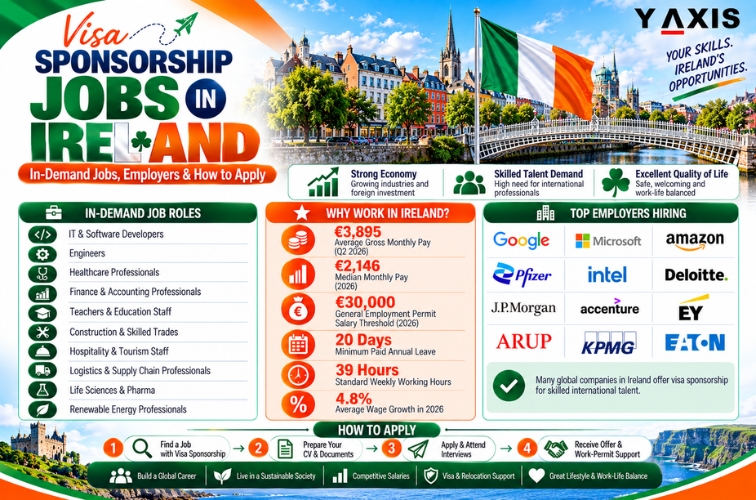
Visa Sponsorship Jobs in Ireland: In-Demand Jobs, Employers & How to Apply