


Posted on July 10 2026
Life in Hungary for Immigrants: Jobs, Housing, Healthcare & PR

By , Editor & Director
Updated July 10 2026
Life for immigrants in Hungary is calm, safe, and affordable. Hungary sits at the heart of Europe. It offers low living costs, a growing job market, and easy access to other EU countries. Budapest leads the way with jobs in IT, finance, and manufacturing. Smaller cities like Debrecen and Győr offer factory and engineering jobs with a lower cost of living. Hungary suits immigrants who want a stable European base without the high costs of Western Europe.
Quick Facts About Hungary
|
Fact |
Detail |
|
Population |
Approximately 9.6 million |
|
Capital |
Budapest |
|
Official Language |
Hungarian |
|
Currency |
Hungarian Forint (HUF); not part of the Eurozone |
|
Popular Immigrant Hubs |
Budapest, Debrecen, Szeged, Győr |
|
Economy |
Strong in manufacturing, automotive, and growing IT and shared services |
|
Typical Route to PR |
3 years of continuous legal residence |
|
Citizenship Timeline |
8 years after permanent residency |
*Want to settle in Hungary? Sign up with Y-Axis for end-to-end assistance.
Why Choose Hungary?
Hungary offers a low cost of living and a central location in Europe. Big companies keep opening new plants and offices here. This creates steady demand for skilled and semi-skilled workers.
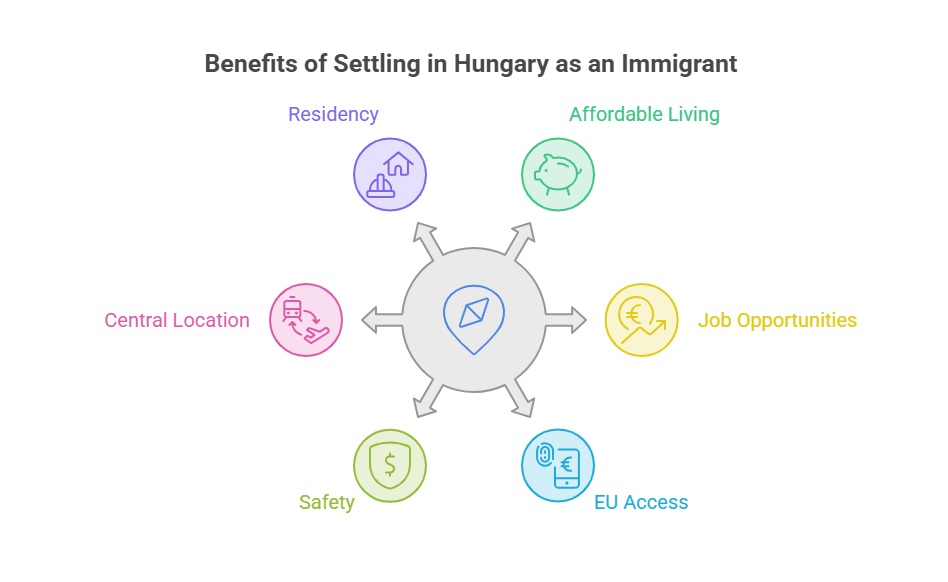
Here is why you should choose a life in Hungary:
- One of the most affordable countries in the European Union
- Home to major plants of Audi, BMW, Mercedes-Benz, Bosch, and Samsung SDI
- Growing IT and shared services sector with firms like Wipro, TCS, and Accenture
- EU membership gives access to the wider European job market
- Safe cities with low crime rates
- Central location with fast rail and flight links to other EU capitals
- Clear path to permanent residency and later citizenship
*Want to work in Hungary? Let Y-Axis guide you with the steps.
Can I Move to Hungary as an Indian Immigrant?
Most Indian nationals can move to Hungary through work, study, or family routes. You must meet the rules set by Hungarian immigration authorities. Your job, skills, and visa type decide your path to long-term settlement in the country.
Here is what you need to do to migrate to Hungary:
- Secure a valid job offer from a registered Hungarian employer
- Your employer must complete a labour market test, unless your role is exempt
- Meet the salary level set for your visa type
- Hold recognised qualifications or work experience for the role
- Maintain a clean criminal record
- Have a valid passport
- Explore family reunification for spouses and children of permit holders
Also, read...
What are the fast-track hiring options in Hungary for Skilled Professionals?
Best Visa Options to Live in Hungary
Hungary offers several permits based on your job, skills, and plans. The table below shows the main options for skilled workers and their route to permanent residency.
|
Visa Type |
Best For |
Duration |
PR Pathway |
|
Single Permit |
Skilled workers with a confirmed job offer |
Up to 2 years (renewable) |
Eligible for PR after 3 years |
|
Highly qualified professionals meeting the salary threshold |
Up to 4 years |
Fast-tracked PR eligibility |
|
|
ICT Permit |
Employees transferred within the same multinational company |
Matches transfer duration |
Contributes toward PR timeline |
|
Guest Worker Permit |
Workers from designated countries in manufacturing, construction, or food processing |
Up to 2 years, no extension |
Does not lead to PR |
|
White Card |
Remote workers earning income from non-Hungarian sources |
1 year (renewable once) |
Does not lead to PR |
|
Guest Investor Residence Permit |
Investors placing funds in approved Hungarian schemes |
10 years (renewable) |
Immediate long-term residency with work rights |
|
Dependent / Family Reunification Permit |
Spouses and children of permit holders |
Matches primary holder's permit |
Eligible after primary applicant secures PR |
Also, read...
Best Cities to Live in Hungary
Hungary's job market and lifestyle differ based on the city you choose to settle in. Where you settle can shape your career, your rent, and your daily life.
The table below highlights the major Hungarian cities and their best qualities for settlement abroad:
|
City |
Best For |
Sightseeing Attractions |
Average Rent |
Job Market |
How Much You Can Save |
|
Budapest |
Tech, finance & shared services |
Parliament Building, Buda Castle, Széchenyi Thermal Bath |
€460–€970/mo (1BR) |
Strongest, major MNC hub |
Moderate, higher cost of living |
|
Debrecen |
Automotive & manufacturing |
Great Church, Debrecen Zoo |
€300–€450/mo (1BR) |
Growing, strong in auto and manufacturing |
Good savings potential |
|
Szeged |
IT & research, university city |
Szeged Cathedral, Anna Thermal Bath |
€280–€420/mo (1BR) |
Steady, growing tech and research base |
Good savings potential |
|
Győr |
Automotive manufacturing (Audi plant) |
Győr Cathedral, Baroque Old Town |
€300–€450/mo (1BR) |
Strong, Audi-driven manufacturing hub |
Good savings potential |
|
Pécs |
Culture & education |
Pécs Cathedral, Zsolnay Cultural Quarter |
€250–€380/mo (1BR) |
Smaller but stable |
Highest savings potential |
Also, read..
Highest Paying Jobs in Hungary for Indians
Cost of Living in Hungary
Hungary's cost of living changes by city. Budapest costs the most, but it still costs far less than most Western European capitals.
Below is a breakdown of average monthly expenses for a single adult in Budapest:
|
Expense |
Average Cost |
|
Rent (1BR apartment, city centre) |
€460–€970/month |
|
Utilities (electricity, heating, water) |
€100–€150/month |
|
Groceries |
€150–€230/month |
|
Public Transport Pass |
€24–€28/month |
|
Private Health Insurance (optional) |
€20–€250/month |
|
Dining Out (per meal) |
€7.50–€15 |
|
Mobile & Internet |
€38–€63/month |
|
Entertainment & Leisure |
€75–€125/month |
Is Hungary Expensive Compared to Other EU Nations?
No. Hungary is one of the cheaper countries in the European Union. Rent in Budapest costs far less than in Berlin, Paris, or Vienna. Groceries, transport, and eating out also cost less.
Wages in Hungary are lower than in Western Europe. But the lower cost of living balances this out. Many skilled immigrants still save a good share of their income each month.
Cities outside Budapest, like Pécs and Szeged, cost even less. This makes Hungary a strong choice for immigrants who want to save money while living in the EU.
Work in Hungary
Hungary's job market runs on manufacturing, automotive, IT, and finance. Global companies keep investing in new plants and offices across the country.
The table below shows some of the most in-demand jobs in Hungary for immigrants.
|
Occupation |
Average Annual Salary |
Demand Level |
Average Savings |
|
Software Engineer |
€30,000–€51,000 |
Very High |
€6,000–€12,000/year |
|
Automotive/Manufacturing Engineer |
€23,000–€38,000 |
High |
€5,000–€9,000/year |
|
Data Analyst |
€23,000–€35,000 |
High |
€4,500–€8,500/year |
|
Registered Nurse |
€15,000–€23,000 |
High |
€3,000–€6,000/year |
|
Financial Analyst |
€22,000–€33,000 |
Moderate–High |
€4,000–€8,000/year |
|
Logistics/Supply Chain Manager |
€20,000–€30,000 |
Moderate |
€3,500–€7,000/year |
Also, read...
Do I need a job offer for Hungary work visa?
Settling in Hungary
Once you arrive in Hungary, you need to find housing, register for healthcare, enrol children in school, and set up banking.
Here is a quick overview of what to expect during your first weeks in the country:
|
Housing |
Healthcare |
Education for Children |
Banking & Financial Essentials |
|
Search via Ingatlan.com or Alberlet.hu; competitive rental market in Budapest |
Register for a TAJ card through your employer for public healthcare access |
Enrol in local public schools; international schools available in Budapest |
Open an account with OTP Bank, K&H Bank, or Erste Bank |
|
Landlords typically ask for 1–2 months' deposit plus first month's rent |
Public system is funded through an 18.5% social security contribution; private insurance is popular for faster access |
Public education is free; private and international schools charge tuition |
A residence permit and address card are usually required to open an account |
|
Allow 2–4 weeks to secure a rental in Budapest |
Apply for a tax ID and TAJ card soon after you start work |
Apply for school places early; international schools have limited seats |
Basic accounts can typically be opened within a week of arrival |
Permanent Residence in Hungary
Permanent residence in Hungary is granted after continuous legal stay in the country, usually 3 years.
The table below shows the average timeline for securing Hungarian permanent residence:
|
Stage |
Requirement |
Approx. Timeline |
|
Work Permit Holder |
Hold a valid Single Permit or EU Blue Card and reside legally |
Years 1–3 |
|
Permanent Residency Application |
Continuous legal residence for 3 years; stable income; clean record |
Year 3 onward |
|
Citizenship Eligibility |
After 8 years of permanent residency; pass a basic Hungarian language and culture test |
Year 11+ |
Also, read...
Can I convert my Hungary work visa to permanent residency?
Dependent Benefits for Immigrants in Hungary
Hungary allows eligible visa holders to bring immediate family members. This applies once dependent visa rules are met.
Here are the benefits of securing a Hungary dependent visa:
- Spouses may apply for their own work authorisation depending on the permit type
- Children can access free public education
- Family members become eligible for public healthcare registration once resident
- Dependents can open bank accounts once they hold a valid address
- Family reunification permits simplify long-term settlement together
Practical Settlement Checklist for Indians Moving to Hungary
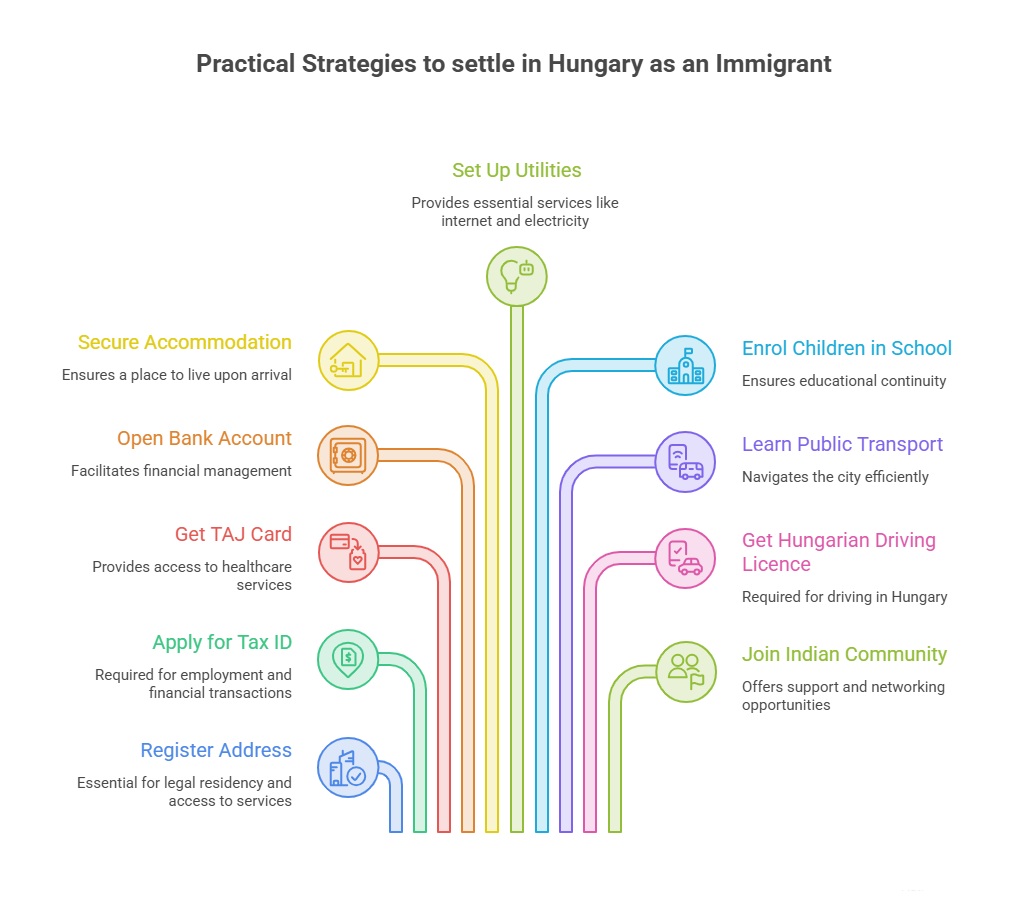
Moving to Hungary involves a few key steps. Complete them in order to avoid delays.
Follow the steps below for a smooth move to Hungary:
Step 1: Register your address at the local Kormányablak (government window office) within 30 days of arrival
Step 2: Apply for a Hungarian tax identification number (adóazonosító jel) at the tax office
Step 3: Apply for your TAJ card (health insurance number) through your employer
Step 4: Open a local bank account
Step 5: Secure accommodation before or shortly after arrival
Step 6: Get a local SIM card and set up household utilities
Step 7: Enrol children in school as early as possible
Step 8: Familiarise yourself with Budapest's public transport and monthly passes
Step 9: Convert or apply for a Hungarian driving licence if needed
Step 10: Join local Indian community groups for support and networking
*Are you looking for step-by-step assistance with overseas immigration? Contact Y-Axis, the world's No. 1 overseas immigration consultancy!
FAQs
What is the easiest way for Indians to move to Hungary?
For most Indian professionals, the easiest route is the Single Permit. This combines work and residence approval into one document. You need a confirmed job offer from a registered Hungarian employer. The EU Blue Card is a strong option if your salary meets the threshold, since it skips some of the standard checks. Family reunification is open to spouses and children of existing permit holders. The right route depends on your job, salary, and long-term plans.
How long does it take to get PR in Hungary?
Permanent residency in Hungary generally becomes available after 3 years of continuous legal residence. You must hold a valid permit throughout this time, such as a Single Permit or EU Blue Card. You also need stable income and a clean criminal record. After you secure permanent residency, you can later apply for citizenship. This requires 8 more years of permanent residency, along with a basic Hungarian language and culture test.
Is healthcare free for immigrants in Hungary?
Hungary runs a public healthcare system funded through social security contributions. If you are employed and contribute 18.5% of your gross salary, you gain access to public healthcare through a TAJ card. Emergency care is generally free for insured residents. Many expats also choose private insurance for shorter wait times and English-speaking doctors. Private plans cost between €20 and €300 a month. Registering for your TAJ card is usually one of the first steps after starting work in Hungary.
What is the average salary for skilled workers in Hungary?
Average salaries in Hungary vary by role and sector. Software engineers typically earn between €30,000 and €51,000 a year. Automotive and manufacturing engineers earn around €23,000 to €38,000. Nurses earn less, generally €15,000 to €23,000. Finance and data roles fall in the middle range. Budapest offers the highest salaries but also has the highest cost of living. IT, automotive, and manufacturing roles offer the strongest pay and most sponsorship options.
Can I bring my family to Hungary on a work visa?
Yes. Most Single Permit and EU Blue Card holders can bring their spouse and children through family reunification. The permit usually matches the length of the main applicant's visa. Once in Hungary, spouses may apply for their own work rights depending on the permit type. Children can attend free public schools. The whole family becomes eligible for public healthcare registration once they hold a valid residence permit and address.
Which city in Hungary is best for Indian immigrants?
Budapest is the top choice for most Indian immigrants. It offers the strongest job market in IT, finance, and shared services, along with a growing Indian community. However, it also has the highest cost of living in Hungary. Debrecen and Győr suit those in automotive and manufacturing roles, thanks to major plants nearby. Szeged and Pécs offer lower costs and a quieter lifestyle. The best city depends on your job, budget, and lifestyle goals.
How much does it cost to live in Hungary?
Monthly living costs in Hungary are lower than most of Western Europe. In Budapest, a single person can expect to pay €460 to €970 for a one-bedroom apartment in the city centre. Utilities cost €100 to €150, and groceries run €150 to €230. Total monthly costs, excluding rent, are usually €600 to €900. Cities outside Budapest, such as Pécs and Szeged, cost noticeably less while still offering a good standard of living.
What is the EU Blue Card in Hungary?
The EU Blue Card is Hungary's fast-track work permit for highly qualified professionals. You need a university degree and a job offer meeting the salary threshold, set at HUF 1,001,048 gross per month from 2026. It skips some of the standard labour market checks needed for other permits. The Blue Card is valid for up to 4 years and offers a faster path toward permanent residency compared to the Single Permit.
Do I need to speak Hungarian to live in Hungary?
No, Hungarian is not required for daily life in Budapest and other major cities. Most workplaces, especially in IT and multinational companies, use English. Younger people and city residents often speak English well. However, Hungarian helps with tasks like banking, government paperwork, and daily errands outside big cities. Learning basic Hungarian phrases makes daily life easier and helps you integrate faster into local communities.
Can I apply for Hungarian citizenship after getting PR?
Yes, but it takes time. After securing permanent residency, you generally need 8 more years of continuous permanent residency before applying for citizenship. You must also pass a basic test on Hungarian language and culture. You need a clean criminal record and a stable, registered address throughout this period. Hungarian citizenship gives you the right to live and work freely across the European Union.
Tags:
Hungary immigration
Hungary work visa
Hungary PR
Living in Hungary
Cost of living in Hungary
Best cities in Hungary
Jobs in Hungary for Indians
Healthcare in Hungary
Housing in Hungary
Settle in Hungary
Share
Options for you by Y-Axis

Get it on your mobile

Get News alerts

Contact Y-Axis
Latest Article
Popular Post
Trending Article
Posted On October 09 2026
Canada’s Immigration Reset: Why the Next Move May Be About Fit, Not Volume