


Posted on July 16 2026
Life in China for Immigrants: Jobs, Housing, Healthcare & PR

By , Editor
Updated July 18 2026
Life for immigrants in China is characterised by fast-paced lifestyle, welcoming communities and vast work opportunity. China is home to some of the world's largest cities and a booming job market. It offers high compensation in tech, teaching, and manufacturing with a relatively lower cost of living. Shanghai and Beijing are booming with jobs in finance, IT, and multinational firms. Cities like Shenzhen and Hangzhou offer tech and e-commerce roles with a lower cost of living. China suits immigrants who want to build a secure career and enjoy modern lifestyle abroad.
Quick Facts About China
| Fact | Detail |
|---|---|
| Population | Approximately 1.41 billion |
| Capital | Beijing |
| Official Language | Mandarin Chinese |
| Currency | Renminbi / Yuan (RMB or CNY) |
| Popular Immigrant Hubs | Shanghai, Beijing, Shenzhen, Guangzhou, Hangzhou |
| Economy | Strong in manufacturing, technology, e-commerce, and finance |
| Typical Route to Long Stay | Employer-sponsored work permit, renewable up to 5 years |
| Permanent Residence | Selective Green Card via employment, investment, or family routes, generally after 3–4 years |
*Want to settle in China? Sign up with Y-Axis for end-to-end assistance.
Why Choose China?
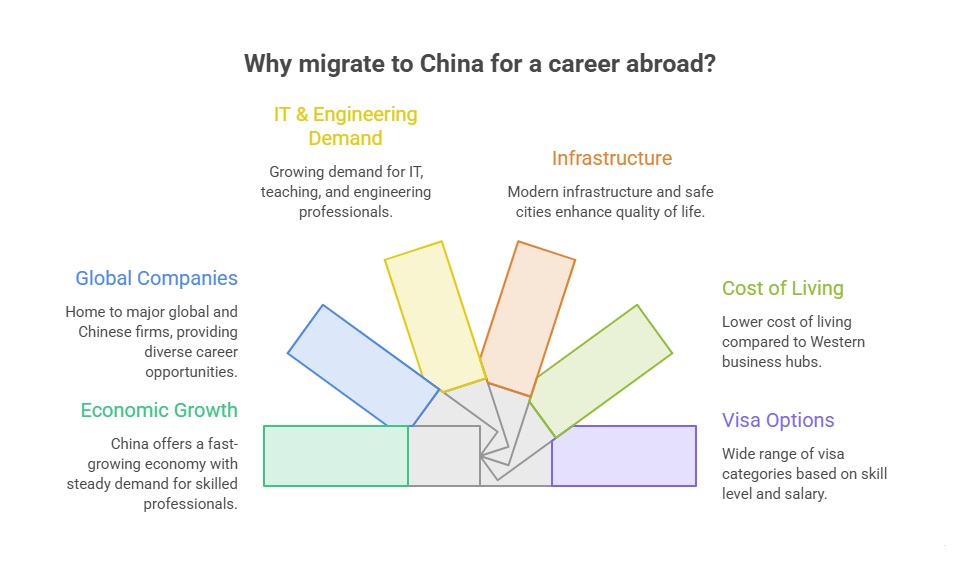
China offers a fast-growing economy and some of the busiest business hubs in Asia. Global and Chinese companies keep expanding their operations creating steady demand for skilled professionals in tech, finance, and engineering.
Here is why you should choose a life in China:
- One of Asia's largest and fastest-growing economies
- Home to major global and Chinese firms such as Tesla, Apple suppliers, Alibaba, Tencent, and Huawei
- Growing demand for IT, teaching, and engineering professionals from India
- Strong high-speed rail and flight routes across Asia
- Modern infrastructure and safe, well-organised cities
- Lower cost of living compared to most Western business hubs
- Wide range of visa categories based on skill level and salary
*Want to work in China? Let Y-Axis assist you with the process.
Can I Move to China as an Indian Immigrant?
Most Indian nationals can move to China through work, study, or family immigration routes. You must meet the rules set by Chinese immigration authorities such as securing job offering , meeting salary requirements as per permit category.
Here is what you need to do to migrate to China:
- Secure a valid job offer from a China-registered employer
- Your employer must apply for a Notification Letter of Foreigner's Work Permit
- Meet the salary and category thresholds set for your work permit class
- Hold recognised qualifications or relevant work experience for the role
- Pass a medical examination and hold a clean criminal record
- Have a valid passport with at least six months' validity
- Explore family reunification for spouses and children of permit holders
Best Visa Options to Live in China
China offers several permits based on your job, skills, and salary. The table below shows the main visa options for skilled workers and their route to long-term residence.
| Visa Type | Best For | Duration | Long-Term Pathway |
|---|---|---|---|
| Z Visa + Category B Work Permit | Skilled professionals with a confirmed job offer | Up to 5 years (renewable) | Renewable; contributes toward long-term residence |
| Category A Work Permit (High-Level Talent) | Executives and specialists meeting salary or points threshold | Up to 5 years | Fast-tracked route to permanent residence |
| R Visa | Urgently-needed, high-level experts | 5–10 years, multiple entry | Accelerated route for qualifying Category A talent |
| Category C Work Permit | Entry-level, seasonal, or quota-based roles | Up to 1 year | Does not lead to permanent residence |
| S1 / S2 Visa (Dependent) | Spouses and children of permit holders | Matches primary holder's permit | Can apply separately once eligible |
| Investor Route (Green Card) | Investors placing stable funds in Chinese enterprises | 3 consecutive years of investment | Direct route to permanent residence |
Also, read...
Best Cities to Live in China
China's job market and living conditions vary significantly across cities. Choosing the right location can influence your career opportunities, cost of living, housing expenses, and overall quality of life.
The table below highlights the major Chinese cities and their best qualities for settlement abroad:
| City | Best For | Sightseeing Attractions | Average Rent | Job Market | How Much You Can Save |
|---|---|---|---|---|---|
| Shanghai | Finance, tech & multinational HQs | The Bund, Yu Garden, Shanghai Tower | ¥7,000–¥12,000/mo (1BR) | Strongest, major MNC hub | Moderate, higher cost of living |
| Beijing | Government, IT & corporate hubs | Forbidden City, Great Wall, Temple of Heaven | ¥6,500–¥11,000/mo (1BR) | Strong, major HQ base | Moderate, higher cost of living |
| Shenzhen | Tech & electronics manufacturing | Window of the World, Shenzhen Bay | ¥5,500–¥9,000/mo (1BR) | Strong, tech and startup hub | Good savings potential |
| Guangzhou | Trade, manufacturing & logistics | Canton Tower, Chen Clan Ancestral Hall | ¥4,500–¥7,500/mo (1BR) | Steady, strong trade base | Good savings potential |
| Hangzhou | E-commerce & IT | West Lake, Lingyin Temple | ¥4,000–¥7,000/mo (1BR) | Growing, Alibaba-driven hub | Good savings potential |
Also, read...
Highest Paying Jobs in China for Indians
Cost of Living in China
China's cost of living changes sharply by city. Shanghai and Beijing cost the most, but even they cost less than most Western business hubs.
Below is a breakdown of average monthly expenses for a single adult in Shanghai:
| Expense | Average Cost |
|---|---|
| Rent (1BR apartment, city centre) | ¥6,000–¥11,000/month |
| Utilities (electricity, heating, water) | ¥300–¥500/month |
| Groceries | ¥1,500–¥2,200/month |
| Public Transport Pass | ¥150–¥200/month |
| Private Health Insurance (optional) | ¥3,000–¥15,000/year |
| Dining Out (per meal) | ¥30–¥80 |
| Mobile & Internet | ¥150–¥250/month |
| Entertainment & Leisure | ¥800–¥1,500/month |
Is China Expensive Compared to Other Asian Nations?
No, once you move outside Shanghai and Beijing, China offers a lower cost of living than Singapore, Hong Kong, or Tokyo. Rent in tier-2 cities like Hangzhou and Chengdu costs far less than in the top-tier cities.
Wages for foreign professionals in China are often competitive within Asia. Combined with lower daily costs, this helps many immigrants save a good share of their income each month.
Cities outside the top tier, like Chengdu and Xi'an, cost even less. This makes China a strong choice for immigrants who want to build savings while working in a growing economy.
Also, read...
What are the fast-track hiring options in China for skilled professionals
Work in China
China's job market runs on manufacturing, technology, e-commerce, and finance. Global and domestic companies keep investing in new offices and plants across the country.
The table below shows some of the most in-demand jobs in China for immigrants.
| Occupation | Average Annual Salary | Demand Level | Average Savings |
|---|---|---|---|
| Software Engineer | ¥250,000–¥500,000 | Very High | ¥60,000–¥150,000/year |
| English/Foreign Language Teacher | ¥150,000–¥300,000 | High | ¥40,000–¥90,000/year |
| Manufacturing/Supply Chain Engineer | ¥200,000–¥380,000 | High | ¥45,000–¥100,000/year |
| Data Analyst | ¥220,000–¥400,000 | High | ¥50,000–¥110,000/year |
| Business Development Manager | ¥250,000–¥450,000 | Moderate–High | ¥55,000–¥120,000/year |
| E-commerce/Digital Marketing Specialist | ¥200,000–¥350,000 | Moderate | ¥40,000–¥90,000/year |
Also, read...
Is a job offer mandatory for China work visa?
Settling in China
Once you arrive in China, you need to find housing, register for healthcare, enrol children in school, and set up banking.
Here is a quick overview of what to expect during your first weeks in the country:
| Housing | Healthcare | Education for Children | Banking & Financial Essentials |
|---|---|---|---|
| Search via Ziroom or local agents; competitive rental market in Shanghai and Beijing | Register for public medical insurance through your employer; private insurance is popular for faster access | Enrol in international schools in major cities; public schools are available with local registration | Open an account with Bank of China, ICBC, or HSBC China |
| Landlords typically ask for 1–3 months' deposit plus the first month's rent | Public healthcare is funded through employer and employee contributions; private insurance covers evacuation and VIP wards | International schools charge high annual fees; public schools are low-cost but taught in Mandarin | A residence permit and passport are usually required to open an account |
| Allow 2–4 weeks to secure a rental in Shanghai or Beijing | Apply for your social insurance card soon after you start work | Apply for school places early; international schools have limited seats | Basic accounts can typically be opened within a few days of arrival |
Watch To Know More: China Work Visa | Jobs, Fees & Processing Time Explained
Learn everything you need to know about the China Work Visa, including in-demand job opportunities, visa fees, processing times, eligibility requirements, and the application process for skilled professionals planning to work in China.
Permanent Residence in China
Permanent residence in China, known as the Chinese Green Card, is one of the most selective in the world. It is granted through defined routes rather than a simple length-of-stay rule.
The table below shows the average timeline for the main routes to Chinese permanent residence:
| Stage | Requirement | Approx. Timeline |
|---|---|---|
| Work Permit Holder | Hold a valid Category A or B work permit and reside legally | Years 1–4 |
| Permanent Residence — Employment Track | Continuous employment for 4 years with at least 3 years' physical residence; high salary and tax record | Year 4 onward |
| Permanent Residence — Investment Track | Direct, stable investment in China for 3 consecutive years with a good tax record | Year 3 onward |
| Chinese Citizenship | Rarely granted; generally requires close family ties or exceptional circumstances | Case by case |
Also, read...
Can I convert my China work visa to permanent residency?
Dependent Benefits for Immigrants in China
China allows eligible work permit holders to bring immediate family members. This applies once dependent visa rules are met.
Here are the benefits of securing a China dependent visa:
- Spouses may apply for their own work authorisation depending on the permit type
- Children can access local public schools once registered
- Family members can enrol in public medical insurance once resident
- Dependents can open bank accounts once they hold a valid residence permit
- Family reunification permits simplify long-term settlement together
Also, read...
What are the eligibility requirements for China work visa?
Practical Settlement Checklist for Indians Moving to China
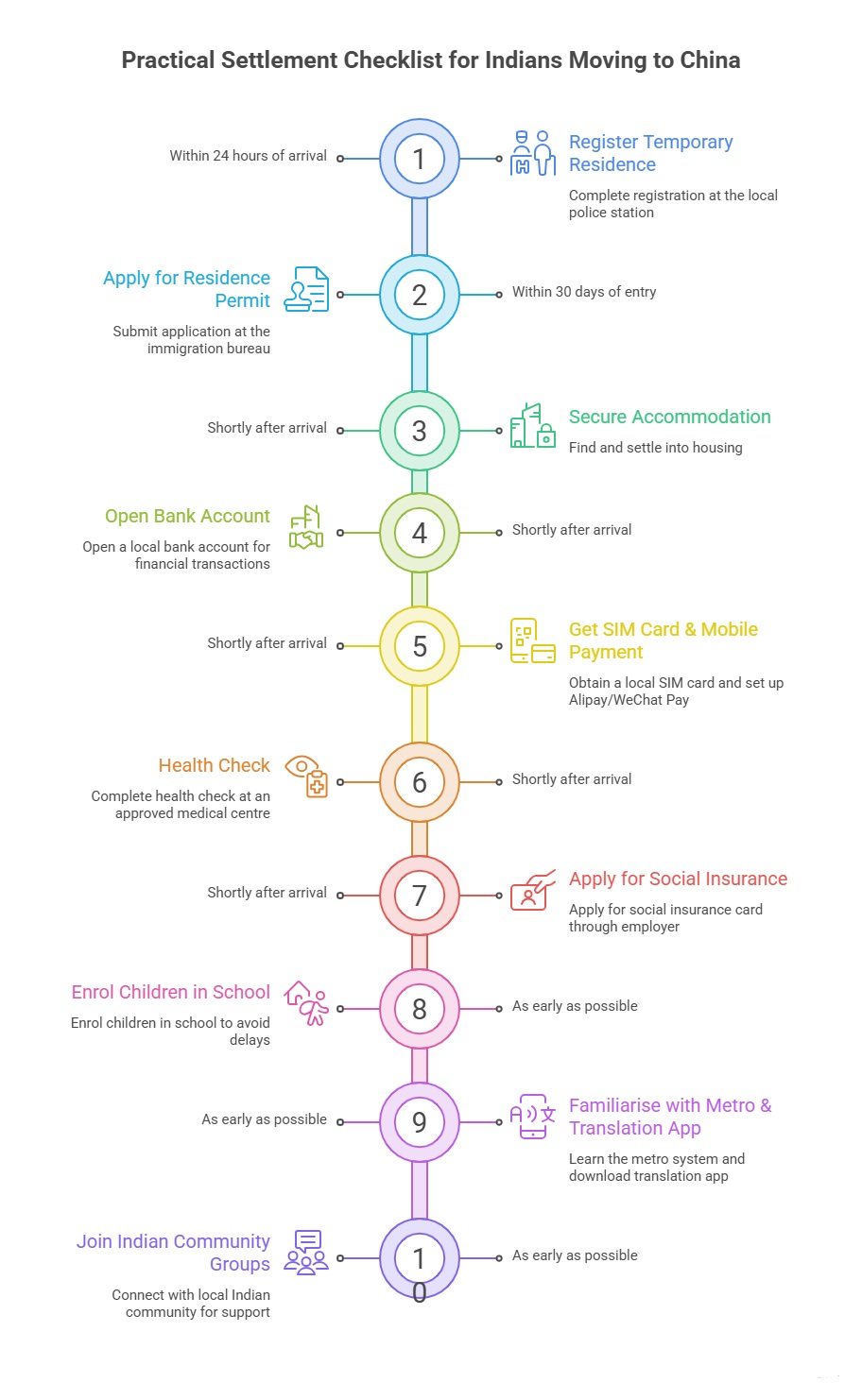
Moving to China involves a few key steps. Complete them in order to avoid delays.
Follow the steps below for a smooth move to China:
Step 1: Register your temporary residence at the local police station within 24 hours of arrival
Step 2: Complete your health check at an approved medical centre for your residence permit
Step 3: Apply for your residence permit within 30 days of entry
Step 4: Apply for your social insurance card through your employer
Step 5: Open a local bank account
Step 6: Secure accommodation before or shortly after arrival
Step 7: Get a local SIM card and set up a mobile payment app such as Alipay or WeChat Pay
Step 8: Enrol children in school as early as possible
Step 9: Familiarise yourself with the city's metro system and download a translation app
Step 10: Join local Indian community groups for support and networking
*Are you looking for step-by-step assistance with overseas immigration? Contact Y-Axis, the world's No. 1 overseas immigration consultancy!
FAQs
What is the easiest way for Indians to move to China?
For most Indian professionals, the easiest route is the Z Visa combined with a Category B work permit. This covers most skilled roles such as engineers, teachers, and managers. You need a confirmed job offer from a China-registered employer before you apply. Category A is a stronger option if your salary or points score meets the high-talent threshold, since it comes with faster processing and fewer restrictions. Family reunification is open to spouses and children of existing permit holders. The right route depends on your job, salary, and long-term plans.
How long does it take to get permanent residency in China?
Permanent residency in China, known as the Chinese Green Card, does not follow a fixed number of years for everyone. Under the employment track, you generally need about 4 years of continuous work with a strong salary and tax record, including at least 3 years of physical residence. Investors need 3 consecutive years of stable investment. High-level talent can qualify faster through simplified routes. China issues very few green cards each year, so approval also depends on your profile and city.
Is healthcare free for immigrants in China?
China runs a public healthcare system funded through employer and employee contributions. If you work for a registered Chinese employer, you are usually enrolled in basic medical insurance, which covers a share of hospital and outpatient costs. Coverage and reimbursement rates vary by city. Many expats also choose private international health insurance, since public hospitals can involve long waits and language barriers, and emergency evacuation is rarely covered by the public plan. Private cover costs between ¥3,000 and ¥15,000 a year depending on the plan.
What is the average salary for skilled workers in China?
Average salaries in China vary widely by role, sector, and city. Software engineers typically earn between ¥250,000 and ¥500,000 a year. Manufacturing and supply chain engineers earn around ¥200,000 to ¥380,000. English and foreign language teachers usually earn ¥150,000 to ¥300,000. Business development and marketing roles fall in the middle to upper range. Shanghai and Beijing offer the highest salaries but also carry the highest cost of living. IT, teaching, and manufacturing roles offer the strongest pay and sponsorship options for Indian professionals.
Can I bring my family to China on a work visa?
Yes. Most Z Visa and work permit holders can bring their spouse and children through the S1 dependent visa. The dependent visa usually matches the length of the main applicant's permit. Once in China, spouses may apply for their own work authorisation depending on the permit type. Children can attend local public schools once registered, or international schools for a fee. The whole family becomes eligible for public medical insurance registration once they hold a valid residence permit and address.
Which city in China is best for Indian immigrants?
Shanghai is the top choice for most Indian immigrants. It offers the strongest job market in finance, IT, and multinational firms, along with a large expat and Indian business community. However, it also has the highest cost of living in China. Beijing suits those in government-linked or corporate roles. Shenzhen and Hangzhou suit tech and e-commerce professionals, thanks to major firms like Huawei, Tencent, and Alibaba nearby. The best city depends on your job, budget, and lifestyle goals.
How much does it cost to live in China?
Monthly living costs in China are lower than in most major Western cities, though Shanghai and Beijing rank among the more expensive cities in Asia. In these two cities, a single person can expect to pay ¥6,000 to ¥11,000 for a one-bedroom apartment in the city centre. Utilities cost ¥300 to ¥500, and groceries run ¥1,500 to ¥2,200. Total monthly costs, excluding rent, are usually ¥3,000 to ¥4,500. Cities outside the top tier, such as Chengdu and Xi'an, cost noticeably less while still offering a good standard of living.
What is the Category A work permit in China?
The Category A work permit is China's fast-track route for high-level foreign talent. It covers top executives, renowned specialists, and professionals who meet a high salary or points-based threshold. Category A applicants skip some of the standard checks needed for Category B and C permits and get faster processing, often about five working days quicker. This category also offers exemptions from certain age, education, and experience requirements and provides a faster path toward long-term residence compared to standard work permits.
Do I need to speak Mandarin to live in China?
No, Mandarin is not required for daily life in international districts of Shanghai, Beijing, and Shenzhen. Many multinational workplaces, especially in IT and finance, use English. However, Mandarin helps significantly with tasks like banking, government paperwork, healthcare visits, and daily errands outside major expat areas. Most public signage, menus, and official forms are in Chinese only. Learning basic Mandarin phrases and using a translation app makes daily life much easier and helps you integrate faster into local communities.
Can I apply for Chinese citizenship after getting permanent residence?
Technically yes, but it is rare in practice. Chinese citizenship requires giving up your existing nationality, since China does not recognise dual citizenship. Approval generally depends on close family ties to Chinese citizens or exceptional, case-by-case circumstances, rather than a fixed number of years of permanent residence. Most immigrants who build a long-term life in China choose to remain permanent residents rather than pursue citizenship, since the Green Card already offers most of the practical rights of citizenship without giving up their original passport.
Tags:
China immigration
China work visa
China Green Card
Living in China
Cost of living in China
Best cities in China
Jobs in China for Indians
Healthcare in China
Housing in China
Settle in China
Share
Options for you by Y-Axis

Get it on your mobile

Get News alerts

Contact Y-Axis
Latest Article
Popular Post
Trending Article

Posted On October 16 2026
Australia Updates Health Insurance Guidance for Visa Holders: What You Need to Know