


Posted on September 04 2026
How to Apply for a China Work Visa From India?

By , Editor
Updated September 05 2026
Applying for a China work visa from India requires you to first secure a job offer from a Chinese employer. The employer applies for a Work Permit Notification through China's Foreigner's Work Management Service System. Once approved, you apply for a Z Visa at a Chinese Visa Application Service Centre (CVASC) in India. After entering China, you must convert your Z Visa into a work-based residence permit within 30 days at the local Entry-Exit Administration Bureau. A China work visa is officially called the Z Visa, issued by a Chinese embassy or consulate. It only allows entry into China; it does not by itself authorise long-term stay or employment. Indian STEM graduates can also apply through the newer K-Visa, which does not require a job offer.
*Want to apply for a China work visa? Let Y-Axis assist you with the process.
How to Apply for a China Work Visa From India?
To apply for a China work visa, foreign professionals should secure a job offer from a Chinese employer. The Chinese employer then applies for a Work Permit Notification on your behalf, before you apply for the Z Visa in India and convert it into a residence permit after arrival.
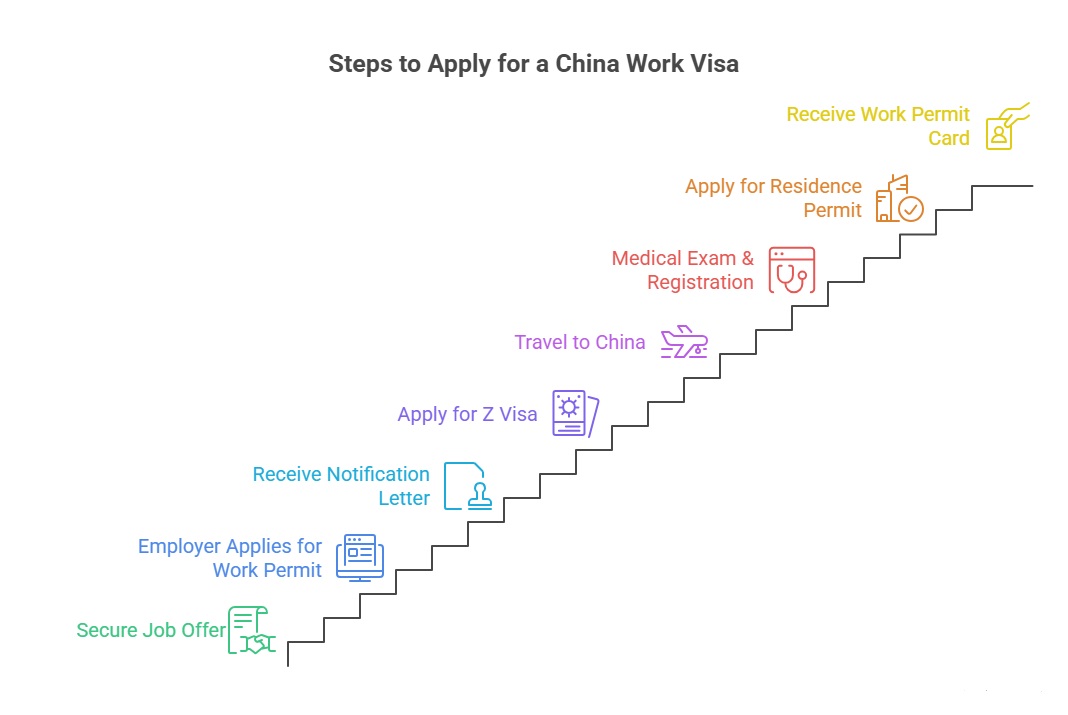
The steps to apply for a China work visa for Indians are as follows:
Step 1: Secure a job offer from a Chinese employer.
Step 2: The employer submits Work Permit Notification application through China's Foreigner's Work Management Service System.
Step 3: Once approved, collect the Notification Letter of Foreigner's Work Permit from your employer.
Step 4: Apply for the Z Visa at your nearest Chinese Visa Application Service Centre (CVASC) in India.
Step 5: Travel to China using your approved Z Visa.
Step 6: Complete a medical examination and register your residence.
Step 7: Apply for your work-based residence permit within 30 days of arrival, at the local Entry-Exit Administration Bureau.
Step 8: Receive your Foreign Work Permit Card, confirming your legal right to stay and work in China.
Also, read...
What are the Most In-Demand Jobs in China for the Next 10 Years?
Requirements for the China Work Visa
Before you apply for a China work visa from India, you must meet certain eligibility conditions and prepare the right documents. The process is largely employer-driven for the standard Z Visa, so most conditions relate to your job offer and your sponsoring company. The list below combines the key eligibility conditions and documents required for a China work visa from India.
- A valid job offer or signed employment contract from a Chinese employer.
- Work Permit Notification issued through China's Foreigner's Work Management Service System.
- A valid passport with at least 6 months' validity and two blank pages.
- Educational certificates and professional qualifications, often required in attested or translated form.
- Work experience letters relevant to your job role.
- Passport-size photographs meeting Chinese visa specifications.
- Proof of accommodation in China.
- Medical examination certificate, confirming fitness to work.
- Police clearance certificate, showing no criminal record.
- Health insurance, generally arranged after arrival.
Also, read...
Cost of Applying for a China Work Visa From India
The total cost of a China work visa from India is lower than many other countries, but includes a few separate charges. Most costs relate to the visa fee, medical examination, and document processing before and after arrival.
The table below shows the approximate fee for each stage, based on current 2026 rates.
|
Cost Item |
Fee (INR) |
Notes |
|
Z Visa / K-Visa Fee |
INR 7,000-12,000 |
Varies by visa type and CVASC location |
|
CVASC Service Charge |
INR 1,200-2,000 |
Payable at the application centre |
|
Document Translation |
Varies |
Required for documents not in English or Chinese |
|
Medical Examination |
Varies by clinic |
Required before or after arrival |
|
Police Clearance Certificate |
Varies by state |
Required as part of the visa application |
|
Residence Permit Fee (after arrival) |
Payable in China |
Charged after Z Visa conversion |
*Are you looking for step-by-step assistance with overseas immigration? Contact Y-Axis, the world's No. 1 overseas immigration consultancy, for end-to-end assistance!
FAQs
Can I apply for a China work visa without a job offer?
Yes, through the China K-Visa. Launched in October 2025, the K-Visa allows young STEM professionals with at least a bachelor's degree to enter China without a confirmed job offer or employer sponsorship. Applications are submitted through the COVA (China Online Visa Application) system. The standard Z Visa route still requires an employer to first secure a Work Permit Notification before you can apply.
What is the processing time for a China work visa from India?
China work visa processing generally takes 2 to 6 weeks, though the exact timeline depends on the visa type, document verification speed, and the workload at the relevant Chinese Embassy or CVASC. Z Visa applications follow the standard timeline, since the employer must first secure a Work Permit Notification. K-Visa applications, aimed at STEM professionals, typically receive priority processing and may be completed faster.
What is the 30-day rule after entering China on a Z Visa?
After entering China on a Z Visa, you must apply for a work-based residence permit within 30 days, at the local Entry-Exit Administration Bureau. The Z Visa itself only authorises entry; it does not permit long-term stay or employment on its own. Missing this 30-day conversion window can lead to visa status complications, including the risk of being treated as an overstayer.
Do I need a medical test for a China work visa?
Yes. A medical examination certificate is a standard requirement for China work visa applicants, confirming that you are fit to work. Depending on your employer and city, this test may be completed before departure or after you arrive in China. Some categories of workers, particularly in healthcare or food-related roles, may require additional health screenings before their residence permit is approved.
Can my spouse and children join me in China?
Yes. Family members of foreign workers can apply for S1 or S2 visas, which allow them to accompany or join the primary visa holder in China. These are separate from the work visa categories, such as the Z Visa or K-Visa, and are specifically designed for dependants. You will generally need to provide proof of your relationship and your own valid work visa or residence permit status.
What is the difference between the Z Visa and K Visa?
The Z Visa is a standard work visa that requires a confirmed job offer, with your employer first securing a Work Permit Notification on your behalf. The K-Visa, launched in October 2025, does not require a job offer or employer sponsorship and is designed for young STEM professionals holding at least a bachelor's degree. K-Visa applications are submitted through the COVA system, while Z Visa applications follow the standard employer-led route.
Is a Chinese work visa the same as a work permit?
No. The Z Visa or K-Visa is your entry document, allowing you to travel to China for work purposes. After arrival, you must convert this visa into a work-based residence permit, which is the document that actually authorises you to live and work in China long-term. Some foreign professionals may also apply for a Foreign Expert Certificate, a separate work permit category issued inside China for specialised roles.
Can I switch employers while on a China work visa?
Changing employers while on a China work visa generally requires your new employer to apply for a fresh Work Permit Notification and update your residence permit accordingly. Working for a different employer without updating your status is not permitted under Chinese immigration rules. Requirements can vary depending on your visa category and city, so confirm the exact process with your new employer or the local Entry-Exit Administration Bureau.
What happens if my China work visa application is rejected?
If your Z Visa or K-Visa application is rejected, the Chinese Embassy, consulate, or COVA system will typically indicate the reason, such as incomplete documentation, a missing Work Permit Notification, or a qualification mismatch. You can usually reapply once the issue is resolved. Since visa fees are generally non-refundable, it helps to review all requirements carefully with your employer or a visa consultant before applying.
Does a China work visa lead to permanent residency?
Yes, though it typically requires several years of stable employment, a clean legal record, and continued employer support. Most foreign professionals must work in China for an extended period before becoming eligible for long-term residence. Highly skilled workers on the K-Visa or R-Visa may qualify for comparatively faster pathways. China's PR status allows long-term stay, easier job changes, and family reunification.
Tags:
China work visa
China Z visa
China work visa from India
China K visa
Work Permit Notification
work in China
China visa requirements
China immigration for Indians
Share
Options for you by Y-Axis

Get it on your mobile

Get News alerts

Contact Y-Axis
Latest Article
Popular Post
Trending Article

Posted On October 16 2026
Australia Updates Health Insurance Guidance for Visa Holders: What You Need to Know