


Posted on May 28 2026
Can I Change My Course or University After Getting a Student Visa?

By , Editor & Director
Updated May 30 2026
Many international students apply for a student visa with one university or course in mind, only to later realize that they may want to make a change. Some students receive admission from a better-ranked university after visa approval, while others discover that their chosen course does not match their career goals, budget, or future PR plans. In some cases, students may even find better job opportunities, scholarships, or migration pathways through another institution or program.
This often leads to one important question: Can you change your course or university after getting a student visa? The answer is yes, but the rules depend completely on the country where you plan to study and the type of change you want to make. While some countries allow students to transfer universities quite easily, others require immigration approval, updated student documents, or even a completely new visa application.
Making the wrong move without following the proper process can create serious immigration problems. In many countries, changing your course or institution incorrectly can lead to visa cancellation, future visa refusals, loss of work rights, PR issues, or even illegal stay status. That is why students must clearly understand the immigration and university transfer rules before making any decision. In this guide, we explain the complete rules for changing your course or university after getting a student visa in major study destinations such as Canada, Australia, the UK, the USA, Germany, Ireland, and New Zealand. You will also learn how these changes can affect your visa status, work rights, and future PR opportunities, along with the correct process to follow in each country.
*Need assistance to Study Abroad? Y-Axis is here to assist you in all ways.
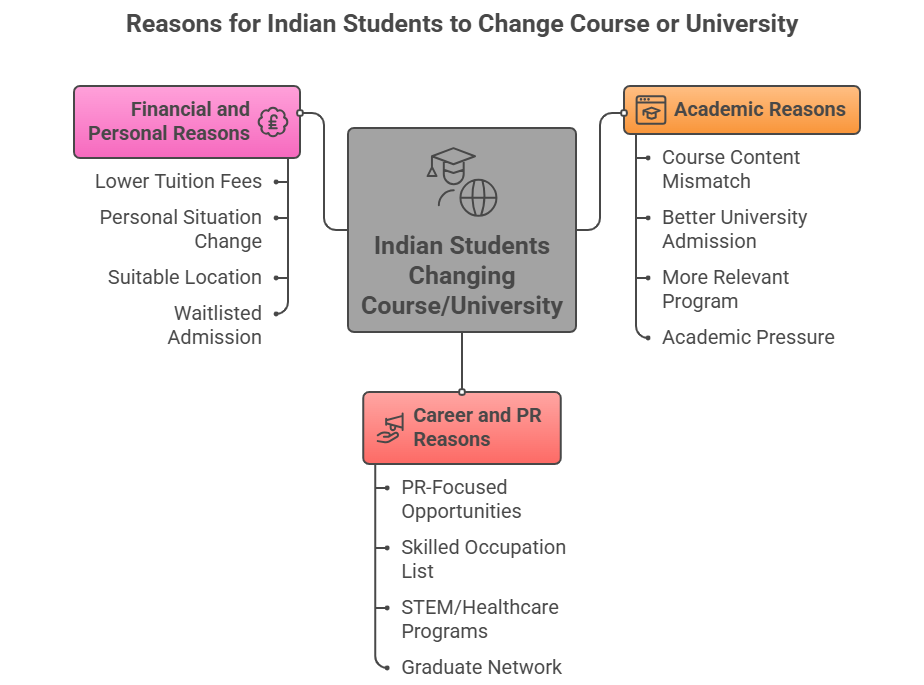
Why Do Indian Students Want to Change Their Course or University?
Many international students decide to change their course or university after getting their student visa. This can happen for academic, career, financial, or personal reasons. Immigration authorities usually accept these changes if the student has a genuine reason and follows the correct process.
Academic Reasons
- The course content or quality did not match expectations after arrival
- A better-ranked university offered admission after the visa was issued
- The student discovered a more relevant program for their career goals
- Academic pressure at the current institution became difficult to manage
Career and PR Reasons
- A different course offers better PR-focused career opportunities, especially in countries like Canada and Australia
- The student discovered that their chosen field is not included in the skilled occupation list
- A STEM or healthcare program offers better post-study work opportunities
- Better job opportunities are available through another university’s graduate network
Financial and Personal Reasons
- A different institution offers lower tuition fees or scholarships
- The student’s personal or family situation changed
- Another city or location is more suitable for the student
- The student received admission from a university where they were earlier waitlisted
All these are generally accepted as valid reasons by immigration authorities when properly explained and supported with documents.
Important Things Students Must Know Before Changing Their Course or University
Before changing your course or university, international students must understand some important immigration rules. Ignoring these rules can create serious visa and immigration problems in the future.
- Your student visa depends on your enrollment status
In most countries, your student visa is linked to the course and university mentioned in your visa application. If you stop attending classes or leave your course without proper approval, your visa may become invalid. - You must inform immigration authorities about major changes
Many countries require international students to inform immigration authorities or their university if they change their course, institution, study level, or course duration. - Your student documents may need to be updated
Different countries use different student documents.- UK: CAS (Confirmation of Acceptance for Studies)
- Australia: COE (Confirmation of Enrolment)
- USA: Form I-20
- These documents must match your current course and university details. Incorrect or outdated information can cause immigration problems.
- Changing to a lower level course can create problems
Moving from a master’s degree to a diploma or certificate course without a valid reason may raise concerns with immigration authorities. They may think the student visa is not being used for genuine study purposes. - Your attendance record is important
Many countries require international students to maintain good attendance. For example, Australia usually requires around 80% attendance. Poor attendance combined with a transfer request may affect your visa status. - Changing your course can affect your PR opportunities
In countries like Canada and Australia, your course plays an important role in future PR pathways and post-study work visas. Changing your course in the middle of your studies may affect your eligibility for PR or work permits.
Country-Wise Rules for Changing Course or University After a Student Visa
Canada Study Permit
Canada is one of the easiest countries for international students who want to change their course or university. However, students still need to follow the rules set by Immigration, Refugees and Citizenship Canada (IRCC).
Can You Change Your University or Course in Canada?
Yes. Students in Canada can change their course, college, or university. But in some cases, you may need to update your study permit or apply for a new one. You are allowed to change your Designated Learning Institution (DLI) or your study program. However:
- If you move to a new college or university, you usually need a new Provincial Attestation Letter (PAL) or Territory Attestation Letter (TAL).
- If you change your level of study, you may need to apply for a new study permit.
Changing Programs in the Same Institution
If you change your course within the same college or university and stay at the same study level, for example, changing from one bachelor’s program to another bachelor’s program, you usually do not need a new study permit. Still, it is recommended to update your details in your IRCC online account.
Changing to a Different Institution
If you move to a different college or university:
- The new institution must be an approved Designated Learning Institution (DLI).
- You will usually need a new PAL or TAL from the new institution.
- You must update your information with IRCC.
Changing Your Study Level
If you change your level of education, such as moving from a diploma program to a bachelor’s degree or from a bachelor’s degree to a master’s degree, you will usually need to apply for a new study permit in Canada. This is because the Canadian immigration authorities treat a change in study level as a major academic change that may require updated approval and documents.
PGWP Impact
Your Post-Graduation Work Permit (PGWP) length depends on the program you complete.
- If you transfer and start a completely new program, your PGWP calculation may restart from the beginning.
- If you change programs at the same level and complete the full course, the PGWP length is usually based on the completed program duration.
PR Impact
Changing your course can also affect your future Permanent Residency (PR) opportunities in Canada. Some Canadian PR programs give more preference to students who graduate in high-demand fields such as healthcare, STEM (Science, Technology, Engineering, and Mathematics), and skilled trades. If you switch from one of these in-demand courses to a less preferred field, your CRS score and PR eligibility may become lower, which can reduce your chances of getting Canadian PR in the future.
| Factor | Details |
|---|---|
| Allowed to Change University? | Yes |
| Need New Visa/Permit? | Sometimes, depending on the course level and institution |
| Need Immigration Approval? | You must update your IRCC account |
| PR Impact | Can affect your future PR options and PGWP duration |
| Work Rights Affected? | No, part-time work rights continue with a valid permit |
| Risk Level | Low to Medium |
| Important Rule | The new institution must be an approved DLI |
*Want to study in Canada? Contact Y-Axis for complete guidance
Australia Student Visa (Subclass 500)
Can Students Change Universities in Australia After Getting a Student Visa?
Australia has strict rules for international students who want to change their university or course. These rules are managed under the ESOS Act and the National Code of Practice 2018. Students cannot simply leave one university and join another without permission from their current institution. If you want to move to a new university or college in Australia, your current education provider must give you a Release Letter. This letter allows you to transfer to another institution. Your current provider will check whether the transfer is good for your studies before approving it. Transfers are more difficult during the first six months of your main course because Australian rules try to prevent unnecessary course changes.
Transfers After Six Months
Changing institutions becomes easier after completing the first six months of your main course. However, your current provider can still refuse the transfer if they have valid academic reasons.
Do You Need a New Student Visa?
You may need a new Australia Student Visa (Subclass 500) if your new course is longer than the validity of your current visa.
- If the new course duration is covered under your existing visa, you usually do not need a new visa.
- If the course extends beyond your current visa expiry date, you must apply for a new student visa.
ESOS Rule Updates
Australia introduced stricter student transfer rules in December 2025.
- Universities and colleges must now report student enrolment changes immediately through the PRISMS visa system.
- Agent commissions for onshore student transfers have been restricted to reduce unnecessary transfers made for financial reasons.
- Immigration officers now closely check whether the course change shows proper academic progress.
Subclass 485 Visa Impact
Australia’s Temporary Graduate Visa (Subclass 485) is linked to the successful completion of your main course in Australia. If you change your main course and start a new one from the beginning, your eligibility for the 485 visa will be based on the completion date of the new course. This can delay your post-study work rights by several months or even years.
PR Impact
Australia’s PR pathways, such as Subclass 189 and Subclass 190 visas, are connected to skilled occupation lists. If you change from a course linked to an occupation on the Medium and Long-term Strategic Skills List (MLTSSL) to a course that is not on the list, your chances of getting Australian PR may become lower and your migration pathway may become more difficult.
| Factor | Details |
|---|---|
| Allowed to Change University? | Yes, but you need a Release Letter from your current provider |
| Need New Visa/Permit? | Only if the new course is longer than your current visa validity |
| Need Immigration Approval? | Your provider reports the change to the Department of Home Affairs |
| PR Impact | Can affect Subclass 485 eligibility if you change your main course |
| Work Rights Affected? | No, work rights depend on your visa, not your course |
| Risk Level | Medium to High, especially during the first 6 months |
| Important Rule | Do not withdraw on your own without getting a Release Letter |
*Want to study in Australia? Contact Y-Axis for complete guidance
UK Student Visa
Can Students Change Universities in the UK After Getting a Student Visa?
The UK Student Visa system is very strict compared to many other countries. Your visa is connected to a CAS (Confirmation of Acceptance for Studies), which is linked to a specific university, course, and study level. Because of this, changing your course or university can directly affect your visa status. If you change to a course at the same study level and the new course is equal to or shorter than your current course, your existing visa may still remain valid.
However, if you:
- Change to a longer course
- Move to a higher level of study
- Transfer to a different university
you will usually need a new CAS and a new UK Student Visa.
Changing Courses in the Same University
In some cases, students can change courses within the same university without applying for a new visa. The university’s international student office will check whether your current CAS still covers the new course. If it does not, the university may issue a Continuer CAS.
Changing to a Different University
If you want to move to another university in the UK:
- The new university must be approved by UKVI as a licensed sponsor.
- You must get a new CAS from the new institution.
- You must apply for a new Student Visa before leaving your current course.
Students should not withdraw from their present course until the new visa is approved.
Placement Year or Integrated Master’s
If your university adds a placement year or upgrades your program into an integrated master’s degree, you may be able to extend your visa from inside the UK without leaving the country.
UK Immigration Update
Under the UK Government’s 2025 Immigration White Paper, immigration officers are now checking students more carefully if they change universities multiple times without clear academic progress. Students moving to lower-ranked or newer universities may face higher scrutiny from UK immigration authorities.
Graduate Route Visa Impact
The UK Graduate Route Visa allows international students to stay and work in the UK after completing their studies. To qualify, students must successfully complete their course at a UKVI-approved institution. If a student leaves their course or transfers without proper approval, they may lose eligibility for the Graduate Route Visa.
PR Impact
The UK’s long-term immigration pathways, such as the Skilled Worker Visa and Indefinite Leave to Remain (ILR), require proof of continuous legal stay in the UK. If a student changes their course or university without proper visa approval and becomes an illegal overstayer, it can negatively affect future UK visa and PR applications permanently.
| Factor | Details |
|---|---|
| Allowed to Change University? | Yes, but you need a new CAS and usually a new visa |
| Need New Visa/Permit? | Usually yes |
| Need Immigration Approval? | Yes, through a new UK Student Visa application |
| PR Impact | Graduate Route Visa requires successful course completion |
| Work Rights Affected? | Yes, stopping classes without approval can lead to visa problems |
| Risk Level | High if done without proper CAS and visa approval |
| Important Rule | The new university must be a UKVI-licensed sponsor |
*Want to study in UK? Contact Y-Axis for complete guidance
USA F-1 Student Visa
Can Students Transfer Universities in the USA After Getting an F-1 Visa?
The USA is one of the most flexible countries for international students who want to change universities. The F-1 visa is not directly tied to one university. Instead, student records are managed through the SEVIS system (Student and Exchange Visitor Information System). However, students must follow the correct transfer process carefully to avoid problems with their F-1 visa status. F-1 students are allowed to transfer to another SEVP-certified school in the USA. The transfer process is handled through the SEVIS system by the Designated School Officials (DSOs) of both institutions. Students usually do not need a new visa stamp if they remain inside the USA and maintain valid F-1 status.
University Transfer Process
To transfer to another university in the USA, students must follow these steps:
- Inform the current school’s DSO about the transfer plans
- Receive admission from a new SEVP-certified school
- The current DSO sets a SEVIS Transfer Release Date
- The new school issues a new Form I-20
- The student must begin classes at the new school within 5 months of the last class at the previous institution
Changing Your Major
F-1 students can currently change their major or field of study freely as long as they continue studying full-time and maintain valid visa status.
Proposed DHS Rule Changes (2025–2026)
In 2025, the US Department of Homeland Security proposed new rules that may stop undergraduate F-1 students from changing their major or transferring universities during their first year of study. As of mid-2026, these rules were still under review. Students should always confirm the latest rules with their DSO before making any changes.
OPT and STEM OPT Impact
Optional Practical Training (OPT) and STEM OPT extension eligibility are connected to graduating from an SEVP-certified school. Changing universities does not usually affect OPT eligibility as long as the student successfully graduates from the new institution.
PR Impact
US permanent residency pathways, such as employment-based Green Cards, are mainly connected to employer sponsorship rather than the university itself. However, graduating from a well-known US university, especially in a high-demand STEM field, can improve job opportunities and may help students move faster toward long-term work and Green Card opportunities in the USA.
| Factor | Details |
|---|---|
| Allowed to Change University? | Yes, through the SEVIS transfer process |
| Need New Visa/Permit? | No new visa stamp needed, but a new Form I-20 is required |
| Need Immigration Approval? | SEVIS must be updated, but no USCIS application is usually needed |
| PR Impact | Green Card pathways depend more on employer sponsorship than the university |
| Work Rights Affected? | OPT eligibility continues after graduation from the new school |
| Risk Level | Low if the SEVIS transfer process is followed correctly |
| Important Rule | The new university must be SEVP-certified |
*Want to study in USA? Contact Y-Axis for complete guidance
Germany Student Residence Permit (Section 16b, Residence Act)
Can Students Change Universities in Germany After Getting a Student Visa?
Germany is more flexible than many countries when it comes to changing universities or courses. International students studying under Section 16b of the German Residence Act can usually change their university or program, especially during the early stage of their studies. However, students must still follow immigration and enrollment rules carefully. Students are generally allowed to change their university or degree course once during the first three semesters (18 months) without getting prior approval from the Foreigners' Authority (Ausländerbehörde), as long as the new course is in a related field of study. For example, changing from Mechanical Engineering to Civil Engineering is usually accepted because both are related fields.
Changes After 18 Months
After completing the first three semesters, changing your university or course becomes more strict. Students must inform the Foreigners' Authority about the change, and approval may be required, especially if the new course is very different from the previous one.
Changing to a Completely Different Field
If a student changes to a completely unrelated field, such as moving from Engineering to Social Sciences, German immigration authorities may treat it as a change in the purpose of stay. In such cases, the student may need to apply for a new residence permit.
Important 90-Day Gap Rule
Students should not have a gap of more than 90 days between leaving their old university and enrolling in the new one. A longer gap can create problems with the student residence permit and may even lead to cancellation of the permit.
Changes Before Visa Approval
Since January 2025, Germany’s Consular Services Portal has digitally linked student visa applications to the university mentioned in the original application. If a student changes universities before the visa is issued, they may need to restart the visa application process.
PR and EU Blue Card Impact
Germany’s common PR pathway for international graduates is through the EU Blue Card system. To qualify, students must complete their degree and get a job offer that meets the required salary level. If a student changes courses or universities and delays graduation, their EU Blue Card eligibility and permanent residency timeline will also be delayed.
| Factor | Details |
|---|---|
| Allowed to Change University? | Yes, usually once within the first 18 months in a related field |
| Need New Visa/Permit? | Sometimes, especially if the field changes completely |
| Need Immigration Approval? | Students must inform the Foreigners' Authority |
| PR Impact | Delays graduation, which can delay Blue Card and PR eligibility |
| Work Rights Affected? | Work rights depend on the residence permit, not the university |
| Risk Level | Low to Medium if rules are followed correctly |
| Important Rule | Do not keep an enrollment gap of more than 90 days |
*Want to study in Germany? Contact Y-Axis for complete guidance
Ireland Student Permission (Stamp 2)
Can Students Change Universities in Ireland After Getting a Student Visa?
International students in Ireland study under a Stamp 2 student permission issued by the Irish immigration authorities. Students are allowed to change their university or course, but certain immigration rules must be followed carefully. Students can change their course or institution in Ireland if the new institution is approved under the Irish immigration system and the course qualifies for Stamp 2 permission. The new course must be offered by a recognized institution and must appear on the official list of approved programs.
Changing Your Institution
Students usually do not need a new visa when changing institutions inside Ireland. However, the change must be updated with Irish immigration authorities. The new university or college must be approved by the Irish immigration system.
Course Level Rules
Stamp 2 permission only allows students to study approved higher education programs. For example, if a student changes from a degree program to a short-term language course that does not qualify under Stamp 2 rules, they may need to change their immigration permission status.
Important Update
Ireland introduced stricter checks on private colleges during 2024–2025. Students should confirm that the new institution is still on the approved provider list before transferring, because some private colleges have had their approvals reviewed or removed.
PR Impact
Ireland’s long-term residency options are based on continuous legal residence in the country. If a student changes courses without proper approval and loses legal immigration status, it can affect future residency applications. Graduates from approved programs may later become eligible for graduate employment opportunities in Ireland.
| Factor | Details |
|---|---|
| Allowed to Change University? | Yes, if the new institution is approved |
| Need New Visa/Permit? | No, but immigration authorities must be informed |
| Need Immigration Approval? | Registration details must be updated with Irish immigration |
| PR Impact | Long-term residency requires continuous legal stay |
| Work Rights Affected? | Students can continue working 20 hours per week with a valid Stamp 2 |
| Risk Level | Medium, because the institution must be approved |
| Important Rule | The new course must qualify for Stamp 2 permission |
*Want to study in Ireland? Contact Y-Axis for complete guidance
New Zealand Student Visa
Can Students Change Universities in New Zealand After Getting a Student Visa?
New Zealand allows international students to change their course or institution, but immigration approval is often required before the change can happen. The rules are managed by Immigration New Zealand (INZ).
Official Rules
If a student changes to a different course within the same institution and the current visa is valid for the new course duration, they may apply for a variation of conditions instead of a completely new visa. However, if the student changes institutions or the new course is longer than the current visa validity, a new student visa is usually required.
Changing to a Different Institution
From 2026, most students changing to a different university or college in New Zealand will need a new student visa.
Students must:
- Get an offer letter from the new institution
- Apply for immigration approval
- Wait for approval before leaving the current institution
Students should not withdraw from their current university until INZ approves the change.
Duration Rules
New Zealand does not allow visa duration extensions through a variation of conditions. If the new course is longer than the current visa validity, even by a small amount, the student must apply for a new student visa.
PR Impact
New Zealand’s Skilled Migrant Category gives points for qualifications earned in New Zealand. If changing courses delays graduation or results in a lower-level qualification, it may reduce the points available for future New Zealand residency applications.
| Factor | Details |
|---|---|
| Allowed to Change University? | Yes, but a new visa is needed in most cases |
| Need New Visa/Permit? | Yes, if changing institution or extending study duration |
| Need Immigration Approval? | INZ approval is required before the change |
| PR Impact | Can affect Skilled Migrant Category points |
| Work Rights Affected? | Part-time work rights continue with a valid visa |
| Risk Level | Medium if rules are not followed correctly |
| Important Rule | Do not leave your current institution before INZ approval |
*Want to study in New Zealand? Contact Y-Axis for complete guidance
What Happens If You Change Your Course or University Without Informing Immigration?
Changing your course or university without informing immigration authorities can create very serious problems for international students. Many students think that studying at any institution is enough to keep their visa valid, but immigration rules do not work that way.
- Visa Cancellation: In countries such as the UK, Australia, and New Zealand, your student visa can be cancelled if immigration authorities find out that you are no longer studying at the institution connected to your visa. In some cases, the visa can be cancelled immediately, even without a warning.
- Deportation Risk: If your visa is cancelled while you are still in the country, immigration authorities may ask you to leave the country immediately. Some students may receive a removal or deportation order for transferring universities without proper approval.
- Future Visa Problems: A visa violation or cancellation stays in your immigration history permanently. This can affect future visa applications not only for the same country but also for other countries such as Canada, Australia, the UK, and the USA, because many countries share immigration information with each other.
- PR and Immigration Problems: If you plan to apply for Permanent Residency (PR) in the future, immigration authorities will check your full visa history. Even a short period of illegal stay or visa violation can negatively affect your PR application and may sometimes lead to rejection.
- Illegal Stay Status: If your approved enrollment ends and you continue studying at another institution without proper approval, you may technically become an illegal resident in that country. Immigration authorities may count the illegal stay period starting from the day your approved course officially ended.
- Universities Must Report Student Changes: Educational institutions are legally required to report student enrollment changes to immigration authorities. For example, in Australia, universities report student course and enrollment updates through the PRISMS system, while in the USA, schools update student records through the SEVIS system. Because these immigration tracking systems are directly connected to educational institutions, it is very difficult for students to hide an unauthorized course change or university transfer from immigration authorities.
*Read more...
Best way to pick study abroad courses
Best Countries With Flexible Student Visa Transfer Rules
Not all countries treat course and university changes the same way. If you are a prospective student choosing a destination partly based on study flexibility, these countries offer the most accommodating transfer rules.
- Canada offers the most flexibility among all top study destinations. The study permit is not locked to a specific institution, and students can change programs within the same DLI at the same level without any permit change. The introduction of graduate-level PAL/TAL exemptions from January 2026 makes Canada even more flexible for master's and PhD students.
- Germany is particularly flexible in the first 18 months. Students who discover a better-fit program or institution within their first three semesters have a clear, structured pathway to transfer without affecting their residence permit — as long as the new field is related and the enrollment gap stays within 90 days.
- USA has one of the smoothest university transfer processes in the world for F-1 students. The SEVIS-based system is designed to accommodate transfers, and no new visa stamp is required. The entire process is handled between the two schools' DSOs. The proposed first-year restrictions (still under review as of mid-2026) would change this somewhat, but the system remains the most transfer-friendly for now.
These three countries are recommended for students who value flexibility in their study plans alongside strong PR and post-study work pathways.
*Want to migrate abroad? Get in touch with experts at Y-Axis to help you with the process!
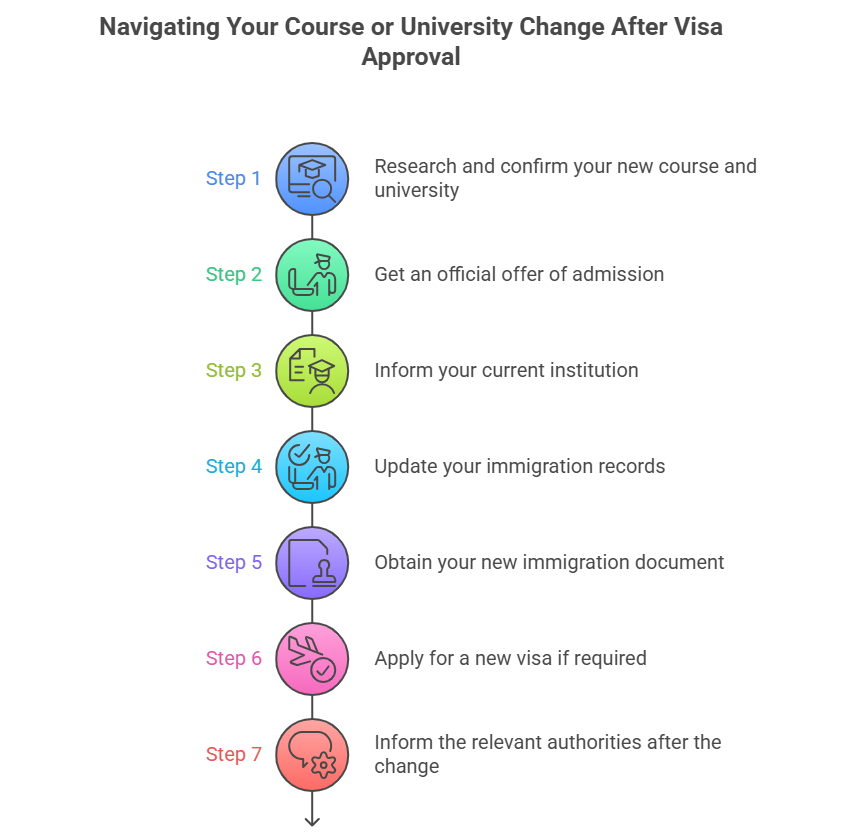
Step-by-Step Process to Change Your Course or University After Visa Approval
Whether you are in Canada, Australia, the UK, or any other country, the general process for changing your course or university follows a logical sequence. Here is a clear step-by-step guide:
Step 1: Research and confirm your new course and university
Before anything else, confirm that the new institution is government-approved (UKVI-licensed, SEVP-certified, DLI-listed, or INIS-approved depending on your country). Verify that the course you want to enrol in is at the appropriate level and meets your visa conditions.
Step 2: Get an official offer of admission
Apply to the new institution and receive a written offer of admission. Do not take any action on your current enrollment until you have this offer in hand.
Step 3: Inform your current institution
Notify your current university's international student office about your intention to transfer. In Australia, formally request a Release Letter from your current provider. In the UK, contact your university about obtaining a Continuer CAS.
Step 4: Update your immigration records
In the USA, contact your DSO to initiate the SEVIS transfer. In Canada, update your information with IRCC through your online account. In Germany, notify the Foreigners' Authority. In New Zealand, submit a variation of conditions application or a new visa application to INZ.
Step 5: Obtain your new immigration document
Depending on your country, this could be a new CAS (UK), a new I-20 (USA), an updated study permit (Canada), a new COE (Australia), or a new student visa (New Zealand). Do not begin studying at your new institution before this document is issued.
Step 6: Apply for a new visa if required
If your country requires a new student visa (UK, Australia in some cases, New Zealand), submit the application with all required documents: new offer letter, updated financial evidence, valid passport, and the new CAS/COE as applicable.
Step 7: Inform the relevant authorities after the change
Once your transfer is complete, update your address and enrollment details with immigration if required. In Germany, formally inform the Foreigners' Authority. In Canada, ensure IRCC reflects your new DLI. Keep all documentation of the change in a safe place.
Common Mistakes Students Make When Changing Course or University
- Withdrawing from the Current Course Before Approval: One of the biggest mistakes students make is leaving their current course before getting official approval from immigration authorities or the university. If you stop studying without proper approval, your student visa may become invalid. Always wait until you receive official confirmation before leaving your current institution.
- Choosing an Unapproved Institution: Some students join colleges or universities without checking whether they are officially approved by the government. Even if the institution looks genuine, studying at an unlicensed or unapproved provider can cause serious visa problems and may even lead to visa cancellation.
- Transferring During the First Six Months in Australia: Australia has strict rules for students who want to transfer during the first six months of their main course. Students who change institutions during this period without approval from their current provider may break their visa conditions.
- Ignoring Post-Study Work Visa and PR Impact: Many students focus only on changing their course or university and forget to check how it may affect their future work visa or Permanent Residency (PR) opportunities. In many countries, changing courses can affect post-study work rights, PR eligibility, and future immigration plans.
- Changing to a Lower Level of Study Without a Strong Reason: Moving from a higher qualification to a lower one, such as from a master’s degree to a diploma, can create immigration concerns. Visa officers may question why the student is moving backward academically. Without a proper explanation, this may negatively affect the student’s immigration status.
- Depending Only on Verbal Confirmation: Some students start attending a new university after receiving only verbal confirmation from the admissions office. However, immigration authorities accept only official written documents such as a CAS, I-20, updated study permit, or formal approval letter. Students should never transfer until they receive proper official documents.
Also read....
Types of exams to study abroad
Tips for Indian Students Changing Course or University Abroad
- Always check the student visa and immigration rules of the country before changing your course or university. Every country has different regulations, and following the correct process is very important.
- Do not leave your current university or stop attending classes until you receive official approval from immigration authorities or your new institution. Leaving early can affect your visa status.
- Make sure the new university or college is officially approved by the country’s immigration authority. Studying at an unapproved institution can create serious visa problems.
- Keep all important documents safely, including admission letters, visa documents, academic records, immigration approvals, and updated enrollment papers.
- Check how the course change may affect your future post-study work visa and Permanent Residency (PR) opportunities. Some countries give better PR benefits for healthcare, STEM, engineering, IT, and skilled trade programs.
- Avoid long study gaps between leaving one institution and joining another. Long enrollment gaps can create immigration issues and may affect your legal student status.
- Always inform immigration authorities or follow the official transfer process when changing institutions. Many countries track student records through immigration systems.
- Avoid changing to a lower-level course without a strong academic reason. For example, moving from a master’s degree to a diploma may create doubts during future visa or PR applications.
- Speak with your university’s international student office or immigration advisor before making any final decision. They can guide you through the proper process.
- Choose a course that supports your long-term career goals instead of selecting a course only because it is easier or cheaper. Your course choice can affect your future job opportunities and settlement options abroad.
Final Thoughts
Changing your course or university after getting a student visa is not just an academic decision it is an immigration decision with long-term consequences. Whether you are in Canada, Australia, the UK, the USA, Germany, Ireland, or New Zealand, the rules are clear: the change is allowed, but only when done through the correct official process, with proper documentation, and with full awareness of the impact on your post-study work rights and PR pathway. The biggest risk is not the change itself it is making the change without following the proper process. Visa cancellations, future visa refusals, PR disqualification, and deportation orders have all resulted from unauthorized course and university transfers that students assumed were harmless. Plan carefully, act through the right channels, and always consult an immigration expert before taking any action. The stakes are high but with the right guidance, a course or university change can be done smoothly and safely.
*Planning your future to study abroad? Contact Y-Axis, the world’s No. 1 overseas immigration consultancy, for end-to-end support!
FAQs
What is the Provincial Nominee Program (PNP) in Canada?
The Provincial Nominee Program (PNP) allows Canadian provinces and territories to nominate immigrants based on their own labour market needs. Each province runs its own streams and draws from its Expression of Interest pool. A successful nomination adds +600 CRS points to your federal Express Entry profile — making an Invitation to Apply virtually certain. PNP is one of the most reliable routes to Canadian permanent residence for skilled workers from India. It is separate from — but works alongside — the federal Express Entry system. Y-Axis can assess your PNP eligibility for free.
Which Canadian province gives PR most easily to Indian professionals?
Saskatchewan, Manitoba, and Nova Scotia are consistently the most accessible provinces for Indian professionals seeking PR. Saskatchewan's SINP uses its own 100-point grid and includes many streams without a job offer requirement. Manitoba's MPNP targets overseas skilled workers through the Labour Market Factor system. Nova Scotia's Labour Market Priorities stream has historically drawn candidates at lower CRS scores than the federal average. Prince Edward Island and New Brunswick also offer accessible entry points with regular draws. The right province for you depends on your occupation, education, and language scores. Y-Axis can match you to the best option.
Can I apply for a Canadian PNP without a job offer?
Yes. Several Canadian PNP streams do not require a Canadian job offer. Saskatchewan's SINP Occupation In-Demand stream allows candidates in listed occupations to apply without employer sponsorship. Manitoba's MPNP Skilled Worker Overseas stream also does not require a job offer in all cases. Alberta's AAIP Accelerated Tech Pathway is open to tech professionals without an offer. Nova Scotia's Labour Market Priorities stream similarly does not always require prior employment in Canada. However, having a job offer — where applicable — significantly boosts your provincial points score. Y-Axis can guide you to the right job-offer-free stream.
What is the CRS score and how does it affect my PNP application?
The Comprehensive Ranking System (CRS) is the federal points grid used in Canada's Express Entry system to rank skilled worker profiles. It scores you on age, education, language ability, work experience, and adaptability. A provincial nomination adds +600 CRS points, which effectively guarantees an Invitation to Apply (ITA) at the next federal draw regardless of your base score. Most provinces also run their own separate scoring systems — meaning a lower federal CRS does not automatically disqualify you at the provincial level. Understanding both scoring systems is key to choosing your fastest route. Y-Axis can calculate your score for free.
How much does it cost to apply for Canadian PR through a province?
Costs vary by province and stream. Provincial nomination fees typically range from CAD 250 to CAD 500 depending on the province. The federal PR application fee through IRCC is CAD 1,365 for the principal applicant, plus CAD 230 as the Right of Permanent Residence fee. Spouse and dependent fees apply separately. Educational credential assessment (ECA) from WES or similar costs approximately CAD 230. Language testing (IELTS) costs approximately INR 16,000–17,000 in India. Total costs for a family of two typically range from CAD 4,000 to CAD 7,000 including all fees. Y-Axis provides a complete cost breakdown.
How long does it take to get PR through a Canadian provincial program?
The total timeline has two stages. First, the provincial nomination stage takes approximately 3 to 6 months depending on the province. Saskatchewan and Nova Scotia are among the fastest at 3 to 5 months. Second, IRCC processes the federal PR application after nomination in approximately 6 to 12 months for Express Entry-linked streams. The total estimated timeline from EOI registration to PR card issuance is typically 9 to 18 months. Incomplete applications, missing documents, or additional verification requests can extend timelines. Starting your ECA and language testing early reduces delays significantly. Y-Axis helps you prepare a complete application from day one.
Is the Saskatchewan SINP a good option for Indian professionals?
Yes. The Saskatchewan Immigrant Nominee Program (SINP) is one of the most popular and accessible PNPs for Indian professionals. It uses a 100-point scoring grid based on education, work experience, language, and adaptability — completely separate from the federal CRS. Many SINP streams, including the Occupation In-Demand stream, do not require a Canadian job offer. Saskatchewan has a persistent shortage of IT professionals, engineers, healthcare workers, accountants, and tradespeople — all common profiles among Indian applicants. Processing time is approximately 3 to 5 months for nomination. Y-Axis has helped hundreds of Indian professionals through the SINP process.
Can I apply for Manitoba MPNP from outside Canada?
Yes. Manitoba's Skilled Worker Overseas stream is specifically designed for applicants living outside Canada. You do not need to be present in Canada to register an Expression of Interest or receive a nomination. Manitoba uses its own Labour Market Factor (LAF) scoring system. Key factors include your occupation, education, language skills, and any connection to Manitoba — such as a close relative, prior study, or a job offer from a Manitoba employer. Overseas applicants with a strong occupational profile in healthcare, IT, manufacturing, or skilled trades are regularly invited. Y-Axis specialises in Manitoba MPNP applications for Indian professionals.
What is the difference between Enhanced PNP and Base PNP?
The Enhanced PNP is linked to Canada's federal Express Entry pool. A province selects a candidate from the Express Entry pool and sends a Notification of Interest. If the candidate accepts, the nomination adds +600 CRS points, guaranteeing an Invitation to Apply at the next federal draw. The Base PNP operates outside the Express Entry system. The province manages its own application portal and EOI pool. Processing under Base PNP is slightly slower — the nominee applies directly to IRCC for PR rather than through Express Entry. Both pathways lead to permanent residence. Y-Axis can advise which track suits your profile.
Does a provincial nomination guarantee Canadian permanent residence?
A provincial nomination does not legally guarantee PR, but it makes approval highly likely. The federal government — through IRCC — makes the final decision on every PR application. However, the approval rate for nominated candidates is consistently above 95%. Receiving a nomination adds +600 CRS points, which ensures an ITA from Express Entry. Once you submit a complete, accurate federal PR application with all required documents, the chances of refusal are very low barring criminal inadmissibility, misrepresentation, or serious medical issues. Starting with a well-prepared application minimises risk significantly. Y-Axis reviews every file for completeness before submission.
What documents do I need for a Canadian PNP application?
Core documents for most PNP applications include a valid passport, an ECA (Educational Credential Assessment) report from WES or IQAS, language test results (IELTS General or CELPIP), employment reference letters on company letterhead, pay stubs and tax records, proof of settlement funds, and police clearance certificates from India and all countries of residence. A job offer letter is required for some streams. Medical examination by an IRCC-designated physician is required at the federal PR stage. Requirements vary by province and stream. Always verify current requirements on the official provincial immigration portal. Y-Axis provides a tailored document checklist.
Which Canadian provinces are best for healthcare professionals from India?
Nova Scotia, Manitoba, and Saskatchewan are the top three provinces for Indian healthcare professionals seeking PR. Nova Scotia's Labour Market Priorities stream regularly invites nurses, healthcare aides, and allied health professionals with targeted draws at lower CRS thresholds. Manitoba's MPNP covers nursing, pharmacy, physiotherapy, and other healthcare occupations in its Skilled Worker in Manitoba stream. Saskatchewan's SINP lists numerous healthcare occupations as in-demand, often without a job offer requirement. British Columbia also has strong demand for nurses and doctors, particularly through the BC PNP Health Authority stream. Y-Axis has dedicated healthcare immigration consultants.
Can my spouse and children get PR with me through a PNP?
Yes. When you apply for Canadian PR, your spouse or common-law partner and dependent children under 22 can be included in your application as accompanying family members. They receive PR status at the same time as you. Your spouse will have full right to work anywhere in Canada once PR is granted. Children can attend Canadian public schools tuition-free as permanent residents. There is an additional IRCC application fee per family member. Some provinces also allow spouses to apply for open work permits during the federal PR processing stage. Y-Axis handles complete family PR applications.
What is the minimum IELTS score required for a Canadian PNP?
Most Canadian PNP streams require a minimum language score equivalent to Canadian Language Benchmark (CLB) 7, which corresponds to an IELTS General Training band score of 6.0 in each module (listening, reading, writing, speaking). However, higher scores improve your CRS points and provincial scoring significantly. A CLB 9 (IELTS 7.0) adds considerably more CRS points than CLB 7. Some provincial streams may accept CLB 5 or 6 for certain trade or low-skilled occupations. CELPIP is accepted as an alternative to IELTS. Y-Axis can help you understand exactly which score you need for your target province and stream.
Can I register with multiple Canadian provinces at the same time?
Yes. Registering an Expression of Interest (EOI) with multiple provincial programs simultaneously is allowed and strongly recommended. Each province has its own EOI pool and draw schedule. Registering with Saskatchewan, Manitoba, and Nova Scotia at the same time maximises your chances of receiving an invitation from whichever province holds a draw first. There is generally no fee for registering an EOI — fees are charged only after you submit a full nomination application. Some provinces require you to declare which province you are applying to, but there is no rule against maintaining profiles in multiple pools. Y-Axis monitors all pools on your behalf.
What happens after I receive a provincial nomination certificate?
Once you receive your provincial nomination certificate, you have two steps remaining. For Enhanced PNP streams — linked to Express Entry — you update your federal Express Entry profile to reflect the nomination. Your CRS score instantly jumps by +600 points and you receive an Invitation to Apply (ITA) at the next federal draw. You then have 60 days to submit a complete PR application to IRCC. For Base PNP streams, you apply directly to IRCC using a paper-based or online process. After IRCC approves your application, you receive your Confirmation of Permanent Residence (COPR) and your PR card arrives by mail. Y-Axis guides every step.
Are there any Canadian PNP streams specifically for international students?
Yes. Several provinces have dedicated PNP streams for international students who graduated from Canadian institutions. British Columbia's BC PNP International Graduate stream targets graduates from BC colleges and universities. Ontario's OINP Masters Graduate and PhD Graduate streams invite recent international graduates. Nova Scotia, New Brunswick, PEI, and Manitoba all have graduate-specific pathways. Saskatchewan's SINP International Graduate stream supports those who studied in Saskatchewan. These streams typically have lower points requirements, recognising Canadian education as a strong integration factor. Graduates with Canadian degrees, diplomas, and post-graduation work permits are well-positioned. Y-Axis assists international graduates returning home.
What is the Alberta Advantage Immigration Program (AAIP)?
The Alberta Advantage Immigration Program (AAIP) is Alberta's provincial nominee program. It has several streams targeting different applicant types. The Accelerated Tech Pathway is designed for software engineers, data scientists, and tech professionals — it does not require a job offer and processes nominations quickly. The Rural Renewal Stream helps smaller Alberta communities recruit immigrants directly. The Alberta Opportunity Stream targets workers already employed in Alberta. The Self-Employed Farmer Stream covers agricultural entrepreneurs. Alberta offers among the highest average salaries in Canada for tech and engineering professionals, with annual earnings often exceeding CAD 85,000. Y-Axis specialises in AAIP applications for Indian professionals.
Can I get Canadian PR without a university degree through a provincial program?
Yes. Several PNP streams do not require a university degree. Trade workers — electricians, welders, plumbers, carpenters, and construction professionals — can qualify through occupation-specific streams in Saskatchewan, New Brunswick, and Manitoba. The key requirements for trade streams are relevant certification, work experience in the trade, and a qualifying language score. A diploma or trade certification is typically sufficient. Some provinces also have streams for food processing workers, truck drivers, and childcare workers. The federal CRS still awards points for higher education, but provincial scoring systems often value work experience equally. Y-Axis can identify the right stream for non-degree applicants.
How can Y-Axis help me get Canadian PR through a provincial program?
Y-Axis Overseas Careers is India's most trusted immigration consultancy with over 25 years of experience and more than 10 lakh clients guided through the process. Our Canada PR specialists assess your CRS score, identify the best matching province, register your EOI, prepare your full documentation, and file both your provincial nomination and federal PR application. We also help with ECA referrals, IELTS preparation, Express Entry profile management, and family visa filing. Our end-to-end support means no missed deadlines, no incomplete files, and no avoidable rejections. Contact us today. Phone: +91-7670800000 | Email: info@y-axis.com | Website: https://www.y-axis.com | Free assessment: https://www.y-axis.com/free-assessment/
📞 Call: +91-7670800000
📩 Email: info@y-axis.com
🌐 Visit: https://www.y-axis.com
Tags:
change university after student visa
change course after study visa
student visa university transfer
transfer university abroad
student visa course change rules
Canada study permit course change
UK student visa transfer rules
Australia student visa
Share
Options for you by Y-Axis

Get it on your mobile

Get News alerts

Contact Y-Axis
Latest Article
Popular Post
Trending Article
Posted On October 09 2026
Canada’s Immigration Reset: Why the Next Move May Be About Fit, Not Volume