

Posted on October 22 2026
Canada vs. UK for Engineers: Which Country Should You Choose?

By , Editor & Director
Updated October 22 2026
Canada and the United Kingdom offer career and settlement opportunities for engineers with relevant qualifications and professional experience. Both countries have engineering jobs across civil, mechanical, electrical, software, chemical, environmental and industrial engineering, as well as construction, infrastructure, manufacturing, energy and technology.
The right destination depends on your engineering specialisation, qualifications, work experience, salary expectations, professional registration requirements and long-term immigration plans. Canada may appeal to engineers seeking permanent residence opportunities and careers in infrastructure, energy, technology and manufacturing. The UK offers opportunities in engineering consultancy, construction, aerospace, advanced manufacturing, renewable energy and technology. Before choosing a country, compare the job market, professional recognition requirements, visa eligibility, living expenses and long-term career prospects.
*Want to migrate abroad? Contact Y-Axis for guidance and assistance with your immigration plans.
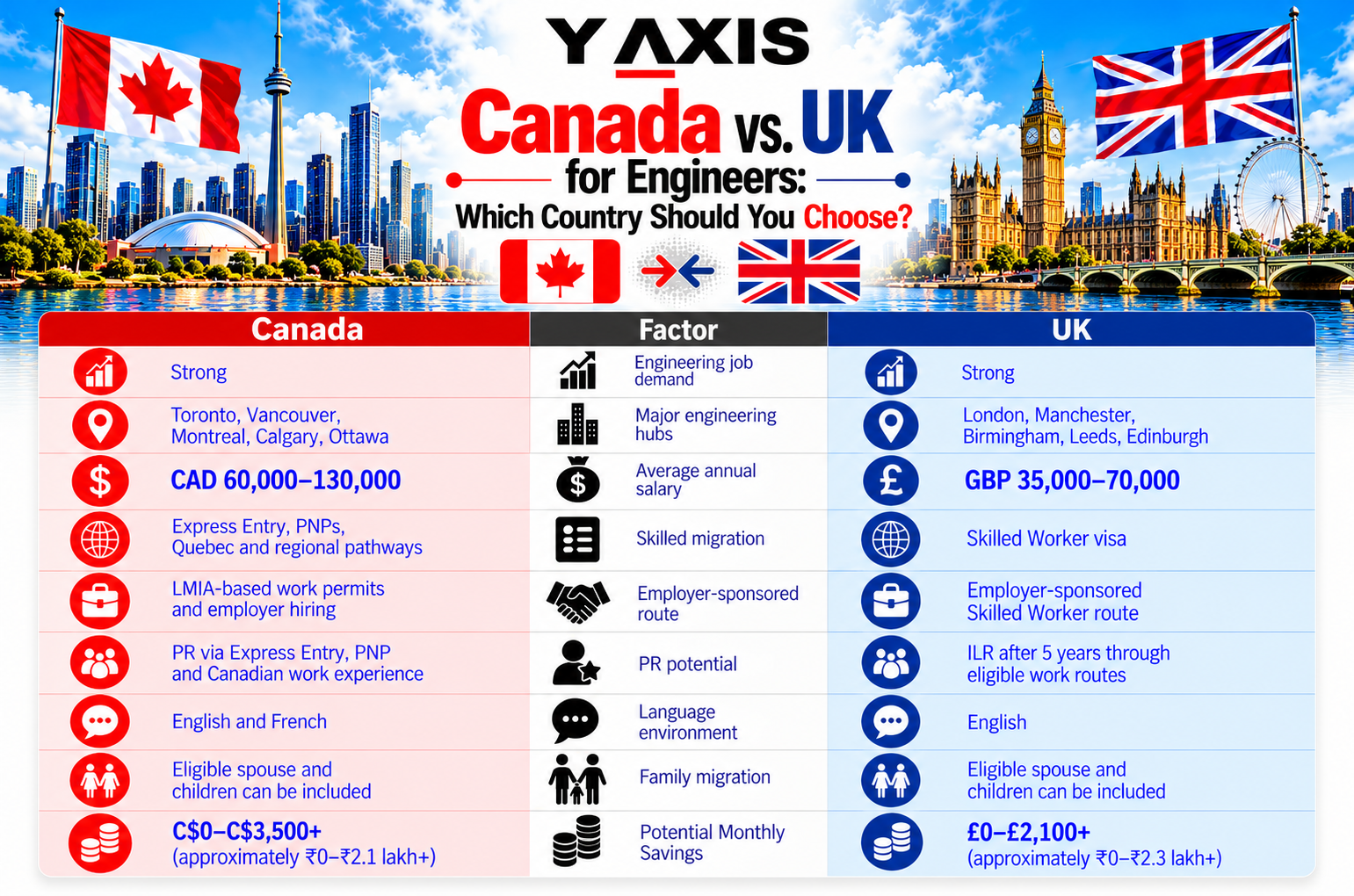
Canada vs. UK for Engineers: Quick Comparison
|
Factor |
Canada |
United Kingdom |
|
Engineering job demand |
Opportunities in civil, mechanical, electrical, software, industrial, mining and environmental engineering. |
Opportunities in civil, mechanical, electrical, software, aerospace, chemical and renewable energy engineering. |
|
Major engineering hubs |
Toronto, Vancouver, Calgary, Edmonton, Ottawa, Montreal and Winnipeg. |
London, Manchester, Birmingham, Bristol, Leeds, Glasgow and Edinburgh. |
|
Popular engineering roles |
Civil Engineers, Mechanical Engineers, Electrical Engineers, Software Engineers, Project Engineers and Engineering Managers. |
Civil Engineers, Mechanical Engineers, Electrical Engineers, Software Engineers, Design Engineers and Project Managers. |
|
Skilled migration |
Express Entry, Provincial Nominee Programs (PNPs) and other eligible immigration programmes. |
Skilled Worker visa and other eligible work and immigration routes. |
|
Qualification assessment |
Foreign qualifications may need assessment for immigration, employment or professional licensing. |
Employers and professional bodies may assess qualifications and experience against role requirements. |
|
Professional certification |
Professional Engineer (P.Eng.) registration is generally required for independent professional engineering practice and use of the designation where regulated. |
Chartered Engineer (CEng) and Incorporated Engineer (IEng) registration can support professional development; requirements depend on the role. |
|
Educational requirements |
An engineering degree is commonly required. Some roles require provincial or territorial licensing. |
An accredited engineering degree or equivalent qualification is commonly preferred for specialist roles. |
|
English-language requirements |
English or French test results may be required for immigration. Employers and licensing bodies may have separate requirements. |
English-language evidence may be required for immigration, depending on the route. Employers and professional bodies may have their own requirements. |
|
Visa sponsorship |
Eligible employers may support a work permit if the employer, role and applicant meet the applicable rules. |
Eligible employers with the required sponsorship licence may sponsor qualifying jobs under the Skilled Worker route. |
|
Permanent residence potential |
Eligible applicants may qualify through Express Entry, PNPs or other permanent residence programmes. |
Eligible applicants may qualify for settlement after meeting the applicable visa, residence and other requirements. |
|
Family migration |
Eligible family members may be able to accompany or join you, depending on the immigration pathway. |
Eligible family members may be able to accompany or join you, depending on the visa type and rules. |
|
Best suited for |
Engineers seeking opportunities across different industries, regional job markets and potential permanent residence pathways. |
Engineers seeking international experience, professional development and opportunities in major industrial and financial centres. |
*Check your eligibility for Canada through the Y-Axis Canada CRS Score Calculator.
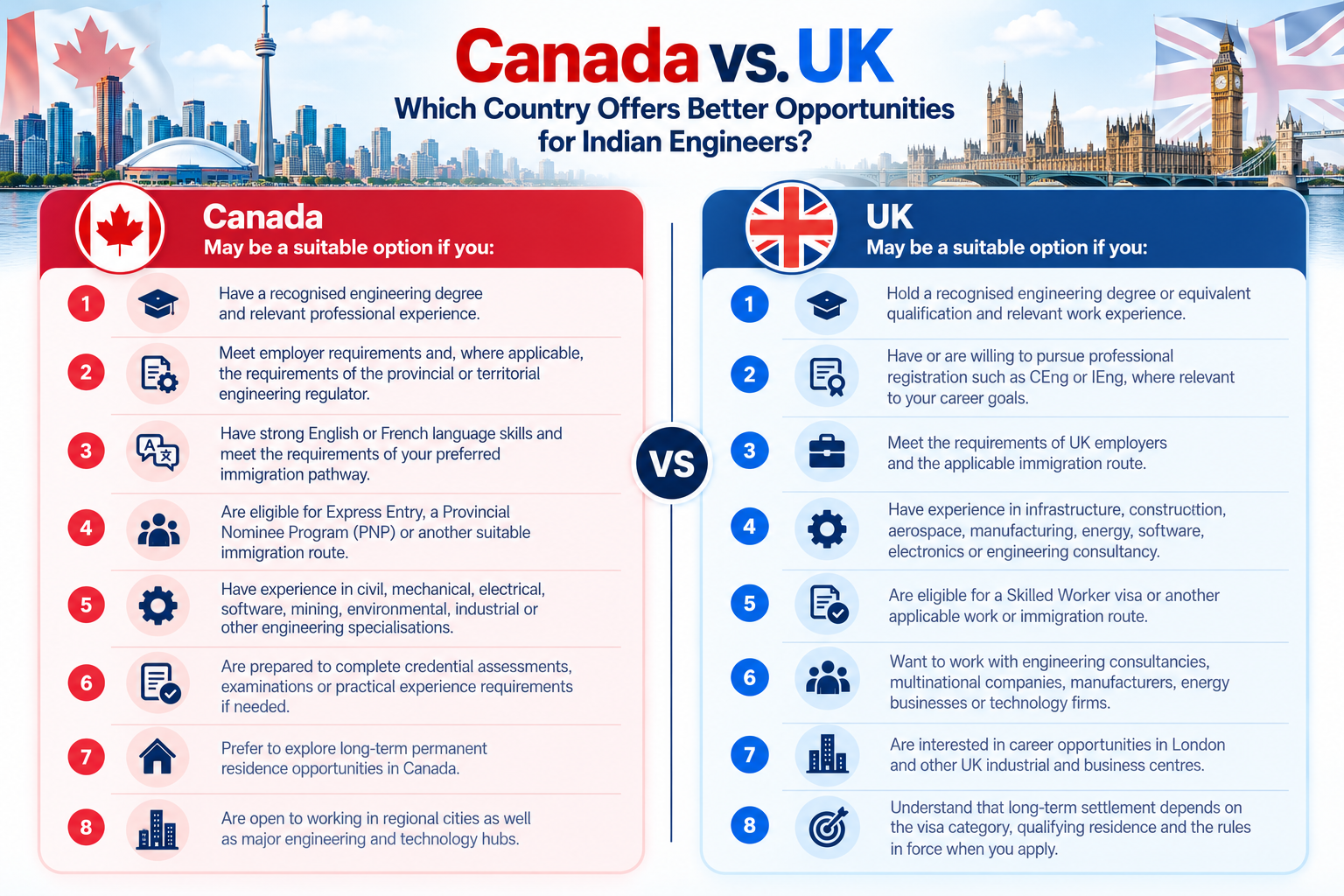
Canada vs. UK: Which Country Offers Better Opportunities for Indian Engineers?
Canada may be a suitable option if you:
- Have a recognised engineering degree and relevant professional experience.
- Meet employer requirements and, where applicable, the requirements of the provincial or territorial engineering regulator.
- Have strong English or French language skills and meet the requirements of your preferred immigration pathway.
- Are eligible for Express Entry, a Provincial Nominee Program (PNP) or another suitable immigration route.
- Have experience in civil, mechanical, electrical, software, mining, environmental, industrial or other engineering specialisations.
- Are prepared to complete credential assessments, examinations or practical experience requirements if needed.
- Prefer to explore long-term permanent residence opportunities in Canada.
- Are open to working in regional cities as well as major engineering and technology hubs.
*Want to migrate to Canada? Contact Y-Axis for guidance on your immigration options.
The UK may be a suitable option if you:
- Hold a recognised engineering degree or equivalent qualification and relevant work experience.
- Have or are willing to pursue professional registration such as CEng or IEng, where relevant to your career goals.
- Meet the requirements of UK employers and the applicable immigration route.
- Have experience in infrastructure, construction, aerospace, manufacturing, energy, software, electronics or engineering consultancy.
- Are eligible for a Skilled Worker visa or another applicable work or immigration route.
- Want to work with engineering consultancies, multinational companies, manufacturers, energy businesses or technology firms.
- Are interested in career opportunities in London and other UK industrial and business centres.
- Understand that long-term settlement depends on the visa category, qualifying residence and the rules in force when you apply.
*Want to migrate to the UK? Contact Y-Axis for guidance on available immigration pathways
Canada vs. UK: Salary, Living Costs and Savings for Engineers
The following table provides illustrative planning estimates for an engineer living alone in a major city.
|
Factor |
Canada |
United Kingdom |
|
Indicative annual gross salary |
C$65,000–C$110,000 (approximately ₹39–₹66 lakh) |
£30,000–£65,000 (approximately ₹33–₹72 lakh) |
|
Indicative monthly gross salary |
C$5,417–C$9,167 (approximately ₹3.3–₹5.5 lakh) |
£2,500–£5,417 (approximately ₹2.8–₹6 lakh) |
|
Estimated monthly take-home salary |
C$3,900–C$6,600 (approximately ₹2.3–₹4 lakh) |
£2,000–£4,000 (approximately ₹2.2–₹4.4 lakh) |
|
One-bedroom city-centre rent |
C$1,600–C$2,800/month (approximately ₹96,000–₹1.68 lakh) |
£1,000–£2,000/month (approximately ₹1.1–₹2.2 lakh) |
|
Monthly grocery expenses |
C$300–C$550 (approximately ₹18,000–₹33,000) |
£200–£350 (approximately ₹22,000–₹39,000) |
|
Public transport expenses |
C$100–C$180/month (approximately ₹6,000–₹11,000) |
£80–£200/month (approximately ₹9,000–₹22,000) |
|
Utilities, internet and mobile |
C$180–C$350/month (approximately ₹11,000–₹21,000) |
£150–£300/month (approximately ₹17,000–₹33,000) |
|
Estimated monthly living costs |
C$2,500–C$4,200 (approximately ₹1.5–₹2.5 lakh) |
£1,600–£3,000 (approximately ₹1.8–₹3.3 lakh) |
|
Potential monthly savings |
C$0–C$3,500+ (approximately ₹0–₹2.1 lakh+) |
£0–£2,100+ (approximately ₹0–₹2.3 lakh+) |
|
Potentially lower-cost cities |
Edmonton, Winnipeg, Quebec City and some smaller regional centres |
Sheffield, Liverpool, Newcastle, Glasgow and some smaller regional centres |
|
Major expensive cities |
Toronto and Vancouver |
London and some high-cost areas in the South East |
*Looking for assistance with overseas immigration? Contact Y-Axis, world’s number one immigration consultancy for guidance on immigration options and visa requirements.
FAQs
Is Canada or the UK better for engineers?
Canada and the UK offer good opportunities for engineers across construction, technology, manufacturing, energy and infrastructure. Canada may suit engineers looking for permanent residence pathways and opportunities in different cities. The UK may appeal to professionals seeking international experience and careers in established engineering industries. The better choice depends on your specialisation, qualifications, salary expectations, job offers and long-term settlement plans.
Which country offers higher salaries for engineers, Canada or the UK?
Engineer salaries vary by specialisation, experience, employer and location. Canada may offer competitive salaries in software, mining, energy and infrastructure engineering. The UK has opportunities in aerospace, construction, technology and renewable energy. However, a higher salary does not always mean greater savings. Compare take-home pay after taxes with rent, transport, groceries and other living expenses before choosing a destination.
Are engineers in demand in Canada?
Canada offers engineering opportunities in civil, mechanical, electrical, software, mining, environmental and industrial engineering. Demand depends on the province, industry and current labour market conditions. Employers may prefer candidates with relevant experience, recognised qualifications and local knowledge. Before applying, research current job vacancies and employer requirements in your specialisation. Some engineering roles may also require professional licensing through the relevant provincial or territorial regulator.
Are engineers in demand in the UK?
The UK offers engineering opportunities in infrastructure, construction, aerospace, manufacturing, energy, electronics and technology. Job availability varies by specialisation, location and economic conditions. Employers may look for relevant qualifications, practical experience and specialist technical skills. Engineers should check current vacancies and the requirements of individual employers. Certain positions may also benefit from professional registration, such as Chartered Engineer (CEng) or Incorporated Engineer (IEng).
Can Indian engineers migrate to Canada without a job offer?
Some Indian engineers may qualify for Canadian permanent residence through Express Entry, Provincial Nominee Programs or other eligible immigration pathways without having a job offer. However, eligibility depends on factors such as qualifications, skilled work experience, language test results and the programme requirements. A job offer may improve options in some circumstances, but it does not guarantee permanent residence. Applicants should check the latest eligibility criteria before applying.
Can Indian engineers work in the UK without a job offer?
Most applicants using the UK Skilled Worker visa need an eligible job offer from an approved sponsor and must meet the applicable salary and other visa requirements. Some alternative immigration routes may not require a job offer, but eligibility varies. Indian engineers should identify the most suitable route before making plans. They should also check whether their qualifications and experience meet the requirements of their intended engineering role.
Do engineers need professional licensing in Canada and the UK?
Professional requirements differ between the two countries and depend on the role. In Canada, engineers generally need a licence from the relevant provincial or territorial regulator to practise as a Professional Engineer and use the protected P.Eng. designation. In the UK, CEng or IEng registration can support professional recognition, but it is not mandatory for every engineering job. Always check the requirements for your specific position.
Which country has a lower cost of living for engineers?
Living costs depend on the city, housing choice, transport needs and lifestyle. Toronto and Vancouver can be expensive in Canada, while London and parts of South East England can have high housing costs. Smaller cities may offer more affordable options in either country. Engineers should compare local rent, utilities, groceries, transport and taxes with expected take-home pay to estimate their likely monthly savings.
Can engineers get permanent residence in Canada or settlement in the UK?
Eligible engineers may apply for Canadian permanent residence through programmes such as Express Entry or Provincial Nominee Programs. In the UK, some visa holders may qualify for settlement after meeting the applicable residence, visa and other requirements. Neither outcome is automatic. Eligibility depends on the immigration route and the rules in force when you apply. Review official government guidance before making long-term relocation decisions.
How should Indian engineers choose between Canada and the UK?
Indian engineers should compare job opportunities in their specialisation, expected salary, living costs, professional recognition and immigration eligibility. Canada may be attractive to those prioritising permanent residence pathways, while the UK may suit professionals seeking roles in established engineering and technology sectors. Consider family needs, preferred cities and long-term career goals too. Research employers and current visa rules before deciding which country best fits your plans.
Tags:
Canada vs UK for Engineers
Engineering Jobs in Canada
Engineering Jobs in UK
Canada Immigration for Engineers
UK Immigration for Engineers
Engineer Salaries in Canada
Engineer Salaries in UK
Canada vs UK Salary
Canada vs UK Cost of Living
Best Co
Share
Options for you by Y-Axis

Get it on your mobile

Get News alerts

Contact Y-Axis
Latest Article
Popular Post
Trending Article
Posted On October 22 2026
Canada vs. UK for Engineers: Which Country Should You Choose?