

Posted on October 15 2026
Canada vs. Australia for Teachers: Which Country Should You Choose?

By , Editor
Updated October 17 2026
Canada and Australia offer good career and settlement opportunities for teachers. Both countries provide teaching jobs, competitive salaries and immigration pathways for eligible professionals. The right choice depends on your qualifications, teaching experience, registration requirements, salary expectations and long-term settlement plans. Canada offers teaching opportunities across public and private schools, while Australia provides roles in government, independent, regional and remote schools. Both countries also have skilled migration and permanent residence pathways for eligible teachers.
*Want to migrate abroad? Contact Y-Axis for complete guidance and assistance.
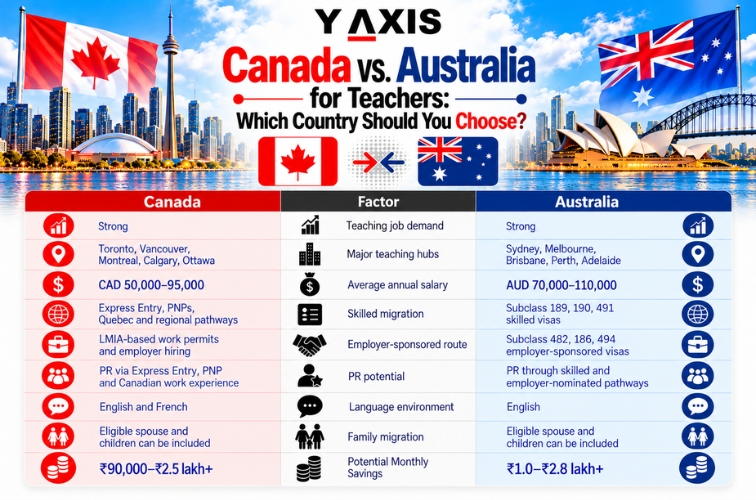
Canada vs. Australia for Teachers: Quick Comparison
|
Factor |
Canada |
Australia |
|
Teaching job demand |
Opportunities in elementary and secondary schools, special education, STEM, French-language education and regional schools |
Opportunities in primary and secondary schools, special education, STEM, early childhood education and regional schools |
|
Major teaching hubs |
Toronto, Vancouver, Calgary, Edmonton, Ottawa, Montreal, Winnipeg and other regional centres |
Sydney, Melbourne, Brisbane, Perth, Adelaide, Canberra, Hobart and regional centres |
|
Popular teaching roles |
Elementary Teachers, Secondary Teachers, Special Education Teachers, Early Childhood Educators, ESL Teachers and Subject Specialists |
Primary Teachers, Secondary Teachers, Special Education Teachers, Early Childhood Teachers, ESL Teachers and Subject Specialists |
|
Skilled migration |
Express Entry, Provincial Nominee Programs (PNPs) and other eligible pathways |
Skilled Independent (189), Skilled Nominated (190), Skilled Work Regional (491) and other eligible pathways |
|
Professional assessment / registration |
Internationally educated teachers must meet the requirements of the relevant provincial or territorial authority |
Internationally qualified teachers must meet the registration requirements of the relevant state or territory authority |
|
Teaching certification / registration |
Provincial/territorial: Certification is managed by the relevant provincial or territorial authority and requirements vary by province |
State/territory: Registration is managed by the relevant state or territory authority and requirements vary by jurisdiction |
|
Professional qualification |
A recognised teaching qualification and applicable provincial/territorial certification are generally required |
A recognised teaching qualification and registration with the relevant state/territory authority are generally required |
|
English-language requirements |
Requirements vary by certification authority and immigration pathway; French may also be relevant |
English requirements may apply for teacher registration and immigration unless exempt |
|
Licensing / competency requirements |
May include credential assessment, language evidence, teaching experience, background checks and other provincial requirements |
May include qualification assessment, English evidence, teaching experience, background checks and other registration requirements |
|
Visa sponsorship |
Eligible schools or employers may support foreign teachers through employer-specific work permits |
Eligible schools or employers may sponsor teachers through employer-sponsored visa pathways |
|
PR potential |
Express Entry, PNPs and other eligible permanent residence pathways |
Skilled and employer-sponsored permanent residence pathways |
|
Family migration |
Available through eligible immigration pathways |
Available through eligible visa pathways |
|
Best suited for |
Teachers seeking long-term settlement, immigration options and opportunities across Canada's provinces and territories |
Teachers seeking skilled migration, career development, outdoor lifestyle and opportunities across urban and regional areas |
*Check your eligibility to Canada through the Y-Axis Canada CRS Score Calculator.
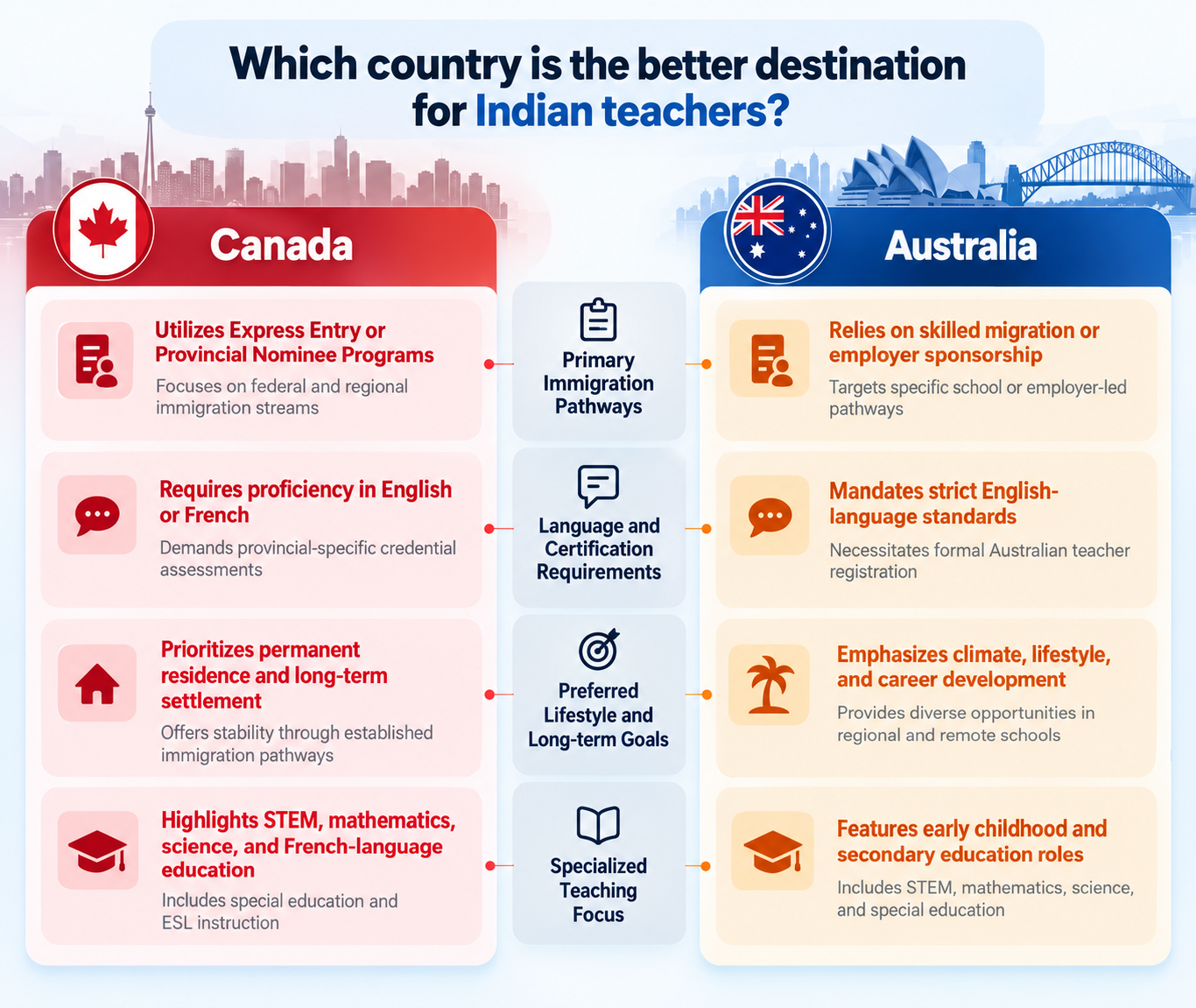
Canada vs. Australia: Which Country Offers Better Opportunities for Indian Teachers?
Canada may be a suitable option if you:
- Have a recognised teaching qualification and relevant classroom experience.
- Meet the teacher certification requirements of the province or territory where you plan to work.
- Have strong English or French language skills and meet the requirements for your preferred immigration pathway.
- Are eligible for Express Entry, a Provincial Nominee Program (PNP) or another suitable pathway.
- Have experience in areas such as STEM, mathematics, science, special education, ESL or French-language education.
- Are prepared to complete required credential assessments, examinations, coursework or certification requirements.
- Prefer long-term settlement and permanent residence opportunities in Canada.
*Want to migrate to Canada? Get in touch with experts at Y-Axis to guide you with the process.
Australia may be a suitable option if you:
- Hold a recognised teaching qualification and meet Australian teacher registration requirements.
- Have relevant classroom experience and meet the required English-language standards.
- Meet the skills assessment and eligibility requirements for your teaching occupation.
- Have experience in areas such as STEM, mathematics, science, special education, early childhood or secondary education.
- Are eligible for skilled migration or have access to an eligible school or employer sponsorship pathway.
- Are interested in opportunities across government, independent, regional and remote schools.
- Prefer Australia's climate, lifestyle and long-term career development opportunities.
*Want to migrate to Australia? Get in touch with experts at Y-Axis to guide you with the process.
Canada vs. Australia: Salary, Living Costs & Savings for Teachers
For teachers, the financial benefit of working abroad depends on more than salary. Taxes, rent, groceries, transport and other living costs can affect monthly savings. The table below provides indicative figures for teachers in Canada and Australia. Actual salaries and expenses vary by teaching level, experience, location, school type, tax situation and lifestyle. Canadian teacher wage data show national median hourly wages of about C$43–C$46 for primary and secondary teachers, while Australian median full-time weekly earnings are about A$2,226 for primary teachers and A$2,322 for secondary teachers.
|
Factor |
Canada |
Australia |
|
Median Teaching Salary |
₹58 lakh–₹82 lakh/year |
₹75 lakh–₹90 lakh/year |
|
Monthly Gross Salary |
₹4.8–₹6.8 lakh |
₹6.2–₹7.5 lakh |
|
Estimated Monthly Take-Home Salary |
₹3.6–₹5.0 lakh |
₹4.8–₹5.8 lakh |
|
1-Bedroom City-Centre Rent |
₹1.35–₹1.90 lakh/month |
₹1.65–₹2.40 lakh/month |
|
Monthly Grocery Expenses |
₹27,000–₹41,000 |
₹20,000–₹34,000 |
|
Public Transport Expenses |
₹7,000–₹11,000/month |
₹10,000–₹15,000/month |
|
Utilities + Internet + Mobile |
₹12,000–₹21,000/month |
₹14,000–₹29,000/month |
|
Estimated Monthly Living Costs |
₹1.85–₹2.70 lakh |
₹2.20–₹3.30 lakh |
|
Potential Monthly Savings |
₹90,000–₹2.5 lakh+ |
₹1.0–₹2.8 lakh+ |
|
Lower-Cost Teaching Cities |
Calgary, Edmonton, Winnipeg, Montreal |
Brisbane, Adelaide, Perth |
|
Major Expensive Teaching Cities |
Toronto, Vancouver |
Sydney, Melbourne |
*Looking for assistance with overseas immigration? Contact Y-Axis, one of the world's leading immigration consultancies, for guidance and visa assistance.
FAQs:
Is Canada or Australia better for teachers?
Canada and Australia both offer good opportunities for qualified teachers. Canada may suit teachers looking for long-term settlement and opportunities across different provinces. Australia offers teaching jobs across cities, regional areas and remote communities. Your choice should depend on your teaching qualification, experience, registration requirements, salary expectations, immigration options, family needs and preferred lifestyle.
Are teachers in demand in Canada and Australia?
Yes, both Canada and Australia have teaching opportunities in several areas. Demand can vary by location, teaching level and subject specialisation. Teachers with experience in STEM, mathematics, science, special education, early childhood education and other specialised areas may find suitable opportunities. Regional and remote areas in both countries can also provide additional employment options for qualified teachers.
Can Indian teachers work in Canada?
Yes, Indian teachers can work in Canada if they meet the requirements of the province or territory where they plan to teach. They generally need a recognised teaching qualification, credential assessment, relevant experience and teacher certification. English or French language requirements may also apply. Additional coursework, examinations or other requirements may be needed depending on the province.
Can Indian teachers work in Australia?
Yes, Indian teachers can work in Australia after meeting the applicable qualification assessment and teacher registration requirements. Requirements vary between states and territories. Teachers may also need to meet English-language requirements and provide evidence of qualifications and professional experience. Eligible teachers can explore skilled migration, employer-sponsored visas and other pathways depending on their qualifications and circumstances.
Which country offers higher salaries for teachers, Canada or Australia?
Teacher salaries vary based on experience, qualifications, teaching level, location and employer. Australia can offer higher average salaries in some teaching roles, while Canada also provides competitive salaries and benefits. However, salary alone should not determine your choice. Taxes, housing, transportation, healthcare, daily expenses and potential savings should also be considered when comparing teaching careers in both countries.
Is teaching registration required in Canada and Australia?
Yes, teachers generally need professional registration or certification to work in recognised teaching positions. In Canada, certification is handled by the relevant province or territory. In Australia, registration is managed by the relevant state or territory authority. International teachers may need to provide qualifications, teaching experience, language evidence and other documents before receiving approval to teach.
Which country is easier for teachers to migrate to?
There is no single answer because migration eligibility depends on your age, qualifications, teaching experience, English-language score, occupation and other factors. Canada offers pathways such as Express Entry and Provincial Nominee Programs. Australia provides skilled and employer-sponsored pathways. A teacher with a strong profile may qualify for one country more easily than the other.
Can teachers get permanent residence in Canada or Australia?
Yes, eligible teachers may apply for permanent residence through different immigration pathways in both countries. Canada offers Express Entry, Provincial Nominee Programs and other eligible routes. Australia offers skilled and employer-sponsored permanent residence pathways. Eligibility depends on factors such as qualifications, age, work experience, language ability, occupation, skills assessment and the specific immigration program.
Which country has a lower cost of living for teachers?
The cost of living depends mainly on the city, housing choice and lifestyle. Major cities such as Toronto and Vancouver can have high housing costs, while Sydney and Melbourne can also be expensive. Teachers may reduce living expenses by choosing smaller cities or regional areas. Comparing rent, groceries, transport, utilities, taxes and salary together gives a better view of affordability.
Should I choose Canada or Australia as a teacher?
The better country depends on your personal and professional goals. Canada may be suitable if you prioritise permanent residence, diverse teaching opportunities and long-term settlement. Australia may suit teachers who value skilled migration, career development, regional opportunities and an outdoor lifestyle. Before deciding, compare teacher registration, salary, living costs, immigration options and employment opportunities for your specific profile.
Tags:
Canada vs Australia for Teachers; Teaching Jobs in Canada; Teaching Jobs in Australia; Canada Immigration for Teachers; Australia Immigration for Teachers; Teacher Salaries in Canada; Teacher Salaries in Australia; Canada vs Australia Salar
Share
Options for you by Y-Axis

Get it on your mobile

Get News alerts

Contact Y-Axis
Latest Article
Popular Post
Trending Article

Posted On October 16 2026
Australia Updates Health Insurance Guidance for Visa Holders: What You Need to Know