

Posted on September 04 2026
What Is the Average Salary in China?

By , Editor
Updated September 05 2026
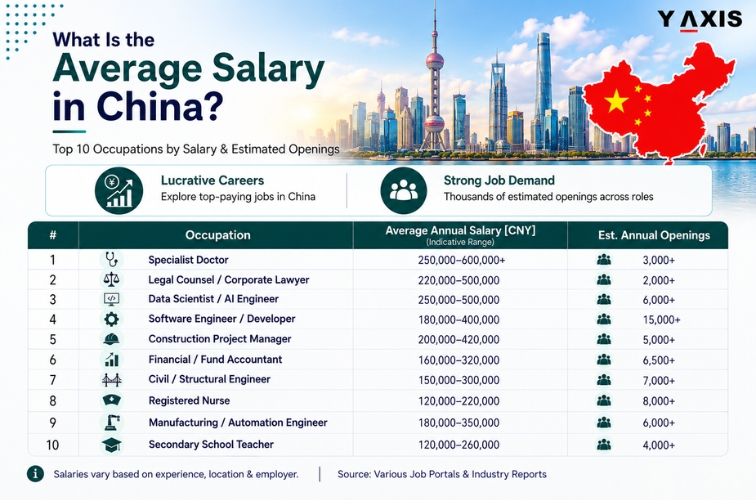
The average salary in China is approximately RMB 10,300 to RMB 10,800 per month for urban non-private sector employees. The annual average compensation of foreign professionals in China is around RMB 124,000 to RMB 130,000, based on National Bureau of Statistics (NBS) data. Private sector employees earn considerably less, averaging closer to RMB 5,800 to RMB 6,000 per month. The median salary is estimated at RMB 6,500 to RMB 7,500 per month, since a small number of high earners in finance, technology, and executive roles pull the average upward. Your salary in range in China will vary widely based on city and sector. Shanghai, Beijing, and Shenzhen pay 1.5 to 3 times more than smaller inland cities, and technology, finance, and semiconductor roles command the highest premiums in China.
*Want to work in China? Let Y-Axis guide you through the process.
Top 10 Highest-Paying Occupations in China
China's job market runs on a few key sectors: technology, semiconductors, finance, manufacturing, and e-commerce. Salaries vary widely between these sectors, and some roles face more demand than others due to skill shortages.
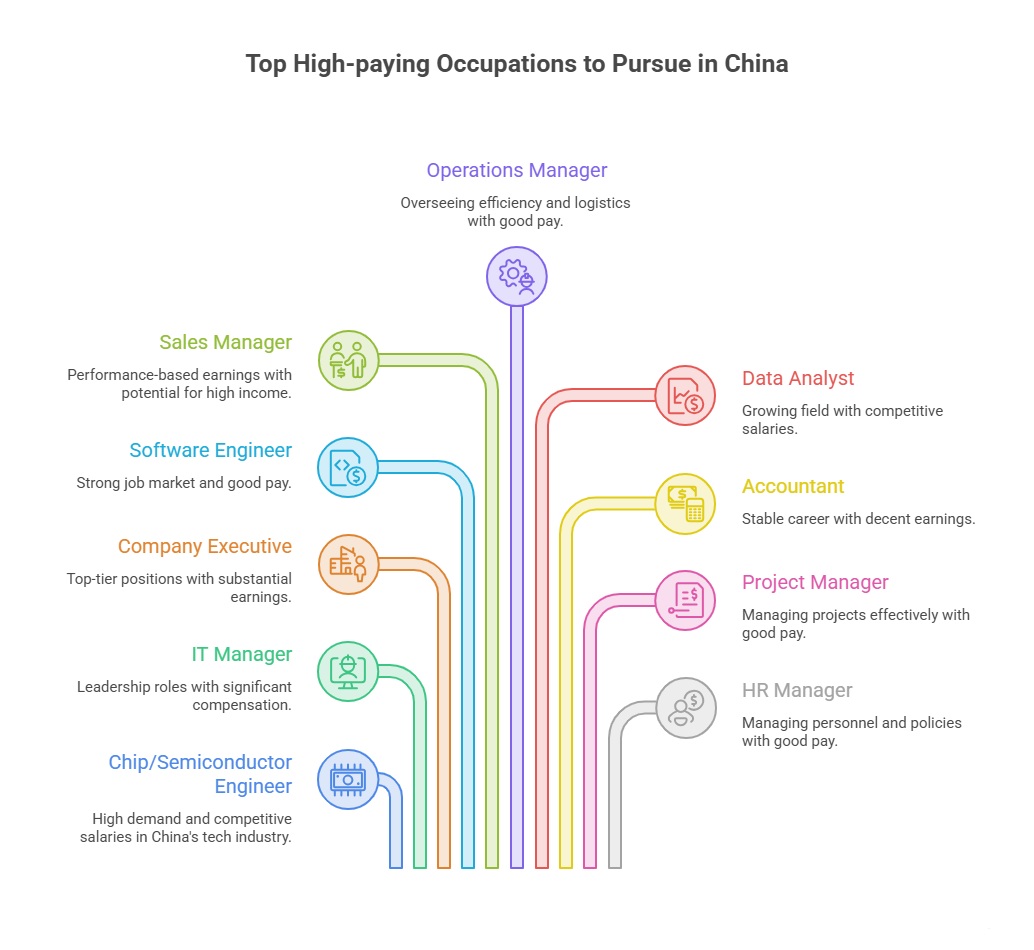
The table below shows ten occupations with strong salaries and steady hiring demand in China.
|
Occupation |
Average Annual Salary (RMB) |
Est. Job Openings (Next Decade) |
Sector Note |
|
Chip / Semiconductor Engineer |
RMB 300,000–360,000 |
400,000+ |
National chip self-sufficiency push |
|
IT Manager / Senior Tech Leader |
RMB 480,000–580,000 |
250,000+ |
Beijing, Shanghai & Shenzhen tech hubs |
|
Company Executive / Senior Manager |
RMB 270,000–320,000 |
500,000+ |
Finance, manufacturing & retail sectors |
|
Software Engineer / Developer |
RMB 250,000–350,000 |
3,000,000+ |
Fast-growing digital economy |
|
Sales Manager |
RMB 350,000–400,000 |
800,000+ |
E-commerce & industrial exports |
|
Operations Manager |
RMB 320,000–380,000 |
600,000+ |
Manufacturing & logistics hubs |
|
Data Analyst / Data Scientist |
RMB 280,000–320,000 |
1,200,000+ |
AI and big data adoption |
|
Accountant / Finance Analyst |
RMB 220,000–280,000 |
900,000+ |
Big 4 and multinational finance teams |
|
Project Manager |
RMB 200,000–240,000 |
700,000+ |
Construction, infrastructure & IT projects |
|
HR Manager / Coordinator |
RMB 160,000–200,000 |
400,000+ |
Growing multinational hiring |
Also, read...
Highest paying Job Opportunities in China
Average Lifestyle Expenses in China
China offers strong salaries in its top-tier cities, but the cost of living, especially housing, varies sharply between Shanghai or Beijing and smaller inland cities. Housing is the biggest expense for most residents, followed by transport, groceries, and utilities. Knowing these costs in advance helps you judge whether a salary offer is genuinely competitive.
- Rent (1-bed apartment, prime area, e.g. Jing'an Shanghai, Sanlitun Beijing): RMB 6,500-9,000 per month
- Rent (1-bed apartment, Tier-2 city, e.g. Chengdu, Xi'an): RMB 2,500-4,000 per month
- Groceries (single person): RMB 1,000-1,800 per month
- Utilities (electricity, water, and gas): RMB 400-800 per month
- Public transport (monthly metro/bus pass): RMB 200-300 per month
- Mobile and internet plan: RMB 150-250 per month combined
- Supplemental health insurance (on top of mandatory employer cover): RMB 2,000-6,000+ per year
- Dining out (casual meal for two): RMB 100-200
- Overall monthly budget, single person, excluding rent: RMB 3,000-4,000
- Overall monthly budget, single person, including rent (comfortable baseline, Tier-1 city): RMB 10,000-13,000
Note: Many professionals manage China's rent by choosing a Tier-2 city over Shanghai or Beijing, using the subway instead of taxis or a car, and sharing an apartment during their first year.
Also, read...
What are the Most In-Demand Jobs in China for the Next 10 Years?
Salary Structure and Take-Home Pay in China
China levies a progressive individual income tax of 3% to 45% across seven brackets, applied after a standard deduction of RMB 5,000 per month. Additionally, employees contribute roughly 15% to 22% of their gross salary toward mandatory social insurance and the housing fund, which cover pension, medical, unemployment, and housing benefits. As a result, gross salary and take-home pay differ significantly.
The table below highlights gross monthly salary and take-home pay for an employee in China:
|
Gross Monthly Salary |
Mandatory Deductions (Tax + Social Insurance) |
Approx. Take-Home Pay |
|
RMB 8,000 |
~RMB 1,500 (~19%) |
~RMB 6,500 (~81%) |
|
RMB 15,000 |
~RMB 3,200 (~21%) |
~RMB 11,800 (~79%) |
|
RMB 25,000 |
~RMB 6,200 (~25%) |
~RMB 18,800 (~75%) |
|
RMB 40,000 |
~RMB 11,500 (~29%) |
~RMB 28,500 (~71%) |
Also, read...
What are the eligibility requirements for a China work visa?
How China's Average Salary Compares to Other Countries
China's average salary sits in the middle of the global pay scale. Professionals in China earn four to five times more than counterparts in India or Vietnam. Additionally, China's comparatively low cost of living outside Shanghai and Beijing means real purchasing power often exceeds what the headline salary suggests.
When comparing job offers between China and other countries, it helps to compare net income after rent, rather than the headline salary or tax rate alone. This gives a clearer picture of what a role in China is really worth compared to opportunities elsewhere around the world.
*Are you looking for step-by-step assistance with overseas immigration? Contact Y-Axis, the world's No. 1 overseas immigration consultancy, for end-to-end assistance!
FAQs
What is the average salary in China in 2026?
The average salary in China is approximately RMB 10,300 to RMB 10,800 per month for urban non-private sector employees, based on National Bureau of Statistics (NBS) data. This works out to roughly RMB 124,000 to RMB 130,000 per year. Private sector employees earn considerably less, averaging around RMB 5,800 to RMB 6,000 per month. The median salary is estimated at RMB 6,500 to RMB 7,500 per month, since high earners in finance, technology, and executive roles pull the average upward.
What is the difference between average and median salary in China?
The average (mean) salary adds up all earnings and divides by the number of workers, so a small number of very high earners pull the figure upward. China's average is about RMB 10,300 to RMB 10,800 per month for the non-private urban sector. The median is the middle value, meaning half of workers earn more and half earn less. China's median is estimated at RMB 6,500 to RMB 7,500 per month, making it a more realistic picture of typical pay.
Which jobs pay the highest salaries in China?
The highest-paying roles in China include semiconductor and chip engineers, senior technology managers, and company executives, often earning RMB 22,000 to RMB 48,000 per month. Sales managers, operations managers, and data scientists also earn well above the national average. These roles cluster around Shanghai, Beijing, and Shenzhen's technology and finance hubs, and in China's growing semiconductor sector, where skilled professionals remain in short supply.
Is there a minimum wage in China?
China does not have a single national minimum wage. Instead, each of the 31 provinces, municipalities, and regions sets its own monthly and hourly minimum rates. Shanghai has the highest monthly minimum wage at RMB 2,740, while Beijing has the highest hourly minimum wage at RMB 27.7. Rates are reviewed periodically and vary significantly, since some inland provinces start below RMB 1,800 per month. Most professional salaries sit well above these minimum thresholds.
How much tax do I pay on my salary in China?
China applies a progressive individual income tax (IIT) of 3% to 45% across seven brackets, after a standard deduction of RMB 5,000 per month (RMB 60,000 per year). On top of this, employees contribute roughly 15% to 22% of their gross salary toward mandatory social insurance and the housing fund, covering pension, medical, unemployment, and housing benefits. Combined, take-home pay is typically 70% to 85% of gross salary, depending on income level and city.
Is the average salary in China enough to live comfortably?
It depends on the city and lifestyle. Outside Shanghai and Beijing, RMB 8,000 to RMB 10,000 per month comfortably covers rent, groceries, transport, and some savings for a single person. In Shanghai or Beijing, RMB 13,000 or more is a more realistic baseline due to higher rent. Choosing a Tier-2 city, sharing an apartment, and relying on the subway instead of taxis can help an average salary stretch considerably further.
Do foreign workers earn more than local workers in China?
Foreign professionals in China often earn more than local employees in similar roles, partly because visa rules set minimum salary thresholds. In Beijing, for example, foreign workers need a monthly salary of about RMB 47,700 to qualify for a standard work permit, or around RMB 71,600 for the highest visa category. This effectively places most foreign hires above the local average salary, though pay ultimately depends on the sector, qualifications, and employer type.
What is a good salary in China for a single person?
A good salary for a single person in Tier-1 cities like Shanghai or Beijing is generally RMB 15,000 or more per month, comfortably covering rent, groceries, transport, and savings. In Tier-2 cities such as Chengdu or Hangzhou, RMB 10,000 or more is a more realistic threshold, since rent and daily costs are considerably lower. Salaries above RMB 25,000 per month place you well above the national average in most industries.
How does China's average salary compare to other countries?
China's average salary sits in the middle of the global pay scale. Chinese professionals typically earn four to five times more than counterparts in India or Vietnam, but earn considerably less than workers in Japan, South Korea, or the United States. Because China applies a progressive income tax similar to Western economies, take-home pay as a share of gross salary is lower than in tax-free markets like the UAE. Lower living costs outside major cities help offset this gap.
What salary do I need to qualify for a work visa in China?
China's work permit system classifies foreign workers into tiers, based partly on salary. Category B, the standard tier for skilled professionals, typically requires a monthly salary of around four times the local average wage, roughly RMB 47,700 in Beijing. Category A, reserved for top talent, requires about six times the local average, or roughly RMB 71,600 in Beijing. Salary thresholds vary by city, since they are tied to local average wages rather than a fixed national figure.
Tags:
Average salary in China
China salary guide
cost of living in China
China income tax
highest paying jobs in China
work in China
China job market
take-home pay China
Share
Options for you by Y-Axis

Get it on your mobile

Get News alerts

Contact Y-Axis
Latest Article
Popular Post
Trending Article

Posted On October 16 2026
Australia Updates Health Insurance Guidance for Visa Holders: What You Need to Know