

Posted on July 21 2026
Visa Sponsorship Jobs in Thailand – In-Demand Jobs, Top Employers & How to Apply

By , Editor
Updated July 25 2026
Thailand is one of Southeast Asia's largest economies and a growing hub for international talent. With unemployment below 1% and rapid growth in technology, tourism, manufacturing, and healthcare, Thai employers are increasingly looking abroad to fill skill gaps. The country faces labour shortages in key areas such as IT, engineering, English teaching, hospitality, and digital marketing. Multinational companies like Agoda, Accenture, CP Group, PTT, and Minor International regularly hire foreign professionals and support them through the work visa process. For foreign nationals, the most common route is a job offer from a Thai employer, followed by a Non-Immigrant B visa and a work permit sponsored by that employer. Thailand also offers special visa routes such as the SMART Visa and the Long-Term Resident (LTR) visa for highly skilled professionals. For Indian professionals, Thailand offers competitive salaries, a low cost of living, proximity to India, and a lifestyle that blends career growth with high quality of life. This guide explains everything you need to know about visa sponsorship jobs in Thailand in 2026.
*Want to apply for a Thailand work visa? Sign up with Y-Axis to help you with the process.
Why Apply for Jobs in Thailand with Visa Sponsorship?
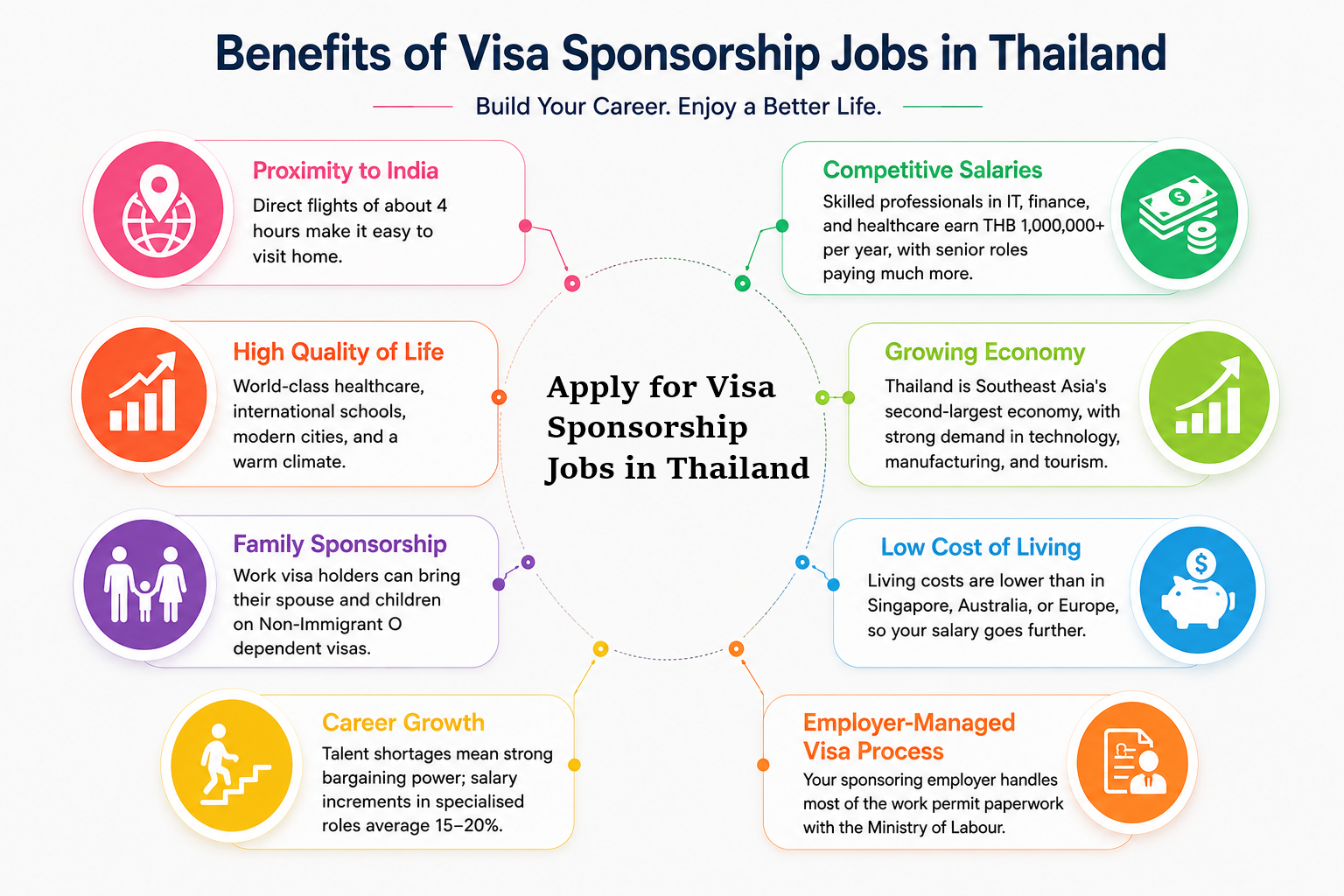
- Competitive salaries: Skilled professionals in IT, finance, and healthcare earn THB 1,000,000+ per year, with senior roles paying much more.
- Growing economy: Thailand is Southeast Asia's second-largest economy, with strong demand in technology, manufacturing, and tourism.
- Low cost of living: Living costs are lower than in Singapore, Australia, or Europe, so your salary goes further.
- Employer-managed visa process: Your sponsoring employer handles most of the work permit paperwork with the Ministry of Labour.
- Career growth: Talent shortages mean strong bargaining power; salary increments in specialised roles average 15–20%.
- Family sponsorship: Work visa holders can bring their spouse and children on Non-Immigrant O dependent visas.
- High quality of life: World-class healthcare, international schools, modern cities, and a warm climate.
- Proximity to India: Direct flights of about 4 hours make it easy to visit home.
What are Visa Sponsorship Jobs in Thailand?
Visa sponsorship jobs in Thailand are positions where a Thai employer hires a foreign worker and supports their legal right to work. To work in Thailand, you need two documents: a Non-Immigrant B visa (to enter the country) and a work permit issued by the Thai Ministry of Labour.
The employer "sponsors" you by providing an invitation letter, company registration documents, and preliminary work permit approval (WP.3 form). The sponsoring company must have registered capital of at least THB 2 million per foreign worker and generally employ four Thai staff for every foreign employee. Anyone with a valid job offer in an occupation open to foreigners can apply. Skilled professionals, managers, teachers, and technical experts are the most commonly sponsored workers.
*Also, read...
Do I need a job offer for a Thailand work visa?
In-Demand Visa Sponsorship Job Opportunities in Thailand
Thailand has a growing demand for skilled international professionals in sectors such as IT, engineering, healthcare, hospitality, finance, logistics, education, and marketing. Many Thai employers sponsor work visas for qualified foreign workers, especially when there is a shortage of local talent. Below are some of the most in-demand sectors, popular job roles, and their average annual salaries.
|
Sector |
In-Demand Roles |
Average Annual Salary (THB) |
|
Information Technology (IT) |
Software Developer, AI/ML Engineer, Data Scientist, Cybersecurity Analyst |
THB 1,000,000–1,500,000 |
|
International Business |
Business Development Manager |
THB 1,200,000 |
|
Finance |
Finance Professional, Accountant |
THB 1,100,000 |
|
Hospitality |
Hotel Manager, Chef (International Cuisine) |
THB 720,000–1,100,000 |
|
Marketing |
Digital Marketing Specialist |
THB 840,000 |
|
Engineering |
Electrical Engineer, Mechanical Engineer |
THB 750,000–780,000 |
|
Healthcare |
Registered Nurse, Medical Technician |
THB 550,000–650,000 |
|
Logistics |
Logistics Coordinator |
THB 600,000 |
|
Education |
English Teacher |
THB 500,000 |
*Also, read...
What are the most in-demand jobs in Thailand for the next 10 years?
Highest Paying Jobs in Thailand
Senior management, technology, and medical roles command the highest salaries in Thailand. Director-level positions in multinational companies can pay THB 200,000–700,000 per month. Below are the top-paying occupations with approximate annual figures.
|
Job Title |
Average Annual Salary (THB) |
Average Annual Salary (INR)* |
|
Medical Specialist / Doctor |
3,000,000 |
₹85.8 lakh |
|
IT Director |
2,800,000 |
₹80.1 lakh |
|
Finance Director |
2,600,000 |
₹74.4 lakh |
|
HR Director |
2,500,000 |
₹71.5 lakh |
|
Commercial / Sales Director |
2,400,000 |
₹68.6 lakh |
|
Marketing Director |
2,200,000 |
₹62.9 lakh |
|
Supply Chain Director |
2,000,000 |
₹57.2 lakh |
|
Hotel General Manager |
1,900,000 |
₹54.3 lakh |
|
Senior Data Scientist |
1,800,000 |
₹51.5 lakh |
|
Cybersecurity Manager |
1,700,000 |
₹48.6 lakh |
|
Software Architect |
1,600,000 |
₹45.8 lakh |
|
Petroleum / Chemical Engineer |
1,400,000 |
₹40.0 lakh |
*Read more...
Highest Paying Jobs in Thailand for Indians
Top Companies Offering Sponsored Jobs in Thailand
Many leading companies in Thailand hire skilled international professionals and provide work visa sponsorship for eligible candidates. These employers operate in industries such as technology, healthcare, hospitality, engineering, manufacturing, education, retail, and energy. The table below highlights some of the top sectors, major employers, and the roles they commonly sponsor.
|
Sector |
Top Companies |
Common Sponsored Roles |
|
Technology & IT |
Agoda, Accenture Thailand, IBM Thailand, Grab |
Software Engineers, Developers, Cloud Engineers, Data Scientists, Product Managers, IT Specialists, Solution Architects, Operations Managers |
|
Energy |
PTT Group |
Petroleum Engineers, Geoscientists, Technical Experts |
|
Manufacturing & Materials |
Siam Cement Group (SCG) |
Engineers, R&D Specialists, Regional Managers |
|
Agribusiness & Conglomerates |
CP Group (Charoen Pokphand) |
Managers, Engineers, International Business Professionals |
|
Hospitality & Tourism |
Minor International, Marriott Thailand, Anantara Hotels, Four Seasons Thailand |
Hotel Managers, Executive Chefs, Guest Relations Executives, Marketing Professionals |
|
Healthcare |
Bumrungrad International Hospital, Bangkok Dusit Medical Services (BDMS) |
Doctors, Nurses, Medical Technicians, Healthcare Administrators, Medical Coordinators |
|
Retail & E-commerce |
Central Group |
Retail Managers, E-commerce Specialists |
|
Food Processing |
Thai Union Group |
Food Technologists, Export Managers |
|
Education |
Bangkok Patana School, NIST International School |
Licensed Teachers, Curriculum Coordinators |
*Also, read...
Thailand Job Market: Trends & Job Opportunities
Eligibility Requirements for Visa Sponsorship Jobs in Thailand
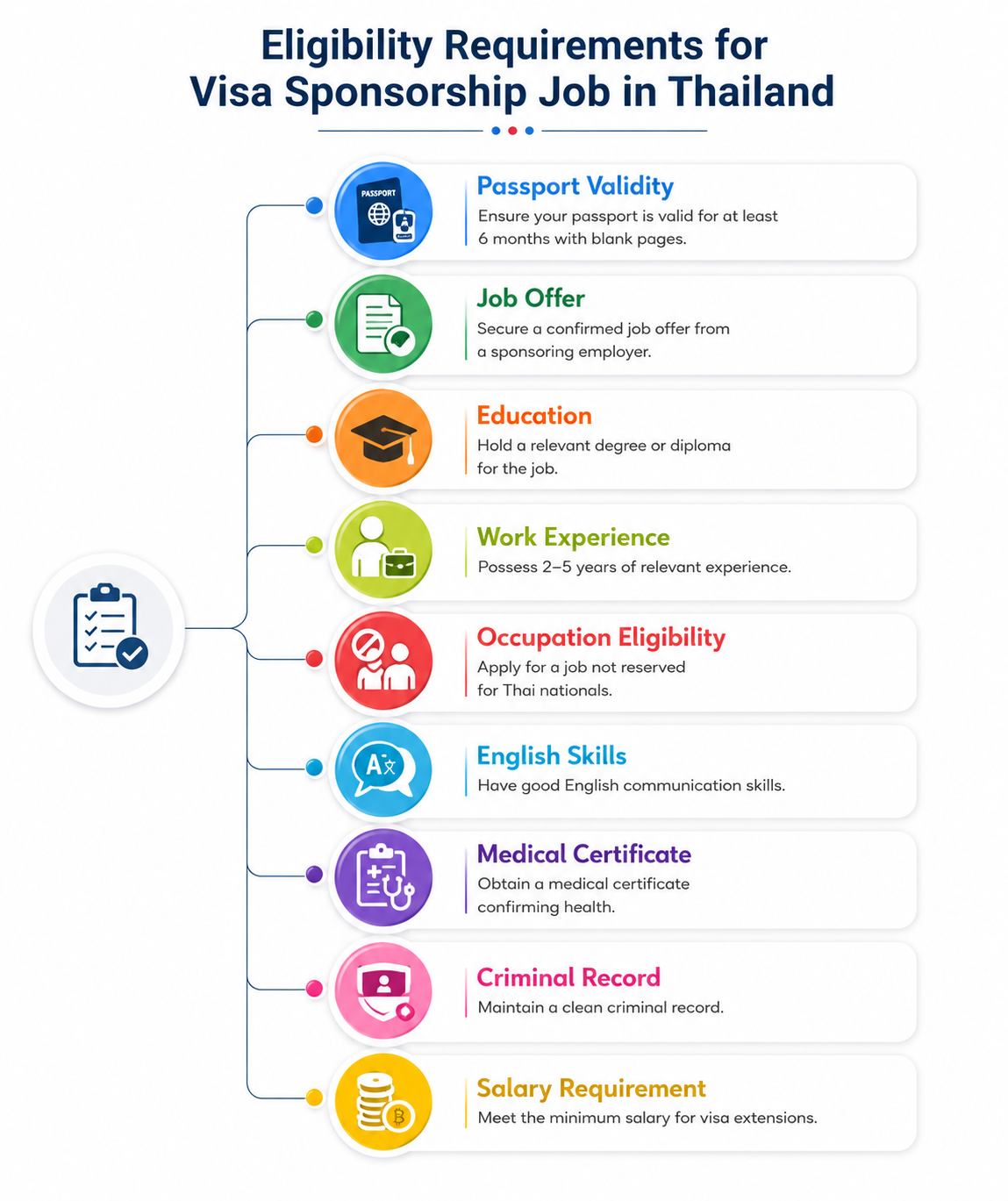
To qualify for a visa sponsorship job in Thailand, you must meet the following requirements:
- Have a passport that is valid for at least 6 months with blank pages for visa stamps.
- Obtain a confirmed job offer from a Thai employer that is eligible to sponsor foreign workers.
- Hold a degree or diploma that is relevant to the job. Most teaching positions require a bachelor's degree.
- Have 2–5 years of relevant work experience for most sponsored roles. Senior positions usually require more experience.
- Apply for a job that is not on Thailand's list of occupations reserved for Thai nationals.
- Have good English communication skills. While IELTS is not mandatory, knowing Thai can be an added advantage.
- Submit a medical certificate confirming that you are free from prohibited diseases.
- Maintain a clean criminal record and provide a police clearance certificate if requested.
- Meet the minimum salary requirement for work visa extensions, which is generally THB 25,000–50,000 per month, depending on nationality (around THB 35,000 for Indian nationals).
Documents Required for a Sponsored Work Visa in Thailand
When applying for a sponsored work visa, you will generally need the following documents:
- A valid passport with at least 6 months of remaining validity.
- A job offer or employment letter showing your position, salary, and employment terms.
- A WP.3 form, which is the preliminary work permit approval arranged by your employer.
- Employer documents, including business registration, shareholder details, and financial statements.
- Educational certificates that match the job requirements.
- Work experience letters, if applicable.
- A medical certificate issued by an approved medical practitioner.
- A police clearance certificate, if required.
- Recent passport-size photographs (4 × 6 cm) with a white background.
- Payment of the visa application fee (THB 2,000 for a single-entry visa or THB 5,000 for a multiple-entry visa).
*Also, read...
Thailand Introduces Online Work Permit Portal for Foreign Workers
How to Get a Visa Sponsorship Job in Thailand?
Step 1: Confirm your profession is open to foreigners and in demand IT, engineering, teaching, hospitality, and healthcare are the best options.
Step 2: Create a clear, achievement-focused CV in English tailored to Thai and multinational employers.
Step 3: Use JobsDB Thailand, LinkedIn, JobThai, and company career pages (Agoda, Accenture, Minor International). Filter for roles open to expatriates.
Step 4: Target multinational companies, BOI-promoted firms, international hotels, and international schools that regularly sponsor foreign staff.
Step 5: Most interviews are online for overseas candidates. Highlight specialised skills that are hard to find locally.
Step 6: Review the offer letter carefully it must state your position, salary, and employment terms, as immigration will check these.
Step 7: Your employer obtains preliminary work permit approval (WP.3) from the Ministry of Labour and sends you the invitation letter and company documents.
Step 8: Apply for the Non-Immigrant B visa at the Royal Thai Embassy/Consulate in India (or via the official e-Visa portal). Processing usually takes 1–2 weeks.
Step 9: Enter Thailand, collect your work permit from the Department of Employment (7–14 working days), then extend your stay to one year at Thai Immigration.
*Want to apply for jobs abroad? Try Y-Axis Resume Marketing services to find the right one.
Work Visa Options for Foreign Workers in Thailand
|
Visa Type |
Purpose |
Validity |
|
Non-Immigrant B Visa |
Standard employer-sponsored work visa |
90 days per entry; extendable to 1 year (renewable) once the work permit is issued |
|
Non-Immigrant IB Visa |
Employment with BOI-promoted companies (faster processing via One Stop Service) |
1 year, renewable |
|
SMART S Visa |
Startup founders in targeted industries (requires THB 600,000 deposit and 25% shareholding or director position) |
2 years, renewable up to 4 years; no separate work permit needed |
|
Long-Term Resident (LTR) Visa |
Highly skilled professionals in targeted industries, remote workers, wealthy individuals, and pensioners (income of about USD 80,000/year for professionals) |
10 years, with digital work permit and tax benefits |
|
Non-Immigrant O Visa |
Dependents (spouse and children) of work visa holders |
Matches the sponsor's visa validity |
*Are you looking for step-by-step assistance for overseas immigration? Contact Y-Axis, the leading visa and immigration consultancy in India!
FAQs
What are visa sponsorship jobs in Thailand?
Visa sponsorship jobs are positions where a Thai employer hires a foreign worker and supports their legal right to work. The employer provides an invitation letter, company documents, and preliminary work permit approval so you can obtain a Non-Immigrant B visa and a work permit. Sponsorship is common in IT, engineering, hospitality, teaching, and healthcare roles where local talent is in short supply.
Can Indians get visa sponsorship jobs in Thailand?
Yes. Indian professionals are regularly hired in Thailand, especially in IT, engineering, finance, hospitality, and teaching. You need a job offer from an eligible Thai employer, who then sponsors your Non-Immigrant B visa and work permit. Immigration typically expects Indian nationals to earn a minimum monthly salary of around THB 35,000 for one-year visa extensions, which most professional roles easily meet.
Which companies sponsor foreign workers in Thailand?
Multinational and large Thai companies such as Agoda, Accenture, IBM, Grab, CP Group, PTT, Siam Cement Group, Minor International, Bumrungrad Hospital, and Central Group hire foreign professionals. Agoda, for example, offers full relocation support including visa sponsorship. International hotels and international schools also sponsor foreign staff regularly. Always confirm sponsorship availability with the employer during the application process.
Which jobs are easiest to get with sponsorship in Thailand?
English teaching is the most accessible sponsored job for foreigners, requiring a bachelor's degree and good English. IT roles like software development and data analysis are also relatively easy for qualified candidates because of local talent shortages. Hospitality roles such as chefs and hotel managers are widely available in tourist destinations like Bangkok, Phuket, and Pattaya.
What are the highest-paying sponsorship jobs in Thailand?
Director-level roles pay the most. HR Directors in FMCG can earn up to THB 700,000 per month, while IT, finance, and commercial directors earn THB 2.4–2.8 million annually. Medical specialists, hotel general managers, senior data scientists, and cybersecurity managers also earn THB 1.7–3 million per year. Technology remains the highest-paying sector due to shortages in AI and cybersecurity skills.
What qualifications are required for jobs in Thailand?
Most sponsored jobs require a bachelor's degree relevant to the role. Teaching positions require a degree, and licensed roles like medicine require Thai professional licences. Technical roles value certifications in cloud, cybersecurity, or data science. Your qualifications must match the position stated in your work permit, as the Ministry of Labour verifies that foreigners fill roles requiring specialised skills.
Do I need work experience for a sponsored job in Thailand?
Most sponsored roles require 2–5 years of relevant experience, and senior positions require more. Hospitality management roles often ask for five years of proven experience. However, fresh graduates can find openings in English teaching and some entry-level tech roles. Experience with multinational companies or regional Asian markets significantly strengthens your application for higher-paying positions.
Is IELTS required to work in Thailand?
No. Thailand does not require IELTS or any language test for work visas. However, strong English communication is expected for most professional roles, and international schools may ask for proof of English proficiency for teaching jobs. Learning basic Thai is not mandatory but helps in daily life and is valued by local employers.
How long does Thailand work visa processing take?
The Non-Immigrant B visa takes about 1–2 weeks to process at a Thai embassy or through the e-Visa portal. After arrival, the work permit takes 7–14 working days from the Department of Employment. Including the employer's preliminary approvals, the full process usually takes 4–8 weeks. Relocation with companies like Agoda typically takes 2–4 months overall.
Can my family accompany me to Thailand?
Yes. Your spouse and children can join you on Non-Immigrant O dependent visas, valid for the same period as your work visa. You will need marriage and birth certificates, plus proof of sufficient income. Dependents cannot work unless they obtain their own work permits. Thailand offers good international schools and healthcare, making it family-friendly for expatriates.
Can visa sponsorship lead to permanent residency in Thailand?
Yes, but it takes time. You can apply for Thai permanent residency after holding one-year visa extensions for three consecutive years, subject to annual quotas (100 per nationality), income requirements, and Thai language ability. The 10-year Long-Term Resident (LTR) Visa is an easier long-term option for highly skilled professionals earning around USD 80,000 per year in targeted industries.
What industries hire foreign workers in Thailand?
The strongest demand is in IT and technology, healthcare, engineering, hospitality and tourism, education, manufacturing, logistics, and digital marketing. Thailand's Eastern Economic Corridor attracts foreign experts in electronics, automotive, and robotics. Multinational companies, BOI-promoted firms, international hospitals, hotel chains, and international schools are the main employers of foreign talent.
How can I find visa sponsorship jobs in Thailand?
Search on JobsDB Thailand, LinkedIn, JobThai, and Glassdoor, filtering for roles open to expatriates or offering relocation. Apply directly on career pages of companies known to sponsor, such as Agoda, Accenture, and Minor International. Networking through industry events and recruiters specialising in Thailand also helps. Y-Axis job search services can guide you to genuine sponsored openings.
Are healthcare jobs in demand in Thailand?
Yes. Thailand is a global medical tourism hub, and international hospitals like Bumrungrad and Bangkok Hospital need nurses, medical technicians, and internationally trained specialists. However, practising medicine requires a Thai medical licence with exams in Thai, so most foreign hires are in advisory, research, coordination, or healthcare management roles. Healthcare professionals earn around THB 900,000 per year on average.
Are IT jobs available for foreigners in Thailand?
Yes, IT is the top sector for foreign professionals. Companies like Agoda, Grab, Accenture, and IBM hire software developers, AI/ML engineers, data scientists, and cybersecurity experts. Average IT salaries are around THB 1,000,000 per year, with experienced professionals earning up to THB 1,600,000. Bangkok's tech salaries run 25–40% higher than other Thai regions.
Can fresh graduates apply for jobs in Thailand?
Yes, though options are fewer. English teaching is the most common entry route, paying THB 25,000–50,000 per month. Some tech companies hire fresh graduates with strong programming skills, starting around THB 600,000 per year. Internship programmes at multinationals can also lead to sponsored roles. Building 1–2 years of experience in India first widens your options considerably.
What is the average salary in Thailand?
Salaries vary widely by sector. IT professionals average THB 1,000,000 per year (about ₹28.6 lakh), engineers THB 750,000 (₹21.5 lakh), healthcare professionals THB 900,000 (₹25.7 lakh), and teachers THB 500,000 (₹14.3 lakh). Directors earn THB 2–8 million annually. Figures are converted at approximately 1 THB ≈ ₹2.86; exchange rates may vary.
What documents are required for a Thailand work visa?
- Valid passport (minimum six months validity)
- Employer's invitation letter
- WP.3 preliminary work permit approval
- Company registration documents
- Educational certificates
- Work experience letters
- Medical certificate
- Recent passport-sized photographs
- Visa application fee (THB 2,000 for a single-entry visa)
- Police clearance certificate (if requested)
Your employer arranges the company-side documents, while you prepare your personal documents.
Can I change employers on a Thailand work visa?
Yes, but your work permit is tied to your employer and specific position. If you change jobs, your new employer must sponsor a fresh work permit, and your visa status must be updated. You cannot legally begin working for the new employer until the new work permit has been issued.
How can Y-Axis help me get a job in Thailand?
Y-Axis provides end-to-end support for your Thailand career move, including international-standard resume writing, personalised job search assistance, guidance on genuine sponsorship openings, complete visa application support, documentation help, and interview preparation. Experienced Y-Axis counsellors guide you through every step, from shortlisting employers to relocating to Thailand for work.
Tags:
Visa sponsorship jobs in Thailand 2026
Thailand work visa sponsorship for Indians
Thailand Non-Immigrant B Visa jobs
Thailand Work Permit for foreign workers
In-demand jobs in Thailand with visa sponsorship
Thailand employer-sponsored jobs
Share
Options for you by Y-Axis

Get it on your mobile

Get News alerts

Contact Y-Axis
Latest Article
Popular Post
Trending Article
Posted On October 16 2026
Australia Updates Health Insurance Guidance for Visa Holders: What You Need to Know