

Posted on July 31 2026
Visa Sponsorship Jobs in South Korea: In-Demand Jobs, Top Employers & How to Apply

By , Editor & Director
Updated August 01 2026
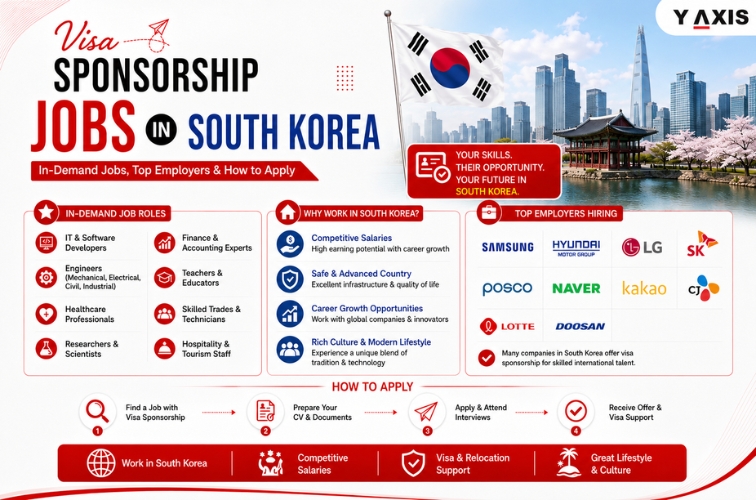
South Korea has one of the strongest economies in Asia. The country is well known for industries such as semiconductors, electronics, shipbuilding, automobiles, and technology. However, South Korea has a low birth rate and a growing elderly population. As a result, many employers are finding it difficult to hire enough local workers. Industries such as manufacturing, healthcare, construction, shipbuilding, and IT need more workers. To meet this demand, the South Korean government provides different work visa options for foreign workers.
In 2026, South Korea has approved 80,000 workers under the E-9 Employment Permit System and 109,000 seasonal workers under the E-8 visa. The E-7 visa also covers around 86 occupations in areas such as IT, engineering, research, healthcare, and management. This creates job opportunities for Indian professionals, skilled workers, and graduates. South Korean employers can sponsor eligible foreign workers who have the required skills and qualifications. Foreign workers can also benefit from competitive salaries, legal wage protection, and options to stay in the country long term.
*Want to work in South Korea? Sign up with Y-Axis for end-to-end support with the process.
Why Apply for Visa Sponsorship Jobs in South Korea?
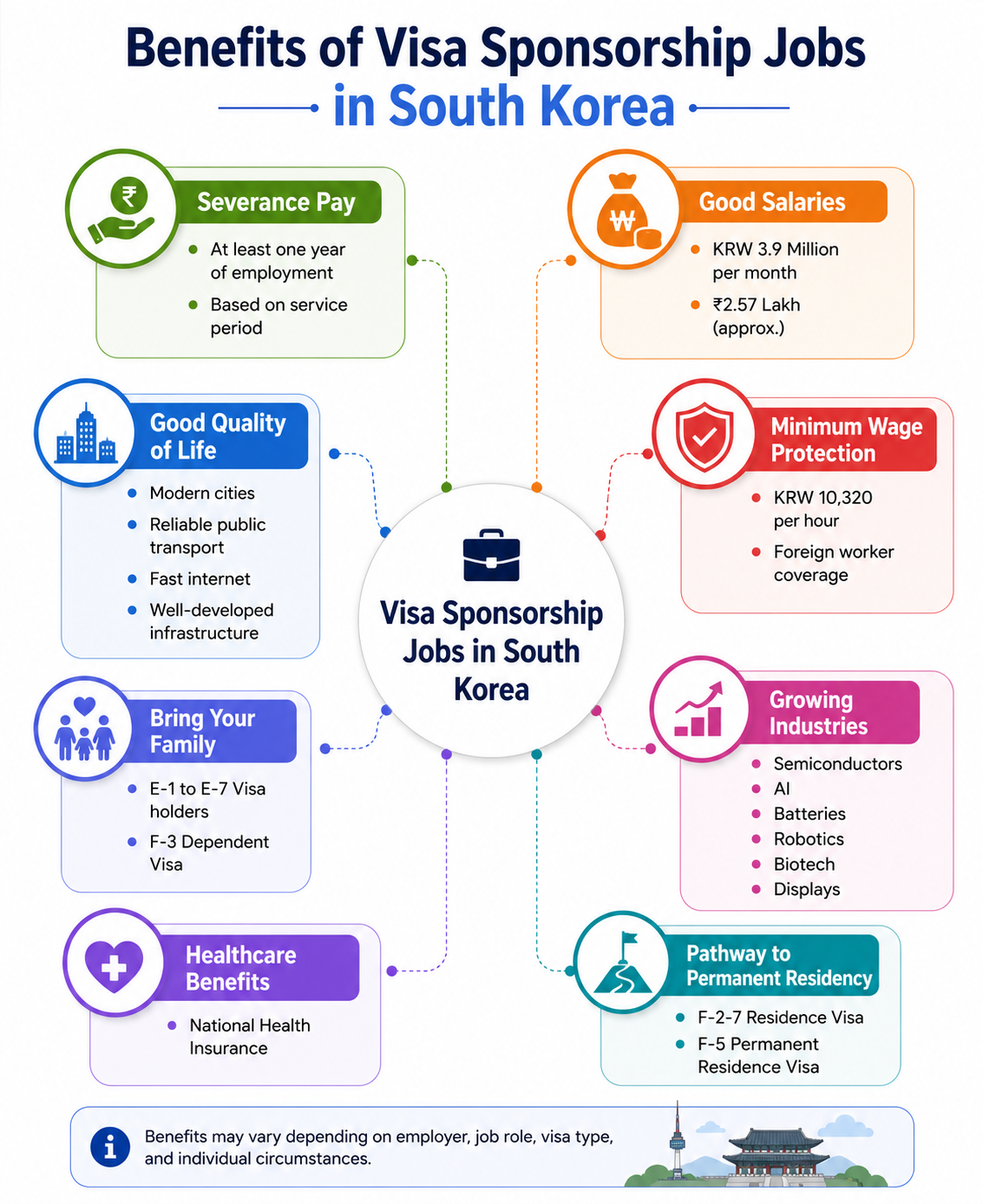
- Good salaries: The average salary in South Korea is around KRW 3.9 million per month (about ₹2.57 lakh).
- Minimum wage protection: The national minimum wage for 2026 is KRW 10,320 per hour, and foreign workers are also covered by minimum wage rules.
- Growing industries: Industries such as semiconductors, AI, batteries, robotics, biotech, and displays need skilled workers.
- Pathway to permanent residency: Eligible work visa holders may later qualify for the F-2-7 residence visa and eventually the F-5 permanent residence visa.
- Healthcare benefits: Eligible foreign workers are covered under South Korea's National Health Insurance system.
- Bring your family: Eligible E-1 to E-7 visa holders can bring their spouse and children through the F-3 dependent visa.
- Good quality of life: South Korea offers modern cities, reliable public transport, fast internet, and a well-developed infrastructure.
- Severance pay: Eligible workers who complete at least one year of continuous employment may receive severance pay based on their period of service.
What are Visa Sponsorship Jobs in South Korea?
A visa sponsorship job is a job where a South Korean employer supports your work visa application. To apply for a Korean work visa, you generally need to first get a job offer from an eligible employer. The employer completes the required process with Korean immigration authorities. Depending on the visa, this may include applying for a Confirmation of Visa Issuance. Once approved, you can use the required documents or confirmation details to apply for your visa through the Korean embassy or consulate.
The employer must be a legally registered business in South Korea, and the job must meet the requirements of the chosen work visa. Salary, skills, qualifications, and work experience requirements can vary by visa type. South Korea offers work visa options for both skilled professionals and workers in eligible non-professional jobs.
*Also, read...
South Korea Introduces K-STAR Visa to Attract Global STEM Professionals. Apply now!
In-Demand Visa Sponsorship Jobs in South Korea
South Korea offers job opportunities for foreign workers across technology, engineering, manufacturing, healthcare, construction, shipbuilding, education, hospitality, logistics, and research. Demand is particularly strong for workers with technical, engineering, digital, and industrial skills. Salaries depend on experience, qualifications, employer, job role, and location.
|
In-Demand Sector |
In-Demand Job Roles |
Average Annual Salary (KRW) |
|
IT & Technology |
Software Developer, Full-Stack Developer, Cloud Engineer, Cybersecurity Specialist, Data Scientist, AI / Machine Learning Engineer |
KRW 50–90 million |
|
Semiconductors & Electronics |
Semiconductor Process Engineer, Chip Design Engineer, Electrical Engineer, Electronics Engineer, Equipment Engineer |
KRW 55–80 million |
|
Automotive & Manufacturing |
Mechanical Engineer, Production Engineer, Quality Engineer, CNC Machine Operator, Machine Technician, Production Worker |
KRW 30–60 million |
|
Engineering |
Mechanical Engineer, Electrical Engineer, Industrial Engineer, Automation Engineer, Robotics Engineer |
KRW 50–75 million |
|
Construction |
Civil Engineer, Site Engineer, Construction Worker, Electrician, Plumber, Equipment Operator |
KRW 32–55 million |
|
Shipbuilding |
Ship Design Engineer, Marine Engineer, Welder, Pipe Fitter, Shipyard Worker, Electrical Technician |
KRW 35–60 million |
|
Healthcare & Care Services |
Registered Nurse, Caregiver, Nursing Assistant, Medical Technician, Healthcare Support Worker |
KRW 30–50 million |
|
Biotechnology & Research |
Biotech Researcher, Laboratory Technician, Research Scientist, Chemical Engineer, R&D Engineer |
KRW 45–75 million |
|
Education |
English Language Instructor, University Lecturer, Research Assistant, International School Teacher |
KRW 30–55 million |
|
Hospitality & Tourism |
Hotel Staff, Restaurant Staff, Chef, Cook, Front Desk Staff, Food Service Worker |
KRW 28–40 million |
|
Logistics & Supply Chain |
Logistics Supervisor, Warehouse Supervisor, Supply Chain Specialist, Inventory Controller, Warehouse Worker |
KRW 30–50 million |
|
Renewable Energy & Batteries |
Battery Engineer, Chemical Engineer, Energy Engineer, Battery Researcher, Production Engineer |
KRW 50–80 million |
*Also, read…
What are the most in-demand jobs in South Korea for the next 10 years?
Highest Paying Jobs in South Korea
Some occupations in South Korea pay very well, especially in technology, healthcare, aviation and advanced manufacturing. The table below shows typical annual salaries in Korean Won and the equivalent in Indian Rupees. Exchange rate used: 1 KRW = ₹0.066 (July 2026). Exchange rates change daily, so please treat INR figures as indicative only.
Highest Paying Jobs in South Korea
|
Job Title |
Average Annual Salary (KRW) |
Average Annual Salary (INR) |
|
Specialist Doctor / Surgeon |
120,000,000 |
₹79.2 lakh |
|
Airline Pilot |
110,000,000 |
₹72.6 lakh |
|
AI / Machine Learning Engineer |
90,000,000 |
₹59.4 lakh |
|
Investment / Finance Manager |
85,000,000 |
₹56.1 lakh |
|
Semiconductor Process Engineer |
80,000,000 |
₹52.8 lakh |
|
Senior Software Engineer |
75,000,000 |
₹49.5 lakh |
|
Cybersecurity Specialist |
70,000,000 |
₹46.2 lakh |
|
IT Project Manager |
68,000,000 |
₹44.9 lakh |
|
Data Scientist |
65,000,000 |
₹42.9 lakh |
|
University Professor / Researcher |
62,000,000 |
₹40.9 lakh |
|
Chemical Engineer |
60,000,000 |
₹39.6 lakh |
|
Mechanical / Automotive Engineer |
58,000,000 |
₹38.3 lakh |
|
Ship Design Engineer |
55,000,000 |
₹36.3 lakh |
|
Civil Engineer |
52,000,000 |
₹34.3 lakh |
|
Registered Nurse |
45,000,000 |
₹29.7 lakh |
*Also, read...
Highest Paying Jobs in South Korea for Indians
Top Companies Offering Visa Sponsorship Jobs in South Korea
South Korea is home to major global companies across technology, semiconductors, automotive, batteries, shipbuilding, manufacturing, e-commerce, and IT services. These companies hire skilled professionals for technical and specialised positions, and eligible foreign candidates may receive work visa sponsorship depending on the role and visa requirements.
|
In-Demand Industry |
Top Companies |
Common Job Roles |
|
Electronics & Semiconductors |
Samsung Electronics, SK Hynix |
Process Engineer, Semiconductor Engineer, Memory Design Engineer, Yield Engineer, Software Developer, AI Researcher |
|
Automotive & EV |
Hyundai Motor Group, Kia Corporation |
Mechanical Engineer, EV Engineer, Automotive Engineer, Quality Engineer, Design Engineer, Manufacturing Specialist |
|
Internet, AI & Technology |
Naver, Kakao |
AI Researcher, Software Engineer, Platform Engineer, Mobile Developer, Data Engineer, Cloud Specialist |
|
E-commerce & Technology |
Coupang |
Backend Engineer, Software Developer, Data Scientist, Supply Chain Analyst, Product Manager |
|
Batteries & Energy |
LG Energy Solution |
Battery Engineer, Cell Engineer, Chemical Engineer, Process Engineer, R&D Engineer |
|
Shipbuilding & Marine Engineering |
Hanwha Ocean, HD Hyundai Heavy Industries |
Naval Architect, Marine Engineer, Ship Design Engineer, Welding Engineer, Project Engineer |
|
IT Services |
Samsung SDS, LG CNS |
Software Engineer, Cloud Engineer, ERP Consultant, IT Project Manager, System Integration Specialist |
|
Electronics & R&D |
LG Electronics |
R&D Engineer, Embedded Software Developer, Product Designer, Electrical Engineer, Software Engineer |
|
Chemicals & Advanced Materials |
LG Chem |
Chemical Engineer, Materials Researcher, Process Engineer, R&D Specialist |
|
Steel & Materials |
POSCO |
Metallurgical Engineer, Process Engineer, Materials Engineer, Production Engineer |
*Also, read...
South Korea Job Market:Trends & Job Opportunities
Eligibility Requirements for Visa Sponsorship Jobs in South Korea
To qualify for a visa sponsorship job in South Korea, applicants must meet the requirements of their specific work visa category. Common requirements include:
- You must have a valid passport for your intended stay in South Korea.
- You need a job offer or employment contract from an eligible employer in South Korea.
- Your employer must complete the required immigration process, which may include obtaining a Confirmation of Visa Issuance.
- Skilled roles such as those under the E-7 category may require a relevant degree, diploma, or professional qualification.
- Relevant work experience may be required depending on your qualifications, occupation, and visa category.
- Your offered salary must meet the minimum requirements applicable to your work visa and occupation.
- IELTS is generally not required for a South Korean work visa. Korean proficiency may be required for certain routes, such as the E-9 process through EPS.
- Applicants may need to complete medical examinations or other health checks depending on the visa and occupation.
- A Police Clearance Certificate (PCC) or criminal-record documentation may be required for certain visa applications.
- Your job must qualify under the occupation and employment rules of the work visa you are applying for.
Documents Required for a Sponsored Work Visa in South Korea
The exact documents depend on the work visa category, occupation, and applicant. Common documents may include:
- Valid passport and copies
- Completed visa application form
- Recent passport-size photographs
- Job offer letter or employment contract
- Confirmation of Visa Issuance, where applicable
- Employer's business registration documents
- Educational certificates and academic transcripts
- Apostilled or authenticated qualifications, where required
- Work experience certificates or letters
- Professional licences or certifications for regulated occupations
- Medical examination or health documents, where required
- Police Clearance Certificate (PCC), where required
- TOPIK or EPS-TOPIK results, when applicable
- Updated resume or CV
- Proof of visa fee payment
How to Get a Visa Sponsorship Job in South Korea?
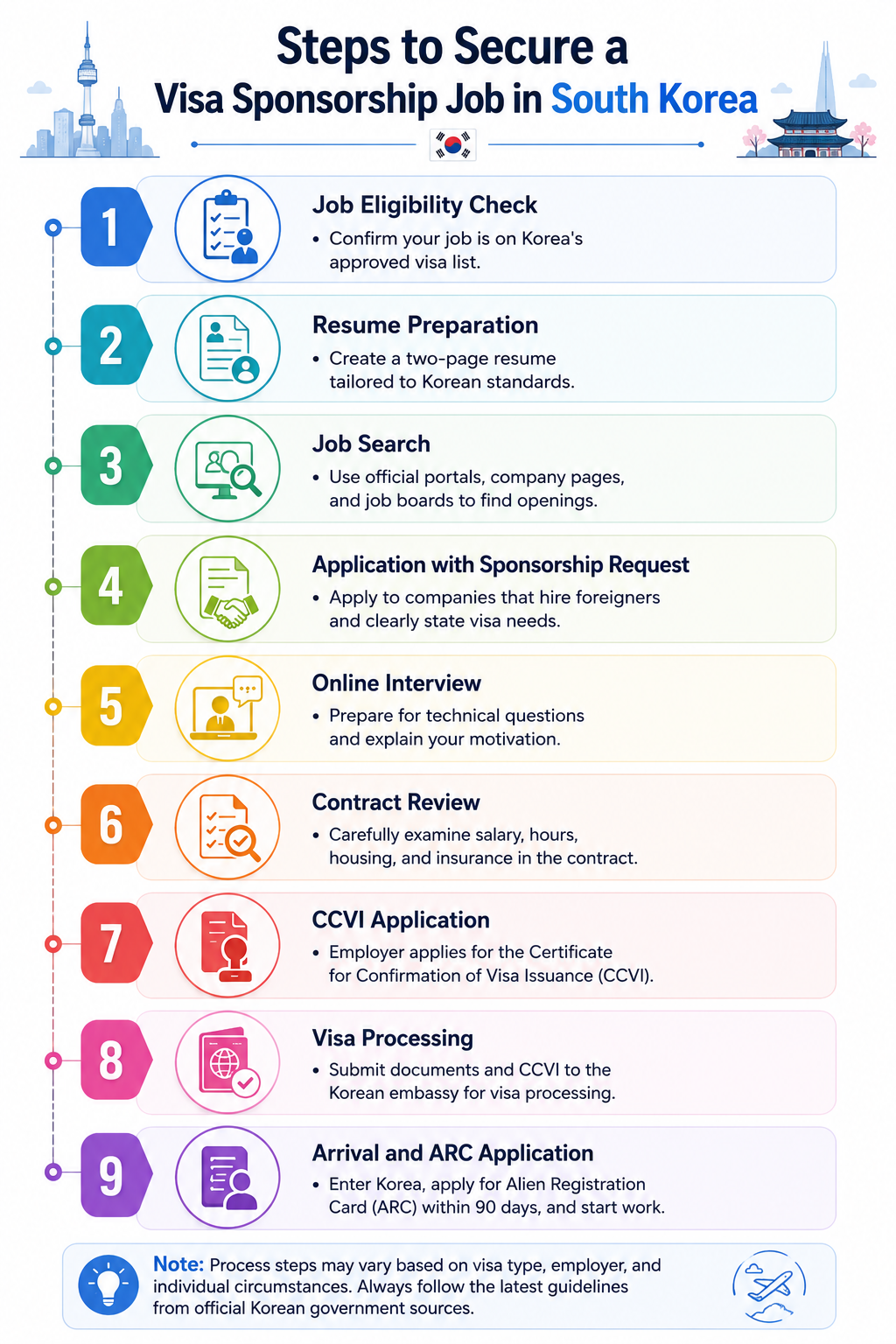
Step 1: Confirm your job is on Korea's approved list E-7 for professionals, E-9 for non-professional workers, or the Top-Tier visa for advanced industries.
Step 2: Create a clear two-page resume matching Korean expectations. Highlight technical skills, tools, certifications and measurable achievements.
Step 3: Use Korea's official government job portals, company career pages, LinkedIn and specialist Korea job boards. For E-9 roles, register through the EPS system.
Step 4: Apply to companies that already hire foreign staff. Mention clearly that you need visa sponsorship so employers can plan.
Step 5: Most interviews are online. Prepare for technical questions and be ready to explain why you want to work in Korea.
Step 6: Review the contract carefully for salary, working hours, housing support, insurance and contract length.
Step 7: Your employer applies to the local Korean immigration office for the CCVI. This usually takes 2 to 4 weeks.
Step 8: Submit your documents and CCVI number to the Korean embassy or consulate in India. Visa processing typically takes 1 to 3 weeks.
Step 9: Enter Korea, then apply for your Alien Registration Card (ARC) within 90 days of arrival and start work.
Work Visa Options for Foreign Workers in South Korea
|
Visa Type |
Purpose |
Validity |
|
E-1 Professor |
Teaching at Korean universities |
Up to 5 years, renewable |
|
E-2 Foreign Language Instructor |
Teaching languages at schools and institutes |
1–2 years, renewable |
|
E-3 Research |
Research at approved institutes and companies |
Up to 5 years, renewable |
|
E-4 Technology Transfer |
Transferring specialised technology to Korean firms |
Up to 5 years |
|
E-5 Professional |
Licensed professionals such as lawyers, doctors, accountants |
Up to 5 years |
|
E-6 Arts and Entertainment |
Performers, athletes, artists |
Up to 2 years |
|
E-7-1 Professional Workers |
67 designated professional occupations |
1–3 years, renewable |
|
E-7-2 Semi-Professional Workers |
Around 9–10 semi-skilled service occupations |
1–3 years, renewable |
|
E-7-3 Skilled Workers |
6 designated skilled trade occupations |
1–3 years, renewable |
|
E-7-4 Skilled Worker Transition |
Upgrade route for E-9, E-10 and H-2 holders via points |
Renewable |
|
E-8 Seasonal Worker |
Short-term agriculture and fisheries work |
Up to 8 months |
|
E-9 Non-Professional (EPS) |
Manufacturing, construction, agriculture, fisheries, services |
3 years, extendable to 4 years 10 months |
|
E-10 Crew Member |
Shipping and fishing vessel crew |
Up to 3 years |
|
D-7 / D-8 / D-9 |
Intra-company transfer, corporate investment, trade management |
1–3 years |
|
D-10 Job Seeker |
Job hunting and internships in Korea |
Up to 6 months, extendable to 2 years |
|
E-7-T / D-10-T / F-2-T (Top-Tier Visa) |
Fast-track route for semiconductors, biotech, batteries, displays, robotics and defence |
Leads to F-5 after 3 years |
|
F-2-7 Points-Based Residence |
Long-term residence for those scoring 80+ points |
3 years, renewable |
|
F-5 Permanent Residency |
Permanent settlement in Korea |
Indefinite |
*Looking for assistance for overseas immigration? Contact Y-Axis, the world’s #1 overseas career consultancy for job search support and visa assistance.
FAQs
What are visa sponsorship jobs in South Korea?
Visa sponsorship jobs are positions where a Korean employer supports your work visa application. The company proves it cannot fill the role locally and obtains a Certificate of Confirmation of Visa Issuance (CCVI) from Korean immigration. You then use this certificate to apply for your work visa at the Korean Embassy or Consulate in India. Without employer sponsorship, you cannot obtain most Korean work visas independently.
Can Indians get visa sponsorship jobs in South Korea?
Yes. Indian nationals are eligible for professional work visas such as E-7, E-3, E-1, and the Top-Tier Visa. Many Indian engineers, IT professionals, researchers, and technical specialists already work in South Korea. The key requirement is securing a genuine job offer from a registered Korean employer willing to sponsor your visa.
Which companies sponsor foreign workers in South Korea?
Many leading Korean companies recruit international professionals, including:
- Samsung Electronics
- SK Hynix
- LG Electronics
- LG Energy Solution
- Hyundai Motor Group
- Kia
- POSCO
- Naver
- Kakao
- Coupang
- Samsung SDS
- LG CNS
- Hanwha Ocean
- HD Hyundai Heavy Industries
Which jobs are easiest to get with sponsorship in South Korea?
The easiest jobs to obtain are those facing labour shortages, including:
- Software Developers
- AI & Machine Learning Engineers
- Semiconductor Engineers
- Mechanical Engineers
- Electrical Engineers
- Welders
- Ship Design Engineers
- Caregivers
- English Teachers
What are the highest-paying sponsorship jobs in South Korea?
Some of the highest-paying sponsored occupations include:
| Occupation | Average Annual Salary |
| Specialist Doctors | 110+ million KRW |
| Airline Pilots | 110+ million KRW |
| AI & Machine Learning Engineers | 90 million KRW |
| Semiconductor Engineers | 80 million KRW |
| Senior Software Engineers | 75 million KRW |
| Finance Managers | High-paying |
| Cybersecurity Specialists | High-paying |
What qualifications are required for a Korean work visa?
Qualification requirements depend on the visa category:
- Bachelor's degree related to the occupation (E-7 professional visa)
- Apostilled educational certificates
- Relevant work experience
- Professional licences where applicable
- EPS-TOPIK language qualification for E-9 workers
Do I need work experience to get a sponsored job in South Korea?
Usually yes. Most E-7 professional visas require a bachelor's degree along with at least one year of relevant work experience. Candidates without a degree may qualify by demonstrating approximately five years of related professional experience. Fresh graduates may explore the D-10 Job Seeker Visa or intra-company transfer options.
Is IELTS required for South Korea work visas?
No. South Korea does not require IELTS or any English language examination for work visa applications. Korean language proficiency is more important for several visa categories. Professional roles at multinational companies often accept English as the primary working language.
How long does South Korea work visa processing take?
Visa processing generally takes between 4 and 8 weeks. The employer's CCVI application usually requires 2–4 weeks, while the embassy visa application generally takes another 1–3 weeks. Processing may take longer if documents are incomplete.
Can family members accompany me to South Korea?
Yes. Holders of professional visas such as E-1 to E-7 can sponsor their spouse and unmarried dependent children under 19 years through the F-3 Dependent Visa. Dependents may study in Korea but generally require separate permission before working.
Can visa sponsorship lead to permanent residency in South Korea?
Yes. Eligible foreign workers may qualify for the F-2-7 Points-Based Residence Visa after meeting income, education, language, and residency requirements. After several years of residence, applicants may become eligible for the F-5 Permanent Residency Visa. Top-Tier Visa holders may qualify for permanent residence after just three years.
What industries hire foreign workers in South Korea?
- Semiconductors
- Electronics
- Information Technology
- Automotive Manufacturing
- Shipbuilding
- Construction
- Chemicals
- Battery Manufacturing
- Healthcare & Elderly Care
- Agriculture, Fisheries, Hospitality & Logistics
How can I find sponsored jobs in South Korea?
You can search for sponsored jobs through official Korean government employment portals, LinkedIn, company career pages, Korea-specific job boards, and recruitment events. Y-Axis also assists candidates by matching eligible profiles with verified overseas employers and supporting the complete application process.
Are healthcare jobs in demand in South Korea?
Yes. South Korea's ageing population has increased demand for nurses, caregivers, elderly-care workers, and healthcare assistants. Foreign nurses generally need their qualifications recognised in Korea and are usually expected to possess Korean language proficiency.
Are IT jobs available in South Korea for foreigners?
Yes. South Korea offers excellent opportunities for foreign IT professionals. Companies including Samsung SDS, LG CNS, Coupang, Naver, and Kakao recruit software developers, cloud engineers, AI researchers, cybersecurity specialists, and data scientists. Many international teams operate primarily in English.
Can fresh graduates apply for visa sponsorship jobs in South Korea?
Yes, although competition is higher. Most professional visas require work experience, but fresh graduates can explore the D-10 Job Seeker Visa, allowing them to stay in Korea while searching for employment. Graduates from Korean universities generally have an easier pathway to work visas.
What is the average salary in South Korea?
The average salary in South Korea in 2026 is approximately 3.9 million KRW per month or about 47 million KRW annually. The median monthly salary is around 3.2 million KRW. The minimum wage for 2026 is 10,320 KRW per hour.
What documents are required for a Korean sponsored work visa?
The required documents generally include:
- Valid passport
- Completed visa application form
- Recent passport-size photographs
- Employment contract
- Certificate of Confirmation of Visa Issuance (CCVI)
- Apostilled educational certificates
- Work experience certificates
- Medical certificate
- Police Clearance Certificate
- Professional licences (if applicable)
- EPS-TOPIK certificate (for E-9 applicants)
Can I change employers in South Korea?
Yes, subject to immigration rules. E-7 visa holders can change employers if the new position matches their approved visa category and the change is reported to Korean immigration. E-9 workers under the Employment Permit System have stricter limitations regarding employer changes.
How can Y-Axis help with South Korea jobs?
Y-Axis provides complete overseas career support, including:
- Profile assessment
- Professional resume writing
- Job search assistance
- Employer connections
- Interview preparation
- Document verification and apostille guidance
- Complete work visa filing support
Tags:
Visa sponsorship jobs in South Korea 2026
South Korea work visa sponsorship for Indians
South Korea work visa jobs
South Korea work visa for foreign workers
In-demand jobs in South Korea with visa sponsorship
South Korea employer-sponsored jobs
Share
Options for you by Y-Axis

Get it on your mobile

Get News alerts

Contact Y-Axis
Latest Article
Popular Post
Trending Article
Posted On September 17 2026
Visa Sponsorship Jobs in Ireland: In-Demand Jobs, Employers & How to Apply